University of Alberta scientists propose new structure for shell of HIV-1 virus

A newly proposed model for the shape of the HIV-1 viral shell may change how we understand the disease

The matrix shell of the HIV-1 virus may have a different shape than previously thought, and a newly proposed model has significant implications for understanding how the virus functions, according to a new study by University of Alberta scientists.

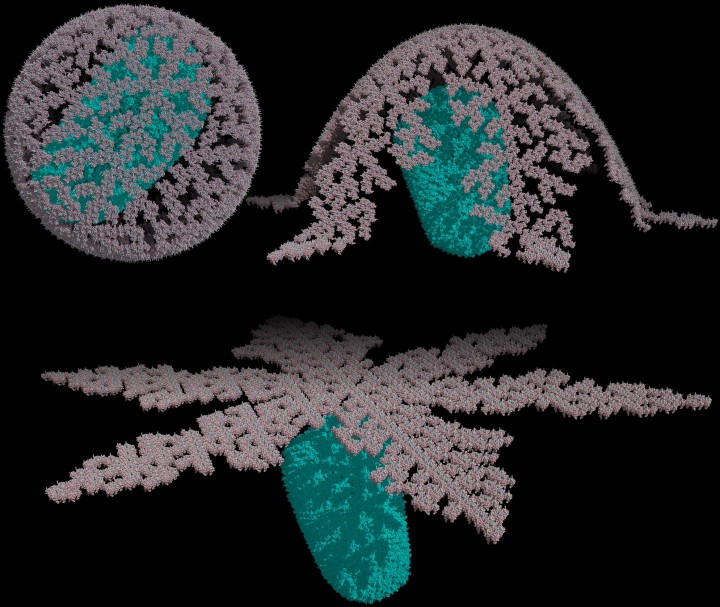
The research suggests that the HIV-1 virus is housed within a spherical matrix shell. When it infects a healthy cell, the shell fuses to the outside of the target cell and then releases the viral capsid inside where it attacks the cell.

"Our new proposed structure for the HIV-1 virus has a very peculiar shape, almost like petals of a flower," said Sean Graves, instructor in the Department of Mathematical and Statistical Sciences and co-author on the study. "A better structural knowledge of the matrix shell may help us understand the fusing and infection process." Graves is also coordinator of the Decima Robinson Support Centre, providing support to more than 1000 undergraduate students each term. A new study proposes a new structure for the shell of the HIV-1 virus, pictured here. Image credit Marcelo Marcet.  CREDIT Marcelo Marcet{module INSIDE STORY}

The research shows that the previous model used to describe the structure of the HIV-1 matrix shell was mathematically impossible and provides a viable alternative. While it is too early to anticipate whether the model will translate into new treatment for HIV, the research will help scientists to better understand and make predictions about the behaviour of the HIV-1 virus. Around the world, nearly 38 million people suffer from HIV or AIDS.

"Our contribution uses mathematical principles to help guide the scientific community in the right direction," added Marcelo Marcet-Palacios, adjunct professor of medicine in the Faculty of Medicine & Dentistry and co-author. "If our model is correct, then we can begin investigating ways we could block or interrupt the mechanism of viral entry. For example, by using a medication that could cross-link the 'petals' of the structure together to prevent the opening of the particle and thus stopping entry of the viral genome into the host cell."

The model is available to anyone, anywhere in the world online.

This research is the result of the work of an interdisciplinary team from the fields of biology, mathematics and supercomputing. One such collaborator is Weijie Sun, Faculty of Science alumnus and a former student of Graves'.

"This collaboration made it possible to come up with a new model consistent with previously observed evidence and allowed us to develop a computer program freely accessible online that other scientists around the world can use to recreate our work and further develop this new model," said Sun. "It is incredible what can be achieved in science when experts from different disciplines get together and collaborate."

University of Maryland mathematicians provide a mathematical explanation for key law of turbulence in fluid mechanics

What if engineers could design a better jet with mathematical equations that drastically reduce the need for experimental testing? Or what if weather prediction models could predict details in the movement of heat from the ocean into a hurricane? These things are impossible now, but could be possible in the future with a more complete mathematical understanding of the laws of turbulence.

University of Maryland mathematicians Jacob Bedrossian, Samuel Punshon-Smith and Alex Blumenthal have developed the first rigorous mathematical proof explaining a fundamental law of turbulence. The proof of Batchelor's law will be presented at a meeting of the Society for Industrial and Applied Mathematics on December 12, 2019.

Although all laws of physics can be described using mathematical equations, many are not supported by detailed mathematical proofs that explain their underlying principles. One area of physics that has been considered too challenging to explain with rigorous mathematics is turbulence. Seen in ocean surf, billowing clouds and the wake behind a speeding vehicle, turbulence is the chaotic movement of fluids (including air and water) that includes seemingly random changes in pressure and velocity.

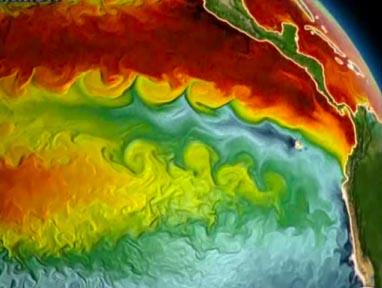
Turbulence is the reason the Navier-Stokes equations, which describe how fluids flow, are so hard to solve that there is a million-dollar reward for anyone who can prove them mathematically. To understand fluid flow, scientists must first understand turbulence. Mathematicians from UMD have developed the first rigorous proof for a fundamental law of turbulence. Batchelor's law, which helps explain how chemical concentrations and temperature variations distribute themselves in a fluid, can be seen at work in the variously sized swirls of mixing warm and cold ocean water.{module INSIDE STORY}
"It should be possible to look at a physical system and understand mathematically if a given physical law is true," said Jacob Bedrossian, a professor of mathematics at UMD and a co-author of the proof. "We believe our proof provides the foundation for understanding why Batchelor's law, a key law of turbulence, is true in a way that no theoretical physics work has done so far. This work could help clarify some of the variations seen in turbulence experiments and predict the settings where Batchelor's law applies as well as where it doesn't."

Since its introduction in 1959, physicists have debated the validity and scope of Batchelor's law, which helps explain how chemical concentrations and temperature variations distribute themselves in a fluid. For example, stirring cream into coffee creates a large swirl with small swirls branching off of it and even smaller ones branching off of those. As the cream mixes, the swirls grow smaller and the level of detail changes at each scale. Batchelor's law predicts the detail of those swirls at different scales.

The law plays a role in such things as chemicals mixing in a solution, river water blending with saltwater as it flows into the ocean and warm Gulfstream water combining with cooler water as it flows north. Over the years, many important contributions have been made to help understand this law, including work at UMD by Distinguished University Professors Thomas Antonsen and Edward Ott. However, a complete mathematical proof of Batchelor's law has remained elusive.

"Before the work of Professor Bedrossian and his co-authors, Batchelor's law was a conjecture," said Vladimir Sverak, a professor of mathematics at the University of Minnesota who was not involved in the work. "The conjecture was supported by some data from experiments, and one could speculate as to why such a law should hold. A mathematical proof of the law can be considered as an ideal consistency check. It also gives us a better understanding of what is really going on in the fluid, and this may lead to further progress."

"We weren't sure if this could be done," said Bedrossian, who also has a joint appointment in UMD's Center for Scientific Computation and Mathematical Modeling. "The universal laws of turbulence were thought to be too complex to address mathematically. But we were able to crack the problem by combining expertise from multiple fields."

An expert in partial differential equations, Bedrossian brought in two UMD postdoctoral researchers who are experts in three other areas to help him solve the problem. Samuel Punshon-Smith (Ph.D. '17, applied mathematics and statistics, and scientific computation), now the Prager Assistant Professor at Brown University, is an expert in probability. Alex Blumenthal is an expert in dynamical systems and ergodic theory, a branch of mathematics that includes what is commonly known as chaos theory. The team represented four distinct areas of mathematical expertise that rarely interact to this degree. All were essential to solving the problem.

"The way the problem has been approached is indeed creative and innovative," Sverak said. "Sometimes the method of proof can be even more important than the proof itself. It is likely that ideas from the papers by Professor Bedrossian and his co-authors will be very useful in future research."

The new level of collaboration that the team brought to this issue sets the stage for developing mathematical proofs to explain other unproven laws of turbulence.

"If this proof is all we achieve, I think we've accomplished something," Bedrossian said. "But I'm hopeful that this is a warmup and that this opens a door to saying 'Yes, we can prove universality laws of turbulence and they are not beyond the realm of mathematics.' Now that we are equipped with a much clearer understanding of how to use mathematics to study these questions, we are working to build the mathematical tools required to study more of these laws."

Understanding the underlying physical principles behind more laws of turbulence could eventually help engineers and physicists in designing better vehicles, wind turbines and similar technologies or in making better weather and climate predictions.


Kobe University's impact crater data rendered onto supercomputer model of Ryugu asteroid illuminates a complicated geological history

Analysis of the impact craters on Ryugu using the spacecraft Hayabusa 2’s remote sensing image data has illuminated the geological history of the Near-Earth asteroid.

A research group led by Assistant Professor Naoyuki Hirata of the Department of Planetology at Kobe University’s Graduate School of Science revealed 77 craters on Ryugu. Through analyzing the location patterns and characteristics of the craters, they determined that the asteroid’s eastern and western hemispheres were formed at different periods of time.

It is hoped that the collected data can be used as a basis for future asteroid research and analysis.

These results were first published in the American Scientific Journal ‘Icarus’ on November 5, 2019.

The Japan Space Agency (JAXA)’s Hayabusa 2 has been used to carry out various missions to increase our understanding of the spinning top-shaped, Near-Earth asteroid Ryugu. Since arriving in June 2018, the unmanned spacecraft has taken samples and a great number of images of the asteroid. It is hoped that these can reveal more about Ryugu’s formation and history.

This research group focused on using the image data to determine the number and location of impact craters on the asteroid. Impact craters are formed when a smaller asteroid or a comet hits the surface of the asteroid. Analyzing the spatial distribution and the number of impact craters can reveal the frequency of collisions and aid researchers in determining the age of different surface areas. Figure 1: Size and location of craters on Ryugu (Figure from the Journal paper): The craters are numbered in order of size.{module INSIDE STORY}

Research Methodology

First of all, the image data from Hayabusa 2 was analyzed. Hayabusa 2 has many different types of camera including Optical Navigation Cameras (ONC). The ONC team has been able to take around 5000 images of Ryugu, which have revealed many surface features- including impact craters. For this study, image data obtained from the ‘ONC-T’ camera between July 2018 and February 2019 was utilized. The research group had to determine which of these images showed craters. 340 images were used for crater counting, with stereo-pair images making it easier to identify the craters. A global image mosaic map was constructed from the ONC images and rendered onto the supercomputer model of Ryugu’s shape. Small Body Mapping Tool software was then used to measure the size, latitude, and longitude of the craters. A LiDAR (Light Detection and Ranging pulsed laser) was also utilized to determine the overall size of Ryugu.

The depressions identified on Ryugu were divided into four categories- depending on how evident their circular appearance was. Category I to III depressions were classified as distinct craters. Category IV depressions only had quasi-circular features, therefore it was hard to determine whether they were craters or not. Many craters were filled with boulders or lacked a distinct shape. Depressions that were too vague to determine were left out of the results.

Research Results

The research team was able to identify all impact craters over 10 to 20m in diameter on Ryugu’s entire surface- a total of 77 craters. Furthermore, a pattern was discovered in their distribution. The section of the eastern hemisphere near the meridian was found to have the most craters. This is the area near the large crater named Cendrillon - which is one of Ryugu’s biggest. In contrast, there are hardly any craters in the western hemisphere- suggesting that this part of the asteroid was formed later. The analysis also revealed that there are more craters at lower latitudes than at higher latitudes on Ryugu. In other words, there are very few craters in Ryugu’s polar regions.

The equatorial ridge in the eastern hemisphere was determined to be a fossil structure. When asteroids like Ryugu rotate at high speeds, this can alter their shape. It is thought that this ridge formed in the distant past during a period when it only took Ryugu 3 hours to rotate. As the eastern hemisphere and western hemisphere were formed at different periods of the asteroid’s history- this suggests that there have been at least two instances where Ryugu’s rotational speed has increased.

Further Research

The results of this study were compiled into a global impact crater catalog for Ryugu. It is hoped that this database can be used as a basis for future research and that comparing these results with those of a similar asteroid will lead to a greater understanding of these astronomical objects.

Hayabusa2 is scheduled to drop the capsule containing samples of Ryugu’s surface into Earth’s atmosphere in late 2020. Analysis of these samples should provide further insight into the asteroid and how it was formed.