Goethe University astrophysicists win breakthrough prize to study blackholes

Professor Luciano Rezzolla and his team, together with 347 researchers from the worldwide Event Horizon Telescope Collaboration, have been awarded the Breakthrough Prize 2020 in recognition of their ground-breaking achievements

For their exceptional and fundamental achievements in capturing the first direct image of a black hole, researchers from the team headed by astrophysicist Professor Luciano Rezzolla of Goethe University, together with 347 scientists from the global Event Horizon Telescope Collaboration, will receive the Breakthrough Prize 2020, which comes with $ 3 million in prize money. With its 10 members, the Goethe University team is one of the largest in the entire collaboration, which comprises 140 institutions in total.

With the aid of eight radio telescopes around the world, to which meanwhile another three have been added, the scientists succeeded in capturing the first direct visual evidence of the supermassive black hole at the centre of the galaxy Messier 87 in April 2019. The prize will be distributed equally among all the co-authors of the corresponding scientific publications, and will be awarded on 3rd November.

beitragsbild black hole rezzolla 8925a{module In-article}
Luciano Rezzolla’s team made fundamental contributions to the theoretical interpretation of the results throughout all phases of the observations: using supercomputers, they simulated how material forms a ring-shaped disc as it orbits and is pulled into the black hole, and how the tremendous gravitation bends light rays around the black hole. It was also necessary to rule out various alternatives to black holes that are also compatible with the theory of relativity. “The confrontation of theory with observations is always a dramatic moment for a theoretical physicist. We were quite relieved, and also proud, that the observations matched our predictions so well,” states Luciano Rezzolla.

Goethe University President Professor Dr. Birgitta Wolff: “Together with Luciano Rezzolla and his team, we are delighted about this important global award. We warmly congratulate all of our colleagues who contributed to this achievement! We remember the enthusiasm of audience in the packed lecture hall on Campus Riedberg when Luciano Rezzolla and his colleagues from the European Consortium (Professor Michael Kramer from the Max Planck Institut für Radioastronomie in Bonn and Professor Heino Falcke from the Dutch Radboud University) first presented the results of their joint research at Goethe University on 17th April 2019. It was a celebration of the power of fascination emanating even from abstract science. I hope that further ground-breaking research will be forthcoming from this great global collaboration.”

Goethe University Vice-President Professor Simone Fulda, who is responsible for research, said: “We are proud to have played such a prominent role as Goethe University in a true scientific breakthrough of global significance and congratulate Luciano Rezzolla and his team for the outstanding achievements that led to it. Physics is an important research focal point that has shaped Goethe University’s research profile for many years.”

“It’s a great honour and an enormous gratification to see that the work done at Goethe University has received the highest recognition and has contributed to pushing the limits of our understanding of fundamental physics. It is also a fair recognition of what has ultimately been a team effort and hence a shared burden and challenge of many scientists across the world,” commented Luciano Rezzolla.

As a collective, this year’s Breakthrough Prize laureates probed the galaxies to capture the first image of a black hole. The jury has found remarkable the achievements by combining telescope after synchronizing them with atomic clocks, producing a virtual telescope as large as the Earth, to obtain unprecedented resolution. The image of the supermassive black hole at the centre of the Messier 87 galaxy was obtained after painstakingly analysing the data with novel algorithms and techniques, and reveals a bright ring marking the point where light orbits the black hole, surrounding a dark region where light cannot escape the black hole’s

gravitational pull. The black hole shadow matched the expectations of Einstein’s theory of General Relativity.

Collaboration Director Shep Doeleman of the Harvard-Smithsonian Center for Astrophysics, who will accept the prize on behalf of the collaboration at the ceremony on 3rd November 2019, says: „We set out to see the unseeable, and we needed to build a telescope as large as the Earth to do it. It sounds like science fiction, but we assembled an incredible global team of experts and used the most advanced radio telescopes on the planet to make it a reality. This breakthrough prize celebrates a new beginning in our study of black holes.“

The “Breakthrough Prize Foundation” has prominent backers. Its founding members are Sergey Brin, Priscilla Chan and Mark Zuckerberg, Ma Huateng, Yuri und Julia Milner, and Anne Wojcicki.

University at Buffalo chemists predict new forms of superhard carbon

A study identifies dozens of new carbon structures that are expected to be superhard, including some that may be about as hard as diamonds

Superhard materials can slice, drill and polish other objects. They also hold potential for creating scratch-resistant coatings that could help keep expensive equipment safe from damage.

Now, science is opening the door to the development of new materials with these seductive qualities.

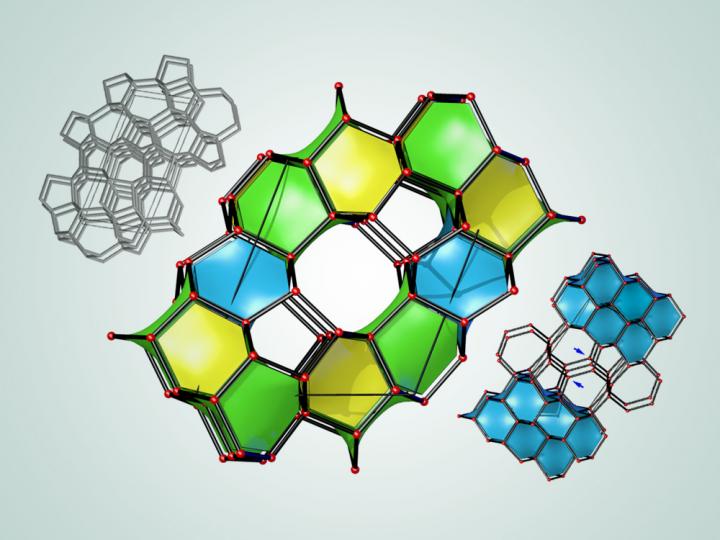
Researchers have used computational techniques to identify 43 previously unknown forms of carbon that are thought to be stable and superhard -- including several predicted to be slightly harder than or nearly as hard as diamonds. Each new carbon variety consists of carbon atoms arranged in a distinct pattern in a crystal lattice. CAPTION An illustration depicts three of 43 newly predicted superhard carbon structures. The cages colored in blue are structurally related to diamond, and the cages colored in yellow and green are structurally related to lonsdaleite.  CREDIT Credit: Bob Wilder / University at Buffalo, adapted from Figure 3 in P. Avery et al., npj Computational Materials, Sept. 3, 2019.{module In-article}

The study -- published on Sept. 3 in the journal npj Computational Materials -- combines computational predictions of crystal structures with machine learning to hunt for novel materials. The work is theoretical research, meaning that scientists have predicted the new carbon structures but have not created them yet.

"Diamonds are right now the hardest material that is commercially available, but they are very expensive," says University at Buffalo chemist Eva Zurek. "I have colleagues who do high-pressure experiments in the lab, squeezing materials between diamonds, and they complain about how expensive it is when the diamonds break.

"We would like to find something harder than a diamond. If you could find other materials that are hard, potentially you could make them cheaper. They might also have useful properties that diamonds don't have. Maybe they will interact differently with heat or electricity, for example."

Zurek, PhD, a professor of chemistry in UB College of Arts and Sciences, conceived of the study and co-led the project with Stefano Curtarolo, PhD, professor of mechanical engineering and materials science at Duke University.

The quest for hard materials

Hardness relates to a material's ability to resist deformation. As Zurek explains, it means that "if you try to indent a material with a sharp tip, a hole will not be made, or the hole will be very small."

Scientists consider a substance to be superhard if it has a hardness value of over 40 gigapascals as measured through an experiment called the Vickers hardness test.

All of the study's 43 new carbon structures are predicted to meet that threshold. Three are estimated to exceed the Vickers hardness of diamonds, but only by a little bit. Zurek also cautions that there is some uncertainty in the calculations.

The hardest structures the scientists found tended to contain fragments of diamond and lonsdaleite -- also called hexagonal diamond -- in their crystal lattices. In addition to the 43 novel forms of carbon, the research also newly predicts that a number of carbon structures that other teams have described in the past will be superhard.

Speeding up the discovery of superhard materials

The techniques used in the new paper could be applied to identify other superhard materials, including ones that contain elements other than carbon.

"Very few superhard materials are known, so it's of interest to find new ones," Zurek says. "One thing that we know about superhard materials is that they need to have strong bonds. Carbon-carbon bonds are very strong, so that's why we looked at carbon. Other elements that are typically in superhard materials come from the same side of the periodic table, such as boron and nitrogen."

To conduct the study, researchers used XtalOpt, an open-source evolutionary algorithm for crystal structure prediction developed in Zurek's lab, to generate random crystal structures for carbon. Then, the team employed a machine learning model to predict the hardness of these carbon species. The most promising hard and stable structures were used by XtalOpt as "parents" to spawn additional new structures, and so on.

The machine learning model for estimating hardness was trained using the Automatic FLOW (AFLOW) database, a huge library of materials with properties that have been calculated. Curtarolo's lab maintains AFLOW and previously developed the machine learning model with Olexandr Isayev's group at the University of North Carolina at Chapel Hill.

"This is accelerated material development. It's always going to take time, but we use AFLOW and machine learning to greatly accelerate the process," Curtarolo says. "The algorithms learn, and if you have trained the model well, the algorithm will predict the properties of material -- in this case, hardness -- with reasonable accuracy."

"You can take the best materials predicted using computational techniques and make them experimentally," says study co-author Cormac Toher, Ph.D., assistant research professor of mechanical engineering and materials science at Duke University.

MU designated as a National Center of Academic Excellence in Cyber Defense Research

The National Security Agency (NSA) and the Department of Homeland Security have recognized the University of Missouri as a National Center of Academic Excellence in Cyber Defense Research. The distinction is designated through June 2024.

"This designation indicates that, once again, Missouri's flagship institution is on the forefront in critical areas that affect our collective safety and future," MU Chancellor Alexander N. Cartwright said. "I am so proud of the hard work of all of our tremendous faculty, staff, and students who made this possible."

The NSA and the Department of Homeland Security jointly sponsor the National Centers of Academic Excellence in Cyber Defense program. The goal of the program is to reduce vulnerability in America's national information infrastructure by promoting higher education and research in cyber defense and producing professionals with cyber defense expertise. Prasad Calyam, associate professor of electrical engineering and computer science in the MU College of Engineering, researches cyber security applications in healthcare, education and manufacturing.{module In-article}

"A highly skilled cybersecurity workforce is a strategic national security advantage," said Rory Smith, National Security Agency program director for the National Center of Academic Excellence in Cyber Defense Research. "The United States Government will continue to invest in and enhance programs that build the domestic talent pipeline, from primary through post-secondary education."

Rohit Chadha, an associate professor of electrical engineering and computer science in MU's College of Engineering, was instrumental in the university's distinction. Among his research interests are formal engineering methods for computer security. He also has experience working with software tools for verifying randomized security protocols and computing information leakage in programs.

"This distinction is a recognition of sustained excellence in cutting-edge research, education, and outreach demonstrated by our faculty and students in the vital field of cybersecurity," Chadha said. "The College of Engineering and the University of Missouri have identified cybersecurity as a strategic area to invest resources, given the national importance of the field."

In addition to Chadha, Prasad Calyam, associate professor of electrical engineering and computer science in the MU College of Engineering, and William Harrison, former associate professor of electrical engineering and computer science, have both made invaluable contributions to the development of cybersecurity research and curriculum at MU, and mentored students in this field. Harrison has worked closely with government agencies on research directed toward the national interest in cybersecurity, including the NSA, Oak Ridge National Laboratory and US Naval Research Laboratory.

Calyam's research interests include the areas of cybersecurity for applications in healthcare, education, and manufacturing. He has organized and led student teams that have won regional and national level cyber challenges. Calyam has also been active in the community and industrial outreach, including organizing summer camps for high school students and workshops for industry partners.

Chadha, Calyam and Harrison established the Cyber Security Initiative at Mizzou, which includes faculty from the College of Engineering, College of Arts and Science, Trulaske College of Business and School of Law.

"This is a testament to the excellence of our faculty and our research strength in the area of cybersecurity," said Mark McIntosh, vice president of Research and Economic Development for the UM System, and vice-chancellor of Research and Economic Development at MU. "Their efforts have had a tremendous impact in this increasingly important and ever-changing field."