Halperin lab creates computational tool to predict how gut microbiome changes over time

New insights into gut microbiome dynamics could lead to better diagnosis, treatment of disease

A new computational modeling method uses snapshots of which types of microbes are found in a person's gut to predict how the microbial community will change over time. The tool, developed by Liat Shenhav, Leah Briscoe and Mike Thompson from the Halperin lab, University of California Los Angeles, and colleagues at the Mizrahi lab at Ben-Gurion University, Israel, is presented in PLOS Computational Biology.

The types and relative amounts of microbes found in a person's gut can reflect and affect the state of their health. Knowing how this microbial community composition changes over time could provide key insights into health and disease. However, it is unclear to what degree the microbial community composition of a person's gut at a given moment determines its future composition. CAPTION New insights into gut microbiome dynamics could lead to better diagnosis, treatment of disease.  CREDIT sbtlneet/pixabay{module In-article}

To address this question, Shenhav and colleagues developed Microbial community Temporal Variability Linear Mixed Model (MTV-LMM), a new method for modeling temporal changes in the microbial composition of the gut. When tested against real-world data, the new tool makes more accurate predictions than do other models previously developed for the same purpose.

The researchers then used MTV-LMM to surface new insights into microbiome dynamics. For instance, they demonstrated that, in both infants and adults, gut microbiome community composition can indeed be accurately predicted based on earlier observations of the community. They also applied the model to data from 39 infants and revealed a key shift around the age of 9 months in how the gut microbiome changes over time.

Looking forward, MTV-LMM could be applied to explore the temporal dynamics of the gut microbiome in the context of disease, which could lead to improved diagnosis and treatment. It could also be useful for understanding other types of temporal microbiome processes, such as those occurring during digestion.

"Our approach provides multiple methodological advancements, but this is still just the tip of the iceberg," Shenhav says. In the future, she and her colleagues will work to further improve the prediction accuracy of the model and explore additional applications. "Modeling the temporal behavior of the microbiome is a fundamental scientific question, with potential applications in medicine and beyond."

Model predicts bat species with the potential to spread deadly Nipah virus in India

Findings can help guide surveillance and prevent deadly outbreaks

Since its discovery in 1999, Nipah virus has been reported almost yearly in Southeast Asia, with Bangladesh and India being the hardest hit. In a new study, published today in PLoS Neglected Tropical Diseases, scientists used machine learning to identify bat species with the potential to host Nipah virus, with a focus on India - the site of a 2018 outbreak. Four new bat species were flagged as surveillance priorities.

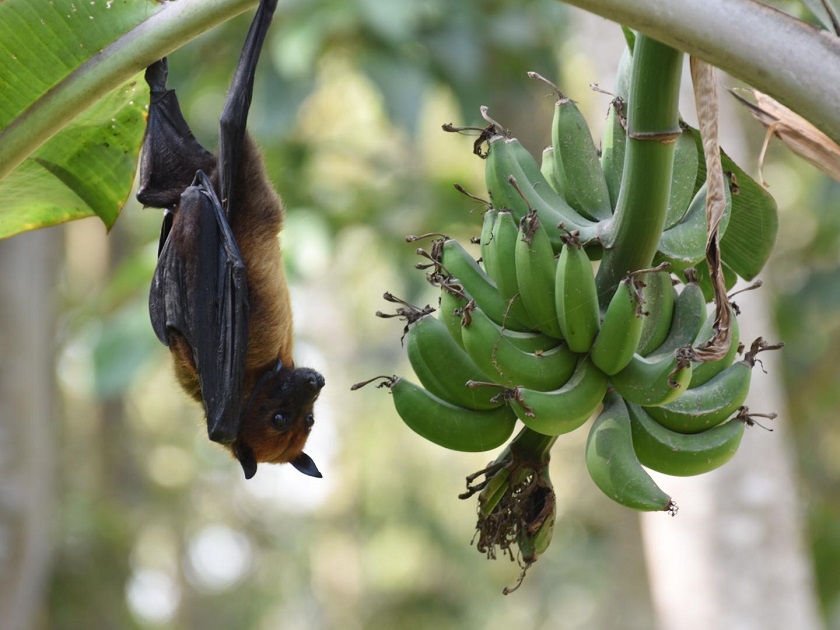
Barbara Han, a disease ecologist at Cary Institute of Ecosystem Studies, is a co-lead author on the paper. She explains, "While there is a growing understanding that bats play a role in the transmission of Nipah virus in Southeast Asia, less is known about which species pose the most risk. Our goal was to help pinpoint additional species with a high likelihood of carrying Nipah, to target surveillance and protect public health." CAPTION Indian flying fox roosting near bananas.  CREDIT Rajib Islam{module In-article}

Raina K. Plowright, a disease ecologist at Montana State University, was also a co-lead author. She notes, "As this paper was going to press, another case of Nipah virus was confirmed in Kerala. The public health community has again been forced into reactive mode. Our study is a starting point for the research needed to contain Nipah at its source, so we are managing spillover risk, instead of human suffering."

Nipah virus is a highly lethal, emerging henipavirus that can be transmitted to people from the body fluids of infected bats. Eating fruit or drinking date palm sap that has been contaminated by bats has been flagged as a transmission pathway. Once infected, people can spread the virus directly to other people, sparking an outbreak. Domestic pigs are also bridging hosts that can infect people. There is no vaccine and the virus has a high mortality rate.

"Bat-borne viruses are found all over the world, yet surveillance and sampling efforts have been patchy," says Han. "There are likely many competent Nipah hosts that have not been identified. For this reason, there is a need to devise new methods that take all available data into account to guide sampling efforts in India and in other regions."

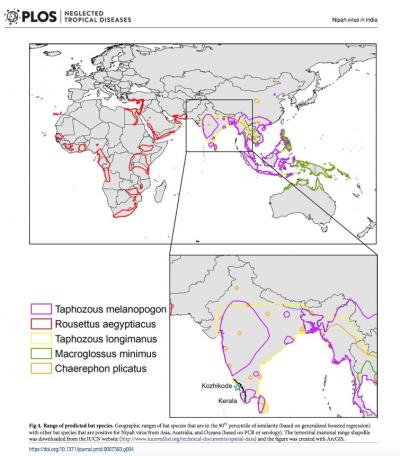
India is home to an estimated 113 bat species. Just 31 of these species have been sampled for Nipah virus, with 11 found to have antibodies that signal host potential. Plowright notes, "Given the role bats play in transmitting viruses infectious to people, investment in understanding these animals has been low. The last comprehensive and systematic taxonomic study on the bats in India was conducted more than a century ago." CAPTION Geographic ranges of bat species that are in the 90th percentile of similarity (based on generalized boosted regression) with other bat species that are positive for Nipah virus from Asia, Australia, and Oceana (based on PCR or serology).  CREDIT Plowright RK, Becker DJ, Crowley DE, Washburne AD, Huang T, Nameer PO, et al. (2019){module In-article}

Machine learning, a form of artificial intelligence, was used to flag bat species with the potential to harbor Nipah. Han explains, "By looking at the traits of bat species known to carry Nipah globally, our model was able to make predictions about additional bat species residing in India with the potential to carry the virus and transmit it to people. These bats are currently not on the public health radar and are worthy of additional study."

First, the team compiled published data on bat species known to carry Nipah and other henipaviruses globally. Data included 48 traits of 523 bat species, including information on foraging methods, diet, migration behaviors, geographic ranges, and reproduction. They also looked at the environmental conditions in which reported spillovers occurred.

Then they applied a trait-based machine learning approach to a subset of species that occur in Asia, Australia, and Oceana. Their algorithm identified known Nipah-positive bat species with 83% accuracy. It also identified six bat species that occur in Asia, Australia, and Oceana that have traits that could make them competent hosts and should be prioritized for surveillance. Four of these species occur in India, two of which are found in Kerala.

Plowright explains, "We set out to make trait-based predictions of likely henipavirus reservoirs near Kerala. Our focus was narrow, but the model was successful in identifying Nipah hosts, demonstrating that this method could serve as a powerful tool in guiding surveillance for Nipah and other disease systems."

The authors note that their predictions must be combined with local knowledge on bat ecology - including distribution, abundance, and proximity to humans - to design sampling plans that can effectively identify bat hosts that pose a risk to humans. This work provides a list of species to guide early surveillance and should not be taken as a definitive list of reservoirs.

"Surveilling high-risk bat populations can provide early warning for veterinarians and public health authorities to take preventative measures needed to preempt an outbreak. Identifying which species harbor disease is an important first step in surveillance planning. We also need to prioritize research on which virus strains pose the greatest risk to people. Ultimately, the goal is to extinguish risk, not fight fires," Han concludes.

The first AI universe sim is fast, accurate; its creators don't know how it works

The new model can envision universes with unique parameters, such as extra dark matter, even without receiving training data in which those parameters varied

For the first time, astrophysicists have used artificial intelligence techniques to generate complex 3D supercomputer simulations of the universe. The results are so fast, accurate and robust that even the creators aren't sure how it all works.

"We can run these simulations in a few milliseconds, while other 'fast' simulations take a couple of minutes," says study co-author Shirley Ho, a group leader at the Flatiron Institute's Center for Computational Astrophysics in New York City and an adjunct professor at Carnegie Mellon University. "Not only that, but we're much more accurate."

The speed and accuracy of the project called the Deep Density Displacement Model, or D3M for short wasn't the biggest surprise to the researchers. The real shock was that D3M could accurately simulate how the universe would look if certain parameters were tweaked -- such as how much of the cosmos is dark matter -- even though the model had never received any training data where those parameters varied. A comparison of the accuracy of two models of the universe. The new model (left), dubbed D3M, is both faster and more accurate than an existing method (right) called second-order perturbation theory, or 2LPT. The colors represent the average displacement error in millions of light-years for each point in the grid relative to a high-accuracy (though much slower) model.{module In-article}

"It's like teaching image recognition software with lots of pictures of cats and dogs, but then it's able to recognize elephants," Ho explains. "Nobody knows how it does this, and it's a great mystery to be solved."

Ho and her colleagues present D3M June 24 in the Proceedings of the National Academy of Sciences. The study was led by Siyu He, a Flatiron Institute research analyst.

Ho and He worked in collaboration with Yin Li of the Berkeley Center for Cosmological Physics at the University of California, Berkeley, and the Kavli Institute for the Physics and Mathematics of the Universe near Tokyo; Yu Feng of the Berkeley Center for Cosmological Physics; Wei Chen of the Flatiron Institute; Siamak Ravanbakhsh of the University of British Columbia in Vancouver; and Barnabás Póczos of Carnegie Mellon University.

Computer simulations like those made by D3M have become essential to theoretical astrophysics. Scientists want to know how the cosmos might evolve under various scenarios, such as if the dark energy pulling the universe apart varied over time. Such studies require running thousands of simulations, making a lightning-fast and highly accurate computer model one of the major objectives of modern astrophysics.

D3M models how gravity shapes the universe. The researchers opted to focus on gravity alone because it is by far the most important force when it comes to the large-scale evolution of the cosmos.

The most accurate universe simulations calculate how gravity shifts each of billions of individual particles over the entire age of the universe. That level of accuracy takes time, requiring around 300 computation hours for one simulation. Faster methods can finish the same simulations in about two minutes, but the shortcuts required to result in lower accuracy.

Ho, He and their colleagues honed the deep neural network that powers D3M by feeding it 8,000 different simulations from one of the highest-accuracy models available. Neural networks take training data and run calculations on the information; researchers then compare the resulting outcome with the expected outcome. With further training, neural networks adapt over time to yield faster and more accurate results.

After training D3M, the researchers ran simulations of a box-shaped universe 600 million light-years across and compared the results to those of the slow and fast models. Whereas the slow-but-accurate approach took hundreds of hours of computation time per simulation and the existing fast method took a couple of minutes, D3M could complete a simulation in just 30 milliseconds.

D3M also churned out accurate results. When compared with the high-accuracy model, D3M had a relative error of 2.8 percent. Using the same comparison, the existing fast model had a relative error of 9.3 percent.

D3M's remarkable ability to handle parameter variations not found in its training data makes it an especially useful and flexible tool, Ho says. In addition to modeling other forces, such as hydrodynamics, Ho's team hopes to learn more about how the model works under the hood. Doing so could yield benefits for the advancement of artificial intelligence and machine learning, Ho says.

"We can be an interesting playground for a machine learner to use to see why this model extrapolates so well, why it extrapolates to elephants instead of just recognizing cats and dogs," she says. "It's a two-way street between science and deep learning."