


SUPERCOMPUTING NEWS SUPERCOMPUTING NEWS
    • MEDIA KIT
    • MOST READ
    • RSS FEED
    • ACADEMIA
    • AEROSPACE
    • APPLICATIONS
    • ASTRONOMY
    • AUTOMOTIVE
    • BIG DATA
    • BIOLOGY
    • CHEMISTRY
    • CLIENTS
    • CLOUD
    • DEFENSE
    • DEVELOPER TOOLS
    • EARTH SCIENCES
    • ECONOMICS
    • ENGINEERING
    • ENTERTAINMENT
    • GAMING
    • GOVERNMENT
    • HEALTH
    • OIL & GAS
    • INDUSTRY
    • INTERCONNECTS
    • MANUFACTURING
    • MIDDLEWARE
    • MOVIES
    • NETWORKS
    • PHYSICS
    • PROCESSORS
    • RETAIL
    • SCIENCE
    • STORAGE
    • SYSTEMS
    • VISUALIZATION
    • AcyMailing subscription form

    • ADD YOUR VIDEOS
    • MANAGE VIDEOS
    • CONVERSATION INBOX
    • SOCIAL ADVERTISER
    • SOCIAL NETWORK VIDEOS
    • SURVEYS
    • GROUPS
    • PAGES
    • MARKETPLACE LISTINGS
    • APPLICATIONS BROWSER
    • PRIVACY CONFIRM REQUEST
    • PRIVACY CREATE REQUEST
    • LEADERBOARD
    • POINTS LISTING
      • BADGES
    • TRADE SHOWS
Sign In
Ioannis Kakadiaris is Hugh Roy and Lillie Cranz Cullen Distinguished University Professor of Computer Science and director of UH's Computational Biomedicine Lab.
Tyler O'Neal, Staff Editor ACADEMIA April 3, 2023, 2:14 pm

UH prof Kakadiaris wins grant to combat food insecurity through AI

Digital platform aims to help food-insecure Texans access nutritious meals

One in eight Texans experiences food insecurity, according to the non-profit agency Feeding America. That means 1.4 million Texas households are food insecure, with limited or inconsistent access to nutritious food for an active, healthy life. The USDA's most recent survey on the issue reported that Texas is among the top nine U.S. states with a higher prevalence of food insecurity than the national average. food pantry
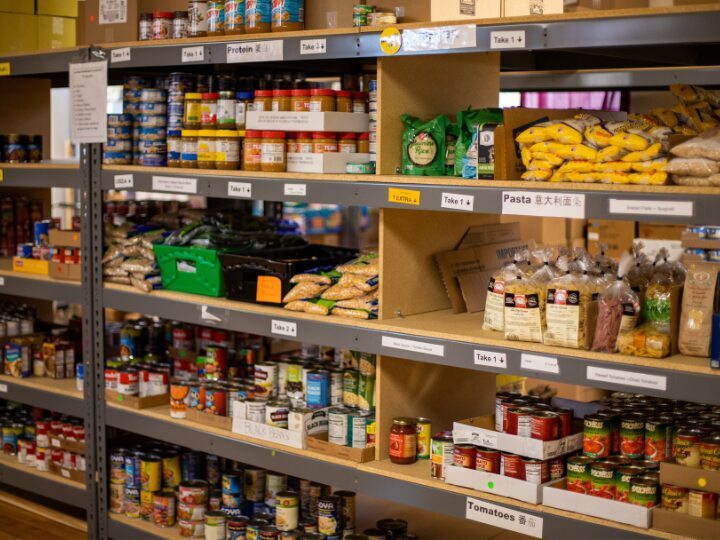
To address this issue, a University of Houston-led team is developing an artificial intelligence-based platform that can support the food charity ecosystem through data-driven technologies.

"The commitment of our team is to help our fellow neighbors," said Ioannis Kakadiaris, principal investigator and Hugh Roy and Lillie Cranz Cullen Distinguished University Professor of Computer Science at UH's College of Natural Sciences and Mathematics. "This is evident in everything we do and permeates all our work."

Funded by a $750,000 grant from the National Science Foundation, the project aims to help food pantries communicate with other pantries, food donors, and agencies while also helping to provide culturally aware and personalized food to clients.

On the demand side, there must be the identification of the nutritional needs, cultural preferences, and food preparation equipment and supplies of food-insecure households, according to Kakadiaris. If someone does not know what a particular food is or how to prepare it, it will go to waste, and the efforts of the food charity ecosystem will fail, he added. On the supply side, there needs to be streamlined logistics, improved communication, and coordinated efforts between the various stakeholders in the food charity system to optimize the supply chain so that inefficiencies are minimized.

The platform will potentially use food delivery services like DoorDash to transfer the food. In turn, food donors could be rewarded for their charitable donations.

"Donors could receive NFT (non-fungible tokens) that will say how good of a donor they have been in the past month," Kakadiaris said. "I envision having gold, silver, or bronze donors, depending on how much food they have donated over the past month or week."

The research team from UH includes Norma Olvera, professor of education and a USDA E. Kika de la Garza Fellow; Elizabeth Anderson-Fletcher, associate professor of supply chain management in the C. T. Bauer College of Business and Hobby School of Public Affairs; and Susie Gronseth, professor of education. From the University of Texas is Junfeng Jiao, associate professor and director of the Urban Information Lab in the School of Architecture.

"We will offer users and stakeholders healthy and culturally appropriate recipes using this platform," said Olvera.

Jiao adds that they will ensure AI is fair, safe, transparent, and accessible to all parties.

"This is a multi-disciplinary team that brings various expertise to the table," said Anderson-Fletcher. The team is partnering with Alison Reese, executive director of Souper Bowl of Caring. Souper Bowl of Caring, home of the Tackle Hunger Map, is a non-profit that uses its digital platform to fundraise for both small and large food charities across the country.

This UH project is one of sixteen projects awarded nationwide, totaling $11 million through the NSF's Convergence Accelerator program that focuses on advancing regenerative agricultural practices and providing equitable and affordable nutritious food options.

"Food and nutrition security is a new focus for the Convergence Accelerator's portfolio, and we are excited to welcome these teams into our program," said Douglas Maughan, head of the NSF Convergence Accelerator. "We hope to create a group of synergistic efforts that advance regenerative agriculture practices, reduce water usage, provide equitable access to nutritious and affordable food for disadvantaged communities, and spur technology and job creation."

Kakadiaris' team has been funded through Phase 1 of their project. The Convergence Accelerator teams will submit formal Phase 2 proposals for additional support of up to $5 million.
Faint galaxies lurking in the dark

Faint galaxies lurking in the dark

Tyler O'Neal, Staff Editor ACADEMIA March 31, 2023, 8:00 am

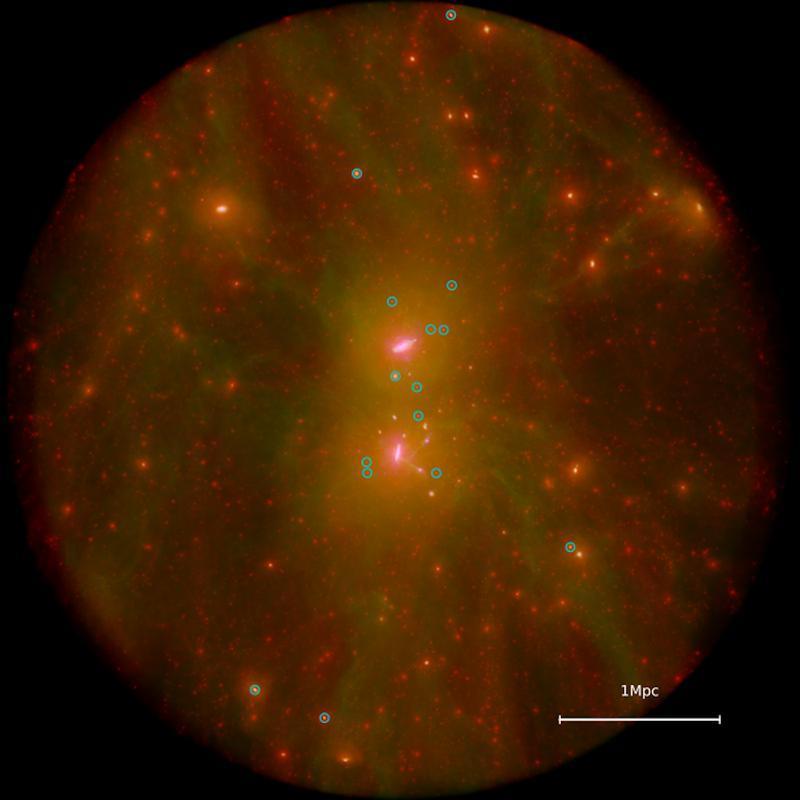
Using the most accurate and detailed cosmological simulations available, an international team has made an exciting prediction that may shed new light on our understanding of the universe: a large population of faint galaxies in our cosmic neighborhood await discovery.

The study focuses on ultra-diffuse galaxies: faint galaxies with masses of up to one billion Suns – about one-thousandth of the mass of the Milky Way – that are spread over an area comparable to the size of our Milky Way. This makes them very faint and difficult to observe, and as a result, they remain poorly understood.

The researchers believe that the Local Group, a small cluster that currently contains approximately 60 known galaxies, including our home galaxies the Milky Way and Andromeda, holds the best prospects for further discoveries. While only two ultra-diffuse galaxies have been found in the Local Group so far, scientists believe that understanding the total number of ultra-diffuse galaxies in the Local Group is crucial to our understanding of the cosmos.

So, how many more lurk in our cosmic backyard? To find out, the international team examined state-of-the-art supercomputer simulations of our cosmic neighborhood. Named after the ancient Greek goddess of the home, the HESTIA simulations are the most accurate and detailed simulations of the Milky Way and its immediate neighborhood in existence. The simulations predict that there may be as many as 12 ultra-diffuse galaxies waiting to be discovered in the Local Group. Based on an analysis of the ultra-diffuse galaxies’ properties in the HESTIA simulations, the team believes several of these galaxies could be directly observable using existing data from surveys such as the Sloan Digital Sky Survey.

The discovery of these new galaxies could have far-reaching implications for our understanding of galaxy formation and evolution. Current models suggest that up to half of the low-mass galaxies in the universe could be extended and diffuse, and most of them will be unobservable with our current technological capabilities. As the number of galaxies in the universe is a strong prediction of various cosmological models, the size of the population of ultra-diffuse galaxies in the Local Group could be used to rule out some of these models.

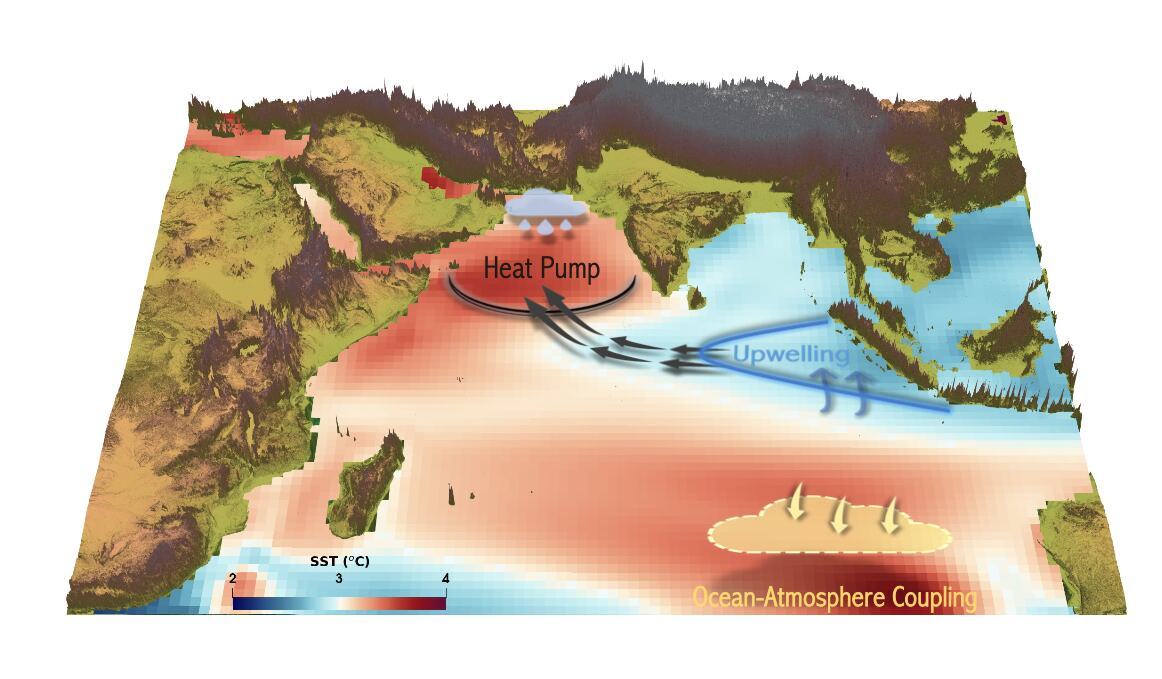
Schematic showing the expected future (2081-2100) warming pattern and the corresponding changes in winds and ocean heat transport for an SSP5-8.5 greenhouse gas emission scenario / Figure credit: Sahil Sharma

Korea's Aleph supercomputer uncovers the mechanisms that cause uneven warming in the Indian Ocean

D. Draper ACADEMIA March 31, 2023, 7:00 am

An international team of climate scientists uncovers the physical mechanisms that can cause uneven future warming in the Indian Ocean and corresponding shifts in monsoon precipitation. 

Even though Global Warming is happening globally, some areas warm faster than others in response to increasing greenhouse gas concentrations. The corresponding climate change temperature difference pattern causes large-scale changes in winds and weather systems, impacting societies and ecosystems. Previous work has mainly focused on the well-known Arctic amplification pattern and on the projected east/west temperature difference in the equatorial Pacific, which in turn can impact regions far outside the tropics. Little attention has been paid so far to the mechanisms that cause uneven heating in the Indian Ocean and related impacts on wind and rainfall in the adjacent land area.

By analyzing data from one of the most extensive future climate change simulations performed to date (the ICCP/CESM Large-Ensemble simulation of the Community Earth System Model, version 2), the team of scientists from South Korea and Japan was able to pinpoint why over the next decades the tropical eastern Indian Ocean is expected to warm less than the Arabian Sea and the Southeastern Indian Ocean (Figure).

A key area identified by the researchers to explain the uneven Indian Ocean warming is the area west of Indonesia, where under present-day conditions colder deep waters occasionally upwell to the surface. This connection between surface and deeper ocean waters serves as a thermostat, which explains the weakened future regional warming signal relative to other Indian Ocean areas. In the tropics, air rises in warmer areas and tends to sink in colder regions.  The reduced eastern equatorial Indian warming is therefore accompanied by higher-than-normal sea level pressure and winds that blow toward the Arabian Sea. 

“Changes in the winds automatically influence the ocean circulation. In our case, stronger future winds blowing from Indonesia towards the Arabian Peninsula push more tropical waters toward the Arabian Sea. This leads to accelerated warming of the ocean there” says Sahil Sharma, a Ph.D. student at the IBS Center for Climate Physics (ICCP) and Pusan National University, South Korea, and the first writer of the study. 

“Enhanced future warming in the Arabian Sea will further reduce atmospheric surface pressure and generate more rainfall, also in the adjacent regions.  Climate models show on average a 50% intensification of mean rainfall over the southern Arabian Peninsula and parts of western India by the year 2100 if CO2 emissions are not cut drastically.”, says Prof. Kyung-Ja Ha from the IBS Center for Climate Physics and Pusan National University and corresponding author of the study.

The writers further highlighted the southeastern Indian ocean as a regional global warming hotspot. In this region, future surface warming induced by greenhouse gases can be further amplified by a reduction of clouds and more sunshine arriving at the surface of the ocean.

“The Indian Ocean is a peculiar region. Ocean currents are less efficient in transporting excess heating from Global Warming to higher latitudes, as compared to other ocean basins. The northern transport route is blocked by land. This means that we find a very different temperature response pattern in the Indian Ocean, which emerges from a combination of oceanic and atmospheric processes, including winds and clouds ”, says Dr. Keith Rodgers from the IBS Center for Climate Physics, co-author of the study.

This study was made possible by using a climate computer model experiment, which was previously conducted on the ICCP/IBS supercomputer Aleph. Rather than running a climate model only once into the future for a given greenhouse gas forcing, the researcher ran 100 simulations into the future which represent different realizations of the internal variability in the climate system.

This new modeling resource has been instrumental in identifying the complex interplay between the ocean and atmosphere which is responsible for the Indian Ocean warming pattern. This understanding will be useful for informing fisheries and other marine resource management concerns.

The research team will further explore how climate change will impact other regional processes in the Indian Ocean area, including marine ecosystems and sea levels.

  1. NASA-built supercomputer model DAGGER makes predictions with AI to give time to prepare for solar storms
  2. Can AI predict how you'll vote in the next election?

Page 33 of 123

  • 28
  • 29
  • 30
  • 31
  • 32
  • 33
  • 34
  • 35
  • 36
  • 37
POPULAR RIGHT NOW
  • Supercomputers uncover a new class of cosmic explosions hidden in plain sight
    Supercomputers uncover a new class of cosmic explosions hidden in plain sight
  • AI supercharges the hunt for stronger magnets: Iowa State researchers launch a new era of intelligent materials discovery
    AI supercharges the hunt for stronger magnets: Iowa State researchers launch a new era of intelligent materials discovery
  • IBM's Historic stock collapse raises questions for the future of enterprise supercomputing
    IBM's Historic stock collapse raises questions for the future of enterprise supercomputing
  • Could a novel dark matter theory simultaneously resolve multiple cosmic enigmas? Supercomputer simulations provide a compelling, albeit currently unverified, potential solution
    Could a novel dark matter theory simultaneously resolve multiple cosmic enigmas? Supercomputer simulations provide a compelling, albeit currently unverified, potential solution
  • Melting icebergs may be reshaping Earth’s greatest ocean current
    Melting icebergs may be reshaping Earth’s greatest ocean current
  • Supercomputers replace ‘bathtub’ flood maps with physics-based digital twins of Britain’s coastline
    Supercomputers replace ‘bathtub’ flood maps with physics-based digital twins of Britain’s coastline
  • Supercomputers push neural quantum simulation beyond previous limits
    Supercomputers push neural quantum simulation beyond previous limits
  • Intel’s AI supercomputing revival: Q2 financial surge signals new era for CPU-powered HPC infrastructure
    Intel’s AI supercomputing revival: Q2 financial surge signals new era for CPU-powered HPC infrastructure
  • AI infrastructure financing fears shake semiconductor sector
    AI infrastructure financing fears shake semiconductor sector
  • AWS supercomputing investment reaches historic scale as Amazon’s AI strategy powers record financial results
    AWS supercomputing investment reaches historic scale as Amazon’s AI strategy powers record financial results
THIS YEAR'S MOST READ
  • Wall Street wants to trade supercomputing power like oil
    Wall Street wants to trade supercomputing power like oil
  • Cosmic ambition at scale: UK’s supercomputer unlocks a 2.5 petabytes universe
    Cosmic ambition at scale: UK’s supercomputer unlocks a 2.5 petabytes universe
  • Hidden order, revealed at scale: Supercomputing, electron ptychography uncover the inner workings of relaxor ferroelectrics
    Hidden order, revealed at scale: Supercomputing, electron ptychography uncover the inner workings of relaxor ferroelectrics
  • Beamforming the future: BeammWave's 6G push signals the rise of orbital-terrestrial wireless networks
    Joakim Axmon
    Joakim Axmon
  • Intel's Q1 results signal supercomputing surge driving Xeon momentum
    Intel's Q1 results signal supercomputing surge driving Xeon momentum
  • When stars fall apart: Supercomputing reveals the hidden physics of black holes
    When stars fall apart: Supercomputing reveals the hidden physics of black holes
  • Multi-layer simulations reveal the hidden supply chain of solar prominences
    Multi-layer simulations reveal the hidden supply chain of solar prominences
  • Japanese scientists decode dolphin speed with supercomputing: Turbulence, vortices, and the hidden physics of propulsion
    Japanese scientists decode dolphin speed with supercomputing: Turbulence, vortices, and the hidden physics of propulsion
  • Cosmic feedback at scale: Supercomputing reveals how quasars regulate the early Universe
    Cosmic feedback at scale: Supercomputing reveals how quasars regulate the early Universe
  • Modeling life at the microscopic scale: A computational breakthrough in oxygen transport
    Modeling life at the microscopic scale: A computational breakthrough in oxygen transport
MOST READ OF ALL-TIME
  • Largest Computational Biology Simulation Mimics The Ribosome
    Details
    112108
    The amino acid (green) slithers into the chemical reaction center, moving through an evolutionarily ancient corridor of the ribosome (purple). The amino acid is delivered to the reaction core by the transfer RNA molecule (yellow).
    The amino acid (green) slithers into the chemical reaction center, moving through an evolutionarily ancient corridor of the ribosome (purple). The amino acid is delivered to the reaction core by the transfer RNA molecule (yellow).
  • Silicon 'neurons' may add a new dimension to chips
    Details
    80994
    Silicon 'neurons' may add a new dimension to chips
  • Linux Networx Accelerators Expected to Drive up to 4x Price/Performance
    Details
    75538
  • Complex Concepts That Really Add Up
    Details
    73637
    Complex Concepts That Really Add Up
  • Blue Sky Studios Donates Animation SuperComputer to Wesleyan
    Details
    68141
    Each rack holds 52 Angstrom Microsystem-brand “blades,” with a memory footprint of 12 or 24 gigabytes each. (Photos by Olivia Bartlett Drake)
    Each rack holds 52 Angstrom Microsystem-brand “blades,” with a memory footprint of 12 or 24 gigabytes each. (Photos by Olivia Bartlett Drake)
  • Humanities, HPC connect at NERSC
    Details
    57947
  • TeraGrid ’09 'Call for Participation'
    Details
    54952
  • Turbulence responsible for black holes' balancing act
    Details
    52312
  • Cray Wins $52 Million SuperComputer Contract
    Details
    50140
  • SDSC Researchers Accurately Predict Protein Docking
    Details
    46080
  • FRONTPAGE
  • LATEST
  • POPULAR
  • REGISTER
  • SOCIAL
  • VIDEO
  • SUBSCRIPTION
  • RSS
  • GUIDELINES
  • PRIVACY
  • TOS
  • ABOUT
  • +1 (816) 799-4488
  • editorial@supercomputingonline.com
© 2001 - 2026 SuperComputingOnline.com, LLC. All rights reserved. This material may not be published, broadcast, rewritten or redistributed without permission.
Sign In
  • FRONT PAGE
  • LATEST
    • MEDIA KIT
    • MOST READ
    • RSS FEED
    • ACADEMIA
    • AEROSPACE
    • APPLICATIONS
    • ASTRONOMY
    • AUTOMOTIVE
    • BIG DATA
    • BIOLOGY
    • CHEMISTRY
    • CLIENTS
    • CLOUD
    • DEFENSE
    • DEVELOPER TOOLS
    • EARTH SCIENCES
    • ECONOMICS
    • ENGINEERING
    • ENTERTAINMENT
    • HEALTH
    • INDUSTRY
    • INTERCONNECTS
    • GAMING
    • GOVERNMENT
    • MANUFACTURING
    • MIDDLEWARE
    • MOVIES
    • NETWORKS
    • OIL & GAS
    • PHYSICS
    • PROCESSORS
    • RETAIL
    • SCIENCE
    • STORAGE
    • SYSTEMS
    • VISUALIZATION
  • VIDEOS
    • ADD YOUR VIDEOS
    • MANAGE VIDEOS
  • COMMUNITY
    • TRADE SHOWS
    • SOCIAL NETWORK VIDEOS
    • SURVEYS
    • APPLICATIONS BROWSER
    • CONVERSATION INBOX
    • SOCIAL ADVERTISER
    • GROUPS
    • MARKETPLACE LISTINGS
    • PAGES
    • LEADERBOARD
    • POINTS LISTING
      • BADGES
    • PRIVACY CONFIRM REQUEST
    • PRIVACY CREATE REQUEST

Hey there! We noticed you’re using an ad blocker.