

SUPERCOMPUTING NEWS SUPERCOMPUTING NEWS
    • MEDIA KIT
    • MOST READ
    • RSS FEED
    • ACADEMIA
    • AEROSPACE
    • APPLICATIONS
    • ASTRONOMY
    • AUTOMOTIVE
    • BIG DATA
    • BIOLOGY
    • CHEMISTRY
    • CLIENTS
    • CLOUD
    • DEFENSE
    • DEVELOPER TOOLS
    • EARTH SCIENCES
    • ECONOMICS
    • ENGINEERING
    • ENTERTAINMENT
    • GAMING
    • GOVERNMENT
    • HEALTH
    • OIL & GAS
    • INDUSTRY
    • INTERCONNECTS
    • MANUFACTURING
    • MIDDLEWARE
    • MOVIES
    • NETWORKS
    • PHYSICS
    • PROCESSORS
    • RETAIL
    • SCIENCE
    • STORAGE
    • SYSTEMS
    • VISUALIZATION
    • AcyMailing subscription form

    • ADD YOUR VIDEOS
    • MANAGE VIDEOS
    • CONVERSATION INBOX
    • SOCIAL ADVERTISER
    • SOCIAL NETWORK VIDEOS
    • SURVEYS
    • GROUPS
    • PAGES
    • MARKETPLACE LISTINGS
    • APPLICATIONS BROWSER
    • PRIVACY CONFIRM REQUEST
    • PRIVACY CREATE REQUEST
    • LEADERBOARD
    • POINTS LISTING
      • BADGES
    • TRADE SHOWS
Sign In
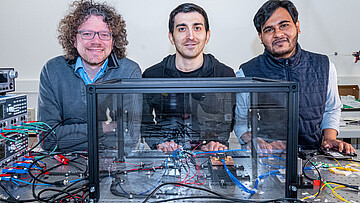
They developed the new integrated quantum light source (from left): Prof. Dr Michael Kues, head of the Institute of Photonics and board member of the Cluster of Excellence PhoenixD at Leibniz University Hannover, with doctoral student Hatam Mahmudlu and Humboldt fellow Dr. Raktim Haldar.
Tyler O'Neal, Staff Editor ACADEMIA April 17, 2023, 5:00 am

German-engineered photonic turnkey quantum source for entangled qubit state generation goes fully on-chip

The new development is scalable and suitable for use in photonic quantum supercomputers

An international team of researchers from Leibniz University Hannover (Germany), the University of Twente (Netherlands), and the start-up company QuiX Quantum has presented an entangled quantum light source fully integrated for the first time on a chip. “Our breakthrough allowed us to shrink the source size by more than 1000, allowing reproducibility, stability over a longer time, scaling, and potentially mass-production. All these characteristics are required for real-world applications such as quantum processors,” says Prof. Dr. Michael Kues, head of the Institute of Photonics, and board member of the Cluster of Excellence PhoenixD at Leibniz University Hannover. 

Quantum bits (qubits) are the basic building blocks of quantum supercomputers and the quantum internet. Quantum light sources generate light quanta (photons) that can be used as quantum bits. On-chip photonics has become a leading platform for processing optical quantum states as it is compact, robust, and can accommodate and arrange many elements on a single chip.  Here, light is directed on the chip through extremely compact structures, which are used to build photonic quantum supercomputing systems. These are already accessible today through the cloud. Scalably implemented, they could solve tasks that are inaccessible to conventional computers due to their limited supercomputing capacities. This superiority is referred to as quantum advantage. The whole quantum light source fits on a chip smaller than a one-euro coin. The researchers reduced the size of the light source by a factor of more than 1,000 by using a novel "hybrid technology" that combines a laser made of indium phosphide and a filter made of silicon nitride on a single chip. The new light source is efficient and stable and can find applications to drive quantum supercomputers or the quantum internet.
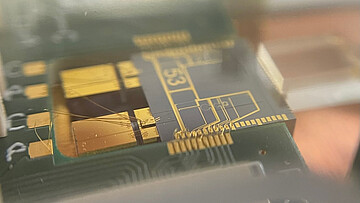
"Until now, quantum light sources required external, off-chip, and bulky laser systems, which limited their use in the field. However, we overcome these challenges through a novel chip design and exploiting different integrated platforms," says Hatam Mahmudlu, a Ph.D. student in Kues' team. Their new development, an electrically-excited, laser-integrated photonic quantum light source, fits entirely on a chip and can emit frequency-entangled qubit states.

“Qubits are very susceptible to noise. The chip must be driven by the laser field, completely free from noise, requiring an on-chip filter. Previously, it was a major challenge to integrate laser, filter, and a cavity on the same chip as there was no unique material that was efficient to build these different components,” says Dr. Raktim Haldar, a Humboldt fellow in Kues’ group. The key was the ‘hybrid technology’ that sticks the laser made of indium phosphide, a filter, and a cavity made of silicon nitride and brings them together into a single chip. On the chip, in a spontaneous nonlinear process, two photons are created from a laser field. Each photon spans a range of colors simultaneously, which is called ‘superposition’, and the colors of both photons are correlated, i.e., the photons are entangled and can store quantum information. "We achieve remarkable efficiencies and state qualities required for application in quantum computers or the quantum internet," says Kues.

"Now we can integrate the laser with other components on a chip so that the whole quantum source is smaller than a one-euro coin. Our tiny device could be considered a step toward quantum advantage on a chip with photons. Unlike Google, which currently uses super-cold qubits in cryogenic systems, the quantum advantage could be achieved with such photonic systems on a chip even at room temperature," says Haldar. The scientists also expect their discovery to help lower the production costs of applications. "We can imagine that our quantum light source will soon be a fundamental component of programmable photonic quantum processors," says Kues. 

Prof. Dr. Michael Kues is head of the Institute of Photonics and a board member of the Cluster of Excellence PhoenixD: Photonics, Optics, and Engineering - Innovation across Disciplines at Leibniz University Hannover, Germany. The PhoenixD research cluster comprises around 120 scientists working on novel integrated optics. The German Research Foundation (DFG) funds PhoenixD with about 52 million euros from 2019 to 2025. Dr. Raktim Haldar is an Alexander von Humboldt Research Fellow at the Institute of Photonics, and Hatam Mahmudlu is a doctoral student in Kues' team. The research was funded by the Federal Ministry of Education and Research (BMBF) and the European Research Council (ERC).

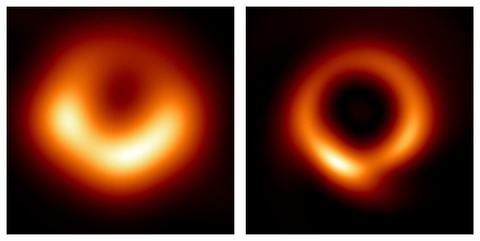
 

Medeiros et al. 2023 New image of M87 supermassive black hole generated by the PRIMO algorithm using 2017 EHT data

Medeiros reconstructs the iconic image of the fuzzy, orange donut of M87 with the help of PRIMO

Tyler O'Neal, Staff Editor ACADEMIA April 14, 2023, 9:00 am

The iconic image of the supermassive black hole at the center of M87—sometimes referred to as the “fuzzy, orange donut”—has gotten its first official makeover with the help of machine learning. The new image further exposes a central region that is larger and darker, surrounded by the bright accreting gas shaped like a “skinny donut.” The team used the data obtained by the Event Horizon Telescope (EHT) collaboration in 2017 and achieved, for the first time, the full resolution of the array. 

In 2017, the EHT collaboration used a network of seven pre-existing telescopes around the world to gather data on M87, creating an “Earth-sized telescope.” However, since it is infeasible to cover the Earth’s entire surface with telescopes, gaps arise in the data—like missing pieces in a jigsaw puzzle. Medeiros et al. 2023 M87 supermassive black hole originally imaged by the EHT collaboration in 2019 (left); and new image generated by the PRIMO algorithm using the same data set (right)

“With our new machine learning technique, PRIMO, we were able to achieve the maximum resolution of the current array,” says lead author Lia Medeiros of the Institute for Advanced Study. “Since we cannot study black holes up close, the detail of an image plays a critical role in our ability to understand its behavior. The width of the ring in the image is now smaller by about a factor of two, which will be a powerful constraint for our theoretical models and tests of gravity.”

PRIMO, which stands for principal-component interferometric modeling, was developed by EHT members Lia Medeiros (Institute for Advanced Study), Dimitrios Psaltis (Georgia Tech), Tod Lauer (NOIRLab), and Feryal Özel (Georgia Tech). Their publication, “The Image of the M87 Black Hole Reconstructed with PRIMO,” is now available in The Astrophysical Journal Letters.

“PRIMO is a new approach to the difficult task of constructing images from EHT observations,” said Lauer. “It provides a way to compensate for the missing information about the object being observed, which is required to generate the image that would have been seen using a single gigantic radio telescope the size of the Earth.” 

{media id=305,layout=solo}

PRIMO relies on dictionary learning, a branch of machine learning which enables computers to generate rules based on large sets of training material. For example, if a computer is fed a series of different banana images—with sufficient training—it may be able to determine if an unknown image is or is not a banana. Beyond this simple case, the versatility of machine learning has been demonstrated in numerous ways: from creating Renaissance-style works of art to completing the unfinished work of Beethoven. So how might machines help scientists to render a black hole image? The research team has answered this very question.

With PRIMO, supercomputers analyzed over 30,000 high-fidelity simulated images of black holes accreting gas. The ensemble of simulations covered a wide range of models for how the black hole accretes matter, looking for common patterns in the structure of the images. The various patterns of the structure were sorted by how commonly they occurred in the simulations and were then blended to provide a highly accurate representation of the EHT observations, simultaneously providing a high-fidelity estimate of the missing structure of the images. A paper about the algorithm itself was published in The Astrophysical Journal on February 3, 2023.

“We are using physics to fill in regions of missing data in a way that has never been done before by using machine learning,” added Medeiros. “This could have important implications for interferometry, which plays a role in fields from exo-planets to medicine.”

The team confirmed that the newly rendered image is consistent with the EHT data and theoretical expectations, including the bright ring of emission expected to be produced by hot gas falling into the black hole. Generating an image required assuming an appropriate form of the missing information, and PRIMO did this by building on the 2019 discovery that the M87 black hole in broad detail looked as predicted.

“Approximately four years after the first horizon-scale image of a black hole was unveiled by EHT in 2019, we have marked another milestone, producing an image that utilizes the full resolution of the array for the first time,” stated Psaltis. “The new machine learning techniques we have developed provide a golden opportunity for our collective work to understand black hole physics.”

The new image should lead to more accurate determinations of the mass of the M87 black hole and the physical parameters that determine its present appearance. The data also provides an opportunity for researchers to place greater constraints on alternatives to the event horizon (based on the darker central brightness depression) and perform more robust tests of gravity (based on the narrower ring size). PRIMO can also be applied to additional EHT observations, including those of Sgr A*, the central black hole in our own Milky Way galaxy.

M87 is a massive, relatively nearby, galaxy in the Virgo cluster of galaxies. Over a century ago, a mysterious jet of hot plasma was observed to emanate from its center. Beginning in the 1950s, the then-new technique of radio astronomy showed the galaxy to have a compact bright radio source at its center. During the 1960s, M87 had been suspected of having a massive black hole at its center powering this activity. Measurements made from ground-based telescopes starting in the 1970s, and later the Hubble Space Telescope starting in the 1990s, provided strong support that M87 indeed harbored a black hole weighing several billion times the mass of the Sun based on observations of the high velocities of stars and gas orbiting its center. The 2017 EHT observations of M87 were obtained over several days from several different radio telescopes linked together at the same time to obtain the highest possible resolution. The now iconic “orange donut” picture of the M87 black hole, released in 2019, reflected the first attempt to produce an image from these observations.

“The 2019 image was just the beginning,” stated Medeiros. “If a picture is worth a thousand words, the data underlying that image have many more stories to tell. PRIMO will continue to be a critical tool in extracting such insights.”

Development of the PRIMO algorithm was enabled through the support of the National Science Foundation Astronomy and Astrophysics Postdoctoral Fellowship.

PRIMO Black Hole Simulations

Tyler O'Neal, Staff Editor ACADEMIA April 14, 2023, 8:30 am
Overview of simulations that were generated for the training set of the PRIMO algorithm. Credit: Medeiros et al. 2023

Read more https://www.supercomputingonline.com/gallery/category/news/primo-black-hole-simulations

  1. UC Berkeley measures the 3D shape of one of the biggest, closest elliptical galaxies to us
  2. Model of M87

Page 28 of 123

  • 23
  • 24
  • 25
  • 26
  • 27
  • 28
  • 29
  • 30
  • 31
  • 32
POPULAR RIGHT NOW
  • Supercomputers uncover a new class of cosmic explosions hidden in plain sight
    Supercomputers uncover a new class of cosmic explosions hidden in plain sight
  • AI supercharges the hunt for stronger magnets: Iowa State researchers launch a new era of intelligent materials discovery
    AI supercharges the hunt for stronger magnets: Iowa State researchers launch a new era of intelligent materials discovery
  • IBM's Historic stock collapse raises questions for the future of enterprise supercomputing
    IBM's Historic stock collapse raises questions for the future of enterprise supercomputing
  • Could a novel dark matter theory simultaneously resolve multiple cosmic enigmas? Supercomputer simulations provide a compelling, albeit currently unverified, potential solution
    Could a novel dark matter theory simultaneously resolve multiple cosmic enigmas? Supercomputer simulations provide a compelling, albeit currently unverified, potential solution
  • Melting icebergs may be reshaping Earth’s greatest ocean current
    Melting icebergs may be reshaping Earth’s greatest ocean current
  • Supercomputers replace ‘bathtub’ flood maps with physics-based digital twins of Britain’s coastline
    Supercomputers replace ‘bathtub’ flood maps with physics-based digital twins of Britain’s coastline
  • Supercomputers push neural quantum simulation beyond previous limits
    Supercomputers push neural quantum simulation beyond previous limits
  • Intel’s AI supercomputing revival: Q2 financial surge signals new era for CPU-powered HPC infrastructure
    Intel’s AI supercomputing revival: Q2 financial surge signals new era for CPU-powered HPC infrastructure
  • AI infrastructure financing fears shake semiconductor sector
    AI infrastructure financing fears shake semiconductor sector
  • AWS supercomputing investment reaches historic scale as Amazon’s AI strategy powers record financial results
    AWS supercomputing investment reaches historic scale as Amazon’s AI strategy powers record financial results
THIS YEAR'S MOST READ
  • Wall Street wants to trade supercomputing power like oil
    Wall Street wants to trade supercomputing power like oil
  • Cosmic ambition at scale: UK’s supercomputer unlocks a 2.5 petabytes universe
    Cosmic ambition at scale: UK’s supercomputer unlocks a 2.5 petabytes universe
  • Hidden order, revealed at scale: Supercomputing, electron ptychography uncover the inner workings of relaxor ferroelectrics
    Hidden order, revealed at scale: Supercomputing, electron ptychography uncover the inner workings of relaxor ferroelectrics
  • Beamforming the future: BeammWave's 6G push signals the rise of orbital-terrestrial wireless networks
    Joakim Axmon
    Joakim Axmon
  • Intel's Q1 results signal supercomputing surge driving Xeon momentum
    Intel's Q1 results signal supercomputing surge driving Xeon momentum
  • When stars fall apart: Supercomputing reveals the hidden physics of black holes
    When stars fall apart: Supercomputing reveals the hidden physics of black holes
  • Multi-layer simulations reveal the hidden supply chain of solar prominences
    Multi-layer simulations reveal the hidden supply chain of solar prominences
  • Japanese scientists decode dolphin speed with supercomputing: Turbulence, vortices, and the hidden physics of propulsion
    Japanese scientists decode dolphin speed with supercomputing: Turbulence, vortices, and the hidden physics of propulsion
  • Cosmic feedback at scale: Supercomputing reveals how quasars regulate the early Universe
    Cosmic feedback at scale: Supercomputing reveals how quasars regulate the early Universe
  • Modeling life at the microscopic scale: A computational breakthrough in oxygen transport
    Modeling life at the microscopic scale: A computational breakthrough in oxygen transport
MOST READ OF ALL-TIME
  • Largest Computational Biology Simulation Mimics The Ribosome
    Details
    112108
    The amino acid (green) slithers into the chemical reaction center, moving through an evolutionarily ancient corridor of the ribosome (purple). The amino acid is delivered to the reaction core by the transfer RNA molecule (yellow).
    The amino acid (green) slithers into the chemical reaction center, moving through an evolutionarily ancient corridor of the ribosome (purple). The amino acid is delivered to the reaction core by the transfer RNA molecule (yellow).
  • Silicon 'neurons' may add a new dimension to chips
    Details
    80994
    Silicon 'neurons' may add a new dimension to chips
  • Linux Networx Accelerators Expected to Drive up to 4x Price/Performance
    Details
    75538
  • Complex Concepts That Really Add Up
    Details
    73637
    Complex Concepts That Really Add Up
  • Blue Sky Studios Donates Animation SuperComputer to Wesleyan
    Details
    68141
    Each rack holds 52 Angstrom Microsystem-brand “blades,” with a memory footprint of 12 or 24 gigabytes each. (Photos by Olivia Bartlett Drake)
    Each rack holds 52 Angstrom Microsystem-brand “blades,” with a memory footprint of 12 or 24 gigabytes each. (Photos by Olivia Bartlett Drake)
  • Humanities, HPC connect at NERSC
    Details
    57947
  • TeraGrid ’09 'Call for Participation'
    Details
    54952
  • Turbulence responsible for black holes' balancing act
    Details
    52312
  • Cray Wins $52 Million SuperComputer Contract
    Details
    50140
  • SDSC Researchers Accurately Predict Protein Docking
    Details
    46080
  • FRONTPAGE
  • LATEST
  • POPULAR
  • REGISTER
  • SOCIAL
  • VIDEO
  • SUBSCRIPTION
  • RSS
  • GUIDELINES
  • PRIVACY
  • TOS
  • ABOUT
  • +1 (816) 799-4488
  • editorial@supercomputingonline.com
© 2001 - 2026 SuperComputingOnline.com, LLC. All rights reserved. This material may not be published, broadcast, rewritten or redistributed without permission.
Sign In
  • FRONT PAGE
  • LATEST
    • MEDIA KIT
    • MOST READ
    • RSS FEED
    • ACADEMIA
    • AEROSPACE
    • APPLICATIONS
    • ASTRONOMY
    • AUTOMOTIVE
    • BIG DATA
    • BIOLOGY
    • CHEMISTRY
    • CLIENTS
    • CLOUD
    • DEFENSE
    • DEVELOPER TOOLS
    • EARTH SCIENCES
    • ECONOMICS
    • ENGINEERING
    • ENTERTAINMENT
    • HEALTH
    • INDUSTRY
    • INTERCONNECTS
    • GAMING
    • GOVERNMENT
    • MANUFACTURING
    • MIDDLEWARE
    • MOVIES
    • NETWORKS
    • OIL & GAS
    • PHYSICS
    • PROCESSORS
    • RETAIL
    • SCIENCE
    • STORAGE
    • SYSTEMS
    • VISUALIZATION
  • VIDEOS
    • ADD YOUR VIDEOS
    • MANAGE VIDEOS
  • COMMUNITY
    • TRADE SHOWS
    • SOCIAL NETWORK VIDEOS
    • SURVEYS
    • APPLICATIONS BROWSER
    • CONVERSATION INBOX
    • SOCIAL ADVERTISER
    • GROUPS
    • MARKETPLACE LISTINGS
    • PAGES
    • LEADERBOARD
    • POINTS LISTING
      • BADGES
    • PRIVACY CONFIRM REQUEST
    • PRIVACY CREATE REQUEST

Hey there! We noticed you’re using an ad blocker.