SUPERCOMPUTING NEWS SUPERCOMPUTING NEWS
    • MEDIA KIT
    • MOST READ
    • RSS FEED
    • ACADEMIA
    • AEROSPACE
    • APPLICATIONS
    • ASTRONOMY
    • AUTOMOTIVE
    • BIG DATA
    • BIOLOGY
    • CHEMISTRY
    • CLIENTS
    • CLOUD
    • DEFENSE
    • DEVELOPER TOOLS
    • EARTH SCIENCES
    • ECONOMICS
    • ENGINEERING
    • ENTERTAINMENT
    • GAMING
    • GOVERNMENT
    • HEALTH
    • OIL & GAS
    • INDUSTRY
    • INTERCONNECTS
    • MANUFACTURING
    • MIDDLEWARE
    • MOVIES
    • NETWORKS
    • PHYSICS
    • PROCESSORS
    • RETAIL
    • SCIENCE
    • STORAGE
    • SYSTEMS
    • VISUALIZATION
    • AcyMailing subscription form

    • ADD YOUR VIDEOS
    • MANAGE VIDEOS
    • CONVERSATION INBOX
    • SOCIAL ADVERTISER
    • SOCIAL NETWORK VIDEOS
    • SURVEYS
    • GROUPS
    • PAGES
    • MARKETPLACE LISTINGS
    • APPLICATIONS BROWSER
    • PRIVACY CONFIRM REQUEST
    • PRIVACY CREATE REQUEST
    • LEADERBOARD
    • POINTS LISTING
      • BADGES
    • TRADE SHOWS
Sign In
UGA researchers use ML to discover new exoplanet
Tyler O'Neal, Staff Editor ACADEMIA April 24, 2023, 10:00 am

UGA researchers use ML to discover new exoplanet

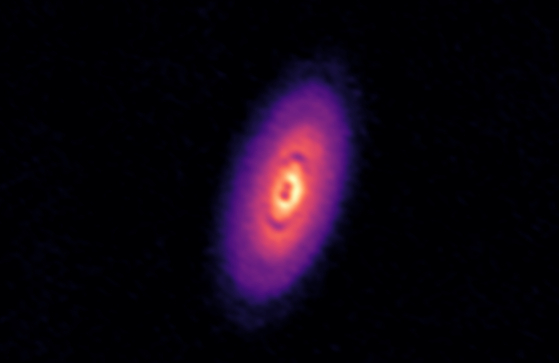
A University of Georgia research team has confirmed evidence of a previously unknown planet outside of our solar system, and they used machine learning tools to detect it. 

A recent study by the team showed that machine learning could correctly determine if an exoplanet is present by looking in protoplanetary disks, the gas around newly formed stars.

The newly published findings represent a first step toward using machine learning to identify previously overlooked exoplanets.

“We confirmed the planet using traditional techniques, but our models directed us to run those simulations and showed us exactly where the planet might be,” said Jason Terry, a doctoral student in the UGA Franklin College of Arts and Sciences Department of Physics and astronomy and lead author on the study.

“When we applied our models to a set of older observations, they identified a disk that wasn't known to have a planet despite having already been analyzed. Like previous discoveries, we ran simulations of the disk and found that a planet could re-create the observation.”

According to Terry, the models suggested a planet’s presence, indicated by several images that strongly highlighted a particular region of the disk that turned out to have the characteristic sign of a planet — an unusual deviation in the velocity of the gas near the planet. 

“This is an incredibly exciting proof of concept. We knew from our previous work that we could use machine learning to find known forming exoplanets,” said Cassandra Hall, assistant professor of computational astrophysics and principal investigator of the Exoplanet and Planet Formation Research Group at UGA. “Now, we know for sure that we can use it to make brand new discoveries.”

The discovery highlights how machine learning has the power to enhance scientists’ work, utilizing artificial intelligence as an added tool to expand researchers’ accuracy and more efficiently economize their time when engaged in such a vast endeavor as investigating deep, outer space.

The models could detect a signal in data that people had already analyzed; they found something that previously had gone undetected.

“This demonstrates that our models — and machine learning in general — have the ability to quickly and accurately identify important information that people can miss. This can dramatically speed up analysis and subsequent theoretical insights,” Terry said. “It only took about an hour to analyze that entire catalog and find strong evidence for a new planet in a specific spot, so we think there will be an important place for these types of techniques as our datasets get even larger.” 
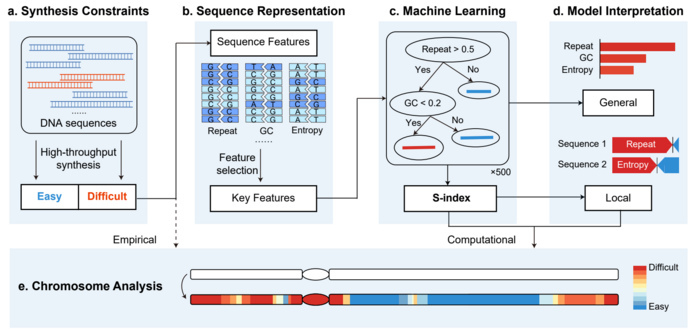
A, Collection of the DNA sequences obtained from high-throughput synthesis. The sequences were classified into easy-to-synthesize (blue) or difficult-to-synthesize (red). B, Graphical representations of DNA sequences: repeat, GC content, information entropy and other types of features. Key features were identified from these sequence features by machine learning methods. C, The XGBoost algorithm utilized to build the classification model and calculate the S-index. D, Methods used to interpret the model. The feature contributions were quantified according to the global importance scores and local SHAP explanations. e, Application of the S-index on a specific chromosome. The heatmap indicates the synthesis difficulties for the different fragments, which range from difficult (red) to easy (blue). The white sequences indicate the unanalyzed chromosome sequence.

China develops an XGBoost model that predicts the synthesis difficulties of fragments for designer chromosomes

Tyler O'Neal, Staff Editor ACADEMIA April 24, 2023, 8:00 am

Artificially synthesizing genomes has broad prospects in medical research and industrial strains. From the synthesis of the artificial life JCVI-syn1.0 by Craig Venter's team in 2010, to the rewriting and synthesis of the prokaryotic E. coli genome, and the Sc2.0 project's artificial synthesis of the yeast genome, researchers are constantly advancing in the depth and breadth of genome design and synthesis. However, there are still difficulties in synthesizing specific gene segments, ultimately leading to the inability to complete artificial chromosomes, which limits the application and promotion of artificial genome synthesis technology. To address this issue, the team of Professor Yingjin Yuan from Tianjin University in China has developed an interpretable machine learning framework (Figure 1) that can predict and quantify the difficulty of chromosome synthesis, guiding optimizing chromosome design and synthesis processes. 

The research team designed an efficient feature selection method by analyzing data from many known chromosome fragments and identified six key sequence features that cover energy and structural information during DNA chemical synthesis and assembly. Based on these results, the team developed an eXtreme Gradient Boosting (XGBoost) model that can effectively predict the synthesis difficulties of chromosome fragments. The model achieved an AUC (area under the receiver operating characteristic curves) of 0.895 in cross-validation and an AUC of 0.885 on an independent test set in collaboration with a DNA synthesis company, demonstrating a high accuracy and predictive ability.

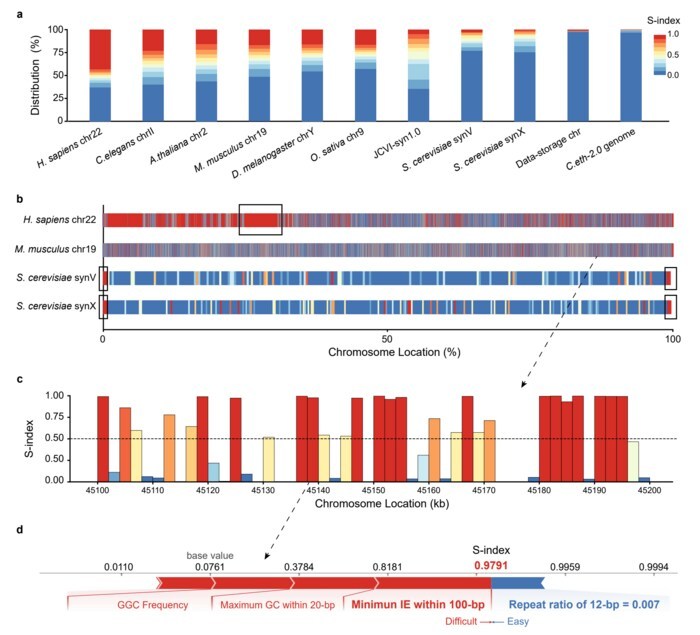
The research team proposed a Synthesis difficulty Index (S-index) based on the SHAP algorithm to evaluate and interpret the synthesis difficulties of chromosomes. The study found that there were significant differences in the synthesis difficulties of different chromosomes, and the S-index could quantitatively explain the causes of synthesis difficulties for some gene fragments (Figure 2), providing a basis for chromosome sequence design and synthesis and improving the efficiency and success rate of designer chromosome synthesis. This achievement provides a practical tool for researchers in chromosome engineering and genome rewriting and is expected to provide more comprehensive guidance and support for chromosome design and synthesis. A, The distribution of DNA sequences with different S-index for the natural and synthetic chromosomes and genomes. The heatmap shows the S-index for the different sequences and the color has the same meaning in B and C. B, The difficulties of synthesizing DNA sequences for the different locations within the chromosomes. The black boxes mark the centromeric satellite of Homo sapiens chromosome 22 and telomeres of synV and synX. c, The S-index for the 45,100-45,200-kb region of M. musculus chr19. D, Force plot for 45,138-45,140 kb sequence of M. musculus chr19. The feature with a positive effect value is highlighted in red, and the feature with a negative effect value is highlighted in blue. Photo credit: Yan Zheng.


Photo by Nate Edwards/BYU Photo. (Photo Illustration)

ChatGPT can't ace accounting exams, but experts think it soon will… What does it mean for teaching?

Tyler O'Neal, Staff Editor ACADEMIA April 20, 2023, 7:00 am

“We’re just seeing the tip of the AI iceberg. What’s coming is going to be exciting or terrifying, depending on your perspective.”

Last month, OpenAI launched its newest AI chatbot product, GPT-4. According to OpenAI, the bot, which uses machine learning to generate natural language text, passed the bar exam with a score in the 90th percentile, passed 13 of 15 AP exams, and got a nearly perfect score on the GRE Verbal test.

Inquiring minds at BYU and 186 other universities wanted to know how OpenAI’s tech would fare on accounting exams. So, they put the original version, ChatGPT, to the test. The researchers say that while it still has work to do in the realm of accounting, it’s a game changer that will change how everyone teaches and learns — for the better.

“When this technology first came out, everyone was worried that students could now use it to cheat,” said lead study author David Wood, a BYU professor of accounting. “But opportunities to cheat have always existed. So for us, we’re trying to focus on what we can do with this technology now that we couldn’t do before to improve the teaching process for faculty and the learning process for students. Testing it out was eye-opening.”

Since its debut in November 2022, ChatGPT has become the fastest-growing technology platform ever, reaching 100 million users in under two months. In response to intense debate about how models like ChatGPT should factor into education, Wood decided to recruit as many professors as possible to see how the AI fared against actual university accounting students.

His co-author recruiting pitch on social media exploded: 327 co-authors from 186 educational institutions in 14 countries participated in the research, contributing 25,181 classroom accounting exam questions. They also recruited undergrad BYU students (including Wood’s daughter, Jessica) to feed another 2,268 textbook test bank questions to ChatGPT. The questions covered accounting information systems (AIS), auditing, financial accounting, managerial accounting, and tax, and varied in difficulty and type (true/false, multiple choice, short answer, etc.).

Although ChatGPT’s performance was impressive, the students performed better. Students scored an overall average of 76.7%, compared to ChatGPT’s score of 47.4%. On 11.3% of questions, ChatGPT scored higher than the student average, doing particularly well on AIS and auditing. But the AI bot did worse on tax, financial, and managerial assessments, possibly because ChatGPT struggled with the mathematical processes required for the latter type.

When it came to question type, ChatGPT did better on true/false questions (68.7% correct) and multiple-choice questions (59.5%), but struggled with short-answer questions (between 28.7% and 39.1%). In general, higher-order questions were harder for ChatGPT to answer. In fact, sometimes ChatGPT would provide authoritative written descriptions for incorrect answers, or answer the same question differently.

“It’s not perfect; you’re not going to be using it for everything,” said Jessica Wood, currently a freshman at BYU. “Trying to learn solely by using ChatGPT is a fool’s errand.”

The researchers also uncovered some other fascinating trends through the study, including:

  • ChatGPT doesn’t always recognize when it is doing math and makes nonsensical errors such as adding two numbers in a subtraction problem or dividing numbers incorrectly.
  • ChatGPT often provides explanations for its answers, even if they are incorrect. Other times, ChatGPT’s descriptions are accurate, but it will then proceed to select the wrong multiple-choice answer.
  • ChatGPT sometimes makes up facts. For example, when providing a reference, it generates a real-looking reference that is completely fabricated. The work and sometimes the authors do not even exist.

That said, authors fully expect GPT-4 to improve exponentially on the accounting questions posed in their study, and the issues mentioned above. What they find most promising is how the chatbot can help improve teaching and learning, including the ability to design and test assignments, or perhaps be used for drafting portions of a project.

“It’s an opportunity to reflect on whether we are teaching value-added information or not,” said study coauthor and fellow BYU accounting professor Melissa Larson. “This is a disruption, and we need to assess where we go from here. Of course, I’m still going to have TAs, but this is going to force us to use them in different ways.”

  1. Spanish researchers demo long-distance quantum teleportation enabled by multiplexed quantum memories
  2. Japanese prof Le proposes a theoretical framework for attaining a higher nonlocal probability

Page 26 of 123

  • 21
  • 22
  • 23
  • 24
  • 25
  • 26
  • 27
  • 28
  • 29
  • 30
POPULAR RIGHT NOW
  • Supercomputers uncover a new class of cosmic explosions hidden in plain sight
    Supercomputers uncover a new class of cosmic explosions hidden in plain sight
  • AI supercharges the hunt for stronger magnets: Iowa State researchers launch a new era of intelligent materials discovery
    AI supercharges the hunt for stronger magnets: Iowa State researchers launch a new era of intelligent materials discovery
  • IBM's Historic stock collapse raises questions for the future of enterprise supercomputing
    IBM's Historic stock collapse raises questions for the future of enterprise supercomputing
  • Could a novel dark matter theory simultaneously resolve multiple cosmic enigmas? Supercomputer simulations provide a compelling, albeit currently unverified, potential solution
    Could a novel dark matter theory simultaneously resolve multiple cosmic enigmas? Supercomputer simulations provide a compelling, albeit currently unverified, potential solution
  • Melting icebergs may be reshaping Earth’s greatest ocean current
    Melting icebergs may be reshaping Earth’s greatest ocean current
  • Supercomputers replace ‘bathtub’ flood maps with physics-based digital twins of Britain’s coastline
    Supercomputers replace ‘bathtub’ flood maps with physics-based digital twins of Britain’s coastline
  • Supercomputers push neural quantum simulation beyond previous limits
    Supercomputers push neural quantum simulation beyond previous limits
  • Intel’s AI supercomputing revival: Q2 financial surge signals new era for CPU-powered HPC infrastructure
    Intel’s AI supercomputing revival: Q2 financial surge signals new era for CPU-powered HPC infrastructure
  • AI infrastructure financing fears shake semiconductor sector
    AI infrastructure financing fears shake semiconductor sector
  • AWS supercomputing investment reaches historic scale as Amazon’s AI strategy powers record financial results
    AWS supercomputing investment reaches historic scale as Amazon’s AI strategy powers record financial results
THIS YEAR'S MOST READ
  • Wall Street wants to trade supercomputing power like oil
    Wall Street wants to trade supercomputing power like oil
  • Cosmic ambition at scale: UK’s supercomputer unlocks a 2.5 petabytes universe
    Cosmic ambition at scale: UK’s supercomputer unlocks a 2.5 petabytes universe
  • Hidden order, revealed at scale: Supercomputing, electron ptychography uncover the inner workings of relaxor ferroelectrics
    Hidden order, revealed at scale: Supercomputing, electron ptychography uncover the inner workings of relaxor ferroelectrics
  • Beamforming the future: BeammWave's 6G push signals the rise of orbital-terrestrial wireless networks
    Joakim Axmon
    Joakim Axmon
  • Intel's Q1 results signal supercomputing surge driving Xeon momentum
    Intel's Q1 results signal supercomputing surge driving Xeon momentum
  • When stars fall apart: Supercomputing reveals the hidden physics of black holes
    When stars fall apart: Supercomputing reveals the hidden physics of black holes
  • Multi-layer simulations reveal the hidden supply chain of solar prominences
    Multi-layer simulations reveal the hidden supply chain of solar prominences
  • Japanese scientists decode dolphin speed with supercomputing: Turbulence, vortices, and the hidden physics of propulsion
    Japanese scientists decode dolphin speed with supercomputing: Turbulence, vortices, and the hidden physics of propulsion
  • Cosmic feedback at scale: Supercomputing reveals how quasars regulate the early Universe
    Cosmic feedback at scale: Supercomputing reveals how quasars regulate the early Universe
  • Modeling life at the microscopic scale: A computational breakthrough in oxygen transport
    Modeling life at the microscopic scale: A computational breakthrough in oxygen transport
MOST READ OF ALL-TIME
  • Largest Computational Biology Simulation Mimics The Ribosome
    Details
    112108
    The amino acid (green) slithers into the chemical reaction center, moving through an evolutionarily ancient corridor of the ribosome (purple). The amino acid is delivered to the reaction core by the transfer RNA molecule (yellow).
    The amino acid (green) slithers into the chemical reaction center, moving through an evolutionarily ancient corridor of the ribosome (purple). The amino acid is delivered to the reaction core by the transfer RNA molecule (yellow).
  • Silicon 'neurons' may add a new dimension to chips
    Details
    80994
    Silicon 'neurons' may add a new dimension to chips
  • Linux Networx Accelerators Expected to Drive up to 4x Price/Performance
    Details
    75538
  • Complex Concepts That Really Add Up
    Details
    73637
    Complex Concepts That Really Add Up
  • Blue Sky Studios Donates Animation SuperComputer to Wesleyan
    Details
    68141
    Each rack holds 52 Angstrom Microsystem-brand “blades,” with a memory footprint of 12 or 24 gigabytes each. (Photos by Olivia Bartlett Drake)
    Each rack holds 52 Angstrom Microsystem-brand “blades,” with a memory footprint of 12 or 24 gigabytes each. (Photos by Olivia Bartlett Drake)
  • Humanities, HPC connect at NERSC
    Details
    57947
  • TeraGrid ’09 'Call for Participation'
    Details
    54952
  • Turbulence responsible for black holes' balancing act
    Details
    52311
  • Cray Wins $52 Million SuperComputer Contract
    Details
    50140
  • SDSC Researchers Accurately Predict Protein Docking
    Details
    46079
  • FRONTPAGE
  • LATEST
  • POPULAR
  • REGISTER
  • SOCIAL
  • VIDEO
  • SUBSCRIPTION
  • RSS
  • GUIDELINES
  • PRIVACY
  • TOS
  • ABOUT
  • +1 (816) 799-4488
  • editorial@supercomputingonline.com
© 2001 - 2026 SuperComputingOnline.com, LLC. All rights reserved. This material may not be published, broadcast, rewritten or redistributed without permission.
Sign In
  • FRONT PAGE
  • LATEST
    • MEDIA KIT
    • MOST READ
    • RSS FEED
    • ACADEMIA
    • AEROSPACE
    • APPLICATIONS
    • ASTRONOMY
    • AUTOMOTIVE
    • BIG DATA
    • BIOLOGY
    • CHEMISTRY
    • CLIENTS
    • CLOUD
    • DEFENSE
    • DEVELOPER TOOLS
    • EARTH SCIENCES
    • ECONOMICS
    • ENGINEERING
    • ENTERTAINMENT
    • HEALTH
    • INDUSTRY
    • INTERCONNECTS
    • GAMING
    • GOVERNMENT
    • MANUFACTURING
    • MIDDLEWARE
    • MOVIES
    • NETWORKS
    • OIL & GAS
    • PHYSICS
    • PROCESSORS
    • RETAIL
    • SCIENCE
    • STORAGE
    • SYSTEMS
    • VISUALIZATION
  • VIDEOS
    • ADD YOUR VIDEOS
    • MANAGE VIDEOS
  • COMMUNITY
    • TRADE SHOWS
    • SOCIAL NETWORK VIDEOS
    • SURVEYS
    • APPLICATIONS BROWSER
    • CONVERSATION INBOX
    • SOCIAL ADVERTISER
    • GROUPS
    • MARKETPLACE LISTINGS
    • PAGES
    • LEADERBOARD
    • POINTS LISTING
      • BADGES
    • PRIVACY CONFIRM REQUEST
    • PRIVACY CREATE REQUEST

Hey there! We noticed you’re using an ad blocker.