SUPERCOMPUTING NEWS SUPERCOMPUTING NEWS
    • MEDIA KIT
    • MOST READ
    • RSS FEED
    • ACADEMIA
    • AEROSPACE
    • APPLICATIONS
    • ASTRONOMY
    • AUTOMOTIVE
    • BIG DATA
    • BIOLOGY
    • CHEMISTRY
    • CLIENTS
    • CLOUD
    • DEFENSE
    • DEVELOPER TOOLS
    • EARTH SCIENCES
    • ECONOMICS
    • ENGINEERING
    • ENTERTAINMENT
    • GAMING
    • GOVERNMENT
    • HEALTH
    • OIL & GAS
    • INDUSTRY
    • INTERCONNECTS
    • MANUFACTURING
    • MIDDLEWARE
    • MOVIES
    • NETWORKS
    • PHYSICS
    • PROCESSORS
    • RETAIL
    • SCIENCE
    • STORAGE
    • SYSTEMS
    • VISUALIZATION
    • AcyMailing subscription form

    • ADD YOUR VIDEOS
    • MANAGE VIDEOS
    • CONVERSATION INBOX
    • SOCIAL ADVERTISER
    • SOCIAL NETWORK VIDEOS
    • SURVEYS
    • GROUPS
    • PAGES
    • MARKETPLACE LISTINGS
    • APPLICATIONS BROWSER
    • PRIVACY CONFIRM REQUEST
    • PRIVACY CREATE REQUEST
    • LEADERBOARD
    • POINTS LISTING
      • BADGES
    • TRADE SHOWS
Sign In
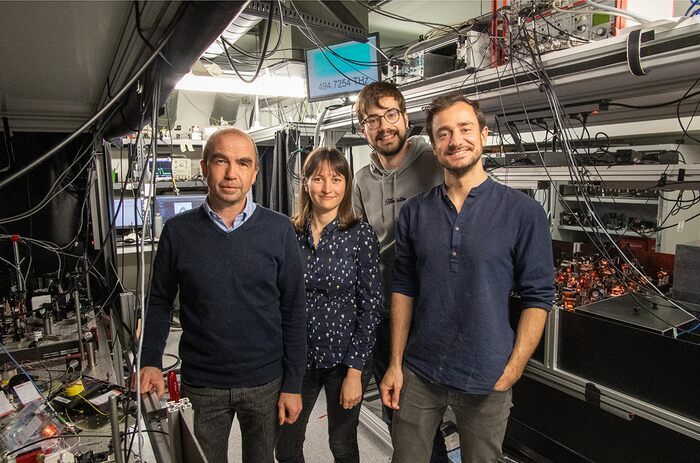
From left to right: researchers Hugues de Riedmatten (group leader), Jelena Rakonjac, Dario Lago and Samuele Grandi in the lab at ICFO. Image credit: ICFO/ D. Lago
Tyler O'Neal, Staff Editor ACADEMIA April 19, 2023, 9:00 am

Spanish researchers demo long-distance quantum teleportation enabled by multiplexed quantum memories

Quantum teleportation is a technique allowing the transfer of quantum information between two distant quantum objects, a sender and a receiver, using a phenomenon called quantum entanglement as a resource. The unique feature of this process is that the actual information is not transferred by sending quantum bits (qubits) through a communication channel connecting the two parties; instead, the information is destroyed at one location and appears at the other one without physically traveling between the two. This surprising property is enabled by quantum entanglement, accompanied by the transmission of classical bits. 

There is a deep interest in quantum teleportation nowadays within the field of quantum communications and quantum networks because it would allow the transfer of quantum bits between network nodes over very long distances, using previously shared entanglement. This would help the integration of quantum technologies into current telecommunication networks and extend the ultra-secure communications enabled by these systems to very long distances. In addition, quantum teleportation permits the transfer of quantum information between different kinds of quantum systems, e.g. between light and matter or between different kinds of quantum nodes.

Quantum teleportation was theoretically proposed in the early 90s and experimental demonstrations were carried out by several groups around the world. While the scientific community has gained extensive experience on how to perform these experiments, there is still an open question on how to teleport information practically, allowing reliable and fast quantum communication over an extended network. It seems clear that such an infrastructure should be compatible with the current telecommunications network. In addition, the protocol of quantum teleportation requires a final operation to be applied on the teleported qubit, conditioned on the result of the teleportation measurement (transmitted by classical bits), to transfer the information faithfully and at a higher rate, a feature called active feed-forward. This means that the receiver requires a device known as a quantum memory that can store the qubit without degrading it until the final operation can be implemented. Finally, this quantum memory should be able to operate in a multiplexed fashion to maximize the speed of teleporting information when the sender and the receiver are far away. To date, no implementation had incorporated these three requirements in the same demonstration.

Located in Castelldefels, Barcelona, Spain, ICFO researchers Dario Lago-Rivera, Jelena V. Rakonjac, and Samuele Grandi, led by ICREA Prof. at ICFO Hugues de Riedmatten have reported achieving long-distance teleportation of quantum information from a photon to a solid-state qubit, a photon stored in a multiplexed quantum memory. The technique involved the use of an active feed-forward scheme, which, together with the multimodality of the memory, has allowed the maximization of the teleportation rate. The proposed architecture was compatible with the telecommunications channels, thus enabling future integration and scalability for long-distance quantum communication.

How to achieve quantum teleportation 

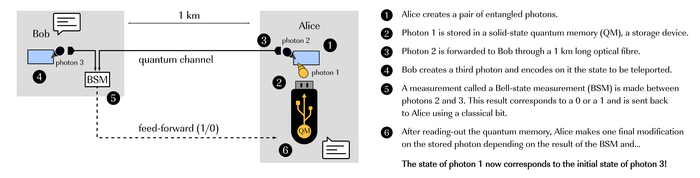
The team built two experimental setups, that in the jargon of the community are usually called Alice and Bob. The two setups were connected by a 1km optical fiber spun up in a spool, to emulate a physical distance between the parties.

Three photons were involved in the experiment. In the first setup, Alice, and the team used a special crystal to create two entangled photons: the first photon at 606 nm, called the signal photon, and the second photon called the idler photon, compatible with the telecommunications infrastructure. Once created, “we kept the first 606 nm photon at Alice and stored it in a multiplexed solid-state quantum memory, holding it in the memory for future processing. At the same time, we took the telecom photon created at Alice and sent it through the 1km of optical fiber to reach the second experimental setup, called Bob,” Dario Lago recalls.

In this second setup, Bob, the scientists had another crystal where they created a third photon, where they had encoded the quantum bit they wanted to teleport. Once the third photon was created, the second photon arrived at Bob from Alice, this is where the core of the teleportation experiment takes place. schematic of the experimental setup of the quantum teleportation platform
Teleporting information over 1km

The second and third photons interfered with each other through what is known as a Bell State measurement (BSM). The effect of this measurement was to mix the state of the second and third photons. Thanks to the fact that the first and second photons were entangled, to begin with, i.e. their joint state were highly correlated, the result of the BSM was that of transferring the information encoded in the third photon to the first one, stored by Alice in the quantum memory, 1 km away. As Dario Lago and Jelena Rakonjac mention, “We are capable of transferring information between two photons that were never in contact before but connected through a third photon that was indeed entangled with the first. The uniqueness of this experiment lies in the fact that we employed a multiplexed quantum memory capable of storing the first photon for long enough such that by the time Alice found out that the interaction had happened, we were still able to process the teleported information as the protocol requires.”

This processing that Dario and Jelena mentioned was the active feed-forward technique mentioned earlier. Depending on the outcome of the BSM, a phase shift was applied to the first photon after storage in the memory. In this way, the same state would always be encoded in the first photon. Without this, half of the teleportation events would have to be discarded. Moreover, the multimodality of the quantum memory allowed them to increase the teleportation rate beyond the limits imposed by the 1 km separation between them without degrading the quality of the teleported qubit. Overall, this resulted in a teleportation rate three times higher than for a single-mode quantum memory, only limited by the speed of the classical hardware.

Scalability and Integration

The experiment carried out by this group in 2021, where they achieved for the first time entanglement of two multimode quantum memories separated by 10 meters and heralded by a photon at the telecommunication wavelength, has been the precursor of this experiment.

As Hugues de Riedmatten emphasizes, “Quantum teleportation will be crucial for enabling high-quality long-distance communication for the future quantum internet. Our goal is to implement quantum teleportation in more and more complex networks, with previously distributed entanglement. The solid-state and multiplexed nature of our quantum nodes as well as their compatibility with the telecom network make them a promising approach to deploying the technology over a long distance in the installed fiber network.”

Further improvements are already being planned. On the one hand, the team is focused on developing and improving the technology to extend the setup to much longer distances while maintaining efficiency and rates. On the other hand, they also aim at studying and using this technique in the transfer of information between different types of quantum nodes, for a future quantum Internet that will be able to distribute and process quantum information between remote parties.
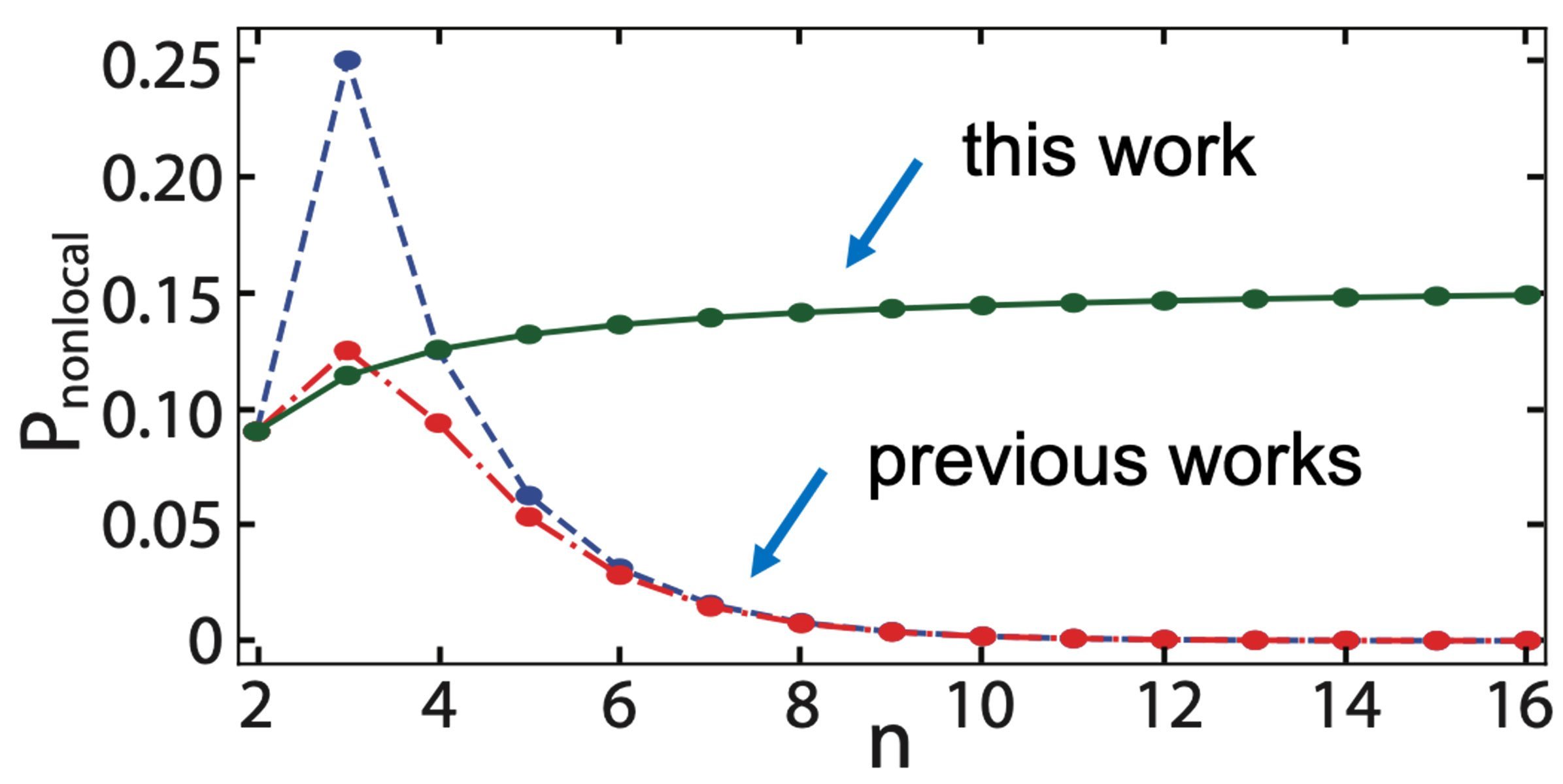
The nonlocal probability increases as the number of particles grows, which differs from previous studies. ©Tohoku University

Japanese prof Le proposes a theoretical framework for attaining a higher nonlocal probability

Tyler O'Neal, Staff Editor ACADEMIA April 19, 2023, 7:03 am

The 2022 Nobel Prize in Physics was awarded to Alain Aspect, John Clauser, and Anton Zeilinger for their works on "quantum nonlocality" in quantum mechanics. Quantum nonlocality is a phenomenon where connected particles can affect each other instantly, regardless of the distance separated. 

Imagine you owned a pair of gloves. These gloves are a pair and therefore correlated in some way, no matter how far apart they are. One day, you place one of the gloves into your backpack and hop on a flight to travel to another country, while the other glove remains at home. According to quantum nonlocality, if you changed the color of the glove you brought with you, the color of the glove back home would instantaneously change too, despite being separated by a large distance.

Nonlocality violates many of the concepts predicted by classical physics, where particles' properties are predetermined and change occurs only through direct physical interaction or fields propagated at a finite speed. Nonlocality has a wide array of implications for understanding the future of reality, quantum mechanics, and the development of quantum technologies. 

There exist several ways to define and interpret nonlocality. For instance, a set of mathematical expressions called the Bell and CHSH inequalities demonstrates nonlocality by violating inequalities. Meanwhile, Lucien Hardy proposed an alternative interpretation of quantum nonlocality in 1992 when he developed the Hardy Paradox.

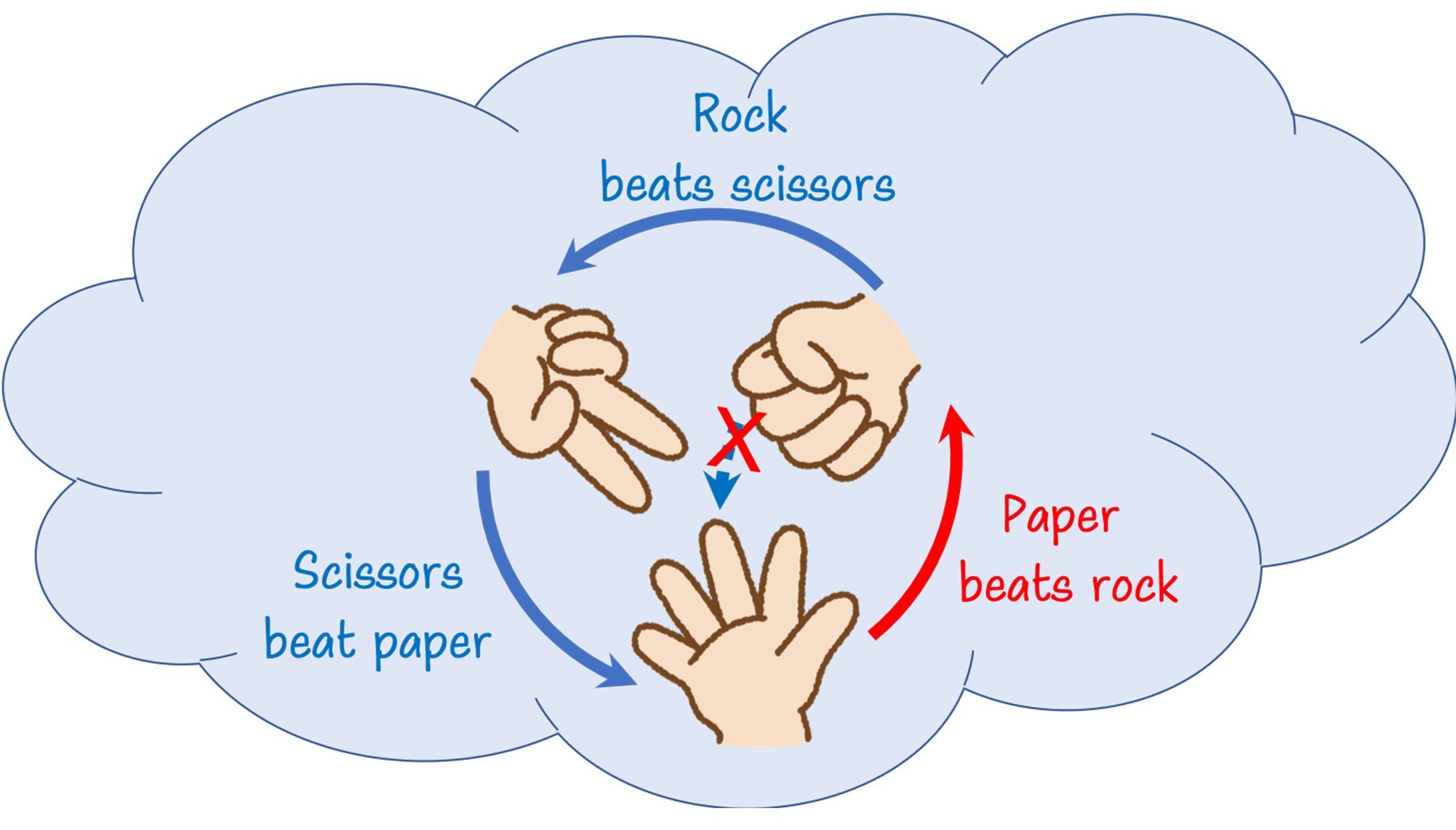
Suppose there are three quantities A, B, and C, where A is greater than B and B is greater than C. Intuitively, and according to a fundamental mathematical property known as the transitive property (or local hidden variable theories in physics), this would render A greater than C.

However, Hardy noted that there is still room for a situation where C is greater than A. This violates the transitive property, and such violations are possible in the quantum world when particles are entangled with each other. In other words, this is nonlocality.

We can use "rock-paper-scissors" to imagine this. While it is evident that rock beats scissors and scissors beat paper, the rock can't beat paper. Paper beating rock does not align with any mathematical reasoning, hence why it is a paradox. The Hardy nonlocality can be interpreted as a rock-paper-scissors game: while rock beats scissors and scissors beat paper, it is impossible for the rock to beat the paper; instead, the paper beats the rock, which causes a paradox, i.e., nonlocality. ©Tohoku University

A recent study, published in the journal American Physical Review A, has made interesting revelations about the Hardy nonlocality. The study was co-authored by Dr. Le Bin Ho from Tohoku University's Frontier Research Institute for Interdisciplinary Sciences (FRIS) in Japan.

"The Hardy nonlocality has significant implications for understanding fundamental quantum mechanics, and it is vital for strengthening the probability of nonlocal," said Le. "We used quantum computers and methods to investigate the measurement of Hardy nonlocality to improve its probability."

Le and his colleagues did this by proposing a theoretical framework for attaining a higher nonlocal probability. They verified this by using a theoretical model and a quantum simulation.

Despite previous studies showing the opposite, they discovered that nonlocal probability increases as the number of particles grows. This suggests that quantum effects persist even at larger scales, further challenging classical theories of physics.

Le says these findings have important ramifications for understanding quantum mechanics and its potential applications in communications. "Understanding quantum nonlocality can lead to groundbreaking technological advancements, such as the secure transmission of information through quantum communication via nonlocality resources."

ESA's trailblazing Aeolus preps for end-of-life activities

ESA's trailblazing Aeolus preps for end-of-life activities

Tyler O'Neal, Staff Editor ACADEMIA April 18, 2023, 7:00 am

On 30 April 2023, all nominal operations of Aeolus, the first mission to observe Earth’s wind profiles on a global scale, will conclude in preparation for a series of end-of-life activities. 

Although a recent upgrade to Aeolus’ original laser meant that in its last months it has been performing as well as ever, diminishing fuel combined with increasing solar activity means the mission must come to an end.

That ESA’s wind mission has made it this far is a great achievement, having outlived its predicted lifetime of three years by over 18 months. 

But it’s not over just yet.

Over the past year, scientists and industry specialists have been designing a thorough roadmap to bring the Aeolus mission to a close. After much consideration and careful planning, it was decided that the best course of action is to carefully re-enter the satellite back to Earth. 

The finishing touches to the end-of-life schedule will be made over the coming weeks and a timeline will be announced in due course. 

Aeolus improves wind measurements

In the meantime, Aeolus will provide data as usual up to the end of operations on 30 April 2023. While no new operational data will be gathered after 30 April, the mission's existing data will still be available to users.  

"My gratitude goes to all our ESA and industry colleagues who have developed and operated this unique mission,” said Aeolus Mission Manager, Tommaso Parrinello. 

“A special thanks goes to the scientific community, whose support has been outstanding and has contributed to one of the most successful missions ever flown by ESA.”

A trailblazing wind mission

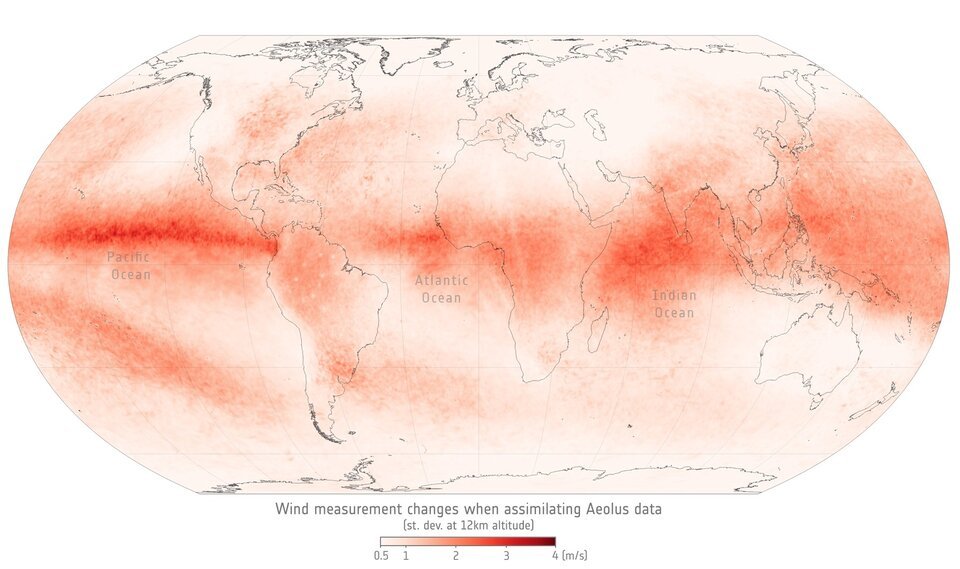
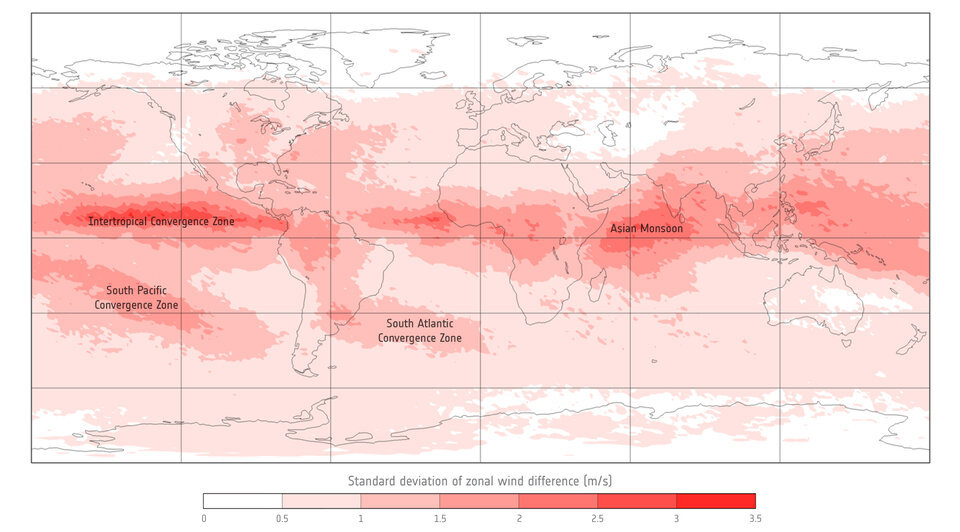
Aeolus tightens up wind models

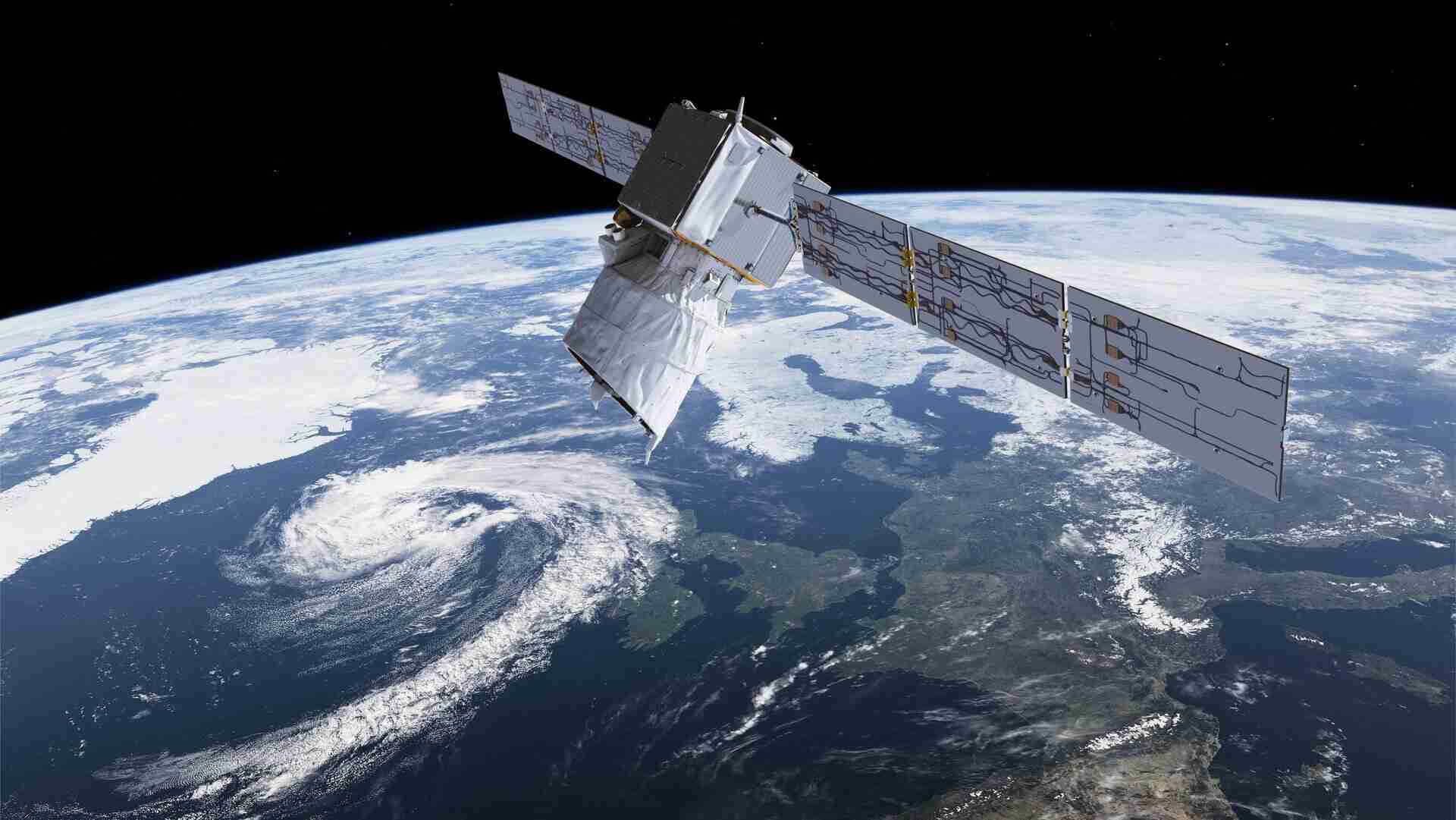
Aeolus, ESA’s fifth Earth Explorer, was tasked with an extraordinarily challenging and pioneering feat: to measure global winds from space using a laser.

Its launch in 2018 was an achievement some thought might not be possible, especially after many years of grit and determination to make its experimental technology work. Plenty of headscratchers and setbacks were encountered along the way. 

Once in orbit, Aeolus met further trials, being forced into switching to its backup laser less than a year after launch.

The struggles were worth it, as Europe’s wind mission triumphed.

Aeolus data are now used by major weather forecasting services worldwide, including the European Centre for Medium-Range Weather Forecasts (ECMWF), Météo-France, the UK Met Office, Germany’s Deutscher Wetterdienst (DWD), and India’s National Centre for Medium-Range Weather Forecasting (NCMRWF).

Its many successes, including economic benefits valued at over €3.5 billion, meaning that an operational follow-on mission called Aeolus-2 will be launched within a decade.

Remarkable improvements in weather forecasts

Aeolus carries an instrument known as ALADIN, which is Europe’s most sophisticated Doppler wind lidar flown in space. A laser fires pulses of ultraviolet light toward Earth’s atmosphere, and a receiver detects the light that is scattered back from air molecules, water molecules, and aerosols such as dust. 

Thanks to subtle changes in the properties of the light that is received, we can measure how quickly these particles travel away from Aeolus - the speed of the wind.

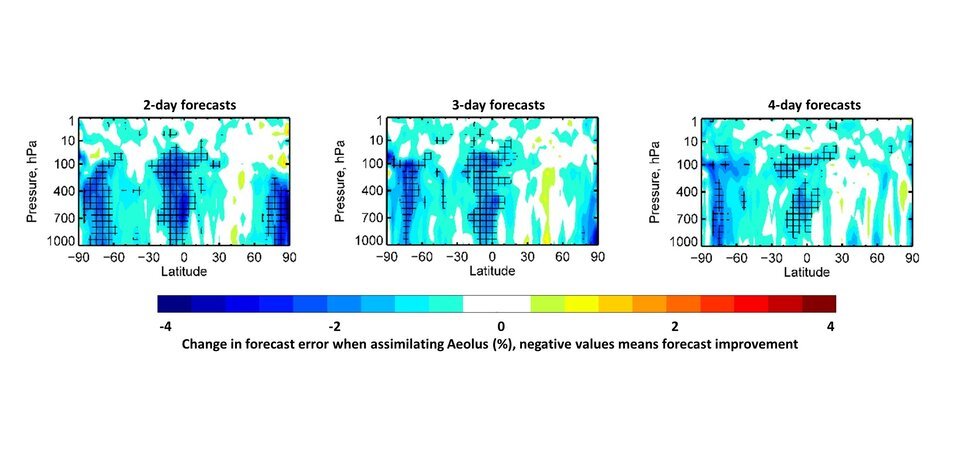
Aeolus improves weather forecasts

Over its four-and-a-half-year lifetime, orbiting Earth 16 times a day and covering the entire globe once a week, ALADIN has beamed down over seven billion laser pulses.

Supported by the ground segment team, well over 99.5% of the data collected reached users such as weather forecasters within three hours.

The impacts have been remarkable.

Since ECMWF started assimilating Aeolus data in 2020 the satellite has become one of the highest impact-per-observation instruments in existence.

A lot is down to Aeolus’ capacity to measure winds where data are scarce. When planes were grounded during the lockdowns imposed due to the COVID pandemic, Aeolus was able to contribute missing data to plug the gap in weather forecasts.

Researchers recently concluded that Aeolus data could also help to improve forecasting of hurricanes in regions of the planet where reconnaissance flights are sparse, particularly over the tropics.

A universal collaboration

The Aeolus mission has been underpinned by a tightly-knit, Europe-wide collaboration of over forty experts that make up the Aeolus Data, Innovation, and Science Cluster (DISC).

Years of calibration and validation activities by the DISC, including tens of thousands of kilometers flown in field campaigns from Greenland to Cape Verde, have honed and improved the instrument and the quality of its data.

In recent years, an international collaboration known as the Joint Aeolus Tropical Airborne Campaign (JATAC) has expanded the remit of Aeolus, honing in on the use of Aeolus data to measure the role of aerosols in tropical weather systems.

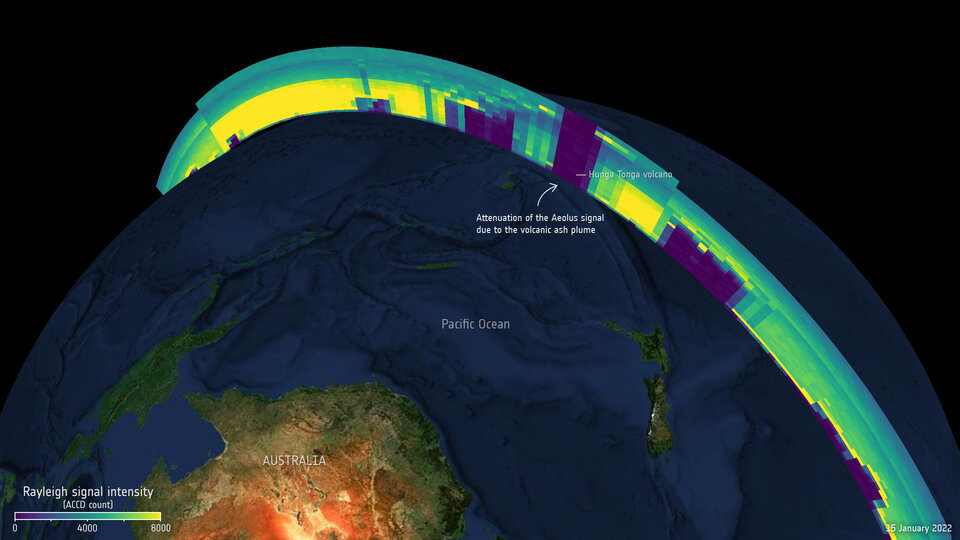
Tonga volcanic ash plume leaves its mark in Aeolus data

Where aerosols are concerned, Aeolus has managed to provide unique insight into volcanic plumes. The satellite was able to track the huge Hunga Tonga eruption of January 2022 and observed a completely new atmospheric phenomenon following the eruption of Raikoke in 2019.

Aeolus wind data also improve supercomputer modeling of plumes as they spread through Earth’s atmosphere, which benefits air traffic safety.

Other innovative projects have used Aeolus data to understand a range of phenomena from Saharan dust to ocean biochemistry and sea surface winds.

The results will inform future Earth Explorer missions such as EarthCARE, a collaborative mission between ESA and JAXA that will carry a similar lidar instrument to measure atmospheric aerosols and clouds.

"The Aeolus mission has been a triumph of European innovation, collaboration, and technical excellence," says ESA’s Director of Earth Observation Programmes, Simonetta Cheli.

"Aeolus is another example of how ESA’s Earth Explorers perform beyond expectations, and a shining light for our Future EO program. Its impacts will live long beyond its lifetime in space, paving the way for future operational missions such as Aeolus-2."

  1. German-engineered photonic turnkey quantum source for entangled qubit state generation goes fully on-chip
  2. Medeiros reconstructs the iconic image of the fuzzy, orange donut of M87 with the help of PRIMO

Page 27 of 123

  • 22
  • 23
  • 24
  • 25
  • 26
  • 27
  • 28
  • 29
  • 30
  • 31
POPULAR RIGHT NOW
  • Supercomputers uncover a new class of cosmic explosions hidden in plain sight
    Supercomputers uncover a new class of cosmic explosions hidden in plain sight
  • AI supercharges the hunt for stronger magnets: Iowa State researchers launch a new era of intelligent materials discovery
    AI supercharges the hunt for stronger magnets: Iowa State researchers launch a new era of intelligent materials discovery
  • IBM's Historic stock collapse raises questions for the future of enterprise supercomputing
    IBM's Historic stock collapse raises questions for the future of enterprise supercomputing
  • Could a novel dark matter theory simultaneously resolve multiple cosmic enigmas? Supercomputer simulations provide a compelling, albeit currently unverified, potential solution
    Could a novel dark matter theory simultaneously resolve multiple cosmic enigmas? Supercomputer simulations provide a compelling, albeit currently unverified, potential solution
  • Melting icebergs may be reshaping Earth’s greatest ocean current
    Melting icebergs may be reshaping Earth’s greatest ocean current
  • Supercomputers replace ‘bathtub’ flood maps with physics-based digital twins of Britain’s coastline
    Supercomputers replace ‘bathtub’ flood maps with physics-based digital twins of Britain’s coastline
  • Supercomputers push neural quantum simulation beyond previous limits
    Supercomputers push neural quantum simulation beyond previous limits
  • Intel’s AI supercomputing revival: Q2 financial surge signals new era for CPU-powered HPC infrastructure
    Intel’s AI supercomputing revival: Q2 financial surge signals new era for CPU-powered HPC infrastructure
  • AI infrastructure financing fears shake semiconductor sector
    AI infrastructure financing fears shake semiconductor sector
  • AWS supercomputing investment reaches historic scale as Amazon’s AI strategy powers record financial results
    AWS supercomputing investment reaches historic scale as Amazon’s AI strategy powers record financial results
THIS YEAR'S MOST READ
  • Wall Street wants to trade supercomputing power like oil
    Wall Street wants to trade supercomputing power like oil
  • Cosmic ambition at scale: UK’s supercomputer unlocks a 2.5 petabytes universe
    Cosmic ambition at scale: UK’s supercomputer unlocks a 2.5 petabytes universe
  • Hidden order, revealed at scale: Supercomputing, electron ptychography uncover the inner workings of relaxor ferroelectrics
    Hidden order, revealed at scale: Supercomputing, electron ptychography uncover the inner workings of relaxor ferroelectrics
  • Beamforming the future: BeammWave's 6G push signals the rise of orbital-terrestrial wireless networks
    Joakim Axmon
    Joakim Axmon
  • Intel's Q1 results signal supercomputing surge driving Xeon momentum
    Intel's Q1 results signal supercomputing surge driving Xeon momentum
  • When stars fall apart: Supercomputing reveals the hidden physics of black holes
    When stars fall apart: Supercomputing reveals the hidden physics of black holes
  • Multi-layer simulations reveal the hidden supply chain of solar prominences
    Multi-layer simulations reveal the hidden supply chain of solar prominences
  • Japanese scientists decode dolphin speed with supercomputing: Turbulence, vortices, and the hidden physics of propulsion
    Japanese scientists decode dolphin speed with supercomputing: Turbulence, vortices, and the hidden physics of propulsion
  • Cosmic feedback at scale: Supercomputing reveals how quasars regulate the early Universe
    Cosmic feedback at scale: Supercomputing reveals how quasars regulate the early Universe
  • Modeling life at the microscopic scale: A computational breakthrough in oxygen transport
    Modeling life at the microscopic scale: A computational breakthrough in oxygen transport
MOST READ OF ALL-TIME
  • Largest Computational Biology Simulation Mimics The Ribosome
    Details
    112108
    The amino acid (green) slithers into the chemical reaction center, moving through an evolutionarily ancient corridor of the ribosome (purple). The amino acid is delivered to the reaction core by the transfer RNA molecule (yellow).
    The amino acid (green) slithers into the chemical reaction center, moving through an evolutionarily ancient corridor of the ribosome (purple). The amino acid is delivered to the reaction core by the transfer RNA molecule (yellow).
  • Silicon 'neurons' may add a new dimension to chips
    Details
    80994
    Silicon 'neurons' may add a new dimension to chips
  • Linux Networx Accelerators Expected to Drive up to 4x Price/Performance
    Details
    75538
  • Complex Concepts That Really Add Up
    Details
    73637
    Complex Concepts That Really Add Up
  • Blue Sky Studios Donates Animation SuperComputer to Wesleyan
    Details
    68141
    Each rack holds 52 Angstrom Microsystem-brand “blades,” with a memory footprint of 12 or 24 gigabytes each. (Photos by Olivia Bartlett Drake)
    Each rack holds 52 Angstrom Microsystem-brand “blades,” with a memory footprint of 12 or 24 gigabytes each. (Photos by Olivia Bartlett Drake)
  • Humanities, HPC connect at NERSC
    Details
    57947
  • TeraGrid ’09 'Call for Participation'
    Details
    54952
  • Turbulence responsible for black holes' balancing act
    Details
    52312
  • Cray Wins $52 Million SuperComputer Contract
    Details
    50140
  • SDSC Researchers Accurately Predict Protein Docking
    Details
    46080
  • FRONTPAGE
  • LATEST
  • POPULAR
  • REGISTER
  • SOCIAL
  • VIDEO
  • SUBSCRIPTION
  • RSS
  • GUIDELINES
  • PRIVACY
  • TOS
  • ABOUT
  • +1 (816) 799-4488
  • editorial@supercomputingonline.com
© 2001 - 2026 SuperComputingOnline.com, LLC. All rights reserved. This material may not be published, broadcast, rewritten or redistributed without permission.
Sign In
  • FRONT PAGE
  • LATEST
    • MEDIA KIT
    • MOST READ
    • RSS FEED
    • ACADEMIA
    • AEROSPACE
    • APPLICATIONS
    • ASTRONOMY
    • AUTOMOTIVE
    • BIG DATA
    • BIOLOGY
    • CHEMISTRY
    • CLIENTS
    • CLOUD
    • DEFENSE
    • DEVELOPER TOOLS
    • EARTH SCIENCES
    • ECONOMICS
    • ENGINEERING
    • ENTERTAINMENT
    • HEALTH
    • INDUSTRY
    • INTERCONNECTS
    • GAMING
    • GOVERNMENT
    • MANUFACTURING
    • MIDDLEWARE
    • MOVIES
    • NETWORKS
    • OIL & GAS
    • PHYSICS
    • PROCESSORS
    • RETAIL
    • SCIENCE
    • STORAGE
    • SYSTEMS
    • VISUALIZATION
  • VIDEOS
    • ADD YOUR VIDEOS
    • MANAGE VIDEOS
  • COMMUNITY
    • TRADE SHOWS
    • SOCIAL NETWORK VIDEOS
    • SURVEYS
    • APPLICATIONS BROWSER
    • CONVERSATION INBOX
    • SOCIAL ADVERTISER
    • GROUPS
    • MARKETPLACE LISTINGS
    • PAGES
    • LEADERBOARD
    • POINTS LISTING
      • BADGES
    • PRIVACY CONFIRM REQUEST
    • PRIVACY CREATE REQUEST

Hey there! We noticed you’re using an ad blocker.