UC Riverside astronomers find large-scale winds associated with active black holes in small galaxies suppress star formation

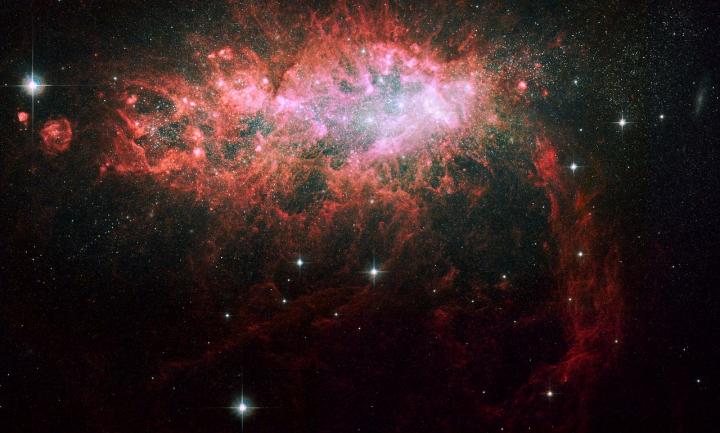
NGC1569 is a star-forming galaxy.

Astronomers at the University of California, Riverside, have discovered that powerful winds driven by supermassive black holes in the centers of dwarf galaxies have a significant impact on the evolution of these galaxies by suppressing star formation. {module In-article}

Dwarf galaxies are small galaxies that contain between 100 million to a few billion stars. In contrast, the Milky Way has 200-400 billion stars. Dwarf galaxies are the most abundant galaxy type in the universe and often orbit larger galaxies.

The team of three astronomers was surprised by the strength of the detected winds. 

"We expected we would need observations with much higher resolution and sensitivity, and we had planned on obtaining these as a follow-up to our initial observations," said Gabriela Canalizo, a professor of physics and astronomy at UC Riverside, who led the research team. "But we could see the signs strongly and clearly in the initial observations. The winds were stronger than we had anticipated."

Canalizo explained that astronomers have suspected for the past couple of decades that supermassive black holes at the centers of large galaxies can have a profound influence on the way large galaxies grow and age.

"Our findings now indicate that their effect can be just as dramatic, if not more dramatic, in dwarf galaxies in the universe," she said.

Study results appear in The Astrophysical Journal.

The researchers, who also include Laura V. Sales, an assistant professor of physics and astronomy; and Christina M. Manzano-King, a doctoral student in Canalizo's lab, used a portion of the data from the Sloan Digital Sky Survey, which maps more than 35% of the sky, to identify 50 dwarf galaxies, 29 of which showed signs of being associated with black holes in their centers. Six of these 29 galaxies showed evidence of winds -- specifically, high-velocity ionized gas outflows -- emanating from their active black holes.

"Using the Keck telescopes in Hawaii, we were able to not only detect, but also measure specific properties of these winds, such as their kinematics, distribution, and power source -- the first time this has been done," Canalizo said. "We found some evidence that these winds may be changing the rate at which the galaxies are able to form stars."

Manzano-King, the first author of the research paper, explained that many unanswered questions about galaxy evolution can be understood by studying dwarf galaxies.

"Larger galaxies often form when dwarf galaxies merge together," she said. "Dwarf galaxies are, therefore, useful in understanding how galaxies evolve. Dwarf galaxies are small because after they formed, they somehow avoided merging with other galaxies. Thus, they serve as fossils by revealing what the environment of the early universe was like. Dwarf galaxies are the smallest galaxies in which we are directly seeing winds -- gas flows up to 1,000 kilometers per second -- for the first time."

Manzano-King explained that as material falls into a black hole, it heats up due to friction and strong gravitational fields and releases radiative energy. This energy pushes ambient gas outward from the center of the galaxy into intergalactic space.

"What's interesting is that these winds are being pushed out by active black holes in the six dwarf galaxies rather than by stellar processes such as supernovae," she said. "Typically, winds driven by stellar processes are common in dwarf galaxies and constitute the dominant process for regulating the amount of gas available in dwarf galaxies for forming stars."

Astronomers suspect that when wind emanating from a black hole is pushed out, it compresses the gas ahead of the wind, which can increase star formation. But if all the wind gets expelled from the galaxy's center, gas becomes unavailable and star formation could decrease. The latter appears to be what is occurring in the six dwarf galaxies the researchers identified.

"In these six cases, the wind has a negative impact on star formation," Sales said. "Theoretical models for the formation and evolution of galaxies have not included the impact of black holes in dwarf galaxies. We are seeing evidence, however, of a suppression of star formation in these galaxies. Our findings show that galaxy formation models must include black holes as important, if not dominant, regulators of star formation in dwarf galaxies."

Next, the researchers plan to study the mass and momentum of gas outflows in dwarf galaxies.

"This would better inform theorists who rely on such data to build models," Manzano-King said. "These models, in turn, teach observational astronomers just how the winds affect dwarf galaxies. We also plan to do a systematic search in a larger sample of the Sloan Digital Sky Survey to identify dwarf galaxies with outflows originating in active black holes."
Johns Hopkins physicist discovers material that could be a game-changer for supercomputing

Quantum supercomputers with the ability to perform complex calculations, encrypt data more securely and more quickly predict the spread of viruses, maybe within closer reach thanks to a discovery by Johns Hopkins researchers.

"We've found that a certain superconducting material contains special properties that could be the building blocks for the technology of the future," says Yufan Li, a postdoctoral fellow in the Department of Physics & Astronomy at The Johns Hopkins University and the paper's first author.

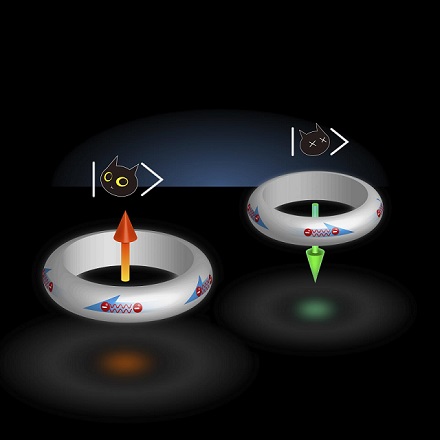
The findings will be published on October 11 in ScienceCAPTION A visual representation of a qubit, which can exist simultaneously between two states. A famous example of a qubit is Schrodinger's cat, a hypothetical cat that can be both dead and alive. Similarly, a flux qubit, or a ring made of a superconducting material, can have electric current flowing both clockwise and counterclockwise at the same time.  CREDIT Yufan Li{module In-article}

Today's supercomputers use bits, represented by an electrical voltage or current pulse, to store information. Bits exist in two states, either "0" or "1." Quantum supercomputers, based on the laws of quantum mechanics, use quantum bits, or qubits, which do not only use two states but a superposition of two states.

This ability to use such qubits makes quantum supercomputers much more powerful than existing supercomputers when solving certain types of problems, such as those relating to artificial intelligence, drug development, cryptography, financial modeling, and weather forecasting.

A famous example of a qubit is Schrodinger's cat, a hypothetical cat that may be simultaneously dead and alive.

"A more realistic, tangible implementation of the qubit can be a ring made of superconducting material, known as flux qubit, where two states with clockwise- and counterclockwise-flowing electric currents may exist simultaneously," says Chia-Ling Chien, Professor of Physics at The Johns Hopkins University and another author on the paper. To exist between two states, qubits using traditional superconductors require a very precise external magnetic field to be applied to each qubit, thus making it difficult to operate practically.

In the new study, Li and colleagues found that a ring of β-Bi2Pd already naturally exists between two states in the absence of an external magnetic field. Current can inherently circulate both clockwise and counterclockwise, simultaneously, through a ring of β-Bi2Pd.

Adds Li: "A ring of β-Bi2Pd already exists in the ideal state and doesn't require any additional modifications to work. This could be a game-changer."

The next step, says Li, is to look for Majorana fermions within β-Bi2Pd; Majorana fermions are particles that are also anti-particles of themselves and are needed for the next level of disruption-resistant quantum supercomputers: topological quantum supercomputers.

Majorana fermions depend on a special type of superconducting material--a so-called spin-triplet superconductor with two electrons in each pair aligning their spins in a parallel fashion--that has thus far been elusive to scientists. Now, through a series of experiments, Li and colleagues found that thin films of β-Bi2Pd have the special properties necessary for the future of quantum computing.

Scientists have yet to discover the intrinsic spin-triplet superconductor needed to advance quantum supercomputing forward, but Li is hopeful that the discovery of β-Bi2Pd's special properties, will lead to finding Majorana fermions in the material next.

"Ultimately, the goal is to find and then manipulate Majorana fermions, which is key to achieving fault-tolerant quantum computing for truly unleashing the power of quantum mechanics," says Li.

Iowa State engineers solve 50-year-old puzzle in signal processing

Something called the fast Fourier transform is running on your cell phone right now. The FFT, as it is known, is a signal-processing algorithm that you use more than you realize. It is, according to the title of one research paper, "An algorithm the whole family can use."

Alexander Stoytchev - an associate professor of electrical and computer engineering at Iowa State University who's also affiliated with the university's Virtual Reality Applications Center, its Human-Computer Interaction graduate program and the department of computer science - says the FFT algorithm and its inverse (known as the IFFT) are at the heart of signal processing.

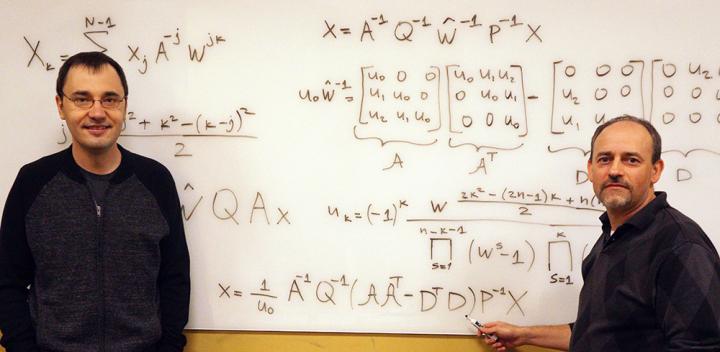
And, as such, "These are algorithms that made the digital revolution possible," he said. CAPTION Vladimir Sukhoy and Alexander Stoytchev, left to right, with the derivation for the ICZT algorithm in structured matrix notation -- the answer to a 50-year-old puzzle in signal processing.  CREDIT Photo by Paul Easker{module In-article}

They're a part of streaming music, making a cell phone call, browsing the internet or taking a selfie.

The FFT algorithm was published in 1965. Four years later, researchers developed a more versatile, generalized version called the chirp z-transform (CZT). But a similar generalization of the inverse FFT algorithm has gone unsolved for 50 years.

Until that is, Stoytchev and Vladimir Sukhoy - an Iowa State doctoral student co-majoring in electrical and computer engineering, and human-computer interaction - worked together to come up with the long-sought algorithm, called the inverse chirp z-transform (ICZT).

Like all algorithms, it's a step-by-step process that solves a problem. In this case, it maps the output of the CZT algorithm back to its input. The two algorithms are a little like a series of two prisms - the first separates the wavelengths of white light into a spectrum of colors and the second reverses the process by combining the spectrum back into white light, Stoytchev explained.

Stoytchev and Sukhoy describe their new algorithm in a paper recently published online by Scientific Reports. Their paper shows that the algorithm matches the computational complexity or speed of its counterpart, that it can be used with exponentially decaying or growing frequency components (unlike the IFFT) and that it has been tested for numerical accuracy.

Stoytchev said he stumbled on the idea to attempt to formulate the missing algorithm while looking for analogies to help the graduate students in his "Computational Perception" course understand the fast Fourier transform. He read a lot of the signal-processing literature and couldn't find anything about the inverse to the related chirp z-transform.

"I got curious," he said. "Is that because they couldn't explain it, or is it because it doesn't exist? It turned out it didn't exist."

And so he decided to try to find a fast inverse algorithm.

Sukhoy said the inverse algorithm is a harder problem than the original, forward algorithm and so "we needed better precision and more powerful computers to attack it." He also said a key was seeing the algorithm within the mathematical framework of structured matrices.

Even then, there were lots of computer test runs "to show everything was working - we had to convince ourselves that this could be done."

It took courage to keep attacking the problem, said James Oliver, director of Iowa State's Student Innovation Center and former director of the university's Virtual Reality Applications Center. Stoytchev and Sukhoy acknowledge Oliver in their paper "for creating the research environment in which we could pursue this work over the past three years."

Oliver said Stoytchev earned his support for a mathematical and computational challenge that hadn't been solved for 50 years: "Alex has always impressed me with his passion and commitment to take on big research challenges. There is always a risk in research and it takes courage to devote years of hard work to a fundamental problem. Alex is a gifted and fearless researcher."