UCLA astronomer gets best look at first comet from outside our solar system

In separate observation, David Jewitt describes 20 previously unidentified moons around Saturn

David Jewitt, a UCLA professor of planetary science and astronomy, has captured the best and sharpest look at a comet from outside of our solar system that recently barged into our own. It is the first interstellar comet astronomers have observed.

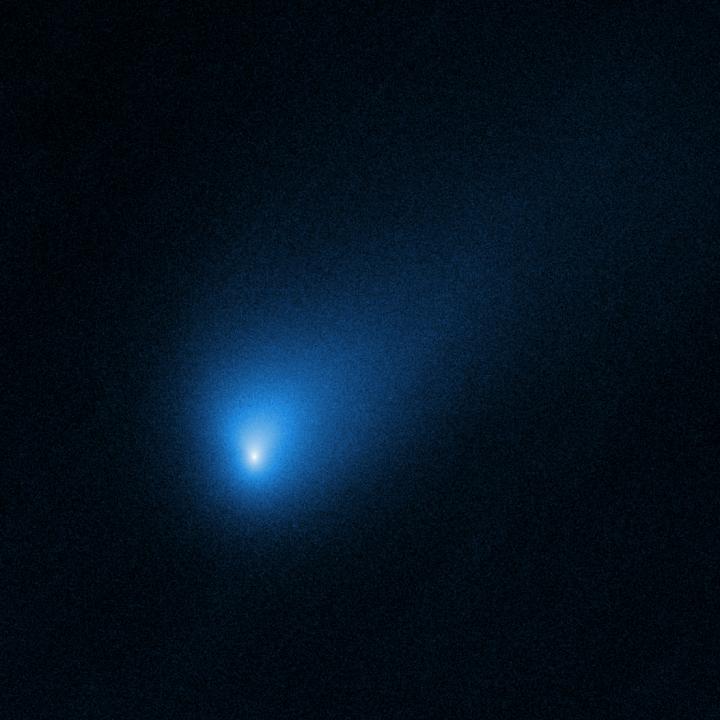
Comet 2I/Borisov (the "I" stands for interstellar) is following a path around the sun at a blazing speed of approximately 110,000 miles per hour, or about as fast as Earth travels around the sun. Jewitt studied it on Oct. 12 using NASA's Hubble Space Telescope, which captured images of the object when it was about 260 million miles away. He observed a central concentration of dust around the comet's solid icy nucleus -- the nucleus itself is too small to be seen by Hubble -- with a 100,000-mile-long dust tail streaming behind. CAPTION The interstellar comet 2I/Borisov, as seen on Oct. 12 with NASA's Hubble Space Telescope.  CREDIT NASA, ESA and David Jewitt/UCLA{module In-article}
Jewitt said it's very different from another interstellar object, dubbed 'Oumuamua, that a University of Hawaii astronomer observed in 2017 before it raced out of our solar system.

"'Oumuamua looked like bare rock, but Borisov is really active -- more like a normal comet," said Jewitt, who leads the Hubble team. "It's a puzzle why these two are so different. There is so much dust on this thing we'll have to work hard to dig out the nucleus."

That work will involve sophisticated image processing to separate the light scattered from the nucleus from light scattered by dust.

2I/Borisov and 'Oumuamua are the first two objects that have traveled from outside of our solar system into ours that astronomers have observed, but that's because scientists' knowledge and equipment are much better now than they ever have been and because they know how to find them. One study indicates there are thousands of such comets in our solar system at any given time, although most are too faint to be detected with current telescopes.

Until 2I/Borisov, every comet that astronomers have observed originated from one of two places. One is the Kuiper belt, a region at the periphery of our solar system, beyond Neptune, that Jewitt co-discovered in 1992. The other is the Oort Cloud, a very large spherical region approximately a light-year from the sun, which astronomers think contains hundreds of billions of comets.

2I/Borisov was initially detected on Aug. 30 by Gennady Borisov at the Crimean Astrophysical Observatory, when it was 300 million miles from the sun. Jewitt said its unusually fast speed -- too fast for the sun's gravity to keep it bound in an orbit -- indicates that it came from another solar system and that it is on a long path en route back to its home solar system.

Because the comet was presumably forged in a distant solar system, the comet provides valuable clues about the chemical composition and structure of the system where it originated.

2I/Borisov will be visible in the southern sky for several months. It will make its closest approach to the sun on Dec. 7, when it will be twice as far from the sun as Earth is. By the middle of 2020, it will pass Jupiter on its way back into interstellar space, where it will drift for billions of years, Jewitt said.

Comets are icy bodies thought to be fragments left behind when planets form in the outer parts of planetary systems.

20 new moons for Saturn

In separate research that has not yet been published, Jewitt is part of a team that has identified 20 previously undiscovered moons of Saturn, for a new total of 82 moons. The revised figure gives Saturn more moons than Jupiter, which has 79.

The new objects are all small, typically a few miles in diameter, and were discovered using the Subaru telescope on Maunakea in Hawaii. They can be seen only using the world's largest telescopes, Jewitt said.

The moons might have formed in the Kuiper belt, said Jewitt, a member of the National Academy of Sciences and a fellow of the American Association for the Advancement of Science and of the American Academy of Arts and Sciences.
Information theory as a forensics tool for investigating climate mysteries

During Earth's last glacial period, temperatures on the planet periodically spiked dramatically and rapidly. Data in layers of ice of Greenland and Antarctica show that these warming events - called Dansgaard-Oeschger and Antarctic Isotope Maximum events -- occurred at least 25 times. Each time, in a matter of decades, temperatures climbed 5-10 degrees Celsius, then cooled again, gradually. While there remain several competing theories for the still-unexplained mechanisms behind these spikes, a new paper in the journal Chaos suggests that mathematics from information theory could offer a powerful tool for analyzing and understanding them.

"In many systems, before an extreme event, information dynamics become disordered," says Joshua Garland, a postdoctoral fellow at the Santa Fe Institute and lead author on the new paper. For instance, information-theoretic tools have been used to anticipate seizure events from disturbances in EEG readings.

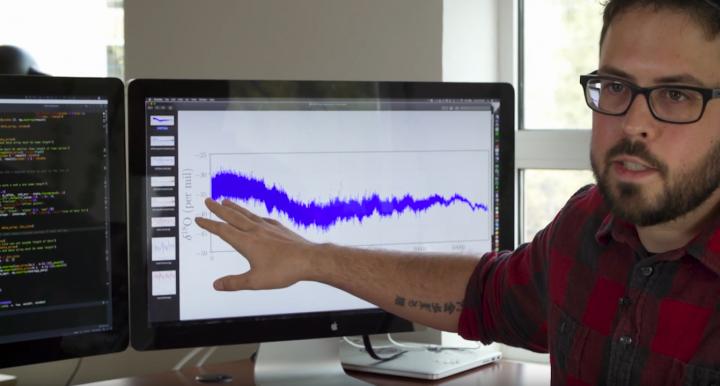
Initially, the authors anticipated they would see a signal - a destabilization in the climate record similar to those seen in pre-seizure EEGs - just before the warming events. But those signals never appeared. "Around these events, you have the same amount of information production," says Garland. And this, suggest the authors, indicates that Dansgaard-Oeschger and Antarctic Isotope Maximum events were most likely regular and predictable patterns of the climate of the last glacial period rather than the results of unexpected events. CAPTION Joshua Garland examines isotopic data from the West Antarctic Ice Sheet.  CREDIT Bryan Rogala/Mountain Standard Creative for the Santa Fe Institute{module In-article}

Also, information theory could improve how scientists calculate accumulation - how much snow fell in any given year. "It's very challenging. Many people are working on this, and they are using sophisticated math, combined with expert knowledge and known features, to figure out the accumulation," says Garland. Currently, fine pollen signatures are some of the best differentiators between years in ice that is tens of thousands of years old, compressed under the weight of each subsequent snowfall. Information theory, and specifically a statistical approach called permutation entropy, offers a different approach. "This could be a fast and efficient tool for the experts to corroborate their work," says Garland.

"When you're dealing with a time-series, you want to know what meaningful information is present. You want to extract it and use it, and to not use information that isn't useful," says Garland. "We hope this tool can help scientists do this with ancient climate records."

Information theory is already being used to identify anomalies in the climate record - particularly, to flag anomalies introduced during the collection and observation of the ice cores.

This paper follows on the heels of two related studies published in Entropy and Advances in Intelligent Data Analysis XV.

"These information-theoretic calculations are not only useful for revealing hidden problems with the data, but also potentially powerful in suggesting new and sometimes surprising geoscience," write the authors in the new paper.

Supercomputer models show clear advantages in new types of wind turbines

Researchers have modeled the fluid dynamics of multi-rotor wind turbines, and how they interact in wind farms; the research demonstrates a clear advantage for a turbine model with four rotors

Researchers have modeled the fluid dynamics of multi-rotor wind turbines, and how they interact in wind farms. The research demonstrates a clear advantage for a turbine model with four rotors.

With their 220-meter diameter, the wind turbines at the future Dogger Bank wind farm in the North Sea are the world's largest yet. But large, larger, largest is not necessarily the best when it comes to wind turbines.

Researchers from Aarhus University and Durham University in the UK have now modeled the fluid dynamics of multi-rotor wind turbines via high-resolution numerical simulations, and it turns out that wind turbines with four rotors on one foundation have a number of advantages.

A wind turbine harvests energy from the incoming wind, but when the wind passes through the blades of the turbine, a region with lower wind speeds and higher turbulence is created called wind turbine wake. A second wind turbine downstream is affected by this turbulence in several ways. First of all, it produces less energy, and secondly, the structural load is increased. {module In-article}CAPTION Assistant Professor Mahdi Abkar, department of engineering, Aarhus University.  CREDIT Lars Kruse, AU Photo

"In the study, we found that turbulence and currents in the wake of the turbines recover much faster with multi-rotor turbines. This means that, with multi-rotors, a second turbine downstream will produce more energy and will be subjected to less load and stress, because the turbulence is correspondingly smaller," says Mahdi Abkar, assistant professor at the Department of Engineering, Aarhus University and an expert in flow physics and turbulence.

Less cost, less hassle, more energy

A wind turbine with more than one rotor creates less turbulence, and the wind is "restored" faster, which means a higher energy output. And this is important knowledge at a time when wind turbines are becoming increasingly larger, and thereby also increasingly expensive.

"You can always increase your energy output by increasing the diameter of the rotor blades, but there are major structural challenges in building these massive constructions with diameters exceeding 150 meters. The material requirements increase, the transport of the structures is cumbersome and expensive, and it becomes more costly to maintain the wind turbines," says Mahdi Abkar.

A turbine with four rotors costs approx. 15% less to construct than a turbine with one rotor, even though the blades cover the same area in total. At the same time, a construction with four rotors is much lighter and therefore easier to transport. And if one of the rotors stops working, the rest of the turbine will still produce energy, unlike ordinary wind turbines.

In addition, the researchers have found that individual multi-rotor turbines actually produce slightly more energy than single-rotor turbines: approx. 2% more.

"We've explored several different geometries and dynamics of multi-rotor turbines and have found that the optimum construction is a turbine with four rotors as far apart as possible. The latter results in less downstream turbulence and a faster stabilization of the wake behind the wind turbines" says Assistant Professor Mahdi Abkar.