Patenting and commercialization crown ten years' development work based on the 'Green IT' approach of Professor Volker Lindenstruth of Goethe University and the GSI Helmholtz Centre for Heavy Ion Research
By 2030, data centers could be responsible for 13 percent of worldwide power consumption. In Frankfurt, the global network node with the highest data volume, data centers today already consume 20 percent of all local electricity - and this figure is rising. A large part of it is used for cooling power. Already today, the waste heat from single large-scale data centers could be used to heat up to 10,000 households.
An answer to this global challenge comes from Hessen. To be specific, it comes from Goethe University and the GSI Helmholtz Centre for Heavy Ion Research, which was recently granted a European patent for their concept for an energy-efficient cooling structure for data centers. This patent now paves the way for the commercialization of the pioneering technology developed by Professor Volker Lindenstruth, Professor Horst Stöcker and Alexander Hauser of e3c. Together with parallel patents outside Europe, the invention can now be put to economic use throughout the world. The team has already received inquiries from various countries for the construction of such data centers.
The data center is thus becoming an important export commodity "Made in Hessen." This success is also thanks to Innovectis, Goethe University's own transfer agency, and its managing director Dr. Martin Raditsch, the driving force behind the invention's commercialization, as well as Dr. Tobias Engert, head of the GSI's Technology Transfer Department. The successful commercialization of the patents is a perfect example of collaboration between a university and a major research facility in Hessen. 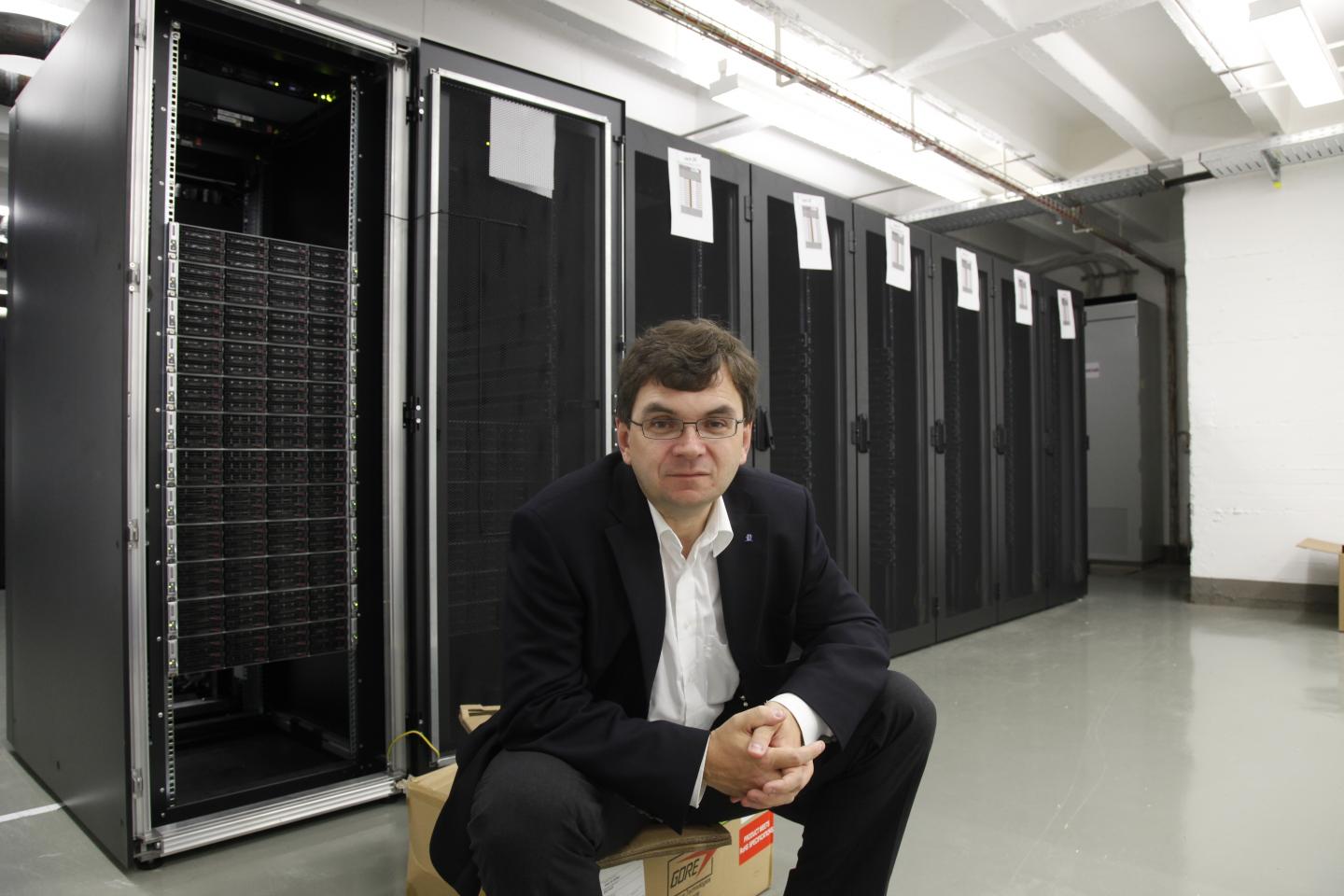 {module INSIDE STORY}
NDC Data Centers GmbH, a Munich-based company, has obtained the rights to market the green technology in data center construction projects around the globe and is thus also making a major contribution to the careful handling of our energy resources against the backdrop of global digitalization.
The basis for these activities is the visionary concept of a significantly optimized cooling system for data centers with the highest possible level of energy efficiency, which was developed by Volker Lindenstruth, Professor for High-Performance Computing Architecture at Goethe University and former head of the Scientific IT Department at GSI. On the basis of his concept, data centers, and commercial IT systems can today be operated with up to 50 percent less primary energy consumption in comparison to conventional data centers.
The technology has been in use for years and is being continuously improved: The first data center of this type was Goethe University's own, which was set at in the Infraserv industrial park. Another very data center, the Green IT Cube, was built by the GSI Helmholtz Centre in Darmstadt and financed from funds provided by the German federal government and the Federal State of Hessen via Helmholtz expansion investments. The concept enables the realization and particularly efficient operation of data centers for large-scale research facilities such as FAIR (Facility for Antiproton and Ion Research), which is currently being set up at the GSI. Later, the Green IT Cube will be the central data center for FAIR, one of the largest projects worldwide in support of research. Moreover, the waste heat from the servers in the Green IT Cube is already being used today to heat a modern office and canteen building on the GSI campus.
Apart from the high energy savings associated with the use of this new technology, the construction of such data centers is also extraordinarily cost-efficient, thus minimizing procurement and operating costs: An expedient coupling of ecology and economy.
Lindenstruth's supercomputers have received several awards for their energy-efficient concept in recent years. At the end of 2014, one of his computers ranked first place in the global listing of the most energy-efficient supercomputers, thanks to its greatly optimized computer architecture.
Goethe University's success in the area of green IT is also spurring on its current application, together with Mainz, Kaiserslautern, and Saarbrücken, to host one of the new National High-Performance Computing Centres. Thanks to the optimized computer architecture based on the Hessian green IT approach, considerably more computing power could be made available to users at the same cost. Goethe University would, therefore, be an ideal location for one of the new centers.
Views on the green supercomputer technology:
Angela Dorn, Hessen's Minister of Science, says: "My sincere congratulations to Professor Lindenstruth and his team. I'm especially pleased that this success has been accomplished in a field close to my heart: The energy turnaround to which green IT can make a very important contribution. I'm also very happy that we as the Federal State of Hessen have contributed to this success. The first supercomputer in which Professor Lindenstruth used his energy-saving technology was the LOEWE-CSC at Goethe University's data center in the Infraserv industrial park. Hessen's Ministry of Science supported this investment with a total of almost € 2 million in the shape of both direct fundings as well as from the LOEWE program. We're therefore today harvesting together with the fruits of this funding and the LOEWE program launched in 2008."
Professor Birgitta Wolff, President of Goethe University, says: "Just as in Goethe's days it made no sense to harness more and more horses in front of a stagecoach in order to increase the speed, so today we are facing a fundamental paradigm shift in IT. Back then, the railroad was the answer to the problem of speed. Today, the smart IT sector has a huge sustainability and energy problem. To satisfy its enormous hunger for data, our IT-based society requires new energy concepts for supercomputers that drastically reduce power consumption. Volker Lindenstruth from Goethe University has developed such a solution. It's successful patenting with the support of our subsidiary Innovectis is a major step in the right direction: The dissemination and commercialization of this truly smart technology."
Professor Volker Lindenstruth, Professor for High-Performance Computing Architecture at Goethe University, says: "Our successful patent registration is a milestone for the further global commercialization of our "Green IT" approach. We've already received inquiries for it from various regions worldwide. This gives our work a further boost, the more so since with NDC we now have a strong business partner at our side to help with the practical steps."
Professor Karlheinz Langanke, Research Director of the GSI Helmholtz Centre for Heavy Ion Research and FAIR - Facility for Antiproton and Ion Research in Europe, says: "The Green IT Cube high-performance computing center at the GSI Helmholtz Centre is an outstanding example of how practical and usable know-how and developments evolve out of basic research. The Green IT Cube was developed for enormous volumes of measurement data from scientific research: It provides the highest computing capacities required and is at the same time extraordinarily energy-efficient and space-saving."
Markus Bodenmeier, NDC co-founder and partner: "With the help of the innovations created by Professor Volker Lindenstruth from Goethe University and by the GSI, NDC Data Centers GmbH builds the most energy-efficient and resource-friendly data centers. In so doing, we can guarantee over the long term the benefits offered by the exponential growth of digitalization. We're in keeping here with the current trend - all major cloud operators are at present keeping a very close eye on the impact of their activities on the environment."
Other statements by experts involved:
Dr. Martin Raditsch, Managing Director of Innovectis GmbH, a subsidiary of Goethe University explains: "The application in practice of this technology is a very nice example of how results from basic research at the university and their transfer lead to technological solutions for societal challenges. Through our technology, the advancing digitalization of industry and society can be accomplished in a far more energy-saving way."
Dr. Tobias Engert, Director of the Technology Transfer Department at the GSI, is very pleased about the invention's success: "The cooling concept of the Green IT Cube at the GSI is based on an innovative idea for the reduction of energy costs, and together with Innovectis we've now been able to successfully market it to NDC. Equipped with an innovative cooling system, the Green IT Cube meets the high requirements of optimum energy efficiency coupled with the highest possible computing power, and it will later become the central data center for the new accelerator FAIR - Facility for Antiproton and Ion Research. The commercialization of the patents is certainly one of the most important examples of technology transfer from the GSI into the industry." His colleague Michael Geier, Director of the Patents Department, adds: "The sale of the patents to NDC corroborates how important it is to protect new technical solutions developed at research facilities such as the GSI through patents. Such patents are a deciding factor for technology transfer into the industry, through which income is generated that then flows back into research."


 {module INSIDE STORY}