

Germany's GERICS data shows new details on climate change; predicts possible heavy rain, heat on a county level 

The GERICS climate outlooks show climate changes at this regional scale for the first time. Each of the 401 climate outlooks is pooled at the county, district, regional district, or city level; and summarizes the results for 17 climate parameters such as temperature, heat days, dry days, wind speed, or heavy rain days on several pages. The results show projected development trends in climate parameters over the course of the 21st century: for a scenario with sufficient climate protection, a scenario with moderate climate protection, and a scenario without effective climate protection. The advantage is that the reports are uniformly structured and thus allow clear comparison. Heat – Effects of Global Warming can also be seen in German counties. Image: Andrey Grinkevich via Unsplash
"The data shows how the climate may change in the individual German regions. This provides not only citizens but also decision-makers in business and politics with a factual basis for long-term decisions. For example, for urban energy suppliers or for the adaptation of infrastructures," says Dr. Diana Rechid who is co-author of the reports together with Dr. Susanne Pfeifer and Dr. Sebastian Bathiany.

The data allow direct comparison

The analysis of the data took one year. The results show where climate change could be most severe in Germany. For each of the 401 areas examined, a climate outlook has been created individually. For example, the climate outlook for the county of Nordfriesland shows that if emissions remain high, various climate and weather phenomena may increase by the end of the century. This applies to sultry temperatures, tropical nights, prolonged periods of a heatwave, and also heavy rain. In the mountainous regions of the Alps or the Black Forest, particularly strong warming is to be expected under such conditions.

"According to our research, there is not a single county in which everything would remain the same if emissions continued at the same level or even increased. The question is: What can we avoid through effective climate protection; and what changes do we need to prepare for in any case?" asks author Diana Rechid. Thus, the climate outlooks are not only a helpful source of information for experts, politicians, and authorities. All citizens can compare the results of their hometown with those of other counties - be it due to a planned change of residence, a decision to acquire property, or to protect themselves against climate change in general.

An elaborate methodology

The data analysis methods for the current reports are based on a new evaluation software called CLIMDEX that was specifically developed for this purpose at GERICS. In addition, statistical methods are used to calculate the "robustness" of the model results to assess the resilience of the projected climate changes. Since the analyses are standardized and fully automated, they will provide a good basis for quality-approved evaluations in the future. The climate outlooks are based on observational data from the HYRAS dataset of the Deutscher Wetterdienst (DWD) and future projections of regional climate models.

A total of 85 simulations with a resolution of 12.5 kilometers were created by many European research institutions by refining the results of global climate models with different regional climate models. "They allow an assessment of different future scenarios in line with the latest scientific findings," says author Sebastian Bathiany. "Even with a lot of climate protection, we have to adapt to changes. This is precisely why climate projections are so important for the future. This provides a more accurate basis for adaptation to climate change at the local level."

The Helmholtz-Zentrum Hereon is part of the Helmholtz-Klima Initiative, where researchers perform research on climate change at a systemic level. A total of 15 Helmholtz Centers combine their climate expertise in 13 research projects. GERICS directs the Cluster Netto-Null - Pfade zur Klimaneutralität 2050.
Using hydrodynamical simulations from the Constrained Local UniversE project, Instituto de Astrofísica de Canarias' Arianna di Cintio shows that satellite galaxies can carry on forming stars when they pass close to their parent galaxies

Historically most scientists thought that once a satellite galaxy has passed close by its higher mass parent galaxy its star formation would stop because the larger galaxy would remove the gas from it, leaving it shorn of the material it would need to make new stars. However, for the first time, a team led by the researcher at the Instituto de Astrofísica de Canarias (IAC), Arianna di Cintio, has shown using numerical simulations that this is not always the case.

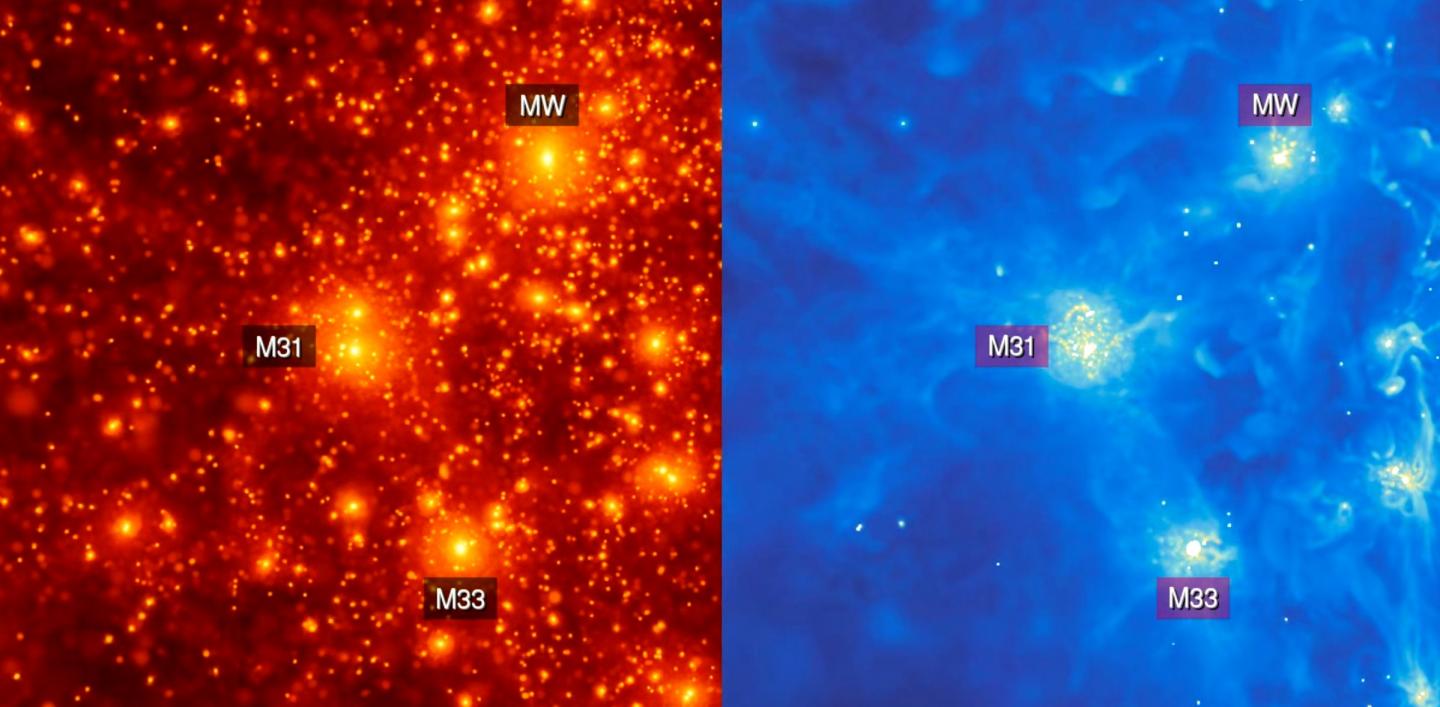
Using sophisticated supercomputer simulations of the whole of the Local Group of galaxies, including the Milky Way, the Andromeda galaxy, and their respective satellite galaxies, the researchers have shown that the satellites not only can retain their gas but also can experience many new episodes of star formation just after passing close to the pericentre of their parent galaxy (the mínimum distance they reach from its center). Image of the simulated local group used for the article. Left, image of dark matter; on the right, gas distribution. The three main galaxies of the Local Group (MW, M31 and M33) are indicated.

The satellite galaxies of the Local Group show a wide variety of star formation histories, whose origin has not previously been fully understood. Using hydrodynamic simulations within the project Constrained Local UniversE (CLUES) the authors studied the star formation histories of satellite galaxies similar to those of the Milky Way in a cosmological context.

While in the majority of the cases the gas of the satellite is sucked out by the parent galaxy due to gravitational action and transfers itself to the larger galaxy, interrupting star formation in the satellite, in a process known as accretion; in some 25% of the sample, they found that star formation was enhanced by this interactive process.

The results show that the peaks of star formation are correlated with the close pass of the satellite around the parent galaxy, and occasionally by the interaction of two satellites. The researchers identified two key features to the star formation: the satellite must enter the parent galaxy with a large reserve of cold gas, and a minimum distance not too small, so that stars may form due to compression of the gas. On the contrary, galaxies that pass too close to the parent galaxy, or to a parent galaxy with little gas, are stripped of their gas and thereby lose the possibility of forming new stars.

"The passage of satellites also coincide with peaks in the star formation of their parent galaxies, which suggests that this mechanism causes bursts of stars equally in both parent galaxies and satellites, in agreement with recent studies of the history of star formation in our own Galaxy", explains Arianna di Cintio, the lead author on the paper.

"This is very important when we try to understand how star formation is produced in the smaller dwarf galaxies of our Local Group, an unresolved question", she adds.

This finding will shed light on the episodes of star formation which are observed in the dwarf galaxies of the Local Group, such as Carina and Fornax, giving an attractive explanation of their existence. It also requires a revision of the theoretical models used to explain the formation of stars in dwarf galaxies.

German scientists develop a new fisheries management planning tool; fewer cod stocks are expected

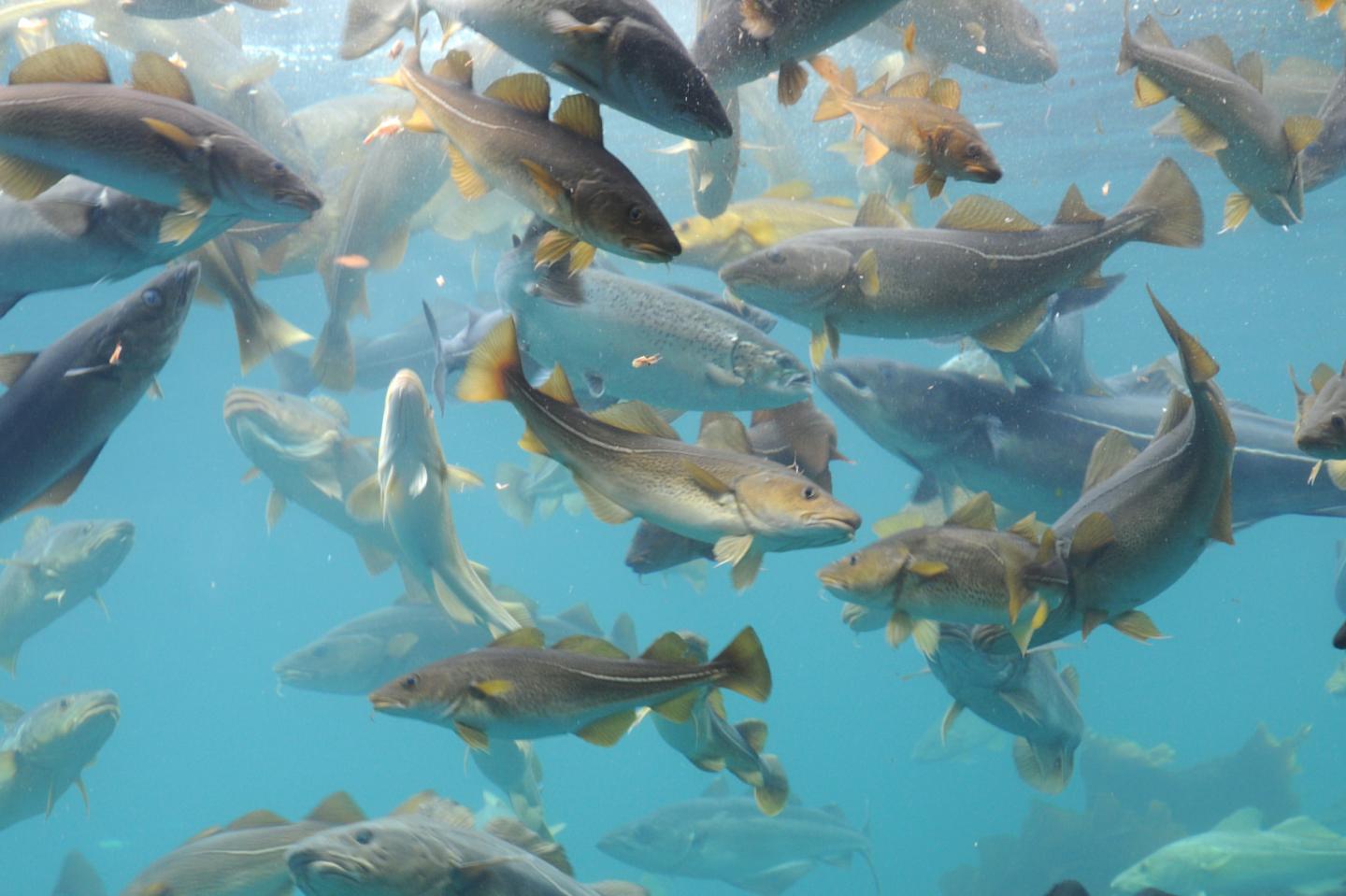
The future of cod stocks in the North Sea and the Barents Sea may be much easier to predict than before. This is the result of an international research project led by the Helmholtz-Zentrum Hereon and its Institute of Coastal Systems - Analysis and Modeling. For the first time, the team has succeeded in predicting the development of stocks for ten years in advance, taking into account both changes due to climate and fishing. Traditionally, fisheries experts provide catch recommendations for about a year in advance, based on which fishing quotas are negotiated and set internationally. This involves first estimating the size of current cod stocks and then calculating how much cod can be caught in the coming year without endangering the stocks as well as harvesting the stock optimally. The climatic change, long-term changes in water temperature, circulation, and mixing, which have a decisive influence on how well cod reproduce, are not included in this prediction so that the development of stocks can only be predicted in the short term. Cod stocks will probably decrease in the future  CREDIT Photo: David Young via Fotolia

The warm North Sea causes stress

As the experts around climate modeler, Vimal Koul und Corinna Schrum of Hereon now have taken temperature into account in their calculations. For the North Sea, the climate forecast continues to predict temperatures at a high level, so that cod stocks are unlikely to recover or reach earlier levels. As a result, catches are expected to remain low. Things look better for the Barents Sea, where stocks can be managed sustainably.

For the researchers, the challenge was that climate models cannot calculate how much fish there will be in the oceans in the future. They only provide information about expected temperatures. "So we first had to develop a program that translates water temperature into fish quantities," says Vimal Koul. Among other things, this took into account the ocean temperature in the North Atlantic. The researchers were then able to run their prediction model. The model starts with today's conditions - the current temperature conditions and the current carbon dioxide content of the atmosphere, and can then calculate how the situation will change as carbon dioxide concentrations increase. The future temperatures are then translated into expected fish abundance and stock sizes.

To test how reliably the model works, it was first compared with real fish data from the 1960s to the present. As it turned out, it was able to correctly estimate fish stocks for the ten-year periods since the early 1960s. In this respect, the researchers led by Vimal Koul can assume that the current view of the coming ten years is also correct.

Fishing intensity is taken into account

Another interesting aspect of the study is that the team of climate modelers, fisheries biologists, and oceanographers took four different fishing scenarios into account. This allowed them to determine how cod stocks would fare if they were fished at different levels - from intensive to sustainable. In this respect, the results of the current study are very practical. "The 10-year estimates will help the fishing industry better plan catches in the future - so that cod stocks are fished sustainably and gently despite climate changes," says Vimal Koul. The new 10-year calculation model could also help fishing companies in their strategic planning - by providing a secure basis for investments in new vessels or processing facilities.