

SUPERCOMPUTING NEWS SUPERCOMPUTING NEWS
    • MEDIA KIT
    • MOST READ
    • RSS FEED
    • ACADEMIA
    • AEROSPACE
    • APPLICATIONS
    • ASTRONOMY
    • AUTOMOTIVE
    • BIG DATA
    • BIOLOGY
    • CHEMISTRY
    • CLIENTS
    • CLOUD
    • DEFENSE
    • DEVELOPER TOOLS
    • EARTH SCIENCES
    • ECONOMICS
    • ENGINEERING
    • ENTERTAINMENT
    • GAMING
    • GOVERNMENT
    • HEALTH
    • OIL & GAS
    • INDUSTRY
    • INTERCONNECTS
    • MANUFACTURING
    • MIDDLEWARE
    • MOVIES
    • NETWORKS
    • PHYSICS
    • PROCESSORS
    • RETAIL
    • SCIENCE
    • STORAGE
    • SYSTEMS
    • VISUALIZATION
    • AcyMailing subscription form

    • ADD YOUR VIDEOS
    • MANAGE VIDEOS
    • CONVERSATION INBOX
    • SOCIAL ADVERTISER
    • SOCIAL NETWORK VIDEOS
    • SURVEYS
    • GROUPS
    • PAGES
    • MARKETPLACE LISTINGS
    • APPLICATIONS BROWSER
    • PRIVACY CONFIRM REQUEST
    • PRIVACY CREATE REQUEST
    • LEADERBOARD
    • POINTS LISTING
      • BADGES
    • TRADE SHOWS
Sign In
Tyler O'Neal, Staff Editor APPLICATIONS July 9, 2021, 3:00 pm

Japanese researcher introduces a new theoretical model of high-temperature superconductivity, in which electrical current can flow with zero resistance, that leads to extremely efficient energy generation, transmission

A scientist from the Division of Quantum Condensed Matter Physics at the University of Tsukuba in Japan has formulated a new theory of superconductivity. Based on the calculation of the "Berry connection," this model helps explain new experimental results better than the current theory. The work may allow future electrical grids to send energy without losses.

Superconductors are fascinating materials that may look unremarkable at ambient conditions, but when cooled to very low temperatures, allow electrical current to flow with zero resistance. There are several obvious applications of superconductivity, such as lossless energy transmission, but the physics underlying this process is still not clearly understood. The established way of thinking about the transition from normal to superconducting is called the Bardeen-Cooper-Schrieffer (BCS) theory. In this model, as long as thermal excitations are kept small enough, particles can form "Cooper pairs" which travel together and resist scattering. However, the BCS model does not adequately explain all types of superconductors, which limits our ability to create more robust superconducting materials that work at room temperature.

Now, a scientist from the University of Tsukuba has come up with a new model for superconductivity that better reveals the physical principles. Instead of focusing on the pairing of charged particles, this new theory uses the mathematical tool called the "Berry connection." This value computes a twisting of space where electrons travel. "In the standard BCS theory, the origin of superconductivity is electron pairing. In this theory, the supercurrent is identified as the dissipationless flow of the paired electrons, while single electrons still experience resistance," Author Professor Hiroyasu Koizumi says.

As an illustration, Josephson junctions are formed when two superconductor layers are separated by a thin barrier made of normal metal or an insulator. Although widely used in high-precision magnetic field detectors and quantum supercomputers, Josephson junctions also do not fit neatly the inside BCS theory. "In the new theory, the role of the electron pairing is to stabilize the Berry connection, as opposed to being the cause of superconductivity by itself, and the supercurrent is the flow of single and paired electrons generated due to the twisting of the space where electrons travel caused by the Berry connection," Professor Koizumi says. Thus, this research may lead to advancements in quantum supercomputing as well as energy conservation.
German modeling forecasts for the Corona pandemic show societies act rationally, in solidarity, but increasingly experience fatigue

Tyler O'Neal, Staff Editor APPLICATIONS July 9, 2021, 12:00 pm

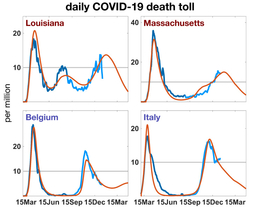
Every pandemic affects life and actions of people, which in turn controls the course of the pandemic. Until now the factors that determine our social, political, and psychological sphere could not be described by mathematical models, making it difficult to venture forecasts for the Corona pandemic. The new study will improve the situation. Researcher Prof. Kai Wirtz of the Hereon Institution for Coastal Systems - Analysis and Modeling quantitatively describes the social phenomena hinted at above. "As a scientist, social modeling has been driving me for a while. It has also reached coastal research in the meantime. The greatest challenge in this development was the integration of human agency into conventional epidemiological models," says Wirtz. The daily mortality curves correspond to the curves of the model. Graphic: Hereon/ Kai Wirtz

How Corona changes people

Due to the problems in the predictability of social dynamics, Wirtz uses the uniqueness of the global Corona pandemic for the new study. This comes along with unprecedented data availability, as he emphasizes. The study uses a part of these data sets - primarily presented by Apple, John Hopkins CSSE und YouGov - to quantitatively test a novel model based on the different pandemic course patterns in 20 affected regions. The regions include 11 EU countries such as Germany, Italy and Sweden, Iran, and eight states in the US.

Societies that were affected by the pandemic at the beginning of 2020, mostly Western industrialized countries, succeeded in curtailing the rates of infection through measures such as social distancing. After the societies began to lift the imposed lockdowns in May 2020, some of them achieved very low case figures while others were affected by an enduring high rate of mortality. Later during the fall and winter seasons of 2020/2021, all these regions were hit by a massive second and third wave despite their experiences made during the first lockdown.

The model of the study combines classic equations for viral spreading with simple rules for social dynamics: as a basis it is assumed that societies act rationally to keep the cumulative damage, resulting from COVID 19-caused mortality and the direct socio-economic cost of social distancing, as low as possible. "However, the simulation results show that another mechanism is crucial to describe the dynamics in the 20 regions: the erosion of so-called "social cohesion" with a reduced willingness for and efficacy of social distancing," says Wirtz.

Lost cohesion

It is only the simulation of this erosion process that results in curves of regional mortality rates and mobility and behavioral changes which are almost identical to the empirical data. Thus, the study presents the first model which increases the period of forecasting from so far a few weeks up to one year. In addition, the model can potentially be used to describe the impact of new SARS-CoV-2 mutants.

Based on this study, the regionally diverse second and third waves of the pandemic can be explained as the consequence of differences in social cohesion and climatological factors. The model calculations showed that in many countries a Zero Covid-strategy would have been possible in the summer of 2020. "But only if the social fatigue would have been halted and strict travel bans applied," says Kai Wirtz. Due to the successful validation, the model can guide medium-term strategic planning, for example, more efficient vaccine distribution. Already, at the beginning of 2021, the model predicted for Germany that each delayed day of the mass vaccination causes 178 further Corona deaths on average. With this piece of research, the human approach in dealing with the virus has become better predictable.

Purdue prof presents models of Goldilocks planets with a tilt evolving complex life

Tyler O'Neal, Staff Editor APPLICATIONS July 9, 2021, 7:00 am

Planets tilted on their axis, like Earth, are more capable of evolving complex life. This finding will help scientists refine the search for more advanced life on exoplanets. This NASA-funded research was presented today at the Goldschmidt Geochemistry virtual conference.

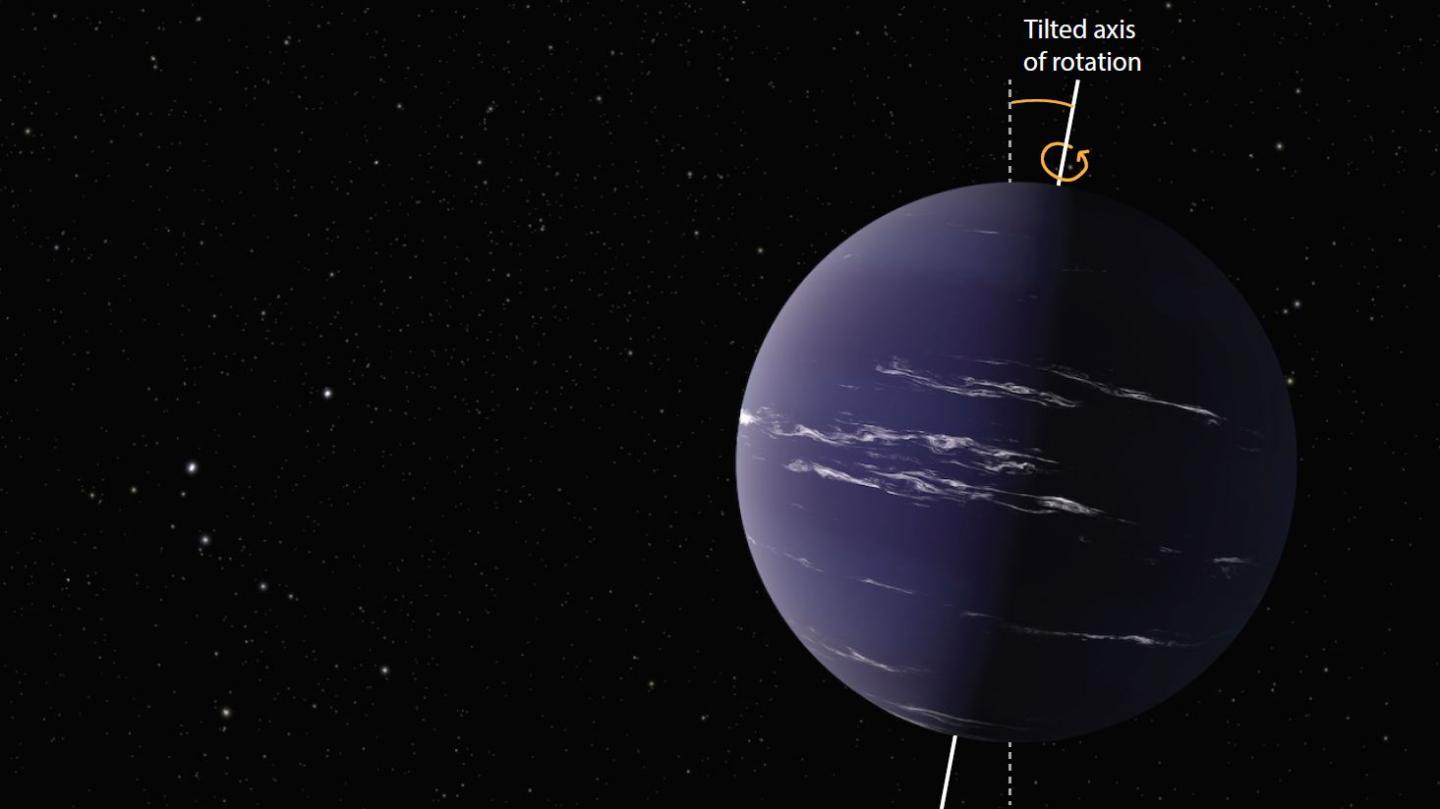
Since the first discovery of exoplanets (planets orbiting distant stars) in 1992, scientists have been looking for worlds that might support life. It is believed that to sustain even basic life, exoplanets need to be at just the right distance from their stars to allow liquid water to exist; the so-called Goldilocks zone. However, for more advanced life, other factors are also important, particularly atmospheric oxygen. Artist's impression of exoplanet, showing tilted axis of rotation (adapted from NASA original image)

Oxygen plays a critical role in respiration, the chemical process which drives the metabolisms of most complex living things. Some basic life forms produce oxygen in small quantities, but for more complex life forms, such as plants and animals, oxygen is critical. Early Earth had little oxygen even though basic life forms existed.

The scientists produced a supercomputer model of the conditions required for life on Earth to be able to produce oxygen. The model allowed them to input different parameters, to show how changing conditions on a planet might change the amount of oxygen produced by photosynthetic life.

Lead researcher Stephanie Olson (Purdue University) said "The model allows us to change things such as day length, the amount of atmosphere, or the distribution of land to see how marine environments and the oxygen-producing life in the oceans respond."

The researchers found that increasing day length, higher surface pressure, and the emergence of continents all influence ocean circulation patterns and associated nutrient transport in ways that may increase oxygen production. They believe that these relationships may have contributed to Earth's oxygenation by favoring oxygen transfer to the atmosphere as Earth's rotation has slowed, its continents have grown, and surface pressure has increased through time.

"The most interesting result came when we modeled 'orbital obliquity' - in other words how the planet tilts as it circles around its star," explained Megan Barnett, a University of Chicago graduate student involved with the study. She continued "Greater tilting increased photosynthetic oxygen production in the ocean in our model, in part by increasing the efficiency with which biological ingredients are recycled. The effect was similar to doubling the amount of nutrients that sustain life."

Earth's sphere tilts on its axis at an angle of 23.5 degrees. This gives us our seasons, with parts of the Earth receiving more direct sunlight in summer than in winter. However, not all planets in our Solar System are tilted like the Earth: Uranus is tilted at 98 degrees, whereas Mercury is not tilted at all. "For comparison, the Leaning Tower of Pisa tilts at around 4 degrees, so planetary tilts can be quite substantial," said Barnett.

Dr. Olson continued "There are several factors to consider in looking for life on another planet. The planet needs to be at the right distance from its star to allow liquid water and have the chemical ingredients for the origin of life. But not all oceans will be great hosts for life as we know it, and an even smaller subset will have suitable habitats for life to progress towards animal-grade complexity. Small tilts or extreme seasonality on planets with Uranus-like tilts may limit the proliferation of life, but a modest tilt of a planet on its axis may increase the likelihood that it develops oxygenated atmospheres that could serve as beacons of microbial life and fuel the metabolisms of large organisms. The bottom line is that worlds that are modestly tilted on their axes may be more likely to evolve complex life. This helps us narrow the search for complex, perhaps even intelligent life in the Universe."

Timothy Lyons, Distinguished Professor of Biogeochemistry in the Department of Earth and Planetary Sciences at the University of California, Riverside commented, "The first biological production of oxygen on Earth and its first appreciable accumulation in the atmosphere and oceans are milestones in the history of life on Earth. Studies of Earth teach us that oxygen may be one of our most important biosignatures in the search for life on distant exoplanets. By building from the lessons learned from Earth via numerical simulations, Olson and colleagues have explored a critical range of planetary possibilities wider than those observed over Earth history. Importantly, this work reveals how key factors, including a planet's seasonality, could increase or decrease the possibility of finding oxygen derived from life outside our solar system. These results are certain to help guide our searches for that life."

  1. Broad Institute genomic analysis uncovers several genetic markers associated with SARS-CoV-2 infection, COVID-19 severity risk factors
  2. Colorado COVID-19 modeling team shows how its models helped reduce spread by informing state policies amidst the pandemic

Page 41 of 66

  • 36
  • 37
  • 38
  • 39
  • 40
  • 41
  • 42
  • 43
  • 44
  • 45
POPULAR RIGHT NOW
  • Supercomputers uncover a new class of cosmic explosions hidden in plain sight
    Supercomputers uncover a new class of cosmic explosions hidden in plain sight
  • AI supercharges the hunt for stronger magnets: Iowa State researchers launch a new era of intelligent materials discovery
    AI supercharges the hunt for stronger magnets: Iowa State researchers launch a new era of intelligent materials discovery
  • IBM's Historic stock collapse raises questions for the future of enterprise supercomputing
    IBM's Historic stock collapse raises questions for the future of enterprise supercomputing
  • Could a novel dark matter theory simultaneously resolve multiple cosmic enigmas? Supercomputer simulations provide a compelling, albeit currently unverified, potential solution
    Could a novel dark matter theory simultaneously resolve multiple cosmic enigmas? Supercomputer simulations provide a compelling, albeit currently unverified, potential solution
  • Melting icebergs may be reshaping Earth’s greatest ocean current
    Melting icebergs may be reshaping Earth’s greatest ocean current
  • Supercomputers replace ‘bathtub’ flood maps with physics-based digital twins of Britain’s coastline
    Supercomputers replace ‘bathtub’ flood maps with physics-based digital twins of Britain’s coastline
  • Supercomputers push neural quantum simulation beyond previous limits
    Supercomputers push neural quantum simulation beyond previous limits
  • Intel’s AI supercomputing revival: Q2 financial surge signals new era for CPU-powered HPC infrastructure
    Intel’s AI supercomputing revival: Q2 financial surge signals new era for CPU-powered HPC infrastructure
  • AI infrastructure financing fears shake semiconductor sector
    AI infrastructure financing fears shake semiconductor sector
  • AWS supercomputing investment reaches historic scale as Amazon’s AI strategy powers record financial results
    AWS supercomputing investment reaches historic scale as Amazon’s AI strategy powers record financial results
THIS YEAR'S MOST READ
  • Wall Street wants to trade supercomputing power like oil
    Wall Street wants to trade supercomputing power like oil
  • Cosmic ambition at scale: UK’s supercomputer unlocks a 2.5 petabytes universe
    Cosmic ambition at scale: UK’s supercomputer unlocks a 2.5 petabytes universe
  • Hidden order, revealed at scale: Supercomputing, electron ptychography uncover the inner workings of relaxor ferroelectrics
    Hidden order, revealed at scale: Supercomputing, electron ptychography uncover the inner workings of relaxor ferroelectrics
  • Beamforming the future: BeammWave's 6G push signals the rise of orbital-terrestrial wireless networks
    Joakim Axmon
    Joakim Axmon
  • Intel's Q1 results signal supercomputing surge driving Xeon momentum
    Intel's Q1 results signal supercomputing surge driving Xeon momentum
  • When stars fall apart: Supercomputing reveals the hidden physics of black holes
    When stars fall apart: Supercomputing reveals the hidden physics of black holes
  • Multi-layer simulations reveal the hidden supply chain of solar prominences
    Multi-layer simulations reveal the hidden supply chain of solar prominences
  • Japanese scientists decode dolphin speed with supercomputing: Turbulence, vortices, and the hidden physics of propulsion
    Japanese scientists decode dolphin speed with supercomputing: Turbulence, vortices, and the hidden physics of propulsion
  • Cosmic feedback at scale: Supercomputing reveals how quasars regulate the early Universe
    Cosmic feedback at scale: Supercomputing reveals how quasars regulate the early Universe
  • Modeling life at the microscopic scale: A computational breakthrough in oxygen transport
    Modeling life at the microscopic scale: A computational breakthrough in oxygen transport
MOST READ OF ALL-TIME
  • Largest Computational Biology Simulation Mimics The Ribosome
    Details
    112108
    The amino acid (green) slithers into the chemical reaction center, moving through an evolutionarily ancient corridor of the ribosome (purple). The amino acid is delivered to the reaction core by the transfer RNA molecule (yellow).
    The amino acid (green) slithers into the chemical reaction center, moving through an evolutionarily ancient corridor of the ribosome (purple). The amino acid is delivered to the reaction core by the transfer RNA molecule (yellow).
  • Silicon 'neurons' may add a new dimension to chips
    Details
    80994
    Silicon 'neurons' may add a new dimension to chips
  • Linux Networx Accelerators Expected to Drive up to 4x Price/Performance
    Details
    75538
  • Complex Concepts That Really Add Up
    Details
    73637
    Complex Concepts That Really Add Up
  • Blue Sky Studios Donates Animation SuperComputer to Wesleyan
    Details
    68141
    Each rack holds 52 Angstrom Microsystem-brand “blades,” with a memory footprint of 12 or 24 gigabytes each. (Photos by Olivia Bartlett Drake)
    Each rack holds 52 Angstrom Microsystem-brand “blades,” with a memory footprint of 12 or 24 gigabytes each. (Photos by Olivia Bartlett Drake)
  • Humanities, HPC connect at NERSC
    Details
    57947
  • TeraGrid ’09 'Call for Participation'
    Details
    54952
  • Turbulence responsible for black holes' balancing act
    Details
    52312
  • Cray Wins $52 Million SuperComputer Contract
    Details
    50140
  • SDSC Researchers Accurately Predict Protein Docking
    Details
    46080
  • FRONTPAGE
  • LATEST
  • POPULAR
  • REGISTER
  • SOCIAL
  • VIDEO
  • SUBSCRIPTION
  • RSS
  • GUIDELINES
  • PRIVACY
  • TOS
  • ABOUT
  • +1 (816) 799-4488
  • editorial@supercomputingonline.com
© 2001 - 2026 SuperComputingOnline.com, LLC. All rights reserved. This material may not be published, broadcast, rewritten or redistributed without permission.
Sign In
  • FRONT PAGE
  • LATEST
    • MEDIA KIT
    • MOST READ
    • RSS FEED
    • ACADEMIA
    • AEROSPACE
    • APPLICATIONS
    • ASTRONOMY
    • AUTOMOTIVE
    • BIG DATA
    • BIOLOGY
    • CHEMISTRY
    • CLIENTS
    • CLOUD
    • DEFENSE
    • DEVELOPER TOOLS
    • EARTH SCIENCES
    • ECONOMICS
    • ENGINEERING
    • ENTERTAINMENT
    • HEALTH
    • INDUSTRY
    • INTERCONNECTS
    • GAMING
    • GOVERNMENT
    • MANUFACTURING
    • MIDDLEWARE
    • MOVIES
    • NETWORKS
    • OIL & GAS
    • PHYSICS
    • PROCESSORS
    • RETAIL
    • SCIENCE
    • STORAGE
    • SYSTEMS
    • VISUALIZATION
  • VIDEOS
    • ADD YOUR VIDEOS
    • MANAGE VIDEOS
  • COMMUNITY
    • TRADE SHOWS
    • SOCIAL NETWORK VIDEOS
    • SURVEYS
    • APPLICATIONS BROWSER
    • CONVERSATION INBOX
    • SOCIAL ADVERTISER
    • GROUPS
    • MARKETPLACE LISTINGS
    • PAGES
    • LEADERBOARD
    • POINTS LISTING
      • BADGES
    • PRIVACY CONFIRM REQUEST
    • PRIVACY CREATE REQUEST

Hey there! We noticed you’re using an ad blocker.