

Webb telescope captures its first image of exoplanet

For the first time, astronomers have used NASA’s James Webb Space Telescope to take a direct image of a planet outside our solar system. The exoplanet is a gas giant, meaning it has no rocky surface and could not be habitable. This image shows the exoplanet HIP 65426 b in different bands of infrared light, as seen from the James Webb Space Telescope: purple shows the NIRCam instrument’s view at 3.00 micrometers, blue shows the NIRCam instrument’s view at 4.44 micrometers, yellow shows the MIRI instrument’s view at 11.4 micrometers, and red shows the MIRI instrument’s view at 15.5 micrometers. These images look different because of the ways the different Webb instruments capture light. A set of masks within each instrument, called a coronagraph, blocks out the host star’s light so that the planet can be seen. The small white star in each image marks the location of the host star HIP 65426, which has been subtracted using the coronagraphs and image processing. The bar shapes in the NIRCam images are artifacts of the telescope’s optics, not objects in the scene. (Unlabeled version.) Credit: NASA/ESA/CSA, A Carter (UCSC), the ERS 1386 team, and A. Pagan (STScI).
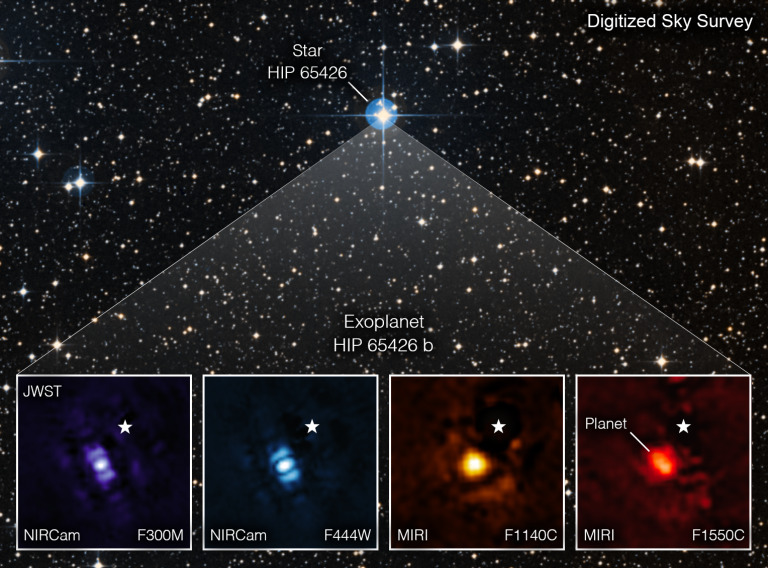
The image, as seen through four different light filters, shows how Webb’s powerful infrared gaze can easily capture worlds beyond our solar system, pointing the way to future observations that will reveal more information than ever before about exoplanets.

“This is a transformative moment, not only for Webb but also for astronomy generally,” said Sasha Hinkley, associate professor of physics and astronomy at the University of Exeter in the United Kingdom, who led these observations with a large international collaboration. Webb is an international mission led by NASA in collaboration with its partners, ESA (European Space Agency) and CSA (Canadian Space Agency).

The exoplanet in Webb’s image, called HIP 65426 b, is about six to 12 times the mass of Jupiter, and these observations could help narrow that down even further. It is young as planets go — about 15 to 20 million years old, compared to our 4.5-billion-year-old Earth.

Astronomers discovered the planet in 2017 using the SPHERE instrument on the European Southern Observatory’s Very Large Telescope in Chile and took images of it using short infrared wavelengths of light. Webb’s view, at longer infrared wavelengths, reveals new details that ground-based telescopes would not be able to detect because of the intrinsic infrared glow of Earth’s atmosphere.

Researchers have been analyzing the data from these observations and are preparing a paper. But Webb’s first capture of an exoplanet already hints at future possibilities for studying distant worlds.

Since HIP 65426 b is about 100 times farther from its host star than Earth is from the Sun, it is sufficiently distant from the star that Webb can easily separate the planet from the star in the image.

Webb’s Near-Infrared Camera (NIRCam) and Mid-Infrared Instrument (MIRI) are both equipped with coronagraphs, which are sets of tiny masks that block out starlight, enabling Webb to take direct images of certain exoplanets like this one. NASA’s Nancy Grace Roman Space Telescope, slated to launch later this decade, will demonstrate an even more advanced coronagraph.

“It was really impressive how well the Webb coronagraphs worked to suppress the light of the host star,” Hinkley said.

Taking direct images of exoplanets is challenging because stars are so much brighter than planets. The HIP 65426 b planet is more than 10,000 times fainter than its host star in the near-infrared, and a few thousand times fainter in the mid-infrared.

In each filtered image, the planet appears as a slightly differently shaped blob of light. That is because of the particulars of Webb’s optical system and how it translates light through the different optics.

“Obtaining this image felt like digging for space treasure,” said Aarynn Carter, a postdoctoral researcher at the University of California, Santa Cruz, who led the analysis of the images. “At first all I could see was light from the star, but with careful image processing I was able to remove that light and uncover the planet.”

While this is not the first direct image of an exoplanet taken from space – the Hubble Space Telescope has captured direct exoplanet images previously – HIP 65426 b points the way forward for Webb’s exoplanet exploration.

“I think what’s most exciting is that we’ve only just begun,” Carter said. “There are many more images of exoplanets to come that will shape our overall understanding of their physics, chemistry, and formation. We may even discover previously unknown planets, too.”
Swedish researchers use supercomputer simulations to show that stable molecules can become reactive with light

Modulating the photocyclization reactivity of diarylethenes through changes in the excited-state aromaticity of the π-linker

Researchers at Linköping University have used supercomputer simulations to show that stable aromatic molecules can become reactive after absorbing light. The results, published in the Journal of Organic Chemistry, may have long-term applications in such areas as the storage of solar energy, pharmacology, and molecular machines. 

“Everyone knows that petrol smells nice. This is because it contains the aromatic molecule benzene. And aromatic molecules don’t just smell nice: they have many useful chemical properties. Our discovery means that we can add more properties”, says Bo Durbeej, professor of computational physics at Linköping University.

In normal organic chemistry, heat can be used to start reactions. However, an aromatic molecule is a stable hydrocarbon, and it is difficult to initiate reactions between such molecules and others simply by heating. This is because the molecule is already in an optimal energy state. In contrast, a reaction in which an aromatic molecule is formed takes place extremely readily. 

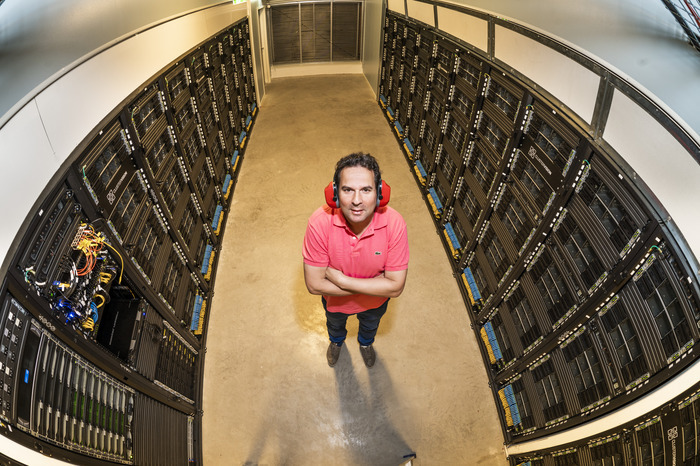
Researchers at Linköping University have now used supercomputer simulations to show that it is possible to activate aromatic molecules using light. Reactions of this type are known as photochemical reactions. Bo Durbeej, professor of computational physics at Linköping University.  CREDIT Thor Balkhed/Linköping University

“It is possible to add more energy using light than using heat. In this case, light can help an aromatic molecule to become antiaromatic, and thus highly reactive. This is a new way to control photochemical reactions using the aromaticity of the molecules”, says Bo Durbeej.

The result was important enough to be highlighted on the cover of the Journal of Organic Chemistry when it was published. In the long term, it has possible applications in many areas. Bo Durbeej’s research group focuses on applications in the storage of solar energy, but he sees potential also in molecular machines, molecular synthesis, and phytopharmacology. In the latter application, it may be possible to use light to selectively activate drugs with aromatic groups at a location in the body where the pharmacological effect is wanted.

“In some cases, it’s not possible to supply heat without harming surrounding structures, such as body tissue. It should, however, be possible to supply light”, says Bo Durbeej.

The researchers tested the hypothesis that it was the loss of aromaticity that led to the increased reactivity by examining the opposite relationship in the simulations. In this case, they started with an antiaromatic unstable molecule and simulated it as subject to light irradiation. This led to the formation of an aromatic compound, and the researchers saw, as expected, that the reactivity was lost.

“Our discovery extends the concept of ‘aromaticity’, and we have shown that we can use this concept in organic photochemistry”, says Bo Durbeej.

UMaine deploys AI in its wireless network to better monitor Maine’s forests

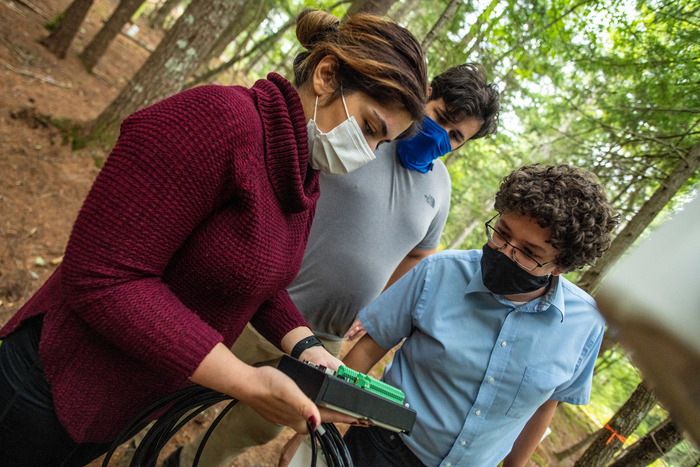
Monitoring and measuring forest ecosystems is a complex challenge because of an existing combination of software, collection systems, and computing environments that require increasing amounts of energy to power. The University of Maine’s Wireless Sensor Networks (WiSe-Net) laboratory has developed a novel method of using artificial intelligence and machine learning to make monitoring soil moisture more energy and cost-efficient — one that could be used to make measuring more efficient across the broad forest ecosystems of Maine and beyond. UMaine researchers testing wireless sensors used to collect forest data.

Soil moisture is an important variable in forested and agricultural ecosystems alike, particularly under the recent drought conditions of past Maine summers. Despite the robust soil moisture monitoring networks and large, freely available databases, the cost of commercial soil moisture sensors and the power that they use to run can be prohibitive for researchers, foresters, farmers, and others tracking the health of the land.

Along with researchers at the University of New Hampshire and the University of Vermont, UMaine’s WiSe-Net designed a wireless sensor network that uses artificial intelligence to learn how to be more power efficient in monitoring soil moisture and processing the data. The research was funded by a grant from the National Science Foundation

“AI can learn from the environment, predict the wireless link quality and incoming solar energy to efficiently use limited energy and make a robust low-cost network run longer and more reliably,” says Ali Abedi, principal investigator of the recent study and professor of electrical and computer engineering at the University of Maine.

The software learns over time how to make the best use of available network resources, which helps produce power-efficient systems at a lower cost for large-scale monitoring compared to the existing industry standards.

WiSe-Net also collaborated with Aaron Weiskittel, director of the Center for Research on Sustainable Forests, to ensure that all hardware and software research is informed by the science and tailored to the research needs. 

“Soil moisture is a primary driver of tree growth, but it changes rapidly, both daily as well as seasonally,” Weiskittel says. “We have lacked the ability to monitor effectively at scale. Historically, we used expensive sensors that collected at fixed intervals — every minute, for example — but were not very reliable. A cheaper and more robust sensor with wireless capabilities like this really opens the door for future applications for researchers and practitioners alike.”

Although the system designed by the researchers focuses on soil moisture, the same methodology could be extended to other types of sensors, like ambient temperature, snow depth, and more, as well as scaling up the networks with more sensor nodes.

“Real-time monitoring of different variables requires different sampling rates and power levels. An AI agent can learn these and adjust the data collection and transmission frequency accordingly rather than sampling and sending every single data point, which is not as efficient,” Abedi says.