

Japan takes a step closer to probabilistic supercomputing with spin-transfer torque in superparamagnetic tunnel junctions

Tohoku University scientists in Japan have developed a mathematical description of what happens within tiny magnets as they fluctuate between states when an electric current and magnetic field are applied. Their findings could act as the foundation for engineering more advanced supercomputers that can quantify uncertainty while interpreting complex data.

Classical computers have gotten us this far, but there are some problems that they cannot address efficiently. Scientists have been working on addressing this by engineering computers that can utilize the laws of quantum physics to recognize patterns in complex problems. But these so-called quantum supercomputers are still in their early stages of development and are extremely sensitive to their surroundings, requiring extremely low temperatures to function.

Now, scientists are looking at something different: a concept called probabilistic supercomputing. This type of supercomputer, which could function at room temperature, would be able to infer potential answers from complex input. A simplistic example of this type of problem would be to infer information about a person by looking at their purchasing behavior. Instead of the computer providing a single, discrete result, it picks out patterns and delivers a good guess of what the result might be. (left) Bird-view of a superparamagnetic tunnel junction device. (right) Top view of scanning electron microscope image of the actual device.  CREDIT Shun Kanai et al.
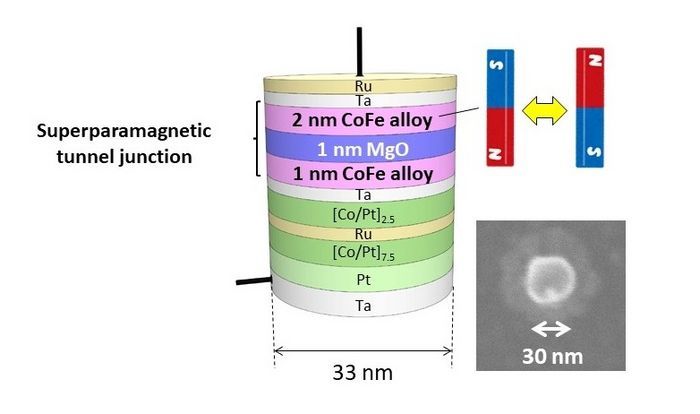
There could be several ways to build such a supercomputer, but some scientists are investigating the use of magnetic tunnel junctions. These are made from two layers of magnetic metal separated by an ultrathin insulator (Fig. 1). When these nanomagnetic devices are thermally activated under an electric current and magnetic field, electrons tunnel through the insulating layer. Depending on their spin, they can cause changes, or fluctuations, within the magnets. These fluctuations, called p-bits, which are the alternative to the on/off or 0/1 bits we have all heard about in classical computers, could form the basis of probabilistic supercomputing. But to engineer probabilistic computers, scientists need to be able to describe the physics that happens within magnetic tunnel junctions.

This is precisely what Shun Kanai, Tohoku University's Research Institute of Electrical Communication professor, and his colleagues have achieved.

"We have experimentally clarified the 'switching exponent' that governs fluctuation under the perturbations caused by the magnetic field and spin-transfer torque in magnetic tunnel junctions," says Kanai. "This gives us the mathematical foundation to implement magnetic tunnel junctions into the p-bit to sophisticatedly design probabilistic computers. Our work has also shown that these devices can be used to investigate unexplored physics related to thermally activated phenomena."

Arkansas researchers show how climate change is increasing frequency of fish mass die-offs

A study of die-offs finds that air and water temperatures are reliable predictors of fish mass mortality events and projects significant increases in the frequency of such events. Simon Tye

As the planet’s climate has gotten warmer, so has the prevalence of fish die-offs or mass mortality events. These die-offs can have severe impacts on the function of ecosystems, imperil existing fish populations and reduce the global food supply. And the frequency of these events appears to be accelerating, with potentially dire consequences for the world if global carbon emissions are not substantially reduced over the 21st century.

Those are the findings of a recent paper co-authored by two members of the University of Arkansas Department of Biological Sciences: doctoral student Simon Tye and associate professor Adam Siepielski, along with several of their colleagues.

The paper, “Climate warming amplifies the frequency of fish mass mortality events across the north temperate lakes,” compiled 526 documented cases of fish die-offs that occurred across Minnesota and Wisconsin lakes between 2003 and 2013. The researchers determined there were three main drivers of these events: infectious diseases, summerkills, and winterkills.

The researchers then narrowed their focus to summerkills — fish mortalities associated with warm temperatures. They found a strong relationship between local air and water temperatures and the occurrence of these events, meaning they increased in frequency as temperature increased. Moreover, their models that used either air or water temperature provided similar results, which is important because air temperature data is more widely available than water temperature data across the world.

Finally, with a historical baseline established, the team used air and water temperature-based models to predict frequencies of future summerkills.

The results were sobering. Based on local water temperature projections, the models predicted an approximately six-fold increase in the frequency of fish mortality events by 2100, while local air temperature projections predicted a 34-fold increase. Importantly, these predictions were based on temperature projections from the most severe climate change scenario, which was the only scenario with the necessary data for these analyses.

As Tye explained, “If there are eight summerkills per year now, the models suggest we could have about 41 per year based on water temperature estimates or about 182 per year based on air temperature estimates.”

“We think predictions from the water temperature model are more realistic, whereas predictions from the air temperature model indicate we need to better understand how and why regional air and water temperature estimates differ over time to predict how many mortality events may occur.”

Nevertheless, their models reveal strong associations between rising temperatures and frequencies of ecological catastrophes.

Though the study used data related to temperate northern lakes, Tye said the study is pertinent to Arkansas. “One of the findings of the paper is that similar deviations in temperature affect all types of fish, such that a regional heatwave could lead to mortalities of both cold- and warm-water fish,” he said.

“Specifically, climate change is more than gradually increasing temperatures because it also increases temperature variation, such as we experienced much of this summer,” he explained “In turn, our findings suggest these rapid changes in temperature affect a wide range of fish regardless of their thermal tolerance.”

Siepielski added, “This work is important because it demonstrates the feasibility of using readily obtainable data to anticipate fish die-offs.

“As with many examples of how climate warming is negatively affecting wild animal populations, this work reveals that temperature extremes can be particularly detrimental.”

“The large scale of the project, using thousands of lakes and over a million air and temperature data points, is particularly impressive,” Siepielski added. “Lakes outside the study area, including those in Arkansas and surrounding areas, are not likely to be immune to these events increasing in frequency.”

Siepielski encouraged citizens of Arkansas to help document these events when they find

Finnish university develops ML approach that facilitates molecular conformer search in complex molecules

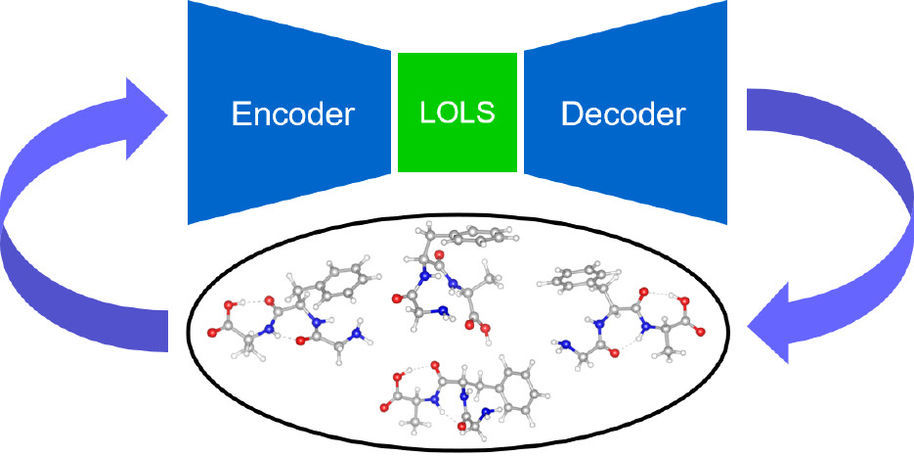
At the Computational Electronic Structure Theory Group (CEST) at Aalto University in Finland, researchers have developed a new machine learning approach based on a low-energy latent space (LOLS) and density functional theory (DFT) to search for molecular conformers. TOC de0e9

Molecular conformer search is a topic of great importance in computational chemistry, drug design, and material science. The challenge is to identify low-energy conformers in the first place. This difficulty arises from the high complexity of search spaces, as well as the computational cost associated with accurate quantum chemical methods. In the past, conformer search would take up considerable time and computational resources.

To address this challenge, visiting doctoral student Xiaomi Guo, together with other CEST researchers Lincan FangProf. Patrick Rinke,  Dr. Xi Chen, and Prof. Milica Todorovic (University of Turku) explored the possibility of performing the molecular conformer search in a low-dimensional latent space. This method uses a generative model variational auto-encoder (VAE) and biases the VAE towards low-energy molecular configurations to generate more informative data. In this way, the model can effectively learn the low-energy potential surface and hence identify the related molecular conformers. The CEST teams call their new method low-energy latent space (LOLS) conformer search.

In a recent publication, the authors tested this new LOLS procedure on amino acids and peptides with 5–9 searching dimensions. The new results agree well with previous studies. The team found that for small molecules such as cysteine, it is more efficient to sample data in real space; however, LOLS turns out to be more suitable for larger molecules such as peptides. The authors now plan to extend their structure search methods to more complex materials beyond molecules.