

AI helping to quantify enzyme activity

Without enzymes, an organism would not be able to survive. It is these biocatalysts that facilitate a whole range of chemical reactions, producing the building blocks of the cells. Enzymes are also used widely in biotechnology and in our households, where they are used in detergents, for example.

To describe metabolic processes facilitated by enzymes, scientists refer to what is known as the Michaelis-Menten equation. The equation describes the rate of an enzymatic reaction depending on the concentration of the substrate – which is transformed into the end products during the reaction. A central factor in this equation is the ‘Michaelis constant’, which characterizes the enzyme’s affinity for its substrate. Schematic presentation of the prediction process for Michaelis constants of enzymes using deep learning methods. (Image: HHU / Swastik Mishra)  CREDIT HHU / Swastik Mishra
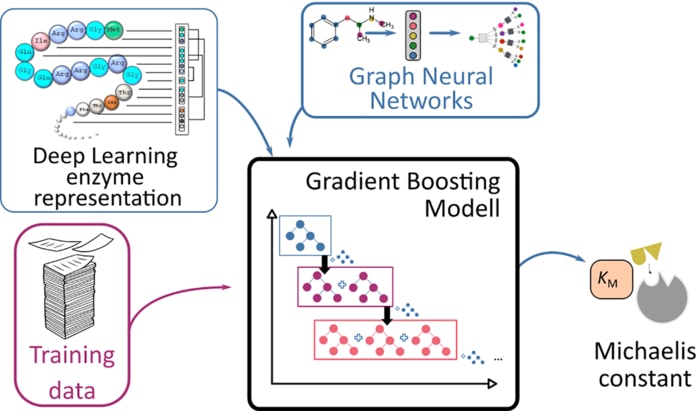
It takes a great deal of time and effort to measure this constant in a lab. As a result, experimental estimates of these constants exist for only a minority of enzymes. A team of researchers from the HHU Institute of Computational Cell Biology and Chalmers University of Technology in Stockholm has now chosen a different approach to predict the Michaelis constants from the structures of the substrates and enzymes using AI.

They applied their approach, based on deep learning methods, to 47 model organisms ranging from bacteria to plants and humans. Because this approach requires training data, the researchers used known data from almost 10,000 enzyme-substrate combinations. They tested the results using Michaelis constants that had not been used for the learning process.

Prof. Lercher had this to say about the quality of the results: “Using the independent test data, we were able to demonstrate that the process can predict Michaelis constants with an accuracy similar to the differences between experimental values from different laboratories. It is now possible for computers to estimate a new Michaelis constant in just a few seconds without the need for an experiment.”

The sudden availability of Michaelis constants for all enzymes of model organisms opens up new paths for metabolic supercomputer modeling, as highlighted by the journal PLOS Biology in an accompanying article.

Japanese built AI enables high-fidelity quantum supercomputing

Researchers at SANKEN use machine learning classification to dramatically improve accuracy when reading the spin states of electrons on quantum dots, which may lead to more robust and practical quantum supercomputing

In Japan, researchers led by the Institute of Scientific and Industrial Research (SANKEN) at Osaka University have trained a deep neural network to correctly determine the output state of quantum bits, despite environmental noise. The team’s novel approach may allow quantum computers to become much more widely used.

Modern computers are based on binary logic, in which each bit is constrained to be either a 1 or a 0. But thanks to the weird rules of quantum mechanics, new experimental systems can achieve increased computing power by allowing quantum bits, also called qubits, to be in “superpositions” of 1 and 0. For example, the spins of electrons confined to tiny islands called quantum dots can be oriented both up and down simultaneously. However, when the final state of a bit is read out, it reverts to the classical behavior of being one orientation or the other. To make quantum supercomputing reliable enough for consumer use, new systems will need to be created that can accurately record the output of each qubit even if there is a lot of noise in the signal.

Now, a team of scientists led by SANKEN used a machine learning method called a deep neural network to discern the signal created by the spin orientation of electrons on quantum dots. “We developed a classifier based on a deep neural network to precisely measure a qubit state even with noisy signals,” co-author Takafumi Fujita explains.

In the experimental system, only electrons with a particular spin orientation can leave a quantum dot. When this happens, a temporary “blip” of increased voltage is created. The team trained the machine learning algorithm to pick out these signals from among the noise. The deep neural network they used had a convolutional neural network to identify the important signal features, combined with a recurrent neural network to monitor the time-series data.

“Our approach simplified the learning process for adapting to strong interference that could vary based on the situation,” senior author Akira Oiwa says. The team first tested the robustness of the classifier by adding simulated noise and drift. Then, they trained the algorithm to work with actual data from an array of quantum dots and achieved accuracy rates over 95%. The results of this research may allow for the high-fidelity measurement of large-scale arrays of qubits in future quantum supercomputers.

BCLIMATE shows how lakes are changing worldwide

International research led by Luke Grant, Inne Vanderkelen, and Prof Wim Thiery of the VUB research group BCLIMATE shows that global changes in lake temperature and ice cover are not due to natural climate variability and can only be explained by massive greenhouse gas emissions since the Industrial Revolution. The influence of human-induced climate change is evident in rising lake temperatures and in the fact that the ice cover forms later and melts sooner.

“These physical properties are fundamental to lake ecosystems,” says Grant, a researcher at VUB and lead author of the study: “As impacts continue to increase in the future, we risk severely damaging lake ecosystems, including water quality and populations of native fish species. This would be disastrous for the many ways in which local communities depend on lakes, ranging from drinking water supply to fishing.”

The team also predicted future development under different warming scenarios. In a low-emission scenario, the average warming of lakes in the future is estimated to stabilize at +1.5°C above pre-industrial levels and the duration of ice cover to be 14 days shorter. In a high-emission world, these changes could lead to an increase of +4.0 °C and 46 fewer days of ice.

At the beginning of the project, the authors observed changes in lakes around the world: temperatures are rising and seasonal ice cover is shorter. However, the role of climate change in these trends had not yet been demonstrated.

“In other words, we had to rule out the possibility that these changes were caused by the natural variability of the climate system,” says fellow VUB researcher and study co-author Vanderkelen.

The team, therefore, developed multiple supercomputer simulations with models of lakes on a global scale, on which they then ran a series of climate models. Once the team had built up this database, they applied a methodology described by the Intergovernmental Panel on Climate Change (IPCC). After determining the historical impact of climate change on lakes, they also analyzed various future climate scenarios.

The results show that it is highly unlikely that the trends in lake temperatures and ice cover in recent decades can be explained solely by natural climate variability. Moreover, the researchers found clear similarities between the observed changes in lakes and model simulations of lakes in a climate influenced by greenhouse gas emissions.

“This is very convincing evidence that climate change caused by humans has already impacted lakes,” says Grant. Projections of lake temperatures and ice cover loss unanimously indicate increasing trends for the future. For every 1°C increase in global air temperature, lakes are estimated to warm by 0.9°C and lose 9.7 days of ice cover. In addition, the analysis revealed significant differences in the impact on lakes at the end of the century, depending on the measures taken by humans to combat climate change.

“Our results underline the great importance of the Paris Agreement to protect the health of lakes around the world,” said Thiery, VUB climate expert and senior author of the study. “If we manage to drastically reduce our emissions in the coming decades, we can still avoid the worst consequences for lakes worldwide.”