

Breakthrough managed ML platform empowers companies to more quickly and easily manage models, allowing them to keep pace with dynamic business needs
At Google I/O, Google Cloud has announced the general availability of Vertex AI, a managed machine learning (ML) platform that allows companies to accelerate the deployment and maintenance of artificial intelligence (AI) models. Vertex AI requires nearly 80% fewer lines of code to train a model versus competitive platforms, enabling data scientists and ML engineers across all levels of expertise the ability to implement Machine Learning Operations (MLOps) to efficiently build and manage ML projects throughout the entire development lifecycle. 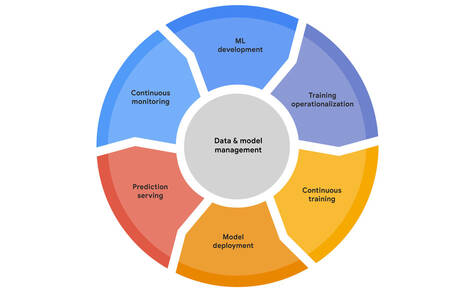
Today, data scientists grapple with the challenge of manually piecing together ML point solutions, creating a lag time in model development and experimentation, resulting in very few models making it into production. To tackle these challenges, Vertex AI brings together the Google Cloud services for building ML under one unified UI and API, to simplify the process of building, training, and deploying machine learning models at scale. In this single environment, customers can move models from experimentation to production faster, more efficiently discover patterns and anomalies, make better predictions and decisions, and generally be more agile in the face of shifting market dynamics.
Through decades of innovation and strategic investment in AI at Google, the company has learned important lessons on how to build, deploy, and maintain ML models in production. Those insights and engineering have been baked into the foundation and design of Vertex AI and will be continuously enriched by the innovation coming out of Google Research. Now, for the first time, with Vertex AI, data science and ML engineering teams can:
- Access the AI toolkit used internally to power Google that includes computer vision, language, conversation, and structured data, continuously enhanced by Google Research.
- Deploy more, useful AI applications, faster with new MLOps features like Vertex Vizier, which increases the rate of experimentation, the fully managed Vertex Feature Store to help practitioners serve, share, and reuse ML features, and Vertex Experiments to accelerate the deployment of models into production with faster model selection.
- Manage models with confidence by removing the complexity of self-service model maintenance and repeatability with MLOps tools like Vertex Continuous Monitoring and Vertex Pipelines to streamline the end-to-end ML workflow.
"We had two guiding lights while building Vertex AI: get data scientists and engineers out of the orchestration weeds, and create an industry-wide shift that would make everyone get serious about moving AI out of pilot purgatory and into full-scale production," said Andrew Moore, vice president and general manager of Cloud AI and Industry Solutions at Google Cloud. "We are very proud of what we came up with within this platform, as it enables serious deployments for a new generation of AI that will empower data scientists and engineers to do fulfilling and creative work."
"Data science practitioners hoping to put AI to work across the enterprise aren't looking to wrangle tooling. Rather, they want tooling that can tame the ML lifecycle. Unfortunately, that is no small order," said Bradley Shimmin, chief analyst for AI Platforms, Analytics, and Data Management at Omdia. "It takes a supportive infrastructure capable of unifying the user experience, plying AI itself as a supportive guide, and putting data at the very heart of the process -- all while encouraging the flexible adoption of diverse technologies."
ModiFace uses Vertex AI to revolutionize the beauty industry
ModiFace, a part of L'Oréal, is a global market leader in augmented reality and artificial intelligence for the beauty industry. ModiFace creates new services for consumers to try beauty products such as hair color, makeup, and nail color, virtually in real-time. ModiFace is using Vertex AI platform to train its AI models for all of its new services. For example, ModiFace's skin diagnostic is trained on thousands of images from L'Oréal's Research & Innovation, the company's dedicated research arm. Bringing together L'Oréal's scientific research combined with ModiFace's AI algorithm, this service allows people to obtain a highly precise tailor-made skincare routine.
"We provide an immersive and personalized experience for people to purchase with confidence whether it's a virtual try-on at web check out, or helping to understand what brand product is right for each individual," said Jeff Houghton, chief operating officer at ModiFace, part of L'Oréal. "With more and more of our users looking for information at home, on their phone, or at any other touchpoint, Vertex AI allowed us to create technology that is incredibly close to actually trying the product in real life."
Essence is built for the algorithmic age with help of Vertex AI
Essence, a global data and measurement-driven media agency that is part of WPP, is extending the value of AI models made by its data scientists by integrating their workflows with developers using Vertex AI. Historically, AI models created by data scientists remain unchanged once created, but this way of operating has evolved with the digital world as human behaviors and channel content is constantly changing. With Vertex AI, developers and data analysts can update models regularly to meet these fast-changing business needs.
"At Essence, we are measured by our ability to keep pace with our clients' rapidly evolving needs," said Mark Bulling, SVP, Product Innovation at Essence. "Vertex AI gives our data scientists the ability to quickly create new models based on the change in the environment while also letting our developers and data analysts maintain models to scale and innovate. The MLOps capabilities in Vertex AI mean we can stay ahead of our client's expectations."
Availability
The Vertex AI platform is generally available today. For more information on how to deploy and specific technical information on how Vertex AI accelerates ML experimentation and deployment, please read this blog.
 {module INSIDE STORY}
 {module INSIDE STORY}