WAE, Imperial College London support Faraday Institution funded BESAFE project to advance the understanding of the initiation, propagation of thermal runaway

  • Williams Advanced Engineering and Imperial College London are collaborating  to advance the understanding of the initiation and propagation of thermal runaway
     
  • The project aims to bridge the gap between thermofluid science and battery electrochemistry, developing a multiphase, multiphysics model of battery failure via thermal runaway
     
  • The program complements the Faraday Institution’s Multi-Scale Modelling and SafeBatt projects 

Imperial College London and Williams Advanced Engineering (WAE) are working on a project to bridge the gap between thermofluid science and battery electrochemistry; developing a first-of-a-kind multiphase multiphysics model of battery failure via thermal runaway (a self-sustaining cascade of exothermic reactions that produce large volumes of gas).  The model will consider gas dynamics and their interactions with electrochemical and thermal behaviors, to advance the understanding of initiation and propagation of the thermal runaway processes and accelerate the design of countermeasures. vcsprasset 3689076 334137 f9cc 66bd7

The work that the Electrochemical Science and Engineering research group at Imperial College London has achieved in the battery field aligns with WAE’s interest in offering greater battery safety and longevity. Achieving this will deliver cost-effective electrification solutions to benefit both WAE and the global client base.

Applying the multiphase multiphysics modeling toolsets will enable the design of safer battery packs with fewer iterations and physical tests; saving time, costs, and materials.

As part of this program, WAE will provide thermal runaway/propagation test data which has been developed as a result of numerous Research and Development programs whilst the battery team will provide technical knowledge and industrial experience on battery safety designs helping steer the project to success.

Rob Millar, Head of Electrification, Williams Advanced Engineering commented “We are confident that the proposed study will bring tangible economic and environmental benefits and look forward to building on our long term partnership with the team at Imperial College London.”

Dr. Huizhi Wang of Imperial College London who is leading the project said “Understanding and modeling thermal runaway plays a crucial role in guiding the development of safer batteries but remains challenging due to the complexity of the process. We are excited to be working with Williams Advanced Engineering on this research project to address the key knowledge gaps in battery safety modeling.”

University of Geneva team develops new model to solve part of the solar problem

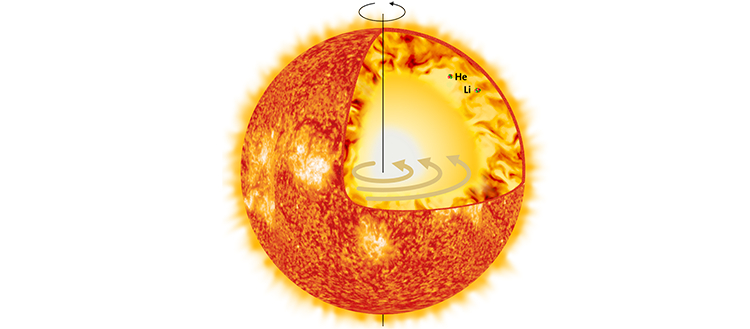
Nothing was going any more in the Sun! In the early 2000s, the abundances of the chemical elements on its surface were revised downwards, preventing astrophysicists from reconciling the values ​​predicted by their standard model with these new data. Called into question, these abundances are nevertheless holding up despite several new analyses. We will therefore have to deal with it and it will be up to the solar models to evolve, especially since they serve as a reference for the study of stars in general. A team from the University of Geneva (UNIGE) in Switzerland, in collaboration with the University of Liège in Liège, Wallonia, Belgium, has developed a new theoretical model which solves part of the problem: by taking into account the rotation of the Sun which has varied during the time, and the resulting magnetic fields, scientists have demonstrated that it is possible to explain its chemical structure.  The model developed by the scientists includes the history of the sun's rotation but also the magnetic instabilities it generates. (c) Sylvia Ekström / UNIGE
“The Sun is the star that can be best characterized. It thus constitutes a fundamental test for our understanding of stellar physics. We have abundance measurements of its chemical elements, but also measurements of its internal structure as for the Earth thanks to seismology”, explains Patrick Eggenberger, lecturer, and researcher at the UNIGE Astronomy Department. and the first author of the study.

These observations must coincide with the predictions of the theoretical models that attempt to explain its evolution. How will the Sunburn the hydrogen in its core, how the energy produced there will be transported to the outer layers, and how will the chemical elements move under the effect of rotation and magnetic fields?

The standard model of the Sun

"The standard solar model used until now considers our star in a simplified form, on the one hand about the transport of chemical elements in its deepest layers, on the other hand for its rotation and its internal magnetic fields. completely neglected up to now”, emphasizes Gaël Buldgen, a researcher in the UNIGE Department of Astronomy and co-author of the study.


However, all of this worked satisfactorily until the early 2000s, when an international scientific team drastically revised the solar abundances by providing a finer analysis. These new abundances have thrown a big stone in the pond of solar models. From then on, no model was able to reproduce the data obtained by helioseismology, ie the study of the vibrations of the Sun, in particular the abundance of helium in the envelope of the Sun.

New model

The new model developed by the UNIGE team includes not only the history of the rotation itself, undoubtedly faster in the past, but also the magnetic instabilities it generates. “We must take into account simultaneously the effects of rotation and magnetic fields on the transport of chemical elements in our stellar models. It is important for the Sun as well as for the general physics of stars, with a direct impact on the chemical evolution of the Universe since the chemical elements so important for life on Earth are manufactured in the heart of stars. says Patrick Eggenberger.

The new model succeeds in correctly predicting the concentration of helium in the outer layers of the Sun and that of lithium, which has also resisted modeling until now. “The helium abundance is correctly reproduced by the new model because the internal rotation of the Sun imposed by the magnetic fields generates a turbulent mixing which prevents this element from falling too quickly towards the center of the star; simultaneously, the abundance of lithium observed on the solar surface is also reproduced because this same mixture transports it to the hot regions where it is destroyed”, explains Patrick Eggenberger.

The problem is not fully resolved

Not all the challenges posed by helioseismology are solved by the new model, however: “Thanks to helioseismology, we know with formidable precision, to within 500 km, the region where convective motions of matter begin, at 199,500 km below the surface of the Sun. However, the theoretical models of the Sun predict a depth offset of 10,000 km!” explains Sébastien Salmon, a researcher at UNIGE and co-author of the article. If the problem still exists with the new model, it opens a new door of understanding: “With the new model of this work, we shed light on the physical processes that can help us resolve this critical disagreement.”

Similar Stars Update

“We are going to have to revise the masses, radii, and ages obtained for the stars of the solar-type that we have studied so far”, underlines Gaël Buldgen, detailing the next steps. Indeed, in the vast majority of cases, solar physics is transposed to cases of studies close to the Sun. Therefore, if the models for analyzing the Sun are modified, this update must also be performed for other stars similar to ours.

Patrick Eggenberger specifies: “This is particularly important if we want to better characterize the host stars of planets, for example within the framework of the PLATO mission.” This observatory of 24 telescopes should fly to Lagrange 2 point (1.5 million kilometers from Earth, opposite the Sun) in 2026 to discover and characterize small planets, and refine the characteristics of their host star.


Algorithms help to distinguish diseases at the molecular level

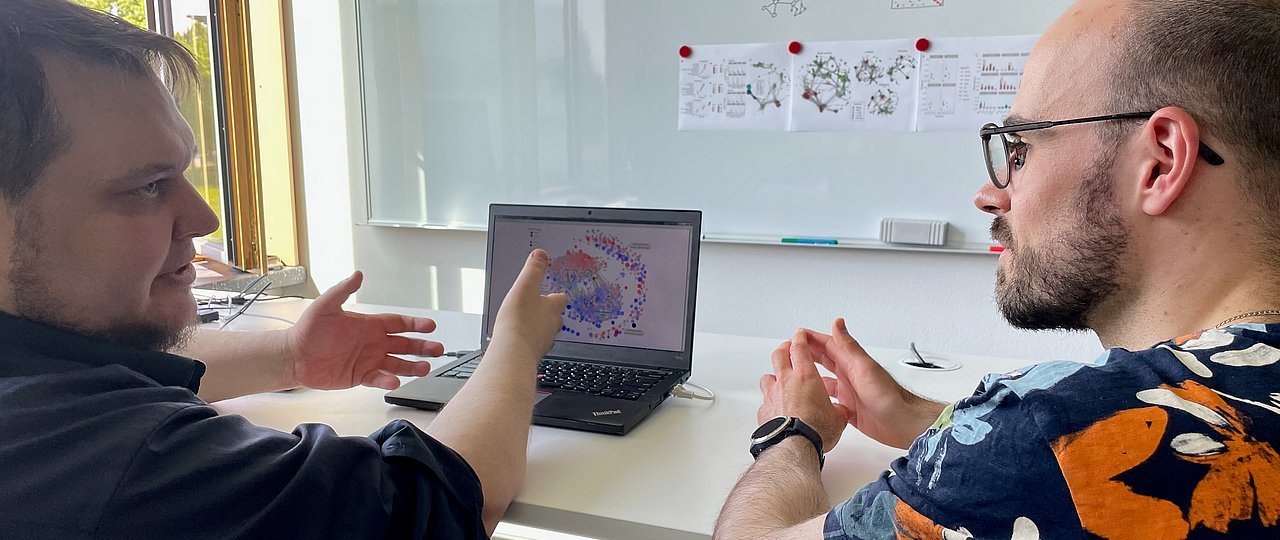
Machine learning is playing an ever-increasing role in biomedical research. Scientists at the Technical University of Munich (TUM) have now developed a new method of using molecular data to extract subtypes of illnesses. In the future, this method can help to support the study of larger patient groups. Head of the LipiTUM research group Dr. Josch Konstantin Pauling (left) and PhD student Nikolai Köhler (right) interpret the disease-related changes in lipid metabolism using a newly developed network. Image: LipiTUM

Nowadays doctors define and diagnose most diseases on the basis of symptoms. However, that does not necessarily mean that the illnesses of patients with similar symptoms will have identical causes or demonstrate the same molecular changes. In biomedicine, one often speaks of the molecular mechanisms of disease. This refers to changes in the regulation of genes, proteins or metabolic pathways at the onset of illness. The goal of stratified medicine is to classify patients into various subtypes at the molecular level in order to provide more targeted treatments.

To extract disease subtypes from large pools of patient data, new machine learning algorithms can help. They are designed to independently recognize patterns and correlations in extensive clinical measurements. The LipiTUM junior research group, headed by Dr. Josch Konstantin Pauling of the Chair for Experimental Bioinformatics has developed an algorithm for this purpose.

Complex analysis via an automated web tool

Their method combines the results of existing algorithms to obtain more precise and robust predictions of clinical subtypes. This unifies the characteristics and advantages of each algorithm and eliminates their time-consuming adjustment. “This makes it much easier to apply the analysis in clinical research,” reports Dr. Pauling. “For that reason, we have developed a web-based tool that permits online analysis of molecular clinical data by practitioners without prior knowledge of bioinformatics.”

On the website (https://exbio.wzw.tum.de/mosbi/), researchers can submit their data for automated analysis and use the results to interpret their studies. “Another important aspect for us was the visualization of the results. Previous approaches were not capable of generating intuitive visualizations of relationships between patient groups, clinical factors, and molecular signatures. This will change with the web-based visualization produced by our MoSBi tool,” says Tim Rose, a scientist at the TUM School of Life Sciences. MoSBi stands for “Molecular Signatures using Biclustering”. “Biclustering” is the name of the technology used by the algorithm.

Application for clinically relevant questions

With the tool, researchers can now, for example, represent data from cancer studies and simulations for various scenarios. They have already demonstrated the potential of their method in a large-scale clinical study. In a cooperative study conducted with researchers from the Max Planck Institute in Dresden, the Technical University of Dresden, and the Kiel University Clinic, they studied the change in lipid metabolism in the liver of patients with non-alcoholic fatty liver disease (NAFLD).

This widespread disease is associated with obesity and diabetes. It develops from the non-alcoholic fatty liver (NAFL), in which lipids are deposited in liver cells, to non-alcoholic steatohepatitis (NASH), in which the liver becomes further inflamed, to liver cirrhosis and the formation of tumors. Apart from dietary adjustments, no treatments have been found to date. Because the disease is characterized and diagnosed by the accumulation of various lipids in the liver, it is important to understand their molecular composition.

Biomarkers for liver disease

Using the MoSBi methods, the researchers were able to demonstrate the heterogeneity of the livers of patients in the NAFL stage at the molecular level. “From a molecular standpoint, the liver cells of many NAFL patients were almost identical to those of NASH patients, while others were still largely similar to healthy patients. We could also confirm our predictions using clinical data,” says Dr. Pauling. “We were then able to identify two potential lipid biomarkers for disease progression.” This is important for early recognition of the disease and its progression and the development of targeted treatments.

The research group is already working on further applications of their method to gain a better understanding of other diseases. “In the future algorithms will play an even greater role in biomedical research than they already do today. They can make it significantly easier to detect complex mechanisms and find more targeted treatment approaches,” says Dr. Pauling.