

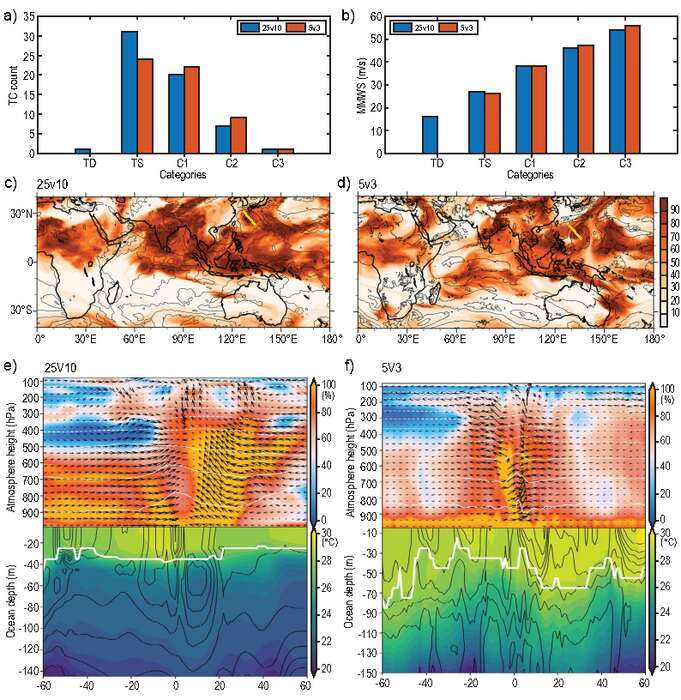
a and b) Distributions of TC counts (panel a) and mean maximum wind speed (MMWS) (panel b) in different categories produced by the 5v3 (red) model in Jan.-Oct. as the model are initialized from the 25v10 state on Jan. 1, 0646-year, compared with the results of 25v10 model in the same period. cd) Distributions of 850 hPa relative humidity (shaded) and wind speed (contours) in the 25v10 model (panel c) at 00UTC of Sep. 3 and 5v3 model at 06UTC of Aug. 31 as the C3 category TC (marked by the green segment in each panel) in both models reaches its maximum wind speed. e and f) The atmosphere and ocean conditions on the air-sea interface in the vertical section of the TC marked by the thick green segment in panels c (for 25v10) and d (for 5v3). The dashed red vertical line represents the center of TC; the atmosphere (ocean) relative humidity (%) (temperature: oC) is color shaded, while the atmosphere (ocean) temperature (unit: oC) (salinity: psu) is contoured, and the vector arrows always represent the atmospheric (u,w×102) (unit: m/s) (ocean currents: 0.04 m/s). The white-bold line represents the mixing layer depth.

China develops Earth system models with clouds, ocean submesoscale eddies

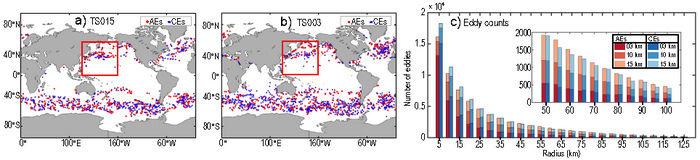
It has been a dream for Earth scientists to have a numerical model that can better represent compound multiple-scale processes in the real-world Earth system. Apart from requiring a deep understanding of the physics of geo-fluid motions, developing such a model demands interdisciplinary advancement in the Earth sciences and high-performance supercomputing as well as software engineering. "The successful development of Earth system models with clouds and ocean submesoscale eddies permitted is a milestone in the advancement of understanding the Earth system," said Dr. Lixin Wu. a and b) Spatial distributions of eddy centroids for Anticyclonic Eddies (AEs) (red) and Cyclonic Eddies (CEs) (blue) with amplitude > .05 m, detected from a) TS015 (panel a) and TS003 (panel b) models, and c) histogram of eddy radius constructed from TS015, TS010 and TS003 for the last year of 3-year model spinup. Red and blue bars stand for AEs and CEs, respectively. The radius range in 50-100 km (denoted by the red box) is zoomed-in the upper-right corner.
Based on the newly-developed “Sunway” heterogeneous architecture supercomputer which has high-performance computing capability, Shaoqing Zhang, Lixin Wu, and Yang Gao, a group of scientists at the Ocean University of China, together with Shiming Xu, Haohuan Fu, and Zhao Liu, a group of professors and engineers at Tsinghua University and National Wuxi Supercomputing Center, organize a large cross-field group of scientists and engineers to take the challenges and develop new high-resolution Earth system models.

After resolving plenty of physical and engineering issues, the large group successfully developed a series of high-resolution coupled Earth system models consisting of 12, 9, and 5 km resolution atmosphere-land models and 15, 10, 5, and 3 km resolution ocean-ice models. “These models can meet the needs of multiscale interaction studies with different computational costs," said Dr. Shaoqing Zhang.

These high-resolution models can simulate cloud cells and ocean submesoscale vortex filaments to some degree. Therefore, they can bring a new understanding of weather-climate mechanisms from the perspective of cross-scale interactions. "The most exciting results from these new high-resolution models are that the major weather-climate extremes in the atmosphere and ocean are captured, stressing the importance of permitted clouds and ocean submesoscale eddies in modeling tropical cyclones and eddy-mean flow interactions,” said Drs. Shiming Xu and Yang Gao.

“The new heterogeneous many-core architecture high-performance supercomputer brings new opportunities for climate modeling once the optimization of heterogeneous architecture computing is efficiently implemented. The low work consumption of heterogeneous architecture computing complies with the ‘green’ future of the world,” said Drs. Haohuan Fu and Zhao Liu. 

The new high-resolution Earth system models lay the foundation for future efforts to sustain the advancement of the Earth sciences through modeling more complex biogeochemical processes and carbon cycling. “These models pave for further model development to resolve finer scales with even higher resolution and more realistic physics. For example, based on these results, development of a non-hydrostatic, cloud and ocean submesoscale resolving Earth system model has been undergoing,” said Drs. Shaoqing Zhang and Yang Gao.
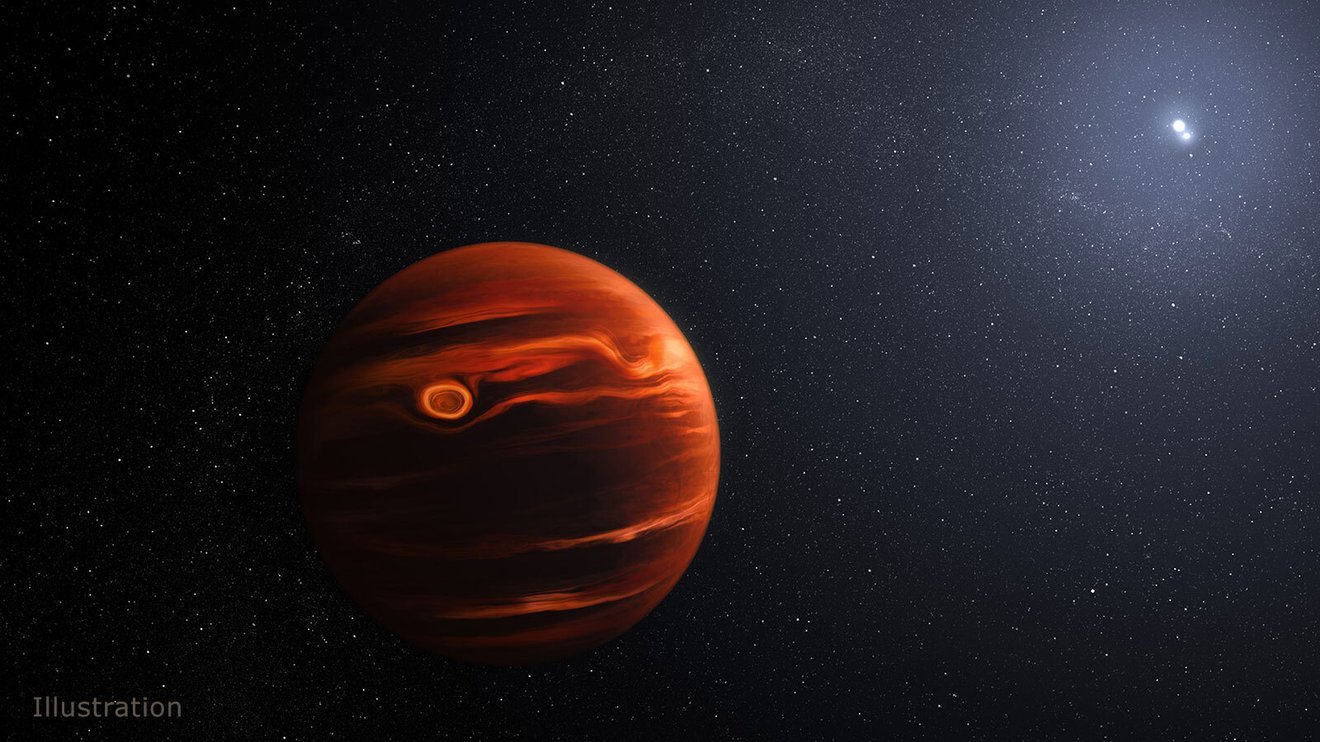
This illustration shows the swirling clouds identified by the James Webb Space Telescope in the atmosphere of exoplanet VHS 1256 b. The planet is about 40 light-years away and orbits two stars. The planet’s clouds, which are filled with silicate dust, are constantly rising, mixing, and moving. Credit: NASA, ESA, CSA, Joseph Olmsted (STScI)

NASA’s Webb spots swirling, gritty clouds on faraway planet

In just a few hours of observations, the space telescope revealed a dynamic atmosphere on a planet 40 light-years from Earth.

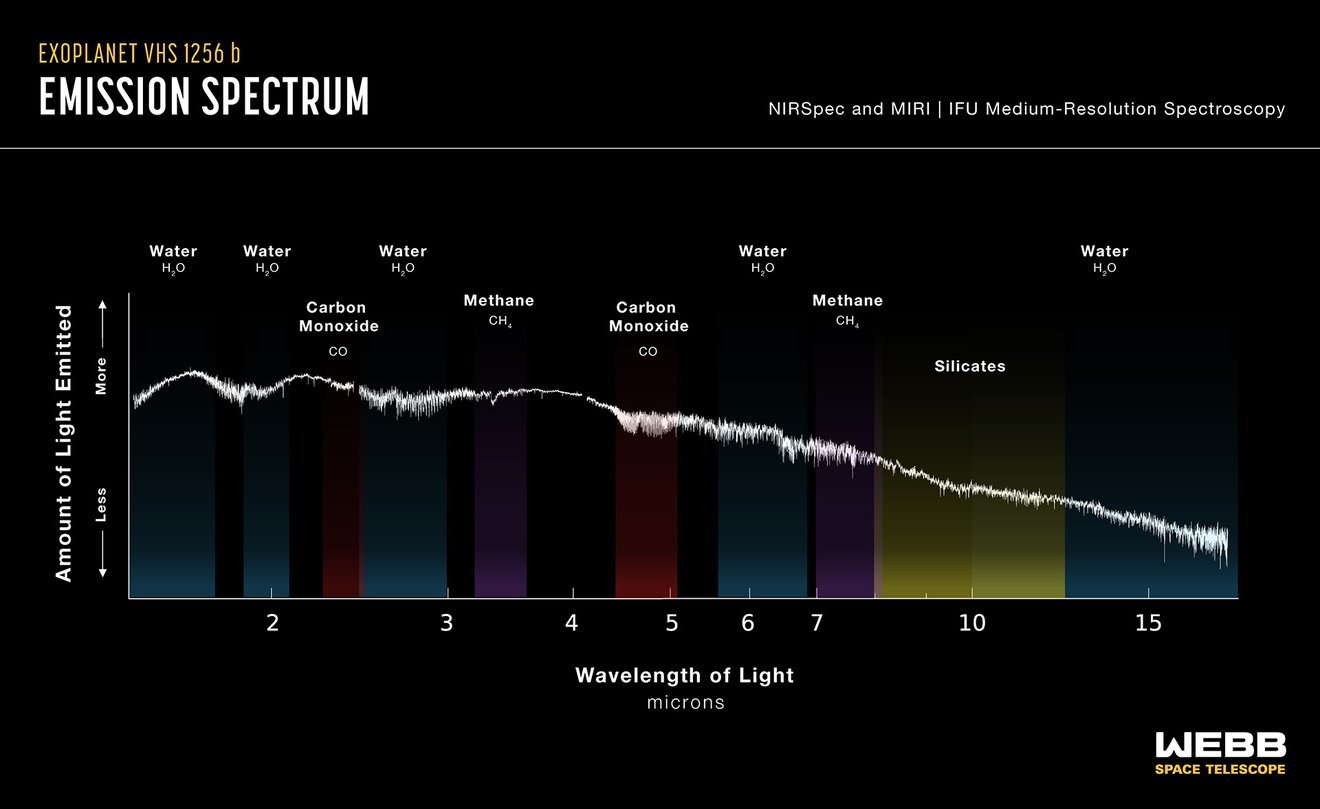
Researchers observing NASA’s James Webb Space Telescope have pinpointed silicate cloud features in a distant planet’s atmosphere. The atmosphere is constantly rising, mixing, and moving during its 22-hour day, bringing hotter material up and pushing colder material down. The resulting brightness changes are so dramatic that it is the most variable planetary-mass object known to date. The team, led by Brittany Miles of the University of Arizona, also made extraordinarily clear detections of water, methane, and carbon monoxide with Webb’s data, and found evidence of carbon dioxide. This is the largest number of molecules ever identified all at once on a planet outside our solar system. Instruments aboard the James Webb Space Telescope known as spectrographs, one on its Near Infrared Spectrograph (NIRSpec) and another on its Mid-Infrared Instrument (MIRI), observed planet VHS 1256 b. The resulting spectrum shows signatures of silicate clouds, water, methane, and carbon monoxide. Credit: NASA, ESA, CSA, J. Olmsted (STScI); Science: Brittany Miles (University of Arizona), Sasha Hinkley (University of Exeter), Beth Biller (University of Edinburgh), Andrew Skemer (University of California, Santa Cruz)

Cataloged as VHS 1256 b, the planet is about 40 light-years away and orbits not one, but two stars over a 10,000-year period. “VHS 1256 b is about four times farther from its stars than Pluto is from our Sun, which makes it a great target for Webb,” Miles said. “That means the planet’s light is not mixed with light from its stars.” Higher up in its atmosphere, where the silicate clouds are churning, temperatures reach a scorching 1,500 degrees Fahrenheit (830 degrees Celsius).

Within those clouds, Webb detected both larger and smaller silicate dust grains, which are shown on a spectrum. “The finer silicate grains in its atmosphere may be more like tiny particles in smoke,” noted co-author Beth Biller of the University of Edinburgh in Scotland. “The larger grains might be like very hot, very small sand particles.”

VHS 1256 b has low gravity compared to more massive brown dwarfs, which means that its silicate clouds can appear and remain higher in its atmosphere where Webb can detect them. Another reason its skies are so turbulent is the planet’s age. In astronomical terms, it’s quite young. Only 150 million years have passed since it formed – and it will continue to change and cool over billions of years.

In many ways, the team considers these findings to be the first “coins” pulled out of a spectrum that researchers view as a treasure chest of data. They’ve only begun identifying its contents. “We’ve identified silicates, but better understanding which grain sizes and shapes match specific types of clouds is going to take a lot of additional work,” Miles said. “This is not the final word on this planet – it is the beginning of a large-scale modeling effort to fit Webb’s complex data.”

Although all of the features the team observed have been spotted on other planets elsewhere in the Milky Way by other telescopes, other research teams typically identified only one at a time. “No other telescope has identified so many features at once for a single target,” said co-author Andrew Skemer of the University of California, Santa Cruz. “We’re seeing a lot of molecules in a single spectrum from Webb that detail the planet’s dynamic cloud and weather systems.”

The team came to these conclusions by analyzing data known as spectra gathered by two instruments aboard Webb, the Near-Infrared Spectrograph (NIRSpec) and the Mid-Infrared Instrument (MIRI). Since the planet orbits at such a great distance from its stars, the researchers were able to observe it directly, rather than using the transit technique or a coronagraph to take this data.

There will be plenty more to learn about VHS 1256 b in the months and years to come as this team – and others – continue to sift through Webb’s high-resolution infrared data. “There’s a huge return on a very modest amount of telescope time,” Biller added. “With only a few hours of observations, we have what feels like the unending potential for additional discoveries.”

What might become of this planet billion of years from now? Since it’s so far from its stars, it will become colder over time, and its skies may transition from cloudy to clear.

The researchers observed VHS 1256 b as part of Webb’s Early Release Science program, which is designed to help transform the astronomical community’s ability to characterize planets and the disks where they form.

The team’s paper, entitled “The JWST Early Release Science Program for Direct Observations of Exoplanetary Systems II: A 1 to 20 Micron Spectrum of the Planetary-Mass Companion VHS 1256-1257 b,” will be published in The Astrophysical Journal Letters on March 22.

Acceldata offers cost-effective, flexible alternative to legacy Cloudera

The solution provides a simplified option, increased ROI, and improved performance amidst the threat of forced migration

Acceldata has announced that it would offer an alternative option for legacy Hortonworks Data Platform (HDP) / Cloudera Data Hub (CDH) customers. Cloudera has announced that it plans to suspend support for HDP/CDH on Sept. 30, 2022. This move will require legacy customers to upgrade in order to receive continued support from Cloudera.

Acceldata offers a flexible, cost-effective, and highly optimized software and support solution that gives customers options to remain on-premises or migrate to cloud data platforms. Acceldata provides an economical and simplified alternative to forced migration and removes the need for organizations to go through the expensive process of rewriting data pipelines to work with the recent Cloudera release.  

Acceldata’s software solution for long-term data platform independence delivers increased performance, reliability, and cost savings. With Acceldata, customers can improve workload performance by 30-40% and save up to 70% on Cloudera support licenses with improved turnaround times for issue resolution.

“This forced migration is unsettling for the large number of companies that still run Hadoop on-premises. Acceldata’s software and service offers a win-win for legacy Cloudera customers as they are no longer locked in with a single vendor and now have the freedom to choose which options work best for them,” said Chandra Sharma, head of customer success, Acceldata. “By eliminating the need to update data pipelines, Acceldata’s data observability platform can significantly decrease cost and increase performance from what they had previously with Cloudera.”

Acceldata offers the following options:

  • Stay on-premises with your current Hadoop release, without the need for Cloudera support 
  • Migrate to the cloud warehouse of your choice and use Acceldata’s insight into application workloads to increase adoption and align cloud warehouse performance, cost, and value 
  • Move to Apache open source confidently and be 100% vendor/distribution independent

Robi Axiata, one of Bangladesh's largest mobile network operators, has become one of the most important telecommunications providers in Asia with nearly $1 billion in annual revenue and more than 50 million subscribers. The company operates a large, complex analytics environment, which runs on a six-petabyte data warehouse for insights into real-time customer events. Previously using Cloudera, Robi Axiata turned to Acceldata when it was experiencing frequent issues with its Hadoop-based data warehouse. 

"With Cloudera, it took 3-6 weeks to perform root cause analysis for system issues, which was creating frustration and potentially causing damage to our customer relationships. But, with Acceldata, we are now completing our root cause analysis in only one minute,” said Mohammad Solaimun Rasel, VP, Platform Planning and Management Department, Robi Axiata Limited.