

SUPERCOMPUTING NEWS SUPERCOMPUTING NEWS
    • MEDIA KIT
    • MOST READ
    • RSS FEED
    • ACADEMIA
    • AEROSPACE
    • APPLICATIONS
    • ASTRONOMY
    • AUTOMOTIVE
    • BIG DATA
    • BIOLOGY
    • CHEMISTRY
    • CLIENTS
    • CLOUD
    • DEFENSE
    • DEVELOPER TOOLS
    • EARTH SCIENCES
    • ECONOMICS
    • ENGINEERING
    • ENTERTAINMENT
    • GAMING
    • GOVERNMENT
    • HEALTH
    • OIL & GAS
    • INDUSTRY
    • INTERCONNECTS
    • MANUFACTURING
    • MIDDLEWARE
    • MOVIES
    • NETWORKS
    • PHYSICS
    • PROCESSORS
    • RETAIL
    • SCIENCE
    • STORAGE
    • SYSTEMS
    • VISUALIZATION
    • AcyMailing subscription form

    • ADD YOUR VIDEOS
    • MANAGE VIDEOS
    • CONVERSATION INBOX
    • SOCIAL ADVERTISER
    • SOCIAL NETWORK VIDEOS
    • SURVEYS
    • GROUPS
    • PAGES
    • MARKETPLACE LISTINGS
    • APPLICATIONS BROWSER
    • PRIVACY CONFIRM REQUEST
    • PRIVACY CREATE REQUEST
    • LEADERBOARD
    • POINTS LISTING
      • BADGES
    • TRADE SHOWS
Sign In
Tyler O'Neal, Staff Editor EARTH SCIENCES May 26, 2021, 10:00 am

What causes the deep Earth's most mysterious earthquakes?

The cause of Earth's deepest earthquakes has been a mystery to science for more than a century, but a team of scientists may have cracked the case.

New research published in AGU Advances provides evidence that fluids play a key role in deep-focus earthquakes--which occur between 300 and 700 kilometers below the planet's surface. The research team includes Carnegie scientists Steven Shirey, Lara Wagner, Peter van Keken, and Michael Walter, as well as the University of Alberta's Graham Pearson.

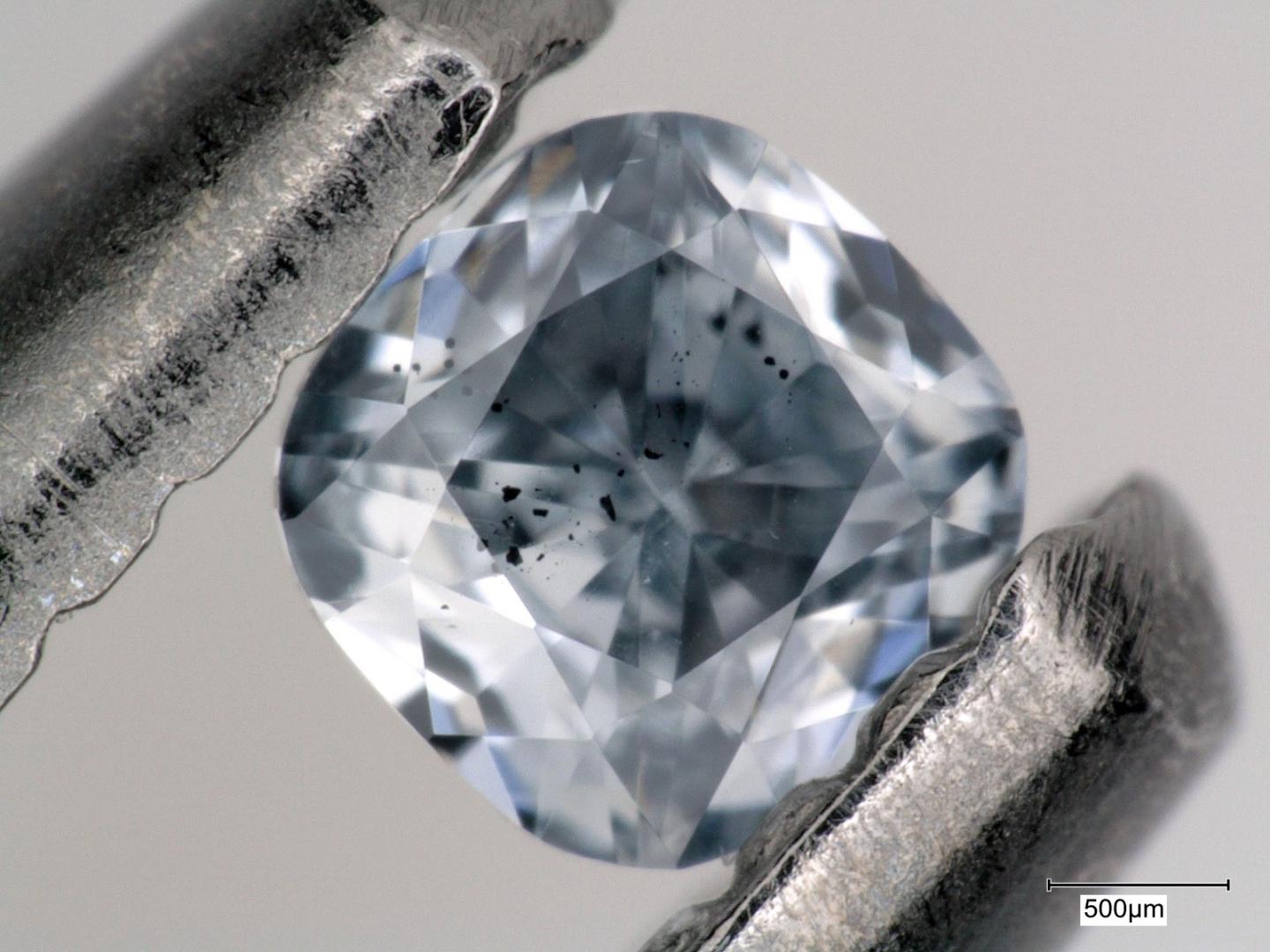
Most earthquakes occur close to the Earth's surface, down to about 70 kilometers. They happen when stress builds up at a fracture between two blocks of rock--known as a fault--causing them to suddenly slide past each other. This close-up view of a super-deep diamond highlights its inclusions, seen here as black spots. Inclusions like these provide geochemical evidence that a sinking oceanic plate can carry water and other fluids deep into the mantle.  CREDIT Photo by Evan Smith/© 2021 GIA
However, deeper into the Earth, the intense pressures create too much friction to allow this kind of sliding to occur and the high temperatures enhance the ability of rocks to deform to accommodate changing stresses. Though theoretically unexpected, scientists have been able to identify earthquakes that originate more than 300 kilometers below the surface since the 1920s.

"The big problem that seismologists have faced is how it's possible that we have these deep-focus earthquakes at all," said Wagner. "Once you get a few tens of kilometers down, it becomes incredibly difficult to explain how we are getting a slip on a fault when the friction is so incredibly high."

Ongoing work over the past several decades has shown us that water plays a role in intermediate-depth earthquakes--those that occur between 70 and 300 kilometers below Earth's surface. In these instances, water is released from minerals, which weakens the rock around the fault and allows the blocks of rock to slip. However, scientists didn't think this phenomenon could explain deep-focus earthquakes, largely because it was believed that water and other fluid-creating compounds couldn't make it far enough down into the Earth's interior to provide a similar effect.

This thinking changed for the first time when Shirey and Wagner compared the depths of rare deep-Earth diamonds to the mysterious deep-focus earthquakes.

"Diamonds form in fluids" explained Shirey, "if diamonds are there, fluids are there."

The diamonds themselves indicated the presence of fluids, however, they also brought samples of the deep-Earth to the surface for the scientists to study. When diamonds form in the Earth's interior, they sometimes capture pieces of minerals from the surrounding rock. These minerals are called inclusions and they may make your jewelry less expensive, but they are invaluable to Earth scientists. They are one of the only ways scientists can study direct samples of our planet's deep interior. 

The diamond's inclusions had the distinct chemical signature of similar materials found in oceanic crust. This means that the water and other materials weren't somehow created deep in the Earth's interior. Instead, they were carried down as part of a sinking oceanic plate.

Said Wagner: "The seismology community had moved away from the idea that there could be water that deep. But diamond petrologists like Steve were showing us samples and saying 'No, no, no. There's definitely water down here' So then we all had to get together to figure out how it got down there." 

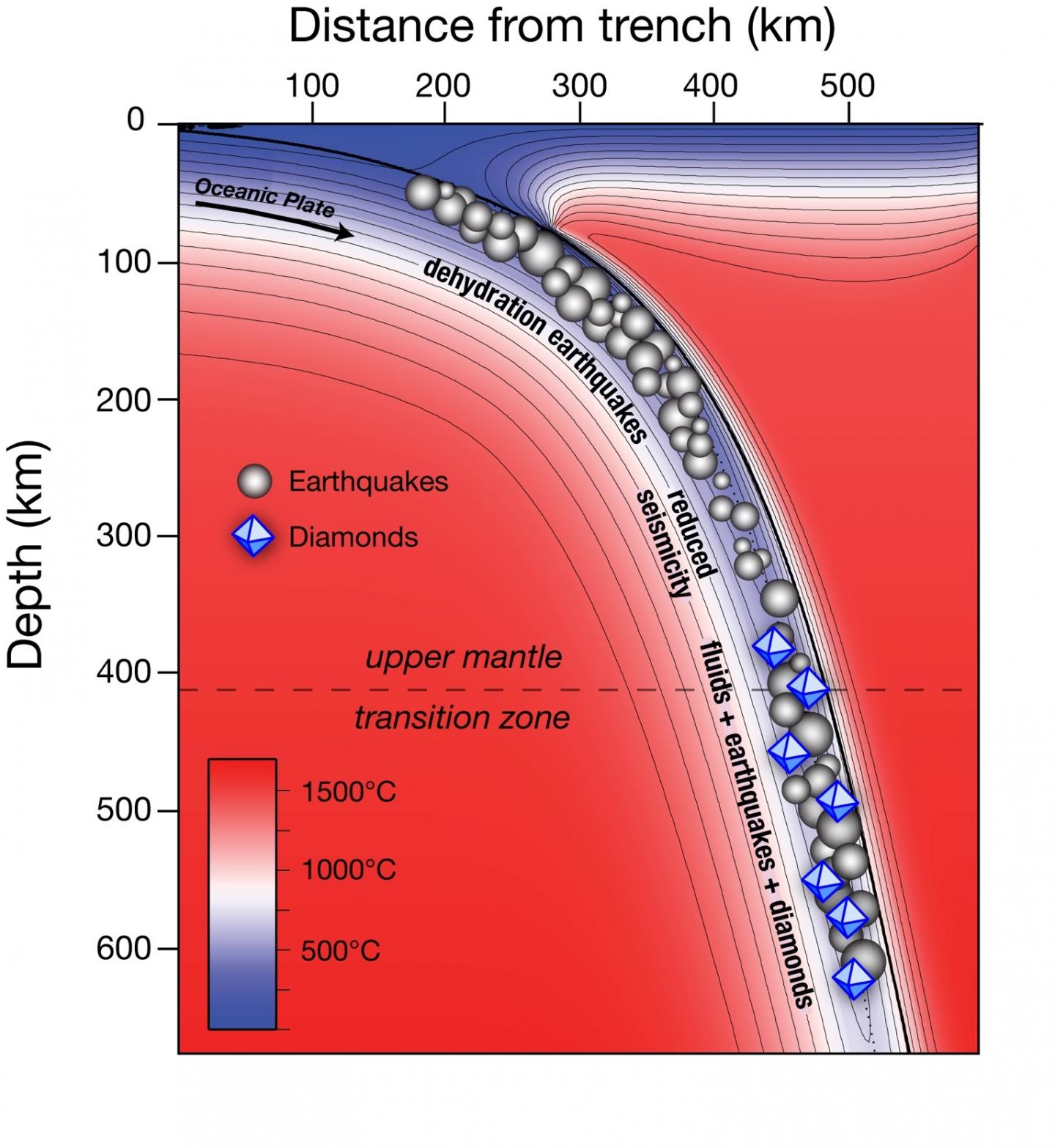
To test the idea, Wagner and van Keken built super computational models to simulate the temperatures of sinking slabs at much greater depths than had been attempted before. In addition to the modeling, Walter examined the stabilities of the water-bearing minerals to show that under the intense heat and pressures of the Earth's deep interior, they would, indeed, be capable of holding on to water in certain conditions. The team showed that even though warmer plates didn't hold water, the minerals in the cooler oceanic plates could theoretically carry water to the depths we associate with deep-focus earthquakes. Some of Earth's largest earthquakes occur at tremendous depths (500-700 km) beneath the surface, always within or near oceanic plates that have sunk back into the Earth's interior. The cause of these events has been an enduring question in geology and geophysics for more than 40 years. In a new paper, a team of Carnegie and University of Alberta geoscientists provide several lines of evidence that fluids contribute to the genesis of deep earthquakes. New thermal modeling shows that carbonated crust and hydrated mantle in cold slabs can transport these fluids down to where deep earthquakes occur. Evidence from diamonds provides mineralogical proof of these mobile fluids in the mantle transition zone (440 - 670 km depth). This figure shows a sample thermal model of a subduction zone, with the relatively cold (blue) oceanic plate sinking into the comparatively hot (red) mantle. Three regions of earthquakes (grey spheres) visible in the oceanic plate: "intermediate-depth" dehydration-related earthquakes occurring between ~70 and ~250 km, a region of reduced seismicity between ~250 and ~350 km, and the region of "deep" seismicity below 350 km that extends to ~700 km. Superdeep diamonds (blue octahedra) are known to crystallize from fluids released in this deep region as the oceanic plate warms by the heat from the surrounding mantle.  CREDIT Illustration by Steven Shirey, Peter van Keken, Lara Wagner, and Michael Walter/Carnegie Institution for Science
To solidify the study the team compared the simulations to real-life seismological data. They were able to show that the slabs that could theoretically carry water to these depths were also the ones experiencing the previously unexplained deep earthquakes.

This study is unusual in applying four different disciplines--geochemistry, seismology, geodynamics, and petrology--to the same question, all of which point to the same conclusion: water and other fluids are a key component of deep-focus earthquakes.

"The nature of deep earthquakes is one of the big questions in geoscience," said Shirey. "We needed all four of these different disciplines to come together to make this argument. It turned out we had them all in-house at Carnegie."
Miami researchers shine a light on hazards of Earth's largest volcano

Tyler O'Neal, Staff Editor EARTH SCIENCES May 25, 2021, 6:00 pm

Researchers find that a large earthquake could set off an eruption of Hawaii's Mauna Loa volcano

Scientists from the University of Miami (UM) Rosenstiel School of Marine and Atmospheric Science analyzed ground movements measured by Interferometric Synthetic Aperture Radar (InSAR) satellite data and GPS stations to precisely model where magma intruded and how magma influx changed over time, as well as where faults under the flanks moved without generating significant earthquakes. The GPS network is operated by the U.S. Geological Survey's Hawaii Volcano Observatory.

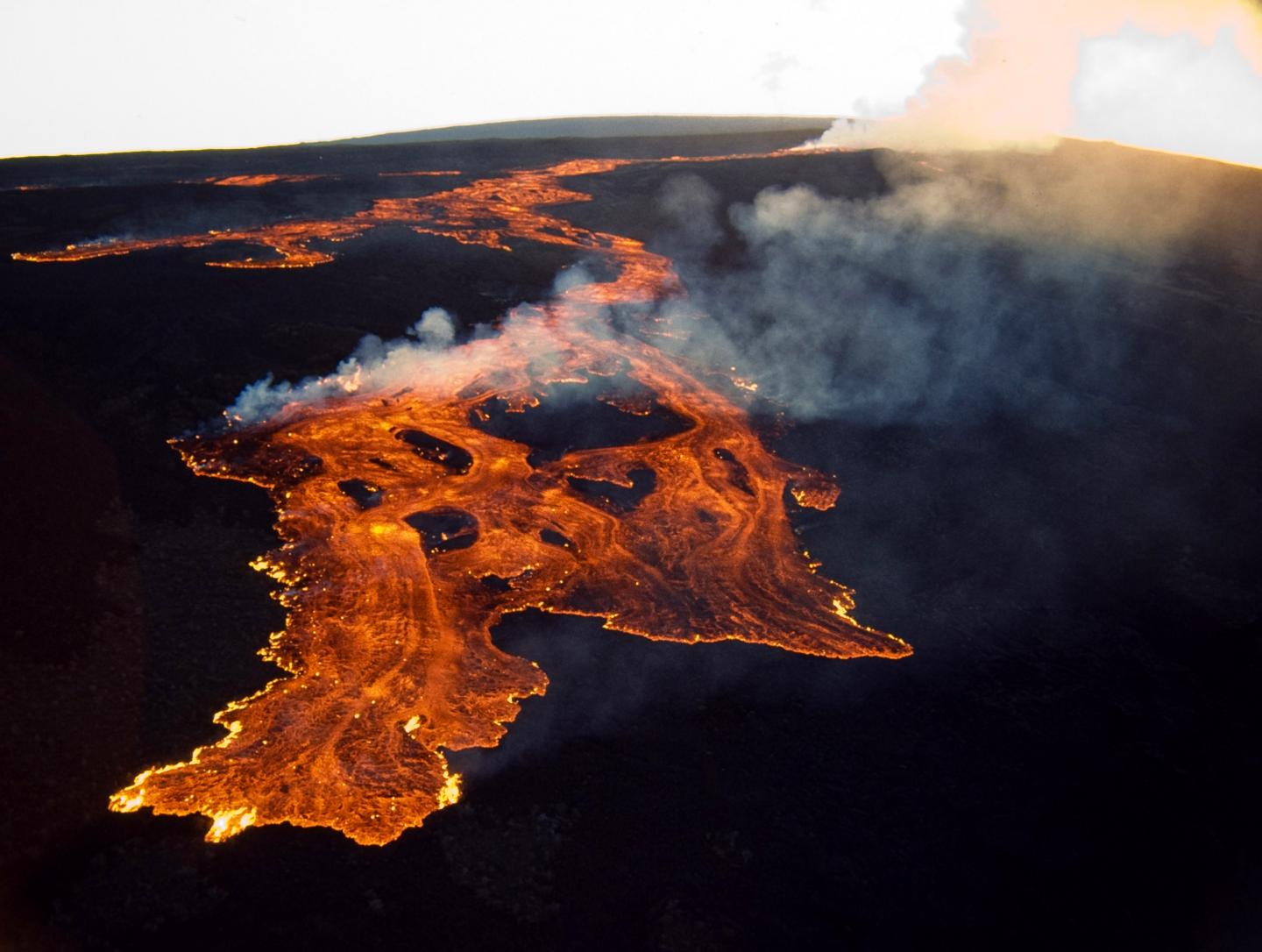
"An earthquake of magnitude-6 or greater would relieve the stress imparted by the influx of magma along a sub-horizontal fault under the western flank of the volcano," said Bhuvan Varugu, a Ph.D. candidate at the UM Rosenstiel School and lead author of the study. "This earthquake could trigger an eruption." Standing 9 kilometers tall from the base on the seafloor to the summit, Mauna Loa is the largest volcano on Earth.

The researchers found that during 2014-2020 a total of 0.11 kilometers3 of new magma intruded into a dike-like magma body located under and south of the summit caldera, with the upper edge at 2.5 - 3 kilometers depth beneath the summit. They were able to determine that in 2015 the magma began expanding southward, where the topographic elevation is lower and the magma had less work to do against the topographic pressure. After the magma flux waned in 2017, the inflation center returned to its previous 2014-2015 horizontal position. Such changes of a magma body have never been observed before.

"At Mauna Loa, flank motion and eruptions are inherently related," said Varugu. "The influx of new magma started in 2014 after more than four years of seaward motion of the eastern flank - which opened up space in the rift zone for the magma to intrude."

The researchers also found that there was a movement not associated with an earthquake along a near-horizontal fault under the eastern flank, however, no movement was detected under the western flank. This led the researchers to conclude that an earthquake under the western flank is due. Motions along near-horizontal faults under the flanks are essential features of long-term volcano growth.

Will the volcano erupt in the near future? "If magma influx continues it is likely, but not required," says Varugu. "The topographic load is pretty heavy, the magma could also propagate laterally through the rift zone".

"An earthquake could be a game-changer," said Falk Amelung, a professor at the UM Rosenstiel School's Department of Marine Geosciences and senior author of the study. "It would release gases from the magma comparable to shaking a soda bottle, generating additional pressure and buoyancy, sufficient to break the rock above the magma."

According to the researchers, there are many uncertainties. Though the stress that was exerted along the fault is known, the magnitude of the earthquake will also depend on the size of the fault patch that will actually rupture. Additionally, there are no satellite data available to determine movements prior to 2002.

"It is a fascinating problem," said Amelung, "We can explain how and why the magma body changed during the past six years. We will continue observing and this will eventually lead to better models to forecast the next eruption site."

Standing 9 kilometers tall from the base on the seafloor to the summit, Mauna Loa is the largest volcano on Earth. In the 1950 eruption, it took only three hours for the lava to reach the Kona coast. Such rapid flows would leave very little time to evacuate people in the path of its lava. Another large eruption of Mauna Loa occurred in 1984.

The combination of earthquakes and eruptions is nothing unusual. The 1950 eruption was preceded by a magnitude 6.3 earthquake three days prior and was followed by a magnitude 6.9 earthquake more than a year later. The 1984 eruption was preceded by a magnitude 6.6 earthquake 5 months prior.

The satellite data were acquired by the Italian Cosmo-Skymed satellites in the framework of the Geohazard Supersites and Natural Laboratories (GSNL) initiative of the Group on Earth Observation (GEO), an international umbrella organization to enhance the use of Earth Observation for societal benefits. Several space agencies pool their satellite resources to enable new studies of hazardous volcanoes. Other volcano supersites include the Icelandic, Ecuadorian, and New Zealand volcanoes as well as Italy's Mt. Etna.

Europe's space freighter Automated Transfer Vehicle Jules Verne burning up over an uninhabited area of the Pacific Ocean at the end of its mission

Tyler O'Neal, Staff Editor EARTH SCIENCES May 13, 2021, 6:09 pm
CREDIT ESA

...

Read more https://www.supercomputingonline.com/categories-media/people-blogs/europe-s-space-freighter-automated-transfer-vehicle-jules-verne-burning-up-over-an-uninhabited-area-of-the-pacific-ocean-at-the-end-of-its-mission

  1. Simulations show Earth's deep mantle may have proton rivers made of superionic phases
  2. LIGO, Virgo scientists discover new gravitational wave

Page 17 of 23

  • 12
  • 13
  • 14
  • 15
  • 16
  • 17
  • 18
  • 19
  • 20
  • 21
POPULAR RIGHT NOW
  • AI supercharges the hunt for stronger magnets: Iowa State researchers launch a new era of intelligent materials discovery
    AI supercharges the hunt for stronger magnets: Iowa State researchers launch a new era of intelligent materials discovery
  • IBM's Historic stock collapse raises questions for the future of enterprise supercomputing
    IBM's Historic stock collapse raises questions for the future of enterprise supercomputing
  • Could a novel dark matter theory simultaneously resolve multiple cosmic enigmas? Supercomputer simulations provide a compelling, albeit currently unverified, potential solution
    Could a novel dark matter theory simultaneously resolve multiple cosmic enigmas? Supercomputer simulations provide a compelling, albeit currently unverified, potential solution
  • Melting icebergs may be reshaping Earth’s greatest ocean current
    Melting icebergs may be reshaping Earth’s greatest ocean current
  • Supercomputers replace ‘bathtub’ flood maps with physics-based digital twins of Britain’s coastline
    Supercomputers replace ‘bathtub’ flood maps with physics-based digital twins of Britain’s coastline
  • Supercomputers push neural quantum simulation beyond previous limits
    Supercomputers push neural quantum simulation beyond previous limits
  • Intel’s AI supercomputing revival: Q2 financial surge signals new era for CPU-powered HPC infrastructure
    Intel’s AI supercomputing revival: Q2 financial surge signals new era for CPU-powered HPC infrastructure
  • AI infrastructure financing fears shake semiconductor sector
    AI infrastructure financing fears shake semiconductor sector
  • AWS supercomputing investment reaches historic scale as Amazon’s AI strategy powers record financial results
    AWS supercomputing investment reaches historic scale as Amazon’s AI strategy powers record financial results
  • Catching the wave of the future: Supercomputers unlock the hidden dynamics of Venus
    Catching the wave of the future: Supercomputers unlock the hidden dynamics of Venus
THIS YEAR'S MOST READ
  • Wall Street wants to trade supercomputing power like oil
    Wall Street wants to trade supercomputing power like oil
  • Beamforming the future: BeammWave's 6G push signals the rise of orbital-terrestrial wireless networks
    Joakim Axmon
    Joakim Axmon
  • Cosmic ambition at scale: UK’s supercomputer unlocks a 2.5 petabytes universe
    Cosmic ambition at scale: UK’s supercomputer unlocks a 2.5 petabytes universe
  • Hidden order, revealed at scale: Supercomputing, electron ptychography uncover the inner workings of relaxor ferroelectrics
    Hidden order, revealed at scale: Supercomputing, electron ptychography uncover the inner workings of relaxor ferroelectrics
  • Intel's Q1 results signal supercomputing surge driving Xeon momentum
    Intel's Q1 results signal supercomputing surge driving Xeon momentum
  • When stars fall apart: Supercomputing reveals the hidden physics of black holes
    When stars fall apart: Supercomputing reveals the hidden physics of black holes
  • Multi-layer simulations reveal the hidden supply chain of solar prominences
    Multi-layer simulations reveal the hidden supply chain of solar prominences
  • Japanese scientists decode dolphin speed with supercomputing: Turbulence, vortices, and the hidden physics of propulsion
    Japanese scientists decode dolphin speed with supercomputing: Turbulence, vortices, and the hidden physics of propulsion
  • Cosmic feedback at scale: Supercomputing reveals how quasars regulate the early Universe
    Cosmic feedback at scale: Supercomputing reveals how quasars regulate the early Universe
  • Modeling life at the microscopic scale: A computational breakthrough in oxygen transport
    Modeling life at the microscopic scale: A computational breakthrough in oxygen transport
MOST READ OF ALL-TIME
  • Largest Computational Biology Simulation Mimics The Ribosome
    Details
    112127
    The amino acid (green) slithers into the chemical reaction center, moving through an evolutionarily ancient corridor of the ribosome (purple). The amino acid is delivered to the reaction core by the transfer RNA molecule (yellow).
    The amino acid (green) slithers into the chemical reaction center, moving through an evolutionarily ancient corridor of the ribosome (purple). The amino acid is delivered to the reaction core by the transfer RNA molecule (yellow).
  • Silicon 'neurons' may add a new dimension to chips
    Details
    81040
    Silicon 'neurons' may add a new dimension to chips
  • Linux Networx Accelerators Expected to Drive up to 4x Price/Performance
    Details
    75563
  • Complex Concepts That Really Add Up
    Details
    73693
    Complex Concepts That Really Add Up
  • Blue Sky Studios Donates Animation SuperComputer to Wesleyan
    Details
    68166
    Each rack holds 52 Angstrom Microsystem-brand “blades,” with a memory footprint of 12 or 24 gigabytes each. (Photos by Olivia Bartlett Drake)
    Each rack holds 52 Angstrom Microsystem-brand “blades,” with a memory footprint of 12 or 24 gigabytes each. (Photos by Olivia Bartlett Drake)
  • Humanities, HPC connect at NERSC
    Details
    57973
  • TeraGrid ’09 'Call for Participation'
    Details
    54976
  • Turbulence responsible for black holes' balancing act
    Details
    52339
  • Cray Wins $52 Million SuperComputer Contract
    Details
    50162
  • SDSC Researchers Accurately Predict Protein Docking
    Details
    46115
  • FRONTPAGE
  • LATEST
  • POPULAR
  • REGISTER
  • SOCIAL
  • VIDEO
  • SUBSCRIPTION
  • RSS
  • GUIDELINES
  • PRIVACY
  • TOS
  • ABOUT
  • +1 (816) 799-4488
  • editorial@supercomputingonline.com
© 2001 - 2026 SuperComputingOnline.com, LLC. All rights reserved. This material may not be published, broadcast, rewritten or redistributed without permission.
Sign In
  • FRONT PAGE
  • LATEST
    • MEDIA KIT
    • MOST READ
    • RSS FEED
    • ACADEMIA
    • AEROSPACE
    • APPLICATIONS
    • ASTRONOMY
    • AUTOMOTIVE
    • BIG DATA
    • BIOLOGY
    • CHEMISTRY
    • CLIENTS
    • CLOUD
    • DEFENSE
    • DEVELOPER TOOLS
    • EARTH SCIENCES
    • ECONOMICS
    • ENGINEERING
    • ENTERTAINMENT
    • HEALTH
    • INDUSTRY
    • INTERCONNECTS
    • GAMING
    • GOVERNMENT
    • MANUFACTURING
    • MIDDLEWARE
    • MOVIES
    • NETWORKS
    • OIL & GAS
    • PHYSICS
    • PROCESSORS
    • RETAIL
    • SCIENCE
    • STORAGE
    • SYSTEMS
    • VISUALIZATION
  • VIDEOS
    • ADD YOUR VIDEOS
    • MANAGE VIDEOS
  • COMMUNITY
    • TRADE SHOWS
    • SOCIAL NETWORK VIDEOS
    • SURVEYS
    • APPLICATIONS BROWSER
    • CONVERSATION INBOX
    • SOCIAL ADVERTISER
    • GROUPS
    • MARKETPLACE LISTINGS
    • PAGES
    • LEADERBOARD
    • POINTS LISTING
      • BADGES
    • PRIVACY CONFIRM REQUEST
    • PRIVACY CREATE REQUEST

Hey there! We noticed you’re using an ad blocker.