

SUPERCOMPUTING NEWS SUPERCOMPUTING NEWS
    • MEDIA KIT
    • MOST READ
    • RSS FEED
    • ACADEMIA
    • AEROSPACE
    • APPLICATIONS
    • ASTRONOMY
    • AUTOMOTIVE
    • BIG DATA
    • BIOLOGY
    • CHEMISTRY
    • CLIENTS
    • CLOUD
    • DEFENSE
    • DEVELOPER TOOLS
    • EARTH SCIENCES
    • ECONOMICS
    • ENGINEERING
    • ENTERTAINMENT
    • GAMING
    • GOVERNMENT
    • HEALTH
    • OIL & GAS
    • INDUSTRY
    • INTERCONNECTS
    • MANUFACTURING
    • MIDDLEWARE
    • MOVIES
    • NETWORKS
    • PHYSICS
    • PROCESSORS
    • RETAIL
    • SCIENCE
    • STORAGE
    • SYSTEMS
    • VISUALIZATION
    • AcyMailing subscription form

    • ADD YOUR VIDEOS
    • MANAGE VIDEOS
    • CONVERSATION INBOX
    • SOCIAL ADVERTISER
    • SOCIAL NETWORK VIDEOS
    • SURVEYS
    • GROUPS
    • PAGES
    • MARKETPLACE LISTINGS
    • APPLICATIONS BROWSER
    • PRIVACY CONFIRM REQUEST
    • PRIVACY CREATE REQUEST
    • LEADERBOARD
    • POINTS LISTING
      • BADGES
    • TRADE SHOWS
Sign In
Tyler O'Neal, Staff Editor EARTH SCIENCES October 23, 2020, 5:42 pm

Scripps chemists develop framework to enable efficient synthesis of 'information-dense' molecules

Researchers harness information theory to better understand how to make complex and compact molecules resembling those in nature.

A team led by scientists at Scripps Research has developed a theoretical approach that could ease the process of making highly complex, compact molecules.

Such molecules are often found in plants and other organisms, and many are considered desirable starting points for developing potential new drugs. But they also tend to be highly challenging for chemists to construct and modify in the lab--a process called synthesis.

The team used supercomputer modeling and a theoretical framework centered on the concept of "information density" to illuminate chemistry principles underlying their landmark 2019 synthesis of the molecule bilobalide, which is produced in the leaves of the ginkgo tree, Ginkgo biloba. Bilobalide is a particularly complex and compact molecule that has shown promise as a potential neurological or psychiatric drug. {module INSIDE STORY} An illustrated model of the molecule bilobalide, which is produced in the leaves of the ginkgo tree, overlays the dense molecular information and biological data from rodent studies. (Image courtesy of the Shenvi laboratory at Scripps Research.)
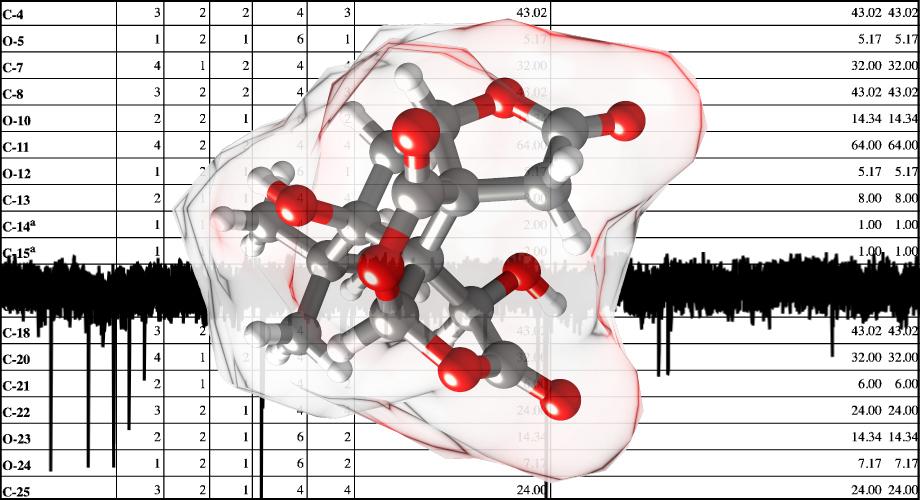
The scientists believe that the theoretical fruits of their new study, published in the Journal of the American Chemical Society, will enable chemists to devise more efficient syntheses of such challenging natural molecules--potentially opening up a new realm of powerfully bioactive compounds for development into medicines and other products.

"When we initially achieved our synthesis of bilobalide, we were essentially following our intuition, but in this new study we dug down to understand how the chemistry actually works and developed principles that we think can be applied to other challenges in organic synthesis," says Ryan Shenvi, Ph.D., a professor of chemistry at Scripps Research and the senior author of the study.

Creating a valuable natural compound

Bilobalide--which evolved in the ginkgo tree, likely to protect its leaves from insects--blocks an insect nerve-cell receptor called RDL. The fact that the molecule kills insects yet seems quite safe in mammals and dissipates quickly in the environment has attracted interest for safe crop protection.

Bilobalide holds strong promise for medicinal use, with evidence that it's relatively safe for humans. It blocks human brain-cell receptors called GABAA receptors, which are evolutionary cousins of insect RDL receptors. An intriguing 2007 study found that the compound could reverse cognitive and memory deficits in mice with a neurological condition modeling human Down syndrome, while other studies have suggested it may protect brain cells from certain kinds of harm.

Although natural bilobalide is synthesized by specialized enzymes in the ginkgo tree's cells, chemists would like to be able to make it in the lab with organic chemistry techniques. In this way, they could obtain large quantities of the compound and modify it to explore and optimize its properties.

But the synthesis of bilobalide has always been a major challenge for scientists because the molecule packs a relatively complex set of atoms--including eight reactive oxygens--into an odd and highly compact chemical structure. If they could overcome that challenge, chemists would have a way to make molecules of potentially enormous value.

"When you have complexity that is condensed to that extent, you start to see interesting emergent properties," Shenvi says.

'Information density' brings a deep understanding

In the study, Shenvi and his colleagues evaluated their 11-step synthesis of bilobalide, achieved in 2019, as well as two longer bilobalide syntheses that had been published previously.

With the help of computational modeling from collaborator Kendall Houk, Ph.D., the Saul Winstein Distinguished Research Chair in Organic Chemistry at UCLA, and a formal theory of "molecular information content" published in 2016 by German researcher Thomas Böttcher, they developed a concept of "information density"--essentially, complexity divided by molecular volume--and used that to analyze the bilobalide syntheses.

Their analysis showed that bilobalide, even compared with other naturally derived, compact, and biologically active molecules, has a very high information density and that its information content comes principally from its oxygen atoms and asymmetric carbon backbone.

The work revealed that the Shenvi lab's synthesis of bilobalide was efficient due to fragment coupling--merging already-complex oxygen-containing molecules--and then making careful modifications to overcome the unusual emergent properties of the system.

The chemistry principles the team developed make sense of their bilobalide synthesis and its greater efficiency over prior syntheses, but are also applicable to many other unsolved problems involving natural-molecule synthesis, the researchers say.

As part of the work, co-author Stefano Forli, Ph.D., wrote a computer script in the Python coding language to automate the calculation of molecular information, which can be otherwise laborious, at the rate of more than 100,000 molecules per minute. (The script is available for download.) Forli is an assistant professor in Scripps Research's Department of Integrative Structural and Computational Biology.

Collaborating investigator Marisa Roberto, Ph.D., a professor in the Department of Molecular Medicine at Scripps Research, studied the activity of bilobalide and another information-dense molecule, jiadifenolide, which Shenvi's team also recently synthesized. In rodent studies, she found that both bilobalide and jiadifenolide showed promise as relatively potent and safe GABAA blockers, suggesting the potential for being translated into drugs for psychiatric conditions involving abnormal GABAA activity.

"The GABA system is dramatically altered in neuropsychiatric disorders such as alcoholism and other forms of addiction, for which one or both of these compounds might one day prove useful," Roberto says.
Johns Hopkins researchers discover 'spooky' similarity in how brains, computers see

Tyler O'Neal, Staff Editor EARTH SCIENCES October 22, 2020, 2:02 pm

Natural and artificial intelligence networks process 3D fragments of visual images in the same way

The brain detects 3D shape fragments (bumps, hollows, shafts, spheres) in the beginning stages of object vision - a newly discovered strategy of natural intelligence that Johns Hopkins University researchers also found in artificial intelligence networks trained to recognize visual objects.

A new paper in Current Biology details how neurons in area V4, the first stage-specific to the brain's object vision pathway, represent 3D shape fragments, not just the 2D shapes used to study V4 for the last 40 years. The Johns Hopkins researchers then identified nearly identical responses of artificial neurons, in an early stage (layer 3) of AlexNet, an advanced computer vision network. In both natural and artificial vision, early detection of 3D shape presumably aids the interpretation of solid, 3D objects in the real world.

"I was surprised to see strong, clear signals for 3D shape as early as V4," said Ed Connor, a neuroscience professor and director of the Zanvyl Krieger Mind/Brain Institute. "But I never would have guessed in a million years that you would see the same thing happening in AlexNet, which is only trained to translate 2D photographs into object labels." {module INSIDE STORY}

One of the long-standing challenges for artificial intelligence has been to replicate human vision. Deep (multilayer) networks like AlexNet have achieved major gains in object recognition, based on high capacity Graphical Processing Units (GPU) developed for gaming and massive training sets fed by the explosion of images and videos on the Internet.

Connor and his team applied the same tests of image responses to natural and artificial neurons and discovered remarkably similar response patterns in V4 and AlexNet layer 3. What explains what Connor describes as a "spooky correspondence" between the brain - a product of evolution and lifetime learning - and AlexNet - designed by computer scientists and trained to label object photographs?

AlexNet and similar deep networks were actually designed in part based on the multi-stage visual networks in the brain, Connor said. He said the close similarities they observed may point to future opportunities to leverage correlations between natural and artificial intelligence.

"Artificial networks are the most promising current models for understanding the brain. Conversely, the brain is the best source of strategies for bringing artificial intelligence closer to natural intelligence," Connor said.

Australian invention to make it easier to find 'new Earths'

Tyler O'Neal, Staff Editor EARTH SCIENCES October 21, 2020, 7:02 pm

Photonics combined with AI will help decipher the ‘twinkle’ of stars

University of Sydney scientists have developed a sensor that will help decipher the 'twinkle' of stars and allow for ground-based exploration of exoplanets. Their invention will be deployed in one of the world's largest telescopes at Mauna Kea, Hawaii.

Australian scientists have developed a new type of sensor to measure and correct the distortion of starlight caused by viewing through the Earth’s atmosphere, which should make it easier to study the possibility of life on distant planets.

Using artificial intelligence and machine learning, the University of Sydney optical scientists have developed a sensor that can neutralize a star’s ‘twinkle’ caused by heat variations in the Earth’s atmosphere. This will make the discovery and study of planets in distant solar systems easier from optical telescopes on Earth.

“The main way we identify planets orbiting distant stars is by measuring regular dips in starlight caused by planets blocking out bits of their sun,” said lead author Dr Barnaby Norris, who holds a joint position as a Research Fellow in the University of Sydney Astrophotonic Instrumentation Laboratory and in the University of Sydney node of Australian Astronomical Optics in the School of Physics. 

“This is really difficult from the ground, so we needed to develop a new way of looking up at the stars. We also wanted to find a way to directly observe these planets from Earth,” he said.

The team’s invention will now be deployed in one of the largest optical telescopes in the world, the 8.2-meter Subaru telescope in Hawaii, operated by the National Astronomical Observatory of Japan.

“It is really hard to separate a star’s ‘twinkle’ from the light dips caused by planets when observing from Earth,” Dr Norris said. “Most observations of exoplanets have come from orbiting telescopes, such as NASA’s Kepler. With our invention, we hope to launch a renaissance in exoplanet observation from the ground.”

Novel methods

Using the new ‘photonic wavefront sensor’ will help astronomers directly image exoplanets around distant stars from Earth.

Over the past two decades, thousands of planets beyond our solar system have been detected, but only a small handful have been directly imaged from Earth. This severely limits the scientific exploration of these exoplanets.

Making an image of the planet gives far more information than indirect detection methods, like measuring starlight dips. Earth-like planets might appear a billion times fainter than their host star. And observing the planet separate from its star is like looking at a 10-cent coin held in Sydney, as viewed from Melbourne.

To solve this problem, the scientific team in the School of Physics developed a ‘photonic wavefront sensor’, a new way to allow the exact distortion caused by the atmosphere to be measured, so it can then be corrected by the telescope’s adaptive optics systems thousands of times a second.

“This new sensor merges advanced photonic devices with deep learning and neural networks techniques to achieve an unprecedented type of wavefront sensor for large telescopes,’ Dr. Norris said.

“Unlike conventional wavefront sensors, it can be placed at the same location in the optical instrument where the image is formed. This means it is sensitive to types of distortions invisible to other wavefront sensors currently used today in large observatories,” he said.

Professor Olivier Guyon from the Subaru Telescope and the University of Arizona is one of the world’s leading experts in adaptive optics. He said: “This is no doubt a very innovative approach and very different from all existing methods. It could potentially resolve several major limitations of the current technology. We are currently working in collaboration with the University of Sydney team towards testing this concept at Subaru in conjunction with SCExAO, which is one of the most advanced adaptive optics systems in the world.”

Wider applications 

The scientists have achieved this remarkable result by building on a novel method to measure (and correct) the wavefront of light that passes through atmospheric turbulence directly at the focal plane of an imaging instrument. This is done using an advanced light converter, known as a photonic lantern, linked to a neural network inference process.

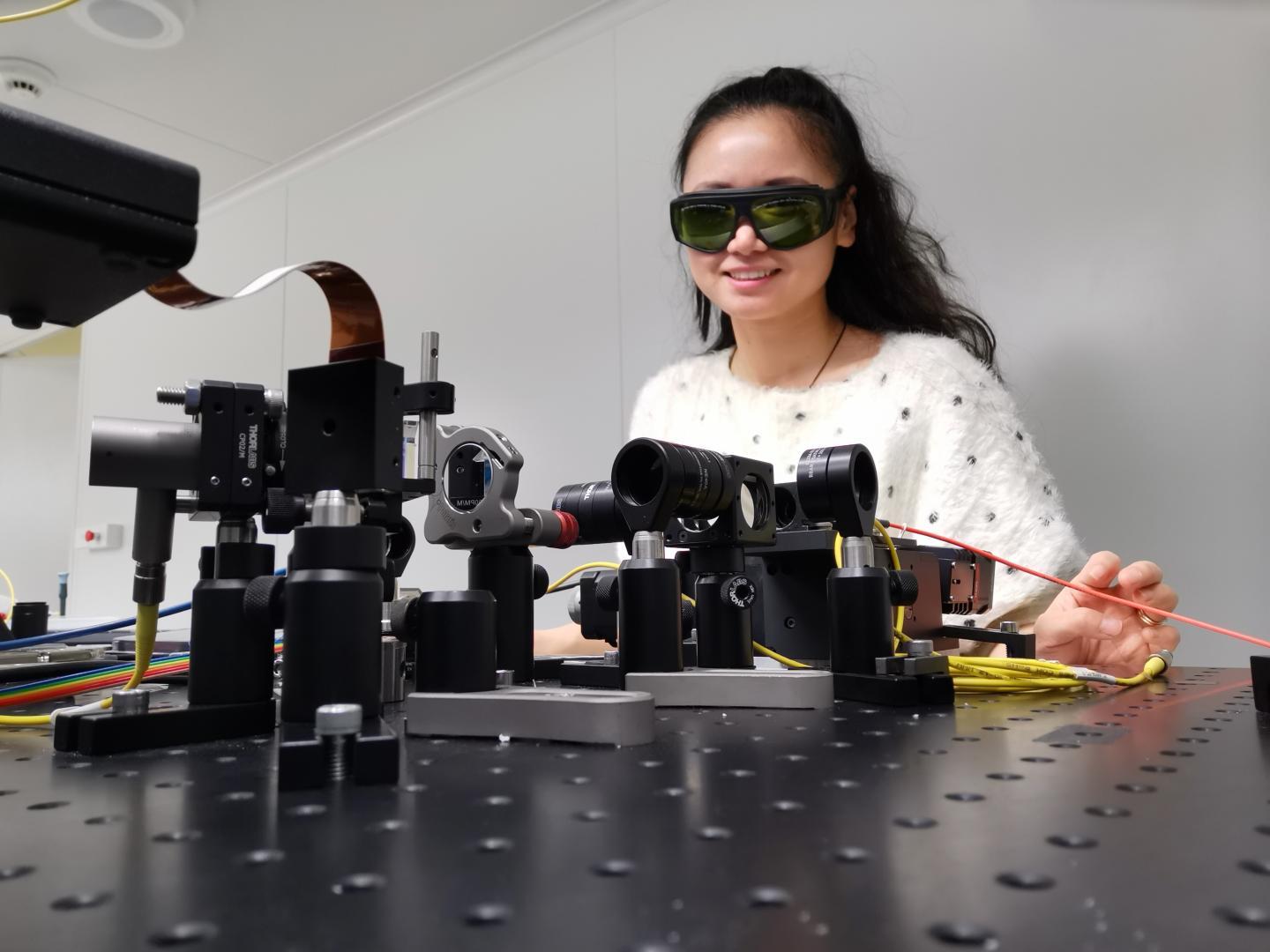
Co-author and graduate student Fiona (Jin) Wei from the School of Physics at the University of Sydney {module INSIDE STORY}

Co-author and postgraduate student Fiona (Jin) Wei in the School of Physics.

“This is a radically different approach to existing methods and resolves several major limitations of current approaches,” said co-author Jin (Fiona) Wei, a postgraduate student at the Sydney Astrophotonic Instrumentation Laboratory.

The Director of the Sydney Astrophotonic Instrumentation Laboratory in the School of Physics at the University of Sydney, Associate Professor Sergio Leon-Saval, said: “While we have come to this problem to solve a problem in astronomy, the proposed technique is extremely relevant to a wide range of fields. It could be applied in optical communications, remote sensing, in-vivo imaging, and any other field that involves the reception or transmission of accurate wavefronts through a turbulent or turbid medium, such as water, blood, or air.”

  1. Evidence of broadside collision with dwarf galaxy discovered in Milky Way
  2. Pitt engineer fights fire with data

Page 20 of 23

  • 14
  • 15
  • 16
  • 17
  • 18
  • 19
  • 20
  • 21
  • 22
  • 23
POPULAR RIGHT NOW
  • AI supercharges the hunt for stronger magnets: Iowa State researchers launch a new era of intelligent materials discovery
    AI supercharges the hunt for stronger magnets: Iowa State researchers launch a new era of intelligent materials discovery
  • IBM's Historic stock collapse raises questions for the future of enterprise supercomputing
    IBM's Historic stock collapse raises questions for the future of enterprise supercomputing
  • Could a novel dark matter theory simultaneously resolve multiple cosmic enigmas? Supercomputer simulations provide a compelling, albeit currently unverified, potential solution
    Could a novel dark matter theory simultaneously resolve multiple cosmic enigmas? Supercomputer simulations provide a compelling, albeit currently unverified, potential solution
  • Melting icebergs may be reshaping Earth’s greatest ocean current
    Melting icebergs may be reshaping Earth’s greatest ocean current
  • Supercomputers replace ‘bathtub’ flood maps with physics-based digital twins of Britain’s coastline
    Supercomputers replace ‘bathtub’ flood maps with physics-based digital twins of Britain’s coastline
  • Supercomputers push neural quantum simulation beyond previous limits
    Supercomputers push neural quantum simulation beyond previous limits
  • Intel’s AI supercomputing revival: Q2 financial surge signals new era for CPU-powered HPC infrastructure
    Intel’s AI supercomputing revival: Q2 financial surge signals new era for CPU-powered HPC infrastructure
  • AI infrastructure financing fears shake semiconductor sector
    AI infrastructure financing fears shake semiconductor sector
  • AWS supercomputing investment reaches historic scale as Amazon’s AI strategy powers record financial results
    AWS supercomputing investment reaches historic scale as Amazon’s AI strategy powers record financial results
  • Catching the wave of the future: Supercomputers unlock the hidden dynamics of Venus
    Catching the wave of the future: Supercomputers unlock the hidden dynamics of Venus
THIS YEAR'S MOST READ
  • Wall Street wants to trade supercomputing power like oil
    Wall Street wants to trade supercomputing power like oil
  • Beamforming the future: BeammWave's 6G push signals the rise of orbital-terrestrial wireless networks
    Joakim Axmon
    Joakim Axmon
  • Cosmic ambition at scale: UK’s supercomputer unlocks a 2.5 petabytes universe
    Cosmic ambition at scale: UK’s supercomputer unlocks a 2.5 petabytes universe
  • Hidden order, revealed at scale: Supercomputing, electron ptychography uncover the inner workings of relaxor ferroelectrics
    Hidden order, revealed at scale: Supercomputing, electron ptychography uncover the inner workings of relaxor ferroelectrics
  • Intel's Q1 results signal supercomputing surge driving Xeon momentum
    Intel's Q1 results signal supercomputing surge driving Xeon momentum
  • When stars fall apart: Supercomputing reveals the hidden physics of black holes
    When stars fall apart: Supercomputing reveals the hidden physics of black holes
  • Multi-layer simulations reveal the hidden supply chain of solar prominences
    Multi-layer simulations reveal the hidden supply chain of solar prominences
  • Japanese scientists decode dolphin speed with supercomputing: Turbulence, vortices, and the hidden physics of propulsion
    Japanese scientists decode dolphin speed with supercomputing: Turbulence, vortices, and the hidden physics of propulsion
  • Cosmic feedback at scale: Supercomputing reveals how quasars regulate the early Universe
    Cosmic feedback at scale: Supercomputing reveals how quasars regulate the early Universe
  • Modeling life at the microscopic scale: A computational breakthrough in oxygen transport
    Modeling life at the microscopic scale: A computational breakthrough in oxygen transport
MOST READ OF ALL-TIME
  • Largest Computational Biology Simulation Mimics The Ribosome
    Details
    112127
    The amino acid (green) slithers into the chemical reaction center, moving through an evolutionarily ancient corridor of the ribosome (purple). The amino acid is delivered to the reaction core by the transfer RNA molecule (yellow).
    The amino acid (green) slithers into the chemical reaction center, moving through an evolutionarily ancient corridor of the ribosome (purple). The amino acid is delivered to the reaction core by the transfer RNA molecule (yellow).
  • Silicon 'neurons' may add a new dimension to chips
    Details
    81040
    Silicon 'neurons' may add a new dimension to chips
  • Linux Networx Accelerators Expected to Drive up to 4x Price/Performance
    Details
    75563
  • Complex Concepts That Really Add Up
    Details
    73693
    Complex Concepts That Really Add Up
  • Blue Sky Studios Donates Animation SuperComputer to Wesleyan
    Details
    68166
    Each rack holds 52 Angstrom Microsystem-brand “blades,” with a memory footprint of 12 or 24 gigabytes each. (Photos by Olivia Bartlett Drake)
    Each rack holds 52 Angstrom Microsystem-brand “blades,” with a memory footprint of 12 or 24 gigabytes each. (Photos by Olivia Bartlett Drake)
  • Humanities, HPC connect at NERSC
    Details
    57973
  • TeraGrid ’09 'Call for Participation'
    Details
    54976
  • Turbulence responsible for black holes' balancing act
    Details
    52339
  • Cray Wins $52 Million SuperComputer Contract
    Details
    50162
  • SDSC Researchers Accurately Predict Protein Docking
    Details
    46115
  • FRONTPAGE
  • LATEST
  • POPULAR
  • REGISTER
  • SOCIAL
  • VIDEO
  • SUBSCRIPTION
  • RSS
  • GUIDELINES
  • PRIVACY
  • TOS
  • ABOUT
  • +1 (816) 799-4488
  • editorial@supercomputingonline.com
© 2001 - 2026 SuperComputingOnline.com, LLC. All rights reserved. This material may not be published, broadcast, rewritten or redistributed without permission.
Sign In
  • FRONT PAGE
  • LATEST
    • MEDIA KIT
    • MOST READ
    • RSS FEED
    • ACADEMIA
    • AEROSPACE
    • APPLICATIONS
    • ASTRONOMY
    • AUTOMOTIVE
    • BIG DATA
    • BIOLOGY
    • CHEMISTRY
    • CLIENTS
    • CLOUD
    • DEFENSE
    • DEVELOPER TOOLS
    • EARTH SCIENCES
    • ECONOMICS
    • ENGINEERING
    • ENTERTAINMENT
    • HEALTH
    • INDUSTRY
    • INTERCONNECTS
    • GAMING
    • GOVERNMENT
    • MANUFACTURING
    • MIDDLEWARE
    • MOVIES
    • NETWORKS
    • OIL & GAS
    • PHYSICS
    • PROCESSORS
    • RETAIL
    • SCIENCE
    • STORAGE
    • SYSTEMS
    • VISUALIZATION
  • VIDEOS
    • ADD YOUR VIDEOS
    • MANAGE VIDEOS
  • COMMUNITY
    • TRADE SHOWS
    • SOCIAL NETWORK VIDEOS
    • SURVEYS
    • APPLICATIONS BROWSER
    • CONVERSATION INBOX
    • SOCIAL ADVERTISER
    • GROUPS
    • MARKETPLACE LISTINGS
    • PAGES
    • LEADERBOARD
    • POINTS LISTING
      • BADGES
    • PRIVACY CONFIRM REQUEST
    • PRIVACY CREATE REQUEST

Hey there! We noticed you’re using an ad blocker.