Image credit: Daniele B. Malesani / PanSTARRS

Black hole engulfs star matter equivalent to three Earths

A black hole in a nearby galaxy is devouring a star similar to our Sun, causing it to lose mass equivalent to three Earths every time it passes by.

The discovery by University of Leicester astronomers is reported today and provides a missing link in our knowledge of black holes disrupting orbiting stars. It suggests a whole menagerie of stars in the process of being consumed that still lie undiscovered. The team was supported by the UK Space Agency and the UK Science and Technology Facilities Council (STFC). 

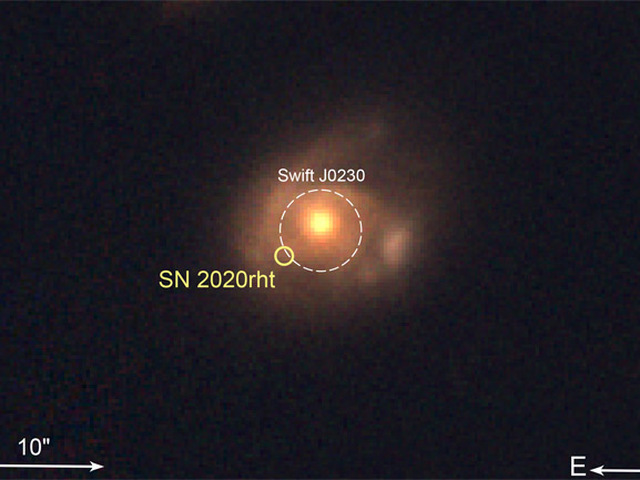
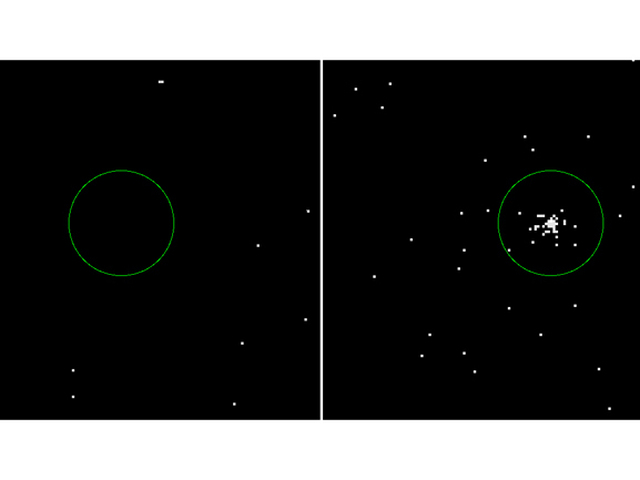
The astronomers were alerted to the star by a bright X-ray flash that seemed to come from the center of the nearby galaxy 2MASX J02301709+2836050, around 500 million light-years away from the Milky Way. Named Swift J0230, it was spotted the moment it happened for the first time using a new tool developed by the scientists for the Neil Gehrels Swift Observatory. They rapidly scheduled further Swift observations of it, finding that instead of decaying away as expected, it would shine brightly for 7-10 days and then abruptly switch off, repeating this process roughly every 25 days. Image credit: Phil Evans (University of Leicester) / NASA Swift.
Similar behavior has been observed in what are termed quasi-periodic eruptions and periodic nuclear transients, where a star has material ripped away by a black hole as its orbit takes it close by, but they differ in how often they erupt, and in whether it is in X-rays or optical light that the explosion is predominant. The regularity of Swift J0230’s emissions fell between the two, suggesting that it forms the ‘missing link’ between the two types of outbursts.

Using the models proposed for these two classes of events as a guide, the scientists concluded that the Swift J0230 outburst represents a star of a similar size to our own sun in an elliptical orbit around a low-mass black hole at the center of its galaxy. As the star’s orbit takes it close to the intense gravitational pull of the black hole, material equivalent to the mass of three Earths is wrenched from the atmosphere of the star and heated up as it falls into the black hole. The intense heat, around 2 million degrees Celsius, releases a huge amount of X-rays which were first picked up by the Swift satellite.

Lead author Dr Phil Evans of the University of Leicester School of Physics and Astronomy said: “This is the first time we've seen a star like our Sun being repeatedly shredded and consumed by a low mass black hole.  So-called ‘repeated, partial tidal disruption’ events are themselves quite a new discovery and seem to fall into two types: those that outburst every few hours, and those that outburst every year or so. This new system falls right into the gap between these, and when you run the numbers, you find the types of objects involved fall nicely into place too.”

Dr. Rob Eyles-Ferris, who works with Dr. Evans on the Swift satellite, recently completed his Ph.D. at Leicester, which included the study of stars being disrupted by black holes. He explains: “In most of the systems we’ve seen in the past the star is completely destroyed. Swift J0230 is an exciting addition to the class of partially-disrupted stars as it shows us that the two classes of these objects already found are really connected, with our new system giving us the missing link.”

Dr. Kim Page from the University of Leicester, who worked on the data analysis for the study, said: “Given that we found Swift J0230 within a few months of enabling our new transient-hunting tool, we expect that there are a lot more objects like this out there, waiting to be uncovered.”

Dr Chris Nixon is a theoretical astrophysicist who recently moved from the University of Leicester to the University of Leeds. He led the theoretical interpretation of this event. His research is funded by the UK Science and Technology Facilities Council and the Leverhulme Trust.

They estimate that the black hole is around 10,000 to 100,000 times the mass of our sun, which is quite small for the supermassive black holes usually found at the center of galaxies. The black hole at the center of our own galaxy is thought to be 4 million solar masses, while most are in the region of 100 million solar masses.

It is the first discovery to be made using the new transient detector for the Swift satellite, developed by the University of Leicester team and running on their supercomputer. When an extreme event takes place, causing an X-ray burst in a region of the sky where there were previously no X-rays, astronomers call it an astronomical X-ray transient. Despite the extreme events they herald, these events are not easy to find, or at least, not quickly – and so this new tool was developed to look for new types of transients in real-time.

Dr Evans adds: “This type of object was essentially undetectable until we built this new facility, and soon after it found this completely new, never-before-seen event. Swift is nearly 20 years old and it's suddenly finding brand new events that we never knew existed. I think it shows that every single time you find a new way of looking at space, you learn something new and find there's something out there you didn't know about before.”

Dr Caroline Harper, Head of Space Science at the UK Space Agency, said: “This is yet another exciting discovery from the world-leading Swift mission - a low mass black hole taking ‘bites’ from a Sun-like star whenever it orbits close enough.

“The UK Space Agency has been working in partnership with NASA on this mission for many years; the UK led the development of hardware for two of the key science instruments and we provided funding for the Swift Science Data Centre, which we continue to support.  We look forward to even more insights from Swift about gamma-ray bursts throughout the cosmos, and the massive events that cause them, in the future.”

The discovery of this ravenous black hole serves as a reminder of the immense power of the universe and the importance of studying it. By understanding the behavior of these objects, we can gain insight into the evolution of galaxies and the formation of stars. This study is a testament to the power of collaboration and the importance of international research efforts. It is a reminder that the universe is full of mysteries and that by working together, we can unlock the secrets of the cosmos.
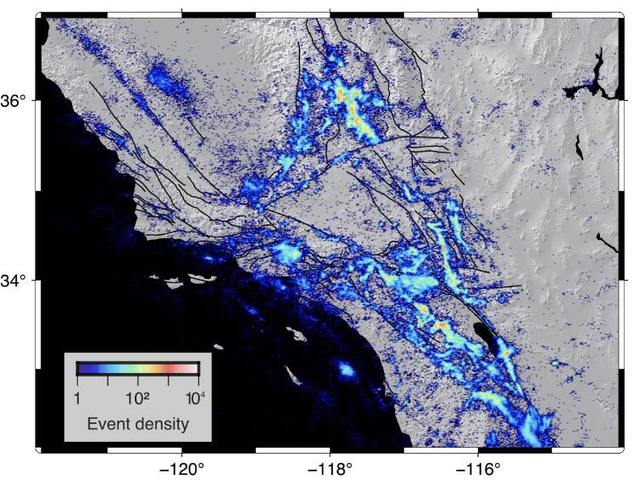

In the above map from the Southern California Earthquake Data Center, some of the individual pixels represent thousands of earthquakes.

Discover the power of deep learning with UCSC seismologists' pioneering technology that enables them to predict earthquakes

Earthquake aftershock forecasting models have remained largely unchanged for more than 30 years. These models work well with limited data but struggle with the vast amount of seismology datasets that are now available. To overcome this limitation, researchers from the University of California, Santa Cruz, and the Technical University of Munich have developed a new model called Recurrent Earthquake foreCAST (RECAST). This model uses deep learning and is more flexible and scalable than the current earthquake forecasting models.

The scientists published a paper in Geophysical Research LettersGeophysical Research Letters, which shows that the new model outperforms the existing model, known as the Epidemic Type Aftershock Sequence (ETAS) model, for earthquake catalogs of about 10,000 events or more.

“The ETAS model approach was designed for the observations that we had in the 80s and 90s when we were trying to build reliable forecasts based on very few observations,” said Kelian Dascher-Cousineau, the lead author of the paper who recently completed his Ph.D. at UC Santa Cruz. “It’s a very different landscape today.” Now, with more sensitive equipment and larger data storage capabilities, earthquake catalogs are much larger and more detailed

“We’ve started to have million-earthquake catalogs, and the old model simply couldn’t handle that amount of data,” said Emily Brodsky, a professor of earth and planetary sciences at UC Santa Cruz and co-author on the paper. One of the main challenges of the study was not designing the new RECAST model itself but getting the older ETAS model to work on huge data sets to compare the two. 

“The ETAS model is kind of brittle, and it has a lot of very subtle and finicky ways in which it can fail,” said Dascher-Cousineau. “So, we spent a lot of time making sure we weren’t messing up our benchmark compared to actual model development.”

To continue applying deep learning models to aftershock forecasting, Dascher-Cousineau says the field needs a better system for benchmarking. To demonstrate the capabilities of the RECAST model, the group first used an ETAS model to simulate an earthquake catalog. After working with the synthetic data, the researchers tested the RECAST model using real data from the Southern California earthquake catalog.

They found that the RECAST model — which can, essentially, learn how to learn — performed slightly better than the ETAS model at forecasting aftershocks, particularly as the amount of data increased. The computational effort and time were also significantly better for larger catalogs.

This is not the first time scientists have tried using machine learning to forecast earthquakes, but until recently, the technology was not quite ready, said Dascher-Cousineau. New advances in machine learning make the RECAST model more accurate and easily adaptable to different earthquake catalogs.

The model’s flexibility could open up new possibilities for earthquake forecasting. With the ability to adapt to large amounts of new data, models that use deep learning could potentially incorporate information from multiple regions at once to make better forecasts about poorly studied areas.

“We might be able to train on New Zealand, Japan, California and have a model that's quite good for forecasting somewhere where the data might not be as abundant,” said Dascher-Cousineau.

Using deep-learning models will also eventually allow researchers to expand the type of data they use to forecast seismicity.

“We’re recording ground motion all the time,” said Brodsky. “So the next level is to use all of that information, not worry about whether we’re calling it an earthquake or not an earthquake but to use everything."

In the meantime, the researchers hope the model sparks discussions about the possibilities of the new technology.

“It has all of this potential associated with it,” said Dascher-Cousineau. “Because it is designed that way.”

The use of deep learning by UCSC seismologists for forecasting earthquakes is a groundbreaking development in the field of seismology. It not only provides an unprecedented level of accuracy in predicting seismic activity but also opens up new possibilities for understanding and preparing for the impacts of earthquakes. This research has the potential to save lives and property and serves as an example of the power of science and technology to improve the world we live in. With further research and development, deep learning could become an invaluable tool in the fight against the destructive forces of nature.

Tohoku team shows how the geomagnetic field protects Earth from electron showers

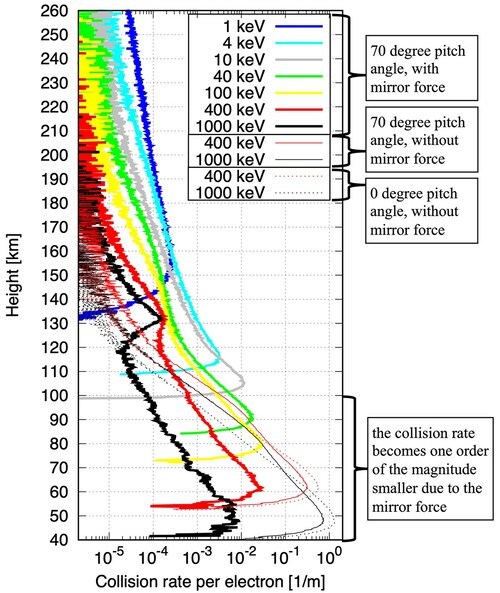
Understanding the ionosphere high in the Earth's atmosphere is important due to its effects on communications systems, satellites, and crucial chemical features including the ozone layer. New insights into the activity of high-energy electrons have come from a supercomputer simulation study led by geophysicist Yuto Katoh at Tohoku University in Japan. Altitude profiles of the collision rate per electron for the cases of the precipitation of 1, 4, 10, 40, 100, 400, and 1000 keV electrons whose initial pitch angle is 70 degrees at an altitude of 400 km (thick solid lines). ©Yuto Katoh et al.

"Our results clarify the unexpected role of the geomagnetic field surrounding the Earth in protecting the atmosphere from high energy electrons," says Katoh.

The ionosphere is a wide region between roughly 60 and more than 600 kilometers above the Earth's surface. It contains electrically charged particles that are a mixture of ions and free electrons generated by the interaction of the atmosphere with radiation from the sun.

Polar regions of the ionosphere are subjected to a particularly steady and energetic stream of incoming electrons in a process called electron precipitation. These 'relativistic' electrons move at close to the speed of light, where the effects of Einstein's relativity theory become ever more significant. They collide with gas molecules and contribute to many phenomena in the ionosphere, including colorful auroral displays. The processes are heavily influenced by the effects of the geomagnetic field on the charged particles involved.

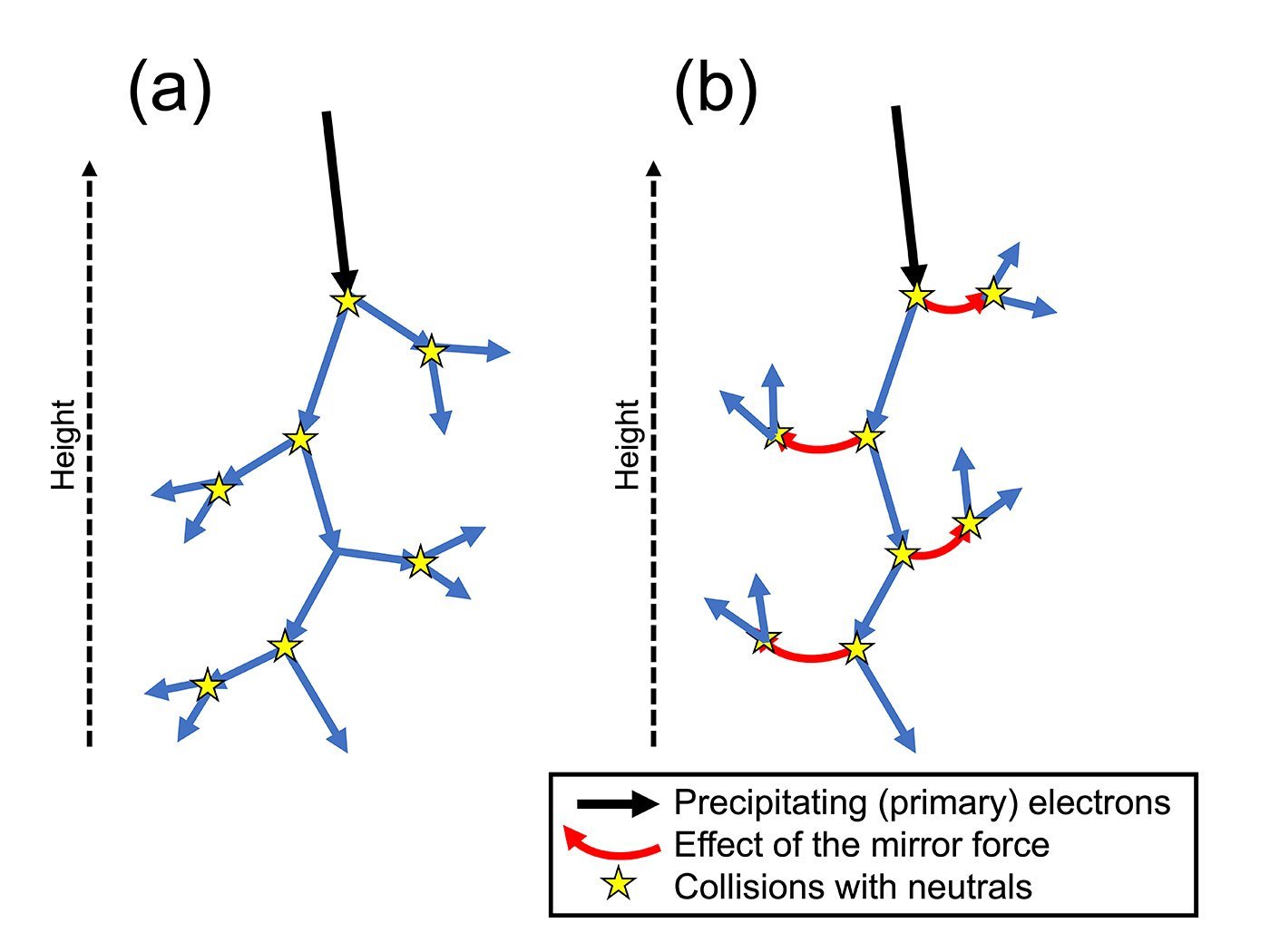
The Tohoku team, with colleagues in Germany and other institutions in Japan, developed a sophisticated software code that focused particular attention on simulating the effects of a relatively unstudied 'mirror force' on electron precipitation. This is caused by the magnetic force acting on charged particles under the influence of the geomagnetic field.

The simulations demonstrated how the mirror force causes relativistic electrons to bounce back upwards, to an extent dependent on the angles at which the electrons arrive. The predicted effects mean that electrons collide with other charged particles higher in the ionosphere than previously suspected.

Illustrating one example of the significance of this work, Katoh comments: "Precipitating electrons that manage to pass through the mirror force can reach the middle and lower atmosphere, contributing to chemical reactions related to variations in ozone levels." Decreased ozone levels at the poles caused by atmospheric pollution reduce the protection ozone offers living organisms from ultraviolet radiation.

Katoh emphasizes the key theoretical advance of the research is in revealing the surprising significance of the geomagnetic field and the mirror force in protecting the lower atmosphere from the effects of electron precipitation activities by keeping them further away.

"We have now started a project to combine the simulation studies used in this work with real observations of the polar ionosphere to build an even deeper understanding of these crucial geophysical processes," says Katoh.

The research conducted by geophysicists from Tohoku University has revealed a remarkable protective role of the geomagnetic field surrounding the Earth. This finding has the potential to revolutionize our understanding of the Earth's environment and its impact on our lives. By furthering our knowledge of the geomagnetic field, we can ensure the safety of our planet and its inhabitants for generations to come. Illustration showing the relation between precipitating electrons, mirror force, and collisions with neutrals. The cases (a) without and (b) with mirror force are shown, indicating that the mirror force tends to move electrons upward through the collisions with neutrals. ©Yuto Katoh et al.