SETI simulates message from ET intelligence to Earth with world's largest decentralized storage network

A Sign in Space imagines how Earth might respond to a signal from aliens and invites the public to help decode an ET message.

What would happen if we received a message from an extraterrestrial civilization? Daniela de Paulis, an established interdisciplinary artist and licensed radio operator who currently serves as Artist in Residence at the SETI Institute and the Green Bank Observatory, has brought together a team of international experts, including SETI researchers, space scientists, and artists, to stage her latest project,  A Sign in Space. This revolutionary presentation of global theater aims to explore the process of decoding and interpreting an extraterrestrial message by engaging the worldwide SETI community, professionals from different fields, and the broader public. This process requires global cooperation, bridging a conversation around SETI, space research, and society across multiple cultures and areas of expertise.  daniela d 25436

As part of the project, on May 24, 2023, the European Space Agency's ExoMars Trace Gas Orbiter (TGO) in orbit around Mars will transmit an encoded message to Earth to simulate receiving a signal from extraterrestrial intelligence.

“Throughout history, humanity has searched for meaning in powerful and transformative phenomena,” said Daniela de Paulis, the visionary artist behind the A Sign in Space project. “Receiving a message from an extraterrestrial civilization would be a profoundly transformational experience for all humankind. A Sign in Space offers the unprecedented opportunity to tangibly rehearse and prepare for this scenario through global collaboration, fostering an open-ended search for meaning across all cultures and disciplines.”

Three world-class radio astronomy observatories located across the globe will detect the encoded message. These include the SETI Institute’s Allen Telescope Array (ATA), the Robert C. Byrd Green Bank Telescope (GBT) at the Green Bank Observatory (GBO), and the Medicina Radio Astronomical Station observatory managed by Italian National Institute for Astrophysics (INAF). The specific content of the encoded message, developed by de Paulis and her team, is currently undisclosed, allowing the public to contribute to decoding and interpreting the content.

The ESA ExoMars Orbiter will transmit the encoded message on May 24 at 19:00 UTC / 12:00 pm PDT, with receipt on Earth 16 minutes later. To engage the public, the SETI Institute will host a social media live stream event featuring interviews with key team members, including scientists, engineers, artists, and more, joining the live stream from around the world, including control rooms from the ATA, the GBT, and Medicina. Hosted by the SETI Institute’s Dr. Franck Marchis and GBO’s Victoria Catlett, the live stream event will begin at 11:15 am PDT here.

“This experiment is an opportunity for the world to learn how the SETI community, in all its diversity, will work together to receive, process, analyze, and understand the meaning of a potential extraterrestrial signal,” said ATA Project Scientist Dr. Wael Farah. “More than astronomy, communicating with ET will require a breadth of knowledge. With “A Sign in Space,” we hope to make the initial steps towards bringing a community together to meet this challenge.”

Following the transmission, ATA, GBT, and Medicina teams will process the signal and then make it available to the public for decoding.

The SETI Institute will securely store the processed data in collaboration with Breakthrough Listen to Open Data Archive and Filecoin, the world's largest decentralized storage network. This collaborative effort ensures the preservation and accessibility of the processed data, safeguarding its availability for further analysis and decoding endeavors. 

{media id=311,layout=solo}

"We're thrilled to partner with SETI on this groundbreaking project," said Stefaan Verveat, Head of Network Growth at Protocol Labs, the company behind Filecoin. "Our decentralized data storage solutions are ideally suited for the secure and reliable storage of the vast amounts of data generated by this project."
A virtual Earth-sized telescope obtains a direct image of a black hole expelling a powerful jet

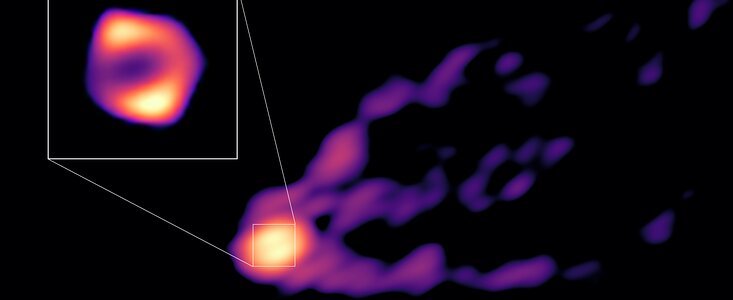
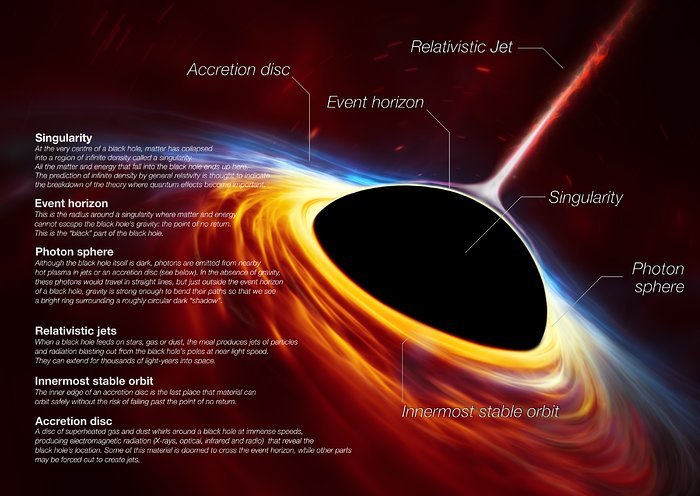
For the first time, astronomers have observed, in the same image, the shadow of the black hole at the center of the galaxy Messier 87 (M87) and the powerful jet expelled from it. The observations were done in 2018 with telescopes from the Global Millimetre VLBI Array (GMVA), the Atacama Large Millimeter/submillimeter Array (ALMA), of which ESO is a partner, and the Greenland Telescope (GLT). Thanks to this new image, astronomers can better understand how black holes can launch such energetic jets. This artist’s impression depicts a rapidly spinning supermassive black hole surrounded by an accretion disc. This thin disc of rotating material consists of the leftovers of a Sun-like star which was ripped apart by the tidal forces of the black hole. The black hole is labelled, showing the anatomy of this fascinating object.

Most galaxies harbor a supermassive black hole at their center. While black holes are known for engulfing matter in their immediate vicinity, they can also launch powerful jets of matter that extend beyond the galaxies that they live in. Understanding how black holes create such enormous jets has been a long-standing problem in astronomy. “We know that jets are ejected from the region surrounding black holes,” says Ru-Sen Lu from the Shanghai Astronomical Observatory in China, “but we still do not fully understand how this actually happens. To study this directly we need to observe the origin of the jet as close as possible to the black hole.”

The new image published today shows precisely this for the first time: how the base of a jet connects with the matter swirling around a supermassive black hole. The target is the galaxy M87, located 55 million light-years away in our cosmic neighborhood, and home to a black hole 6.5 billion times more massive than the Sun. Previous observations had managed to separately image the region close to the black hole and the jet, but this is the first time both features have been observed together. “This new image completes the picture by showing the region around the black hole and the jet at the same time,” adds Jae-Young Kim from the Kyungpook National University in South Korea and the Max Planck Institute for Radio Astronomy in Germany.

The image was obtained with the GMVAALMA, and the GLT, forming a network of radio telescopes around the globe working together as a virtual Earth-sized telescope. Such a large network can discern very small details in the region around M87’s black hole.

The new image shows the jet emerging near the black hole, as well as what scientists call the shadow of the black hole. As matter orbits the black hole, it heats up and emits light. The black hole bends and captures some of this light, creating a ring-like structure around the black hole as seen from Earth. The darkness at the center of the ring is the black hole shadow, which was first imaged by the Event Horizon Telescope (EHT) in 2017. Both this new image and the EHT one combine data taken with several radio telescopes worldwide, but the image released today shows radio light emitted at a longer wavelength than the EHT one: 3.5 mm instead of 1.3 mm. “At this wavelength, we can see how the jet emerges from the ring of emission around the central supermassive black hole,” says Thomas Krichbaum of the Max Planck Institute for Radio Astronomy. 

The size of the ring observed by the GMVA network is roughly 50% larger than the Event Horizon Telescope image. "To understand the physical origin of the bigger and thicker ring, we had to use computer simulations to test different scenarios,” explains Keiichi Asada from the Academia Sinica in Taiwan. The results suggest the new image reveals more of the material that is falling toward the black hole than what could be observed with the EHT. 

{media id=308,layout=solo}

These new observations of M87’s black hole were conducted in 2018 with the GMVA, which consists of 14 radio telescopes in Europe and North America [1]. In addition, two other facilities were linked to the GMVA: the Greenland Telescope and ALMA, of which ESO is a partner. ALMA consists of 66 antennas in the Chilean Atacama desert, which played a key role in these observations. The data collected by all these telescopes worldwide are combined using a technique called interferometry, which synchronizes the signals taken by each individual facility. But to properly capture the actual shape of an astronomical object the telescopes must be spread all over the Earth. The GMVA telescopes are mostly aligned East-to-West, so the addition of ALMA in the Southern hemisphere proved essential to capture this image of the jet and shadow of M87’s black hole. “Thanks to ALMA’s location and sensitivity, we could reveal the black hole shadow and see deeper into the emission of the jet at the same time,” explains Lu.

Future observations with this network of telescopes will continue to unravel how supermassive black holes can launch powerful jets. “We plan to observe the region around the black hole at the center of M87 at different radio wavelengths to further study the emission of the jet,” says Eduardo Ros from the Max Planck Institute for Radio Astronomy. Such simultaneous observations would allow the team to disentangle the complicated processes that happen near the supermassive black hole. “The coming years will be exciting, as we will be able to learn more about what happens near one of the most mysterious regions in the Universe,” concludes Ros.

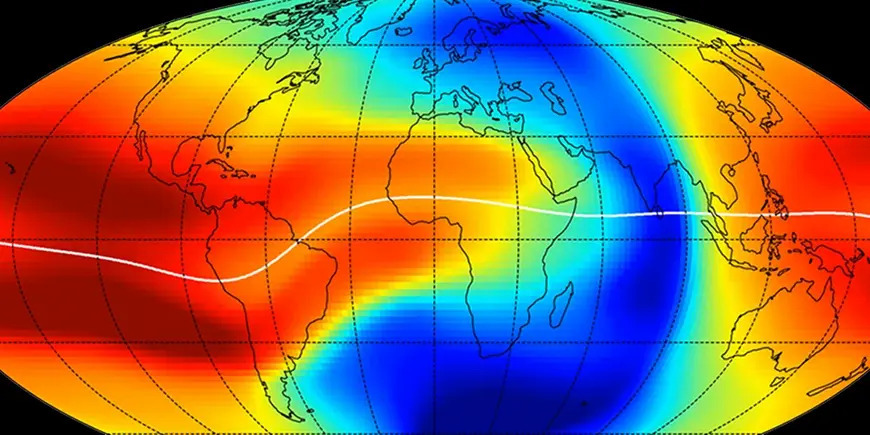
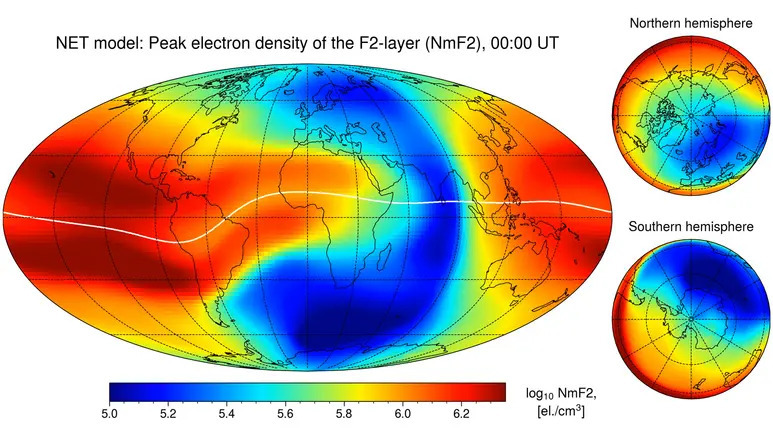
Electron density of the Ionosphere around the Earth for a certain point of time: high values in red, low values in blue. The white line marks the geomagnetic equator. (Figure: CCBY 4.0 Smirnov et al. (2023)

GFZ German Research Centre for Geosciences builds a more precise model of the Earth's ionosphere

The ionosphere – the region of geospace spanning from 60 to 1000 kilometers above the Earth – impairs the propagation of radio signals from global navigation satellite systems (GNSS) with its electrically charged particles. This is a problem for the ever-higher precision required by these systems – both in research and for applications such as autonomous driving or precise orbit determination of satellites. Models of the ionosphere and its uneven, dynamic charge distribution can help correct the signals for ionospheric delays, which are one of the main error sources in GNSS applications. Researchers led by Artem Smirnov and Yuri Shprits of the GFZ German Research Centre for Geosciences have presented a new model based on neural networks and satellite measurement data from 19 years. In particular, it can reconstruct the topside ionosphere, the upper, electron-rich part of the ionosphere much more precisely than before. It is thus also an important basis for progress in ionospheric research, with applications in studies on the propagation of electromagnetic waves or for the analysis of certain space weather events, for example. 

Importance and complexity of the ionosphere

The Earth's ionosphere is the region of the upper atmosphere that extends from about 60 to 1000 kilometers in altitude. Here, charged particles such as electrons and positive ions dominate, caused by the radiation activity of the Sun – hence the name. The ionosphere is important for many scientific and industrial applications because the charged particles influence the propagation of electromagnetic waves such as radio signals. The so-called ionospheric propagation delay of radio signals is one of the most important sources of interference for satellite navigation. This is proportional to the electron density in the space traversed. Therefore, a good knowledge of electron density can help in correcting the signals. In particular, the upper region of the ionosphere, above 600 kilometers, is of interest, since 80 percent of the electrons are gathered in this so-called topside ionosphere.

The problem is that the electron density varies greatly – depending on the longitude and latitude above the Earth, the time of day and year, and solar activity. This makes it difficult to reconstruct and predict them, the basis for correcting radio signals, for example.

Previous models

There are various approaches to modeling electron density in the ionosphere, among others, the International Reference Ionosphere Model IRI, which has been recognized since 2014. It is an empirical model that establishes a relationship between input and output variables based on the statistical analysis of observations. However, it still has weaknesses in the important area of the topside ionosphere because of the limited coverage of previously collected observations in that region.

Recently, however, large amounts of data have become available for this area. Therefore, Machine learning (ML) approaches lend themselves to deriving regularities from this, especially for complex non-linear relationships. Electron density of the Ionosphere around the Earth for a certain point of time: high values in red, low values in blue. The white line marks the geomagnetic equator. (Figure: CCBY 4.0 Smirnov et al. (2023)

A new approach using machine learning and neural networks

A team from the GFZ German Research Centre for Geosciences around Artem Smirnov, Ph.D. student and first author of the study, and Yuri Shprits, head of the “Space Physics and Space Weather” section and Professor at University Potsdam, took a new ML-based empirical approach. For this, they used data from satellite missions from 19 years, in particular CHAMP, GRACE, and GRACE-FO, which were and are significantly co-operated by the GFZ, and COSMIC. The satellites measure – among other things – the electron density in different height ranges of the ionosphere and cover different annual and local times as well as solar cycles.

With the help of Neural Networks, the researchers then developed a model for the electron density of the topside ionosphere, which they call the NET model. They used the so-called MLP method (Multi-Layer Perceptrons), which iteratively learns the network weights to reproduce the data distributions with very high accuracy.

The researchers tested the model with independent measurements from three other satellite missions.

Evaluation of the new model

“Our model is in remarkable agreement with the measurements: It can reconstruct the electron density very well in all height ranges of the topside ionosphere, all around the Globe, at all times of the year and day, and at different levels of solar activity, and it significantly exceeds the International Reference Ionosphere Model IRI in accuracy. Moreover, it covers space continuously,” first author Artem Smirnov sums up.

Yuri Shprits adds: “This study represents a paradigm shift in ionospheric research because it shows that ionospheric densities can be reconstructed with very high accuracy. The NET model reproduces the effects of numerous physical processes that govern the dynamics of the topside ionosphere and can have broad applications in ionospheric research.”

Possible applications in ionosphere research

The researchers see possible applications, for instance, in wave propagation studies, for calibrating new electron density data sets with often unknown baseline offsets, for tomographic reconstructions in the form of a background model, as well as to analyze specific space weather events and perform long-term ionospheric reconstructions. Furthermore, the developed model can be connected to plasmaspheric altitudes and thus can become a novel topside option for the IRI.

The developed framework allows the seamless incorporation of new data and new data sources. The retraining of the model can be done on a standard PC and can be performed regularly. Overall, the NET model represents a significant improvement over traditional methods and highlights the potential of neural network-based models to provide a more accurate representation of the ionosphere for communication and navigation systems that rely on GNSS.