UC3M uses AI techniques to obtain antibiotic resistance patterns

The Universidad Carlos III de Madrid (UC3M) is conducting research that analyses antibiotic resistance patterns with the aim of finding trends that can help decide which treatment to apply to each type of patient and stop the spread of bacteria. This study, recently published in an academic journal, has been carried out together with the University of Exeter, the University of Birmingham (both in the United Kingdom), and the Westmead Hospital in Sydney (Australia). AI

In order to observe a bacterial pathogen’s resistance to an antibiotic in clinical environments, a measure called MIC (Minimum Inhibitory Concentration) is used, which is the minimum concentration of antibiotic capable of inhibiting bacterial growth. The greater the MIC of a bacterium against an antibiotic, the greater its resistance.

However, most public databases only contain the frequency of resistant pathogens, which is aggregated data calculated from MIC measurements and predefined resistance thresholds. “For example, for a given pathogen, the antibiotic resistance threshold maybe 4: if a bacterium has a MIC of 16, it is considered resistant and is counted when calculating the resistance frequency”, says Pablo Catalán, lecturer and researcher in the UC3M Mathematics Department and author of the study. In this regard, the resistance reports that are carried out nationally and by organizations such as the WHO are prepared using this aggregated resistance frequency data.

To conduct this research, the team has analyzed a database that is ground-breaking, as it contains raw data on antibiotic resistance. This database, called ATLAS, is managed by Pfizer and has been public since 2018. The working group led by UC3M has compared the information of 600,000 patients from over 70 countries and has used machine learning methods (a type of artificial intelligence technique) to extract resistance evolution patterns.

By analyzing this data, the research team has discovered that there are resistance evolution patterns that can be detected when using the raw data (MIC), but which are undetectable using the aggregated data. “A clear example of this is a pathogen whose MIC is slowly increasing over time, but below the resistance threshold. Using this frequency data we wouldn’t be able to say anything, since the resistance frequency remains constant. However, by using MIC data we can detect such a case and be on alert. In the paper, we discuss several clinically relevant cases which have these characteristics. Furthermore, we are the first team to describe this database in-depth”, says Catalán.

This study makes it possible to design antibiotic treatments that are more effective in controlling infections and curbing the rise of resistance which causes many clinical problems. “The research uses mathematical ideas to find new ways of extracting antibiotic resistance patterns from 6.5 million data points”, concludes the research author. 
EPFL's Lab for Data Security develops a cryptography game-changer for biomedical research at scale

Predictive, preventive, personalized, and participatory medicine, known as P4, is the healthcare of the future. To both accelerate its adoption and maximize its potential, clinical data on large numbers of individuals must be efficiently shared between all stakeholders. However, data is hard to gather. It’s siloed in individual hospitals, medical practices, and clinics around the world. Privacy risks stemming from disclosing medical data are also a serious concern, and without effective privacy-preserving technologies, have become a barrier to advancing P4 medicine. 

Existing approaches either provide only limited protection of patients’ privacy by requiring the institutions to share intermediate results, which can in turn leak sensitive patient-level information, or they sacrifice the accuracy of results by adding noise to the data to mitigate potential leakage. Personalized medicine is set to revolutionize healthcare, yet large-scale research studies towards better diagnoses and targeted therapies are currently hampered by data privacy and security concerns.

Now, researchers from EPFL’s Laboratory for Data Security, working with colleagues at Lausanne University Hospital (CHUV), MIT CSAIL, and the Broad Institute of MIT and Harvard, have developed “FAMHE.” This federated analytics system enables different healthcare providers to collaboratively perform statistical analyses and develop machine learning models, all without exchanging the underlying datasets. FAHME hits the sweet spot between data protection, the accuracy of research results, and practical computational time - three critical dimensions in the biomedical research field. 

{media id=260,layout=solo}

The research team says the crucial difference between FAMHE and other approaches trying to overcome the privacy and accuracy challenges is that FAMHE works at scale and it has been mathematically proven to be secure, which is a must due to the sensitivity of the data. 

In two prototypical deployments, FAMHE accurately and efficiently reproduced two published, multi-centric studies that relied on data centralization and bespoke legal contracts for data transfer centralized studies – including Kaplan-Meier survival analysis in oncology and genome-wide association studies in medical genetics. In other words, they have shown that the same scientific results could have been achieved even if the datasets had not been transferred and centralized.

“Until now, no one has been able to reproduce studies that show that federated analytics works at scale. Our results are accurate and are obtained with a reasonable computation time. FAMHE uses multiparty homomorphic encryption, which is the ability to make computations on the data in its encrypted form across different sources without centralizing the data and without any party seeing the other parties’ data” says EPFL Professor Jean-Pierre Hubaux, the study’s lead senior author.

“This technology will not only revolutionize multi-site clinical research studies but also enable and empower collaborations around sensitive data in many different fields such as insurance, financial services, and cyberdefense, among others”, adds EPFL senior researcher Dr. Juan Troncoso-Pastoriza.

Patient data privacy is a key concern of the Lausanne University Hospital. "Most patients are keen to share their health data for the advancement of science and medicine, but it is essential to ensure the confidentiality of such sensitive information. FAMHE makes it possible to perform secure collaborative research on patient data at an unprecedented scale”, says Professor Jacques Fellay from the CHUV Precision Medicine unit. 

“This is a game-changer towards personalized medicine, because, as long as this kind of solution does not exist, the alternative is to set up bilateral data transfer and use agreements, but these are ad hoc and they take months of discussion to make sure the data is going to be properly protected when this happens. FAHME provides a solution that makes it possible once and for all to agree on the toolbox to be used and then deploy it”, says Prof. Bonnie Berger of MIT, CSAIL, and Broad.

“This work lays down a key foundation on which federated learning algorithms for a range of biomedical studies could be built in a scalable manner. It is exciting to think about possible future developments of tools and workflows enabled by this system to support diverse analytic needs in biomedicine”, says Dr. Hyunghoon Cho at the Broad Institute.

So how fast and how far do the researchers expect this new solution to spread? “We are in advanced discussions with partners in Texas, The Netherlands, and Italy to deploy FAMHE at scale. We want this to become integrated into routine operations for medical research,” says CHUV Dr. Jean Louis Raisaro, one of the senior investigators of the study.

International research team with participants from Chemnitz University of Technology observes ultra-fast motion in ferromagnetic thin film systems for the first time

For modern memory and data processing technologies based on ferromagnetic materials, it is essential to understand the dynamics of magnetic phenomena on time scales of a thousandth of a billionth of a second (terahertz range). This applies, for example, to applications in MRAMs (Magnetic Random Access Memories) or the classic and still relevant hard disks in data centers. Until now, these have operated in the gigahertz range for data transmission (one gigahertz corresponds to an oscillation with a period of one billionth of a second).

The results are now available from an international research team’s basic research, which included the participation of the Professorship of Magnetic Functional Materials (https://www.tu-chemnitz.de/physik/MAGFUN/ ) (Head: Prof. Dr. Olav Hellwig) at Chemnitz University of Technology, open up possible applications for faster and more power-efficient data transfers in the terahertz range. One terahertz corresponds to an oscillation of one-thousandth of a billionth of a second. Prof. Dr. Olav Hellwig's research includes ultra-fast movements in ferromagnetic thin film systems. Photo/Montage: Rico Welzel/Jacob Müller

Ultrafast nutation observed for the first time in ferromagnetic thin film systems

The core of the team's observations were so-called thin-film systems. All modern memory and data processing technologies are based on thin-film systems. This usually refers to layers from one atomic layer down to the micrometer range. Researchers here use layers that are typically in the thickness range of 1 to 50 nm. What happens in these ferromagnetic layers on such a short time scale was previously unclear due to a lack of experimental techniques and corresponding data on such a short time scale.

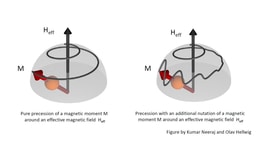
The research team has now succeeded for the first time in observing ultra-fast nutation in ferromagnetic thin film systems. In simplified terms, nutation is the spinning motion of a force-free gyroscope’s figure axis (see figure).

The team included physicists from Chemnitz University of Technology, Helmholtz-Zentrum Dresden-Rossendorf (HZDR), University of Duisburg-Essen, German Aerospace Center, TU Berlin, École Polytechnique (France), University of Naples Federico II, Parthenope University of Naples, Ca' Foscari University of Venice and Stockholm University. The lead was taken by Kumar Neeraj and Stefano Bonetti, scientists and experts in ultrafast experiments from Sweden and Italy.

The TELBE facility at HZDR was used for the studies, which were supported by Prof. Hellwig and his team from Chemnitz and Dresden. The TELBE facility is part of the ELBE electron accelerator and uniquely allows the generation of phase-stable high-field terahertz pulses with extremely flexible parameters such as repetition rate, pulse shape, and polarization. The samples required for the experiments were produced at the Professorship of Functional Magnetic Materials at Chemnitz University of Technology. The so-called "magnetron sputter deposition technique" was used. Illustration of the precession of a magnetic moment without (left) and with nutation. Graphic: Kumar Neeraj and Olav Hellwig

Chemnitz and Dresden expertise in magneto-dynamic properties

"My group produced the samples for these measurements and optimized them accordingly for these measurements together with our collaboration partners," explains Prof. Olav Hellwig. This involved optimizing the layer sequence, layer thickness, and lateral microstructure, as well as the magneto-dynamic properties, such as magnetic damping, he said. "This process is part of the special expertise of my working group for magnetic functional materials in Chemnitz and Dresden," says Hellwig.

The method used was the common "pump-probe experiment." For this, the researchers irradiated the thin film samples with ultrashort pulsed radiation in the terahertz wavelength range. These were in turn detected with an ultrashort, variably time-delayed 800 nm femtosecond laser pulse. In this way, the team tested how the magnetic moments in the sample responded to the terahertz pulse.

"These super-short terahertz pulses can be used to target magnetic systems on ultrashort time scales and then, hopefully, soon control them. In doing so, in addition to the already known precession motion, we have observed in this publication for the first time a nutation motion of the ferromagnetic moments, which takes place on an even faster time scale," says Olav Hellwig.