

Donald lab discovers how superbugs use mirror images to create antibiotic resistance

Methicillin-resistant Staphylococcus aureus (MRSA) is a bacterial infection that has become resistant to most of the antibiotics used to treat regular staph infections. Webp.net resizeimage 2022 02 18T182229.499 0003e
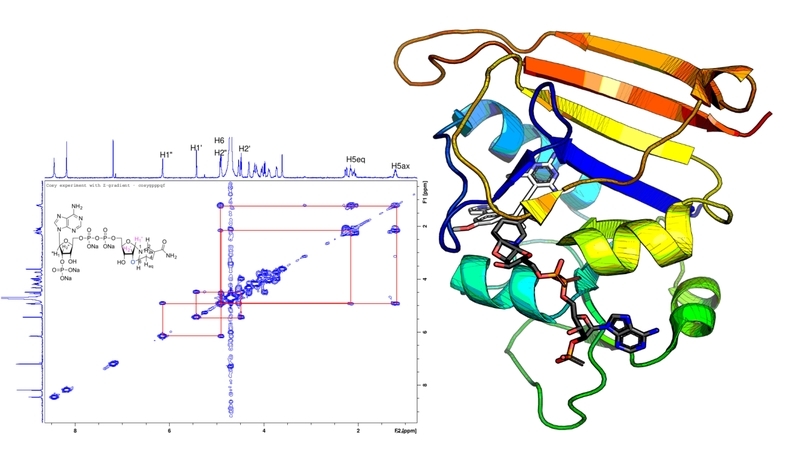
Bruce Donald, Ph.D., James B Duke Distinguished Professor of Computer Science, and collaborators at the University of Connecticut are working to develop new enzyme inhibitors to fight MRSA. In research published in PLOS Computational Biology, the team discovered how a single small mutation makes a big difference in drug efficacy.

They examined dihydrofolate reductase (DHFR), an enzyme that antibiotics target to fight MRSA. Drugs that inhibit DHFR work a bit like locks and keys; they bind to enzymes in MRSA, which have a specific three-dimensional structure that only allows molecules that fit precisely to attach to them.

A mutation can change the structure of a bacterial enzyme and cause drugs to lose effectiveness. The F98Y mutation is a well-known resistance mutation. A slight change in the 98th amino acid in the DHFR enzyme changes phenylalanine to tyrosine. “Those two amino acids are structurally similar,” said Graham Holt, grad student in the Donald lab, “but the mutation has a huge effect on the efficacy of the inhibitors.” In essence, it changes the lock. 

Pablo Gainza, Ph.D., a former graduate student in the Donald lab, thought he should be able to predict this mutation using OSPREY, a suite of programs for computational structure-based protein design developed in the Donald lab. But he couldn’t. After knocking down hypothesis after hypothesis to figure out why he was unable to predict this mutation, he went back to examine the starting structure. 

“We looked at the electron density data from the crystallographer and found something strange,” Donald said. In trying to determine the structure of the F98Y mutant, crystallographers used a computer program that—unbeknownst to them – flipped the chirality, or made a mirror image, of the NADPH cofactor to get a better fit. The “flipped” chemical species they discovered through their analysis exists in experimental conditions in the laboratory and plausibly in vivo.

“Using OSPREY, we discovered this flipped chirality,” Donald said, “which we believe happened because of the F98Y mutation.” As in 2-factor authentication, the single enzyme mutation and the flipped cofactor appear to conspire together to evade the inhibitor.

This “chiral evasion” changes the structural basis for resistance. But now Donald and colleagues know not only how a single small mutation changed the lock, but also the structure they need to make a better key – a better drug inhibitor. 

“This is the first example of an enzyme that exploits the chirality of its cofactor to evade its inhibitors,” Holt said. “Now that we see this happening, that will help inform computational strategies to develop better inhibitors.”

The Donald lab showed that, by taking flipped chirality into account, OSPREY’s predictions closely match experimental measurements of inhibitor potency. They worked with collaborators at the University of Connecticut who conducted biochemical experiments to test the theory and provide structural evidence. 

“This is only the beginning of the story,” Donald said. “Our discovery of chiral evasion should lead to more resilient inhibitors: better drug designs.” Right now, most drug design is reactive, waiting for resistance to arise, which it always does. “We hope to make drug design proactive, by using our algorithms to anticipate resistance,” Donald said.

Faraon's lab develops technique that could make quantum networking possible

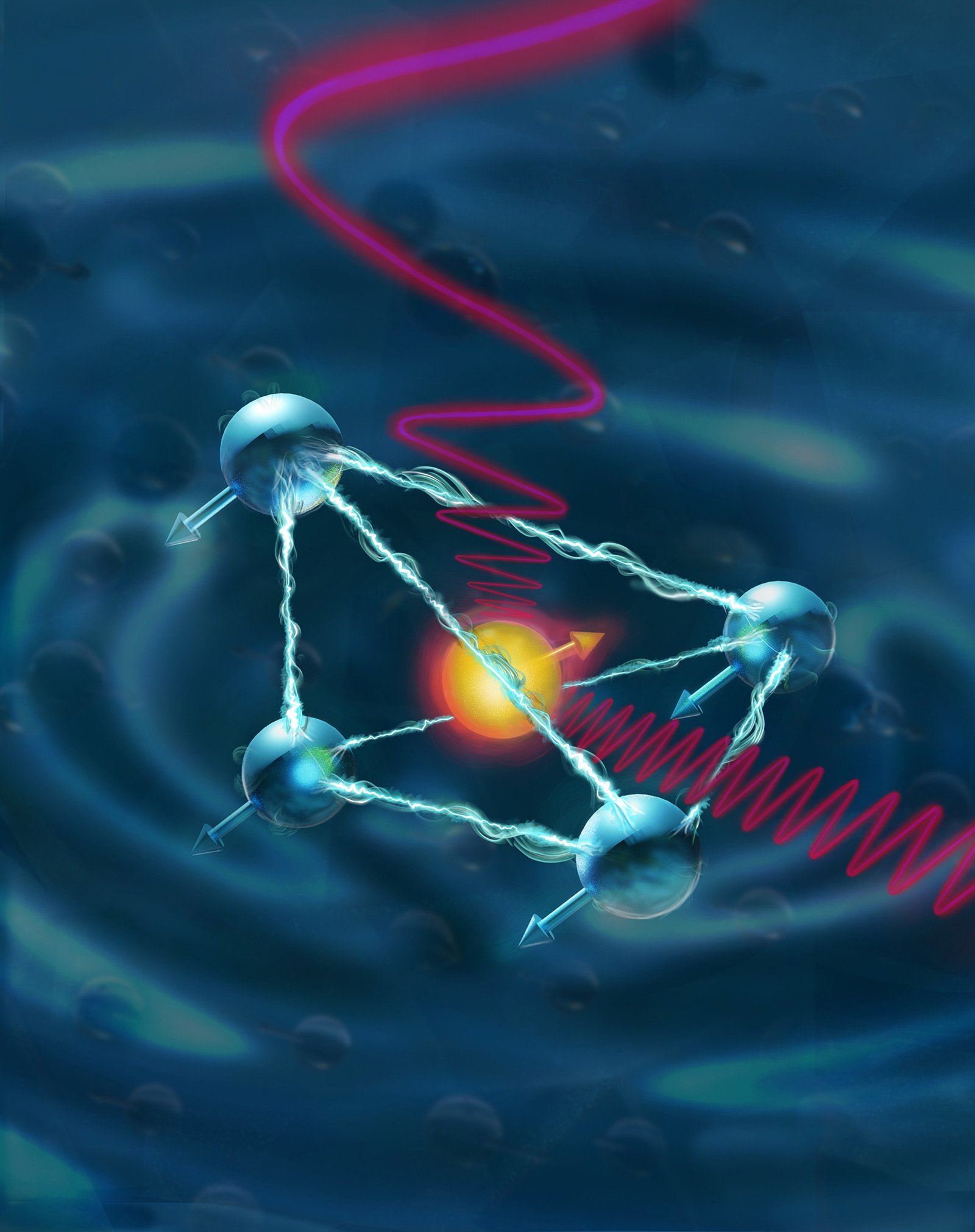
Engineers at Caltech have developed an approach for quantum storage that could help pave the way for the development of large-scale optical quantum networks. Artist's illustration depicts the quantum spin of an ytterbium ion with the surrounding yttrium orthovanadate crystal. The spin states of the atoms can be used as a processing unit (like transistors on a computer chip). By using the ytterbium to control four vanadium atoms simultaneously, the engineers were able to realize a 2-qubit processor, an important building block in the development of quantum computers and quantum networks.  (Credit: MAAYAN VISUALS)

The new system relies on nuclear spins—the angular momentum of an atom's nucleus—oscillating collectively as a spin-wave. This collective oscillation effectively chains up several atoms to store information.

The work utilizes a quantum bit (or qubit) made from an ion of ytterbium (Yb), a rare earth element also used in lasers. The team, led by Andrei Faraon (BS '04), professor of applied physics and electrical engineering, embedded the ion in a transparent crystal of yttrium orthovanadate (YVO4) and manipulated its quantum states via a combination of optical and microwave fields. The team then used the Yb qubit to control the nuclear spin states of multiple surrounding vanadium atoms in the crystal.

"Based on our previous work, single ytterbium ions were known to be excellent candidates for optical quantum networks, but we needed to link them with additional atoms. We demonstrate that in this work," says Faraon, the co-corresponding author of the Nature paper.

The device was fabricated at the Kavli Nanoscience Institute at Caltech, and then tested at very low temperatures in Faraon's lab.

A new technique to utilize entangled nuclear spins as a quantum memory was inspired by methods used in nuclear magnetic resonance (NMR).

"To store quantum information in nuclear spins, we developed new techniques similar to those employed in NMR machines used in hospitals," says Joonhee Choi, a postdoctoral fellow at Caltech and co-corresponding writer of the paper. "The main challenge was to adapt existing techniques to work in the absence of a magnetic field."

A unique feature of this system is the pre-determined placement of vanadium atoms around the ytterbium qubit as prescribed by the crystal lattice. Every qubit the team measured had an identical memory register, meaning it would store the same information.

"The ability to build a technology reproducibly and reliably is key to its success," says graduate student Andrei Ruskuc, first author of the paper. "In the scientific context, this let us gain unprecedented insight into microscopic interactions between ytterbium qubits and the vanadium atoms in their environment."

This research is part of a broader effort by Faraon's lab to lay the foundation for future quantum networks.

Quantum networks would connect quantum computers through a system that operates at a quantum, rather than classical, level. In theory, quantum computers w one day be able to perform certain functions faster than classical computers by taking advantage of the special properties of quantum mechanics, including superposition, which allows quantum bits to store information as a 1 and a 0 simultaneously.

As they can with classical computers, engineers would like to be able to connect multiple quantum computers to share data and work together—creating a "quantum internet." This would open the door to several applications, including the ability to solve computations that are too large to be handled by a single quantum computer, as well as the establishment of unbreakably secure communications using quantum cryptography.

UK scientists discover how plants evolved to colonize land over 500 million years ago

UK scientists analyzing one of the largest genomic datasets of plants have discovered how the first plants on Earth evolved the mechanisms used to control water and ‘breathe’ on land hundreds of millions of years ago. Trees article image 47915

The study by the University of Bristol and the University of Essex, published in New Phytologist, has important implications in understanding how plant water transport systems have evolved and how these might adapt in the future in response to climate change.

Over the last 500 million years, the evolution of land plants has supported the diversity of life on an increasingly green planet. Throughout their evolution, plants have acquired adaptations such as leaves and roots, allowing them to control water colonize the land. Some of these ‘tools’ evolved in early land plants and today are found in both tiny mosses and giant trees which form complex forest ecosystems.

Researchers from Essex’s School of Life Sciences and Bristol’s Schools of Biological Sciences and Geographical Sciences first compared the genes of 532 plant species to investigate the role of new and old genes in the genesis of these adaptations. Of these, the team focused on 218 genes which were genes related to major innovations in land plant evolution such as roots and vascular tissues.

They discovered that some early traits essential for land plants, like stomata (pores that plants use to ‘breathe’), are related to the origin of new genes. In contrast, later innovations (e.g. roots, the vascular system) recycle old genes that emerged in the ancestors of land plants and showed that different parts of plant anatomies (stomata, vascular tissue, roots) are involved in the transport of water were linked to different methods of gene evolution.

Dr. Jordi Paps, joint lead author and Senior Lecturer from Bristol's School of Biological Sciences, explained: “Our analyses shed new light on the genetic basis of the greening of the planet, highlighting the different methods of gene evolution in the diversification of the plant kingdom. Historically it has not been clear if evolutionary innovations are driven by the emergence of new genes or by the repurposing of old ones. Our findings tell us how plants have evolved at distinct moments in their history and how different modes of evolution, the origin of new genes, and the recycling of older ones, contributed to the emergence of major innovations key to the greening of the planet."

Dr. Ulrike Bechtold, joint lead author and Senior Lecturer from Essex’s School of Life Sciences explained that this study “provides insights into the mechanistic changes underpinning water uptake and transport, which are important for plant health and productivity. It allows researchers to select and investigate the function of old, repurposed, and new genes in the lab, with the aim to select genes that reduce water use and improve drought resilience in crop plants.”

Dr Alexander Bowles from Bristol’s School of Geographical Sciences, one of the study’s co-authors, added: “As well as helping us make sense of the past, this work is important for the future. By understanding how water transport systems have evolved, we can begin to understand the limiting factors for plant growth. This has particular importance when considering the growth of crops as well as their resilience to drought.”