

Spanish researchers discover a way to predict the degradation of a neural network

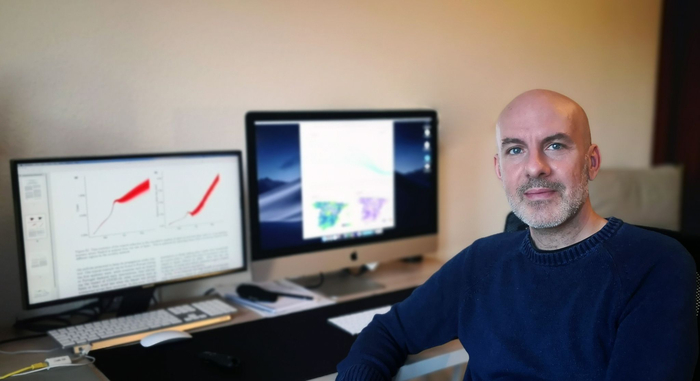
How does a neural network work? How does it react to a failure? How can you mathematically predict when it will stop working and what will happen when it does. All these questions have now been answered by a research team led by Àlex Arenas, a professor at the Universitat Rovira i Virgili's Department of Computer Engineering and Mathematics. Arenas has found the theoretical explanation for a very complex process that will now make it possible to predict how all network systems will function. Àlex Arenas
Percolation is the process by which a network system suffers a failure at a particular point that ends up affecting the whole network structure. One example of this is an electrical network that leaves a whole district without electricity when there is a problem in one tower. The process is even clearer in biological systems such as neurons. For various reasons, neurons degenerate until some of them die. These neuronal failures, caused by aging, diseases, or accidents, eventually lead to a significant loss of connectivity to the brain and the neural network stops working properly. The scientific community has been studying this percolation process for decades, along with what is known as phase transitions: the point at which a network will stop functioning completely if it is cut.

"Our research began a few years ago when I was working with the UB neuroscience team led by the researcher Jordi Soriano," explains Arenas. "We observed that, even though we directly damaged neuronal connections with lasers, the system continued to function very efficiently." This phenomenon is known as homeostatic plasticity: despite being cut, the system tries to continue doing what it was doing before the cut. It looks for alternatives, ways to continue functioning correctly.

Now, the URV research team has managed to find the answers to the phase transitions of percolation degradation: that is to say, to understand how much damage a system can undergo before it will be degraded and lose its functionality. "We have been able to find this transition and we have also been able to calculate the homeostatic response (i.e., the ability to find alternatives and continue functioning) of the network," says Arenas.

These results are important because the scientific community now has at its disposal a set of mathematical tools "that can be very useful not only in neuroscience but in any type of network," he says. The research is a step forward in our understanding of how network systems react to external damage while maintaining their functionality, compensating for the failure in one of the parts, and redirecting activity to another.

"Understanding these processes can provide solutions in many areas," says Arenas, who gives us an example of diseases such as Alzheimer's, in which many patients can remember episodes from their childhood but not more recent aspects of their lives. This is related to the degradation undergone by their neural network. Now we understand why this happens and we can apply this knowledge in research in people who begin to suffer from the disease. "For example, we will be able to know how they respond to control questions, infer to what extent their neuronal system is degraded and try medication or some other sort of intervention in an attempt to reconnect because now we know how these degradation processes act physically," says the researcher.

The results of the research can also be applied to other fields, such as road networks. If a road needs to be cut and traffic redirected to other areas, it will be possible to predict where there will be jams and what action will have to be taken to absorb the traffic there.
MD Anderson's Chen develops an AI tool for finding rare cell populations in large single-cell datasets

The super computational approach enables analysis of meaningful data that otherwise may be lost in the noise

Researchers at The University of Texas MD Anderson Cancer Center have developed a first-of-its-kind artificial intelligence (AI)-based tool that can accurately identify rare groups of biologically important cells from single-cell datasets, which often contain gene or protein expression data from thousands of cells.

This super computational tool, called SCMER (Single-Cell Manifold presERving feature selection), can help researchers sort through the noise of complex datasets to study cells that would likely not be identifiable otherwise.

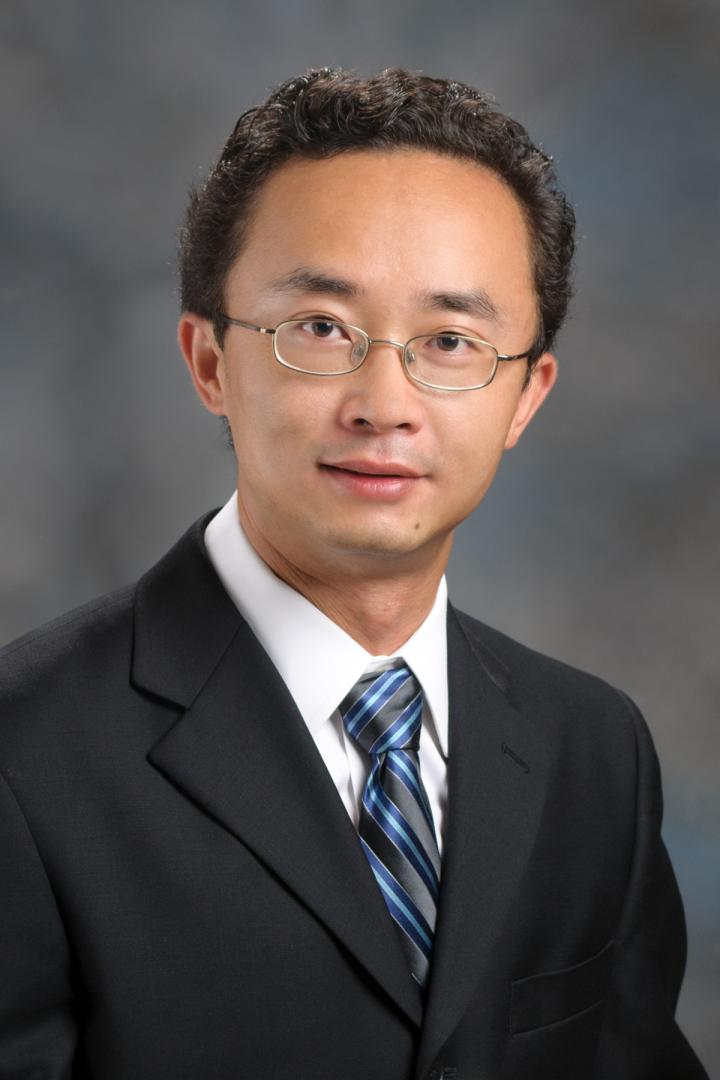
SCMER may be used broadly for many applications in oncology and beyond, explained senior author Ken Chen, Ph.D., associate professor of Bioinformatics & Computational Biology, including the study of minimal residual disease, drug resistance, and distinct populations of immune cells. Ken Chen, Ph.D.

"Modern techniques can generate lots of data, but it has become harder to determine which genes or proteins actually are important in those contexts," Chen said. "Small groups of cells can have important features that may play a role in drug resistance, for example, but those features may not be sufficient to distinguish them from more common cells. It's become very important in analyzing single-cell datasets to be able to detect these rare cells and their unique molecular features."

Developing methods to effectively study small or rare cell populations in cancer research is a direct response to one of the provocative questions posed by the National Cancer Institute (NCI) in 2020, designating this an important and underexplored research area. SCMER was designed to address the issue and to enable researchers to get the most out of increasingly complex datasets.

Rather than the traditional approach of sorting cells into clusters based on all data contained in a dataset, SCMER takes an unbiased look to detect the most meaningful distinguishing features that define unique groups of cells. This allows researchers not only to detect rare cell populations but to generate a compact set of genes or proteins that can be used to detect those cells among many others. To highlight the utility of SCMER, the research team applied it to analyze several published single-cell datasets and found it compared favorably to currently available computational approaches.

In a reanalysis of more than 4,500 melanoma cells, SCMER was able to distinguish the cell types present using the expression of just 75 genes. The results also pointed to a number of genes involved in tumor development and drug resistance that were not identified as meaningful in the original study.

In a complex dataset of nearly 40,000 gastrointestinal immune cells, SCMER separated cells using only 250 distinct features. This analysis identified all the original cell types detected in the original study, but in many cases further defined subgroups of rare cells that were not previously identified.

Finally, the research team applied SCMER to study more than 1,400 lung cancer cells taken at various points in time after drug treatment. Using just 80 genes, the tool was able to accurately distinguish cells based on treatment responses and pointed to possible novel drivers of therapeutic resistance.

"Using state-of-the-art AI techniques, we have developed an efficient and user-friendly tool capable of uncovering new biological insights from rare cell populations," Chen said. "SCMER offers researchers the ability to reduce high dimensional, complex datasets into a compact set of actionable features with biological significance."

Brown researchers use holey math, machine learning to study cellular self-assembly

The field of mathematical topology is often described in terms of donuts and pretzels.

To most of us, the two differ in the way they taste or in their compatibility with morning coffee. But to a topologist, the only difference between the two is that one has a single hole and the other has three. There's no way to stretch or contort a donut to make it look like a pretzel -- at least not without ripping it or pasting different parts together, both of which are verboten in topology. The different number of holes make two shapes that are fundamentally, inexorably different.

In recent years, researchers have drawn on the mathematical topology to help explain a range of phenomena like phase transitions in the matter, aspects of Earth's climate, and even how zebrafish form their iconic stripes. Now, a Brown University research team is working to use topology in yet another realm: training computers to classify how human cells organize into tissue-like architectures.

In a study published in the May 7 issue of the journal Soft Matter, the researchers demonstrate a machine learning technique that measures the topological traits of cell clusters. They showed that the system can accurately categorize cell clusters and infer the motility and adhesion of the cells that comprise them. 

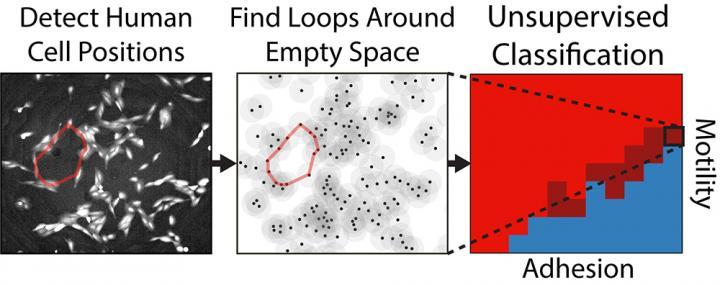
"You can think of this as topology-informed machine learning," said Dhananjay Bhaskar, a recent Ph.D. graduate who led the work. "The hope is that this can help us to avoid some of the pitfalls that affect the accuracy of machine learning algorithms." Topology-based machine learning classifies how human cells organize into spatial patterns based on the presence of persistent topological loops around empty regions, which can be used to infer cellular behaviors such as adhesion and migration.

Bhaskar developed the algorithm with Ian Y. Wong, an assistant professor in Brown's School of Engineering, and William Zhang, a Brown undergraduate.

There's been a significant amount of work in recent years to use artificial intelligence as a means of analyzing big data with spatial information, such as medical imaging of patient tissues. Progress has been made in training these systems to classify accurately, "but how they work is opaque and a little finicky," Wong said. "Just like people, sometimes computers hallucinate. You can have a few pixels in the wrong place, and it can confuse the algorithm. So Dhananjay has been thinking about ways we might be able to make those analyses a little more robust."

In developing this new system, Bhaskar took inspiration from modern art, specifically Pablo Picasso's "Bull." The series of 11 lithographs starts with a bull depicted in full detail. Each successive frame strips away a bit of detail, ending in a simple drawing capturing only the animal's fundamental attributes. By employing topology, Bhaskar thought he might be able to do something similar to understand the underlying form of tissue-like architectures.

The way in which cells migrate and interact depends on the physiology of the cells involved. For example, healthy tissues contain higher numbers of stationary epithelial cells. Processes like wound repair or cancer, however, often involve more mobile mesenchymal cells. Differences in physiology between the two cell types cause them to cluster together differently. Epithelial cells tend to aggregate into larger, more closely packed clusters. Mesenchymal cells tend to be more dispersed, with groups of cells branching off in different directions. But when assemblages contain a mix of both kinds of cells, it can be difficult to accurately analyze them.

The new algorithm uses a mathematical framework called persistent homology to examine microscope images of cell assemblages. Specifically, it looks at the topological patterns -- loops or holes -- that the cells form collectively. By looking at which patterns persist across different spatial resolutions, the algorithm determines which patterns are intrinsic to the image.

It starts by looking at the cells in their finest detail, determining which cells seem to be part of topological loops. Then it blurs the detail a bit by drawing a circle around each cell -- effectively making each cell a little larger -- to see which loops persist at that more coarse-grained scale and which get blurred out. The process is repeated until all the topological features eventually disappear. In the end, the algorithm produces a sort of bar code showing which loops persist across spatial scales. Those that are most persistent are stored as a simplified representation of the overall shape.

As it turns out, those persistent topological objects can be used to categorize clusters of different types of cells. After training their algorithm on computer-simulated cells programmed to behave like different types of cells, the team turned it loose on real experimental images of migratory cells. Those cells had been exposed to varying biochemical treatments so that some were more epithelial, some were more mesenchymal, and some were somewhere in between. The study showed that the topological algorithm was able to correctly classify different spatial patterns according to which biochemical treatment the cells had received.

"It was able to pull out all of these experimental treatments just by identifying these persistent topological loops," Wong said. "We were kind of amazed at how well it did."

The team hopes that one day the algorithm could be used in laboratory experiments to test drugs, helping to determine how different drugs can alter cell migration and adhesion. Eventually, it may also be used on medical images of tumors, potentially helping doctors to determine how malignant those tumors may be.

"We're looking for ways to catch subtleties that might not be apparent to the human eye," Wong said. "We hope that this might be a human interpretable approach that complements existing machine learning approaches."