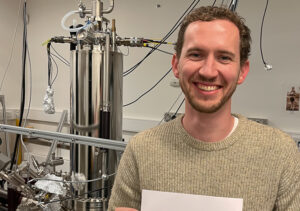
The Chair will focus on quantum information technologies, such as data transfer, quantum memories and cryptography. Here, an experiment to activate a quantum memory.  CREDIT © Olivier Zimmermann
The Chair will focus on quantum information technologies, such as data transfer, quantum memories and cryptography. Here, an experiment to activate a quantum memory. CREDIT © Olivier Zimmermann

Swiss universities name Tittel as quantum research chair in Geneva

A chair dedicated to quantum communication is being created in Geneva. The result of a partnership between the University of Geneva (UNIGE) and Constructor University (CU) based in Bremen and Schaffhausen - which was signed on Wednesday 30 November in Geneva - this chair will be positioned at the crossroads of fundamental research and applied research in this cutting-edge field of quantum physics. By pooling the expertise of researchers from both institutions, this new chair promises major advances and innovations, particularly in the field of secure information transfer. This first collaboration between UNIGE and Constructor University is part of a broader vision shared in a Memorandum of Understanding signed in 2021 that will reinforce the newly created Geneva Quantum Centre (GQC).

Building bridges between research, incubation, industry, and teaching: this is the purpose of the new chair in quantum communication created in Geneva and headed by Professor Wolfgang Tittel. The chair, which is the result of a partnership between the University of Geneva (UNIGE) and Constructor University (CU) will focus its activities on quantum information technologies, such as data transfer, quantum memories, and cryptography.

“This collaboration with Constructor University enables UNIGE to further sustain and support its longstanding history in quantum technology research. We are thrilled to merge our shared vision in establishing an internationally recognized quantum chair with the goal to advance academic offerings and explore applications of these fascinating technologies across the field,” noted Prof. Yves Flückiger, Rector of UNIGE.

“Partnership with UNIGE is the first step of building Constructor University’s global institute of advanced studies. We invite other universities, institutions, and individual professors worldwide to collaborate in solving the most pressing world challenges of today. Constructor University chooses Geneva to further develop its quantum research operations, as Geneva is already a hub for quantum science and technology in Switzerland, with Geneva Quantum Centre (GQC) of UNIGE being its major actor,” commented Dr. Serg Bell, Founder of Constructor University and Chairman of the Board.

The new chair is based at the University of Geneva, within the Faculty of Science. Constructor University will cover 50% of the operating costs. It will also provide an initial investment of 1.5 million francs to finance a new laboratory dedicated to its activities. The creation of this chair is the first step in this collaboration which commits UNIGE and Constructor University for a period of ten years. UNIGE and Constructor University plan to create other specific chairs dedicated to quantum physics in the years to come.

Shared expertise

Quantum physics research, a field of expertise of UNIGE and Constructor University, has led the past to numerous technological innovations such as computing, mobile phones, and satellite navigation. This field of research is now driving a second revolution, particularly in the field of information: researchers are currently exploiting quantum properties to create telecommunication networks that allow data to be transferred in an ultra-secure manner. These same properties are being used to develop detectors for light particles (photons) of unprecedented sensitivity.


Among the world leaders in the field, the UNIGE is the first institution to have carried out quantum communications outside the protected environment of the laboratory, using optical fibers. It has also enabled the creation of a company in the field, ID Quantique, active in cryptography and founded by physicists Nicolas Gisin, Hugo Zbinden, and Grégoire Ribordy.

Constructor University focuses on eight research areas, including quantum technology, software engineering, cyber protection and robotics. Founded in 2019, it already has an extensive network of partners in industry and academia. Its purpose is to create a unique ecosystem where the world’s leading experts in computing, physics and business come together to find innovative solutions to global challenges.

“We've freed the researchers from most of the tedious, manual tasks of data input,” says Emory theoretical chemist Fang Liu (center). Her team members who developed the toolkit include Emory graduate student Ariel Gale (left) and postdoctoral fellow Eugen Husk (right). Not shown is Xiao Huang, who worked on the project as an undergraduate.

Emory's theoretical chemist Liu clears new paths for discovery with AutoSolvate

A new open-source toolkit automates the process of supercomputing molecular properties in the solution phase, clearing new pathways for artificial intelligence design and discovery in chemistry and beyond. The Journal of Chemical Physics published the free, open-source toolkit developed by theoretical chemists at Emory University.

Known as AutoSolvate, the toolkit can speed the creation of large, high-quality datasets needed to make advances in everything from renewable energy to human health. 

“By using our automated workflow, researchers can quickly generate 10, or even 100 times, more data compared to the traditional approach,” says Fang Liu, Emory assistant professor of chemistry and corresponding author of the paper. “We hope that many researchers will access our toolkit to perform high-throughput simulation and data curation for molecules in solution.”

Such datasets, Liu adds, will provide a foundation for applying state-of-the-art machine-learning techniques to drive innovation in a broad range of scientific endeavors.

The first author of the paper is Eugen Hruska, a postdoctoral fellow in the Liu lab. Co-authors include Emory Ph.D. candidate Ariel Gale and Xiao Huang, who worked on the paper as an Emory undergraduate and is now a graduate student of chemistry at Duke University.

Exploring the quantum world

A theoretical chemist, Liu leads a team specializing in computational quantum chemistry, including modeling and deciphering molecular properties and reactions in the solution phase.  

The world becomes much more complex as it shrinks down to the scale of atoms and small molecules, where quantum mechanics describes the wave-particle duality of energy and matter. 

Theoretical chemists use supercomputers to simulate the structures of molecules and the vast array of interactions that can occur during a reaction so that they can make predictions about how a molecule will behave under certain conditions. Understanding these dynamics is key to identifying promising molecules for various applications and for driving reactions efficiently.

Researchers have already generated datasets for the properties of many molecules in the gas phase. Molecular properties in the solution phase, however, remain relatively unexplored in the context of big data and machine learning, despite the fact that most reactions occur in solution. 

The problem is that studying a molecule in solution requires much more time and effort.

A complicated process

“In the gas phase, molecules are far from each other,” Liu explains, “so when we study a molecule of interest, we don’t have to consider its neighbors.”

In the solution phase, however, a molecule is closely immersed with many other molecules, making the system much larger. “Imagine a solvent molecule surrounded by layers and layers of water molecules,” Liu says. “Depending on its size and structure, a molecule may be covered by tens, or even up to hundreds, of water molecules. In systems of such large size, the computation will be slow and may not even be feasible.”

Before running a quantum chemistry program for a molecule in the solution phase it’s necessary to first determine the geometry of the molecule and the location and orientation of the surrounding solvent molecules.

“This process is difficult to do,” Liu says. “It takes so much time and effort, and it’s so complicated, that a researcher can only perform this calculation for a few systems that they care about in one paper,” Liu says. 

Technical issues can also arise during each step in the process, she adds, leading to errors in the results.

A streamlined solution

Liu and her colleagues replaced the complicated steps required to perform these calculations with their automated system AutoSolvate.

Previously, a computational chemist might have to type hundreds of lines of code into a supercomputer to run a simulation. The command-line interface for AutoSolvate, however, requires just a few lines of code to conduct hundreds of calculations automatically.

“The time for running the simulations may be long, but that’s a job for the computer,” Liu says. “We’ve freed the researchers from most of the tedious, manual tasks of data input so that they can focus on analyzing their results and other creative work.”

In addition to the command-line interface geared toward more experienced theoretical chemists, AutoSolvate includes an intuitive graphical interface that is suitable for graduate students who are learning to run simulations. 

Labs can now efficiently generate many data points for solvated molecules and then use the dataset to build machine-learning models for chemical design and discovery. AutoSolvate also makes it easier to build and share datasets across different research groups.

Setting the stage for machine learning

“During the past 10 years, machine learning has become a popular tool for chemistry but the lack of computational datasets has been a bottleneck,” Liu says. “AutoSolvate will allow the research community to curate a huge number of datasets for molecular properties in the solution phase.”

Determining the redox potential of a solvent molecule, or the likelihood for oxidation to occur is just one example of a key research area that AutoSolvate could help advance. Redox-active molecules hold potential for applications in the development of anticancer drugs and chemical batteries for renewable-energy storage.

“Building up redox-potential datasets will then allow us to use machine learning to look at millions of different compounds to rapidly find the ones with redox potential within the desired range,” Liu says.

Instead of a black-box result, such analyses of large datasets can yield interpretable artificial intelligence or basic rules for molecular models. 

“The ultimate goal is to identify rules that can then be applied to solve a broad range of fundamental science problems,” Liu says.

The development of AutoSolvate was funded by Emory University with computational resources provided by the National Science Foundation.

Chalmers researchers develop AI that tailors artificial DNA for drug development

With the help of artificial intelligence, researchers at Chalmers University of Technology, Sweden, have succeeded in designing synthetic DNA that controls the cells' protein production.  The technology can contribute to the development and production of vaccines, drugs for severe diseases, as well as alternative food proteins much faster and at significantly lower costs than today. Aleksej Zelezniak

How our genes are expressed is a process that is fundamental to the functionality of cells in all living organisms. Simply put, the genetic code in DNA is transcribed to the molecule messenger RNA (mRNA), which tells the cell's factory which protein to produce and in which quantities.

Researchers have put a lot of effort into trying to control gene expression because it can, among other things, contribute to the development of protein-based drugs. A recent example is the mRNA vaccine against Covid-19, which instructed the body's cells to produce the same protein found on the surface of the coronavirus. The body's immune system could then learn to form antibodies against the virus. Likewise, it is possible to teach the body's immune system to defeat cancer cells or other complex diseases if one understands the genetic code behind the production of specific proteins.

Most of today's new drugs are protein-based, but the techniques for producing them are both expensive and slow because it is difficult to control how the DNA is expressed.  Last year, a research group at Chalmers, led by Aleksej Zelezniak, Associate Professor of Systems Biology, took an important step in understanding and controlling how much of a protein is made from a certain DNA sequence.

"First it was about being able to fully ‘read’ the DNA molecule's instructions. Now we have succeeded in designing our own DNA that contains the exact instructions to control the quantity of a specific protein", says Aleksej Zelezniak about the research group's latest important breakthrough.

DNA molecules made-to-order

The principle behind the new method is similar to when an AI generates faces that look like real people. By learning what a large selection of faces looks like, the AI can then create completely new but natural-looking faces. It is then easy to modify a face by, for example, saying that it should look older, or have a different hairstyle. On the other hand, programming a believable face from scratch, without the use of AI, would have been much more difficult and time-consuming. Similarly, the researchers' AI has been taught the structure and regulatory code of DNA. The AI then designs synthetic DNA, where it is easy to modify its regulatory information in the desired direction of gene expression. Simply put, the AI is told how much of a gene is desired and then  ‘prints’ the appropriate DNA sequence.

“DNA is an incredibly long and complex molecule. It is thus experimentally extremely challenging to make changes to it by iteratively reading and changing it, then reading and changing it again. This way it takes years of research to find something that works. Instead, it is much more effective to let an AI learn the principles of navigating DNA. What otherwise takes years is now shortened to weeks or days”, says first author Jan Zrimec, a research associate at the National Institute of Biology in Slovenia and past postdoc in Aleksej Zelezniak’s group.

The researchers have developed their method in the yeast Saccharomyces cerevisiae, whose cells resemble mammalian cells. The next step is to use human cells. The researchers have hopes that their progress will have an impact on the development of new as well as existing drugs.

"Protein-based drugs for complex diseases or alternative sustainable food proteins can take many years and can be extremely expensive to develop. Some are so expensive that it is impossible to obtain a return on investment, making them economically nonviable. With our technology, it is possible to develop and manufacture proteins much more efficiently so that they can be marketed", says Aleksej Zelezniak.

The authors of the study are Jan Zrimec, Xiaozhi Fu, Azam Sheikh Muhammad, Christos Skrekas, Vykintas Jauniskis, Nora K. Speicher, Christoph S. Börlin, Vilhelm Verendel, Morteza Haghir Chehreghani, Devdatt Dubhashi, Verena Siewers, Florian David, Jens Nielsen, and Aleksej Zelezniak.

The researchers are active at Chalmers University of Technology, Sverige; National Institute of Biology, Slovenia; Biomatter Designs, Lithuania; Institute of Biotechnology, Lithuania; BioInnovation Institute, Denmark; King’s College London, UK.