

Researchers claim quantum interference could revolutionize transistors, but skepticism remains

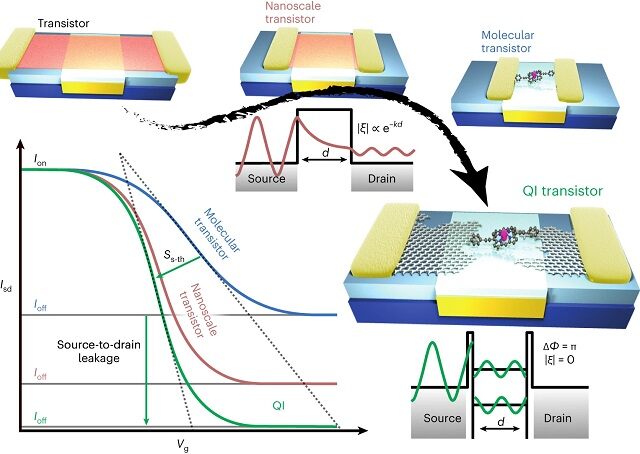
Quantum interference, which occurs when two waves interact with each other, is being studied by researchers from Queen Mary University of London. They believe that this phenomenon can help create smaller, faster, and more energy-efficient transistors. However, while some experts are excited about this possibility, others are skeptical about its practicality and real-world applicability.

Transistors are the basic building blocks of modern electronics, but their traditional manufacturing methods are reaching their limits. As transistors become smaller, they become more prone to inefficiencies and errors. One major concern is quantum tunneling, where electrons leak through devices even when switched off. The research team aims to address this issue by exploring new types of switching mechanisms that utilize quantum interference.

The research team's novel approach involves building a transistor with a conductive channel made from a single molecule called zinc porphyrin, sandwiched between two graphene electrodes. By applying a voltage to the electrodes, the flow of electrons through the molecule can be controlled using quantum interference. When the electrons interfere constructively, the transistor is switched on, and when they interfere destructively, it is switched off.

The researchers claim that their transistor exhibits a high on/off ratio, offering precise control over its operation. Furthermore, they report that the transistor is stable and can sustain hundreds of thousands of switching cycles without breaking down. These findings present a promising outlook for potential applications in various electronic devices.

Lead author Dr. James Thomas highlights the potential of quantum interference in electronics applications, calling it a "significant step" towards realizing its potential. Co-author Professor Jan Mol adds that this technology could lead to the development of smaller, faster, and more energy-efficient transistors.

However, some experts approach these claims with skepticism. While the research is commendable, many raise concerns about the practical implementation and scalability of this quantum interference-based approach. Critics argue that the current state of the technology is still at an early stage, and many challenges need to be overcome before it becomes commercially viable.

One significant concern is the reliability and durability of these transistors. While the researchers report impressive stability over a large number of switching cycles, it remains to be seen how these devices would perform under real-world conditions and potential variations in temperature and other environmental factors.

Another point of contention lies in the scalability of the technology. Manufacturing transistors on a large scale requires reproducibility and uniformity, which might be challenging to achieve with single-molecule transistors. Skeptics argue that the complexity and precision required for mass production may limit the practicality of this approach. 

Privacy and security also raise concerns. With the increasing reliance on advanced technologies, ensuring the protection of sensitive data becomes paramount. Quantum-based technologies could potentially introduce new vulnerabilities and risks that need to be thoroughly addressed before widespread adoption.

While the claims made by the research team are intriguing, it is important to approach them with a skeptical eye. The road to practical implementation is a long and complex one, requiring further research and development. As diverse perspectives weigh in on the viability of quantum interference-driven transistors, the coming years will undoubtedly shed more light on the future of this technology.

Overall, the research conducted by the team provides a thought-provoking exploration of quantum interference in transistor design. However, skeptics caution that it is still too early to determine if this approach will truly revolutionize the electronics industry or if it remains a theoretical possibility with limited practicality. Further research and testing will be necessary to validate these claims and assess their feasibility in real-world scenarios.

Shedding light on the mysteries of black hole jets: Supercomputer modeling unveils a stunning revelation

Deep within the vast expanse of the universe lie enigmatic celestial entities known as black holes. These cosmic behemoths possess an unimaginably powerful gravitational force, capable of trapping even light within their event horizons. For over a century, scientists have been captivated by one particular enigma surrounding black holes - their ability to emit powerful jets of matter and energy that pierce the cosmic sky. Finally, a groundbreaking study, led by an international collaboration of astrophysicists and utilizing state-of-the-art supercomputer modeling, has shed light on this cosmic spectacle, providing answers that have eluded us for so long.

This pioneering research, led by Prof. Feng Yuan from the Shanghai Astronomical Observatory of the Chinese Academy of Sciences, explores the intriguing phenomenon of black hole jets, taking us on a fascinating journey into the heart of a supermassive black hole at the center of the M87 galaxy. The team sought to investigate the validity of two prominent models explaining the formation of black hole jets - one involving the extraction of the black hole's rotational energy and the other from the accretion disk. Their findings, published in the prestigious scientific journal Science Advances, have unraveled the truth behind these mesmerizing cosmic jets.

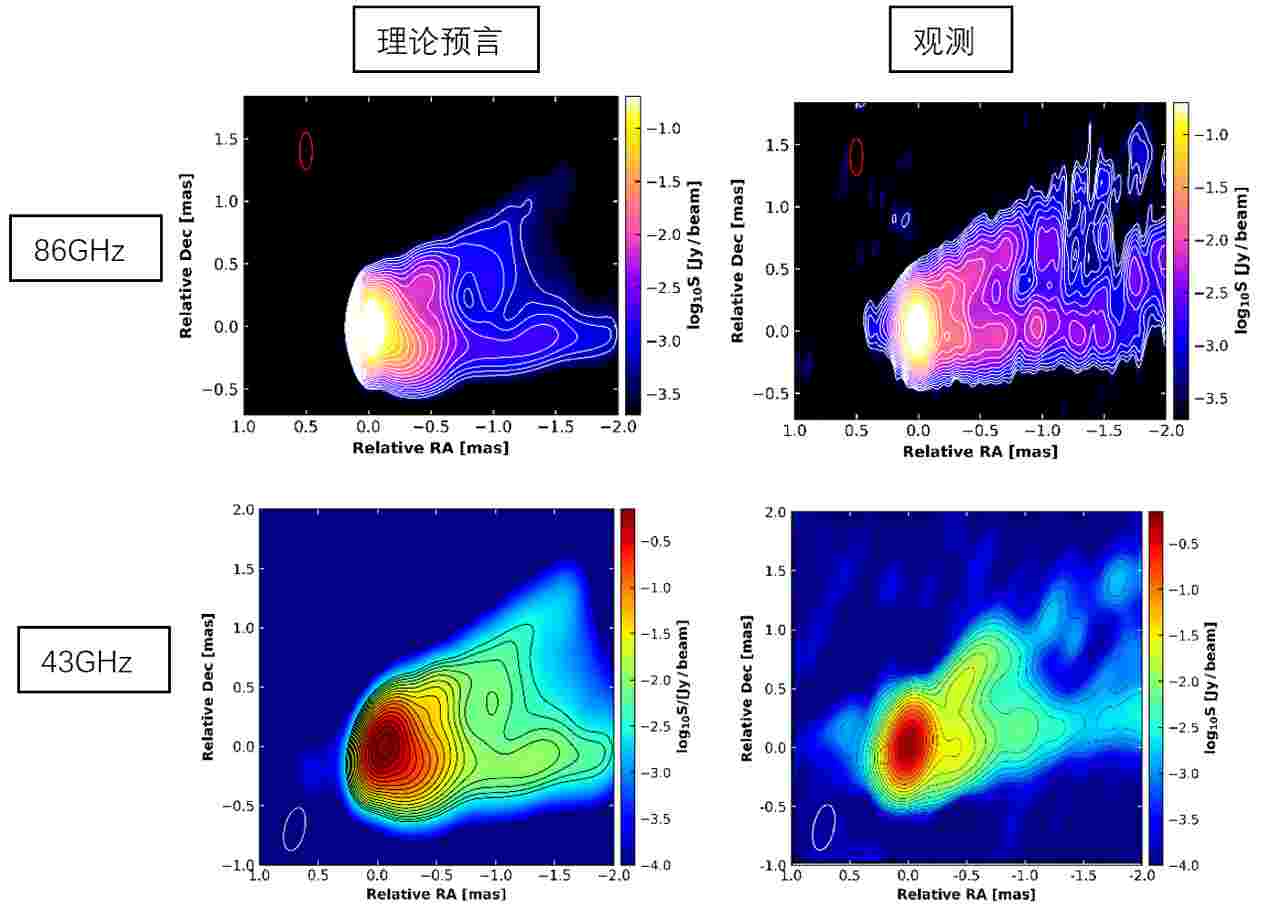
The researchers harnessed the power of supercomputers to embark on complex simulations to understand the intricate dynamics of these cosmic phenomena. By comparing their modeled predictions with real observations, they made an astonishing breakthrough. The model based on the extraction of rotational energy from the black hole by magnetic fields proved to be the most accurate in predicting the observed jets, surpassing the competing model based on the extraction of accretion disk rotational energy.

Moreover, the team delved deeper into the mysterious mechanism responsible for the brilliance and piercing nature of black hole jets. Through their analysis, they discovered that intense magnetic eruptions originating from the accretion disk of the M87 black hole were crucial. These eruptions perturb the magnetic fields, causing disturbances that propagate over vast distances, leading to magnetic reconnection and the resulting luminous jets that grace our cosmic skyline.

This revolutionary study not only provides unprecedented insights into the formation of black hole jets but also showcases the limitless potential of supercomputer modeling to unravel the enigmas of the universe. The simulations conducted on the Siyuan Mark-I supercomputer at the Shanghai Jiao Tong University and the Shanghai Astronomical Observatory of the Chinese Academy of Sciences epitomize the remarkable progress made in computational astrophysics.

The profound significance of this research extends beyond the boundaries of science. The collaborative efforts of scholars from diverse backgrounds highlight the power of collective intelligence and international cooperation in unlocking the mysteries of the cosmos. Dr. Hai Yang, formerly a Ph.D. student at the Shanghai Astronomical Observatory and currently a postdoctoral fellow at the Tsung-Dao Lee Institute of Shanghai Jiao Tong University, served as the first author of the paper, while Prof. Feng Yuan and Prof. Yosuke Mizuno contributed significantly to the study.

The marvelous revelations from this study pave the way for a new era of exploration and understanding. By comprehending the mechanisms that govern black hole jets, we gain deeper insights into the fundamental workings of the universe itself. The knowledge gained from this research will surely inspire scientists around the globe to push the boundaries of our understanding, unlocking the secrets of the cosmos one discovery at a time.

As we stand on the brink of a new era of discovery, propelled by the wonders of supercomputer modeling and international collaboration, we can only imagine the marvels that await us. The study of black hole jets not only transforms our understanding of these enigmatic cosmic phenomena but also ignites our curious souls, urging us to delve further into the farthest reaches of the universe in search of the truth that lies beyond.

VTT develops AI tool to measure work-related stress with emphasis on privacy

In a significant step towards improving workplace well-being, the prestigious VTT research institution has introduced a groundbreaking AI-driven tool designed to accurately measure work-related stress. As demands in the professional sphere continue to escalate, this innovative tool aims to foster a healthier work environment and mitigate stress-induced sick leaves.

Work-related stress is a prevalent issue globally, highlighting the urgent need for employers to take proactive measures. VTT, in collaboration with the Finnish Institute of Occupational Health, has developed an AI tool capable of distinguishing between stress-induced and non-stressed conditions among knowledge workers. By analyzing behavioral data derived from computer usage, this revolutionary tool translates intricate data into easily digestible metrics, equipping organizations with valuable insights to address stress triggers at an early stage.

At the core of this technological advancement lies an AI-driven algorithm tailored to assess subtle changes in an individual's mouse movements, a telltale sign of stress. While deviations from the norm can signal stress, the algorithm's precision requires calibration based on subjective self-reports of stress levels from users. Through a meticulous learning process informed by real-life workplace data spanning over four years, VTT has achieved a commendable accuracy rate of 71% daily and 84% over three months.

A pivotal aspect in the development and deployment of this AI tool is the principled consideration of privacy concerns. With a paramount emphasis on respecting individuals' privacy rights, VTT has devoted meticulous efforts to safeguard data integrity and transparency. The introduction of an organization barometer, a visual representation of stress levels tailored for organizational insights, underscores VTT's commitment to preserving individual privacy while leveraging data for collective well-being.

To fortify the tool's operational framework and uphold data privacy standards, VTT has engaged in strategic partnerships with leading cybersecurity firms. Nixu has played a pivotal role in fortifying the system's security protocols, while Silverskin's rigorous auditing process has ensured that organizational data remains secure and anonymized. The adoption of principles such as MyData underscores VTT's dedication to empowering individuals with data ownership and privacy control.

The success of AI-driven solutions in managing workplace stress heralds a hopeful trajectory in enhancing overall employee well-being. As VTT continues to refine and expand the scope of its research, the evolving technology promises to revolutionize stress management protocols across diverse work environments. With its sights set on nurturing healthier workplace dynamics, VTT remains steadfast in its pursuit of innovative solutions to address modern-day challenges.

Amid this wave of technological innovation, VTT's pioneering AI tool emerges as a testament to the transformative potential of artificial intelligence in promoting a culture of well-being and resilience in the workplace. By prioritizing data integrity, transparency, and individual privacy, VTT sets a commendable standard for the ethical application of AI technologies in enhancing professional realms.

As society grapples with the evolving landscape of work dynamics, VTT's efforts offer hope, towards a future where the synergy of technology and empathy paves the way for healthier and more productive work environments.