Hewlett Packard Enterprise reports fiscal 2024 first quarter results amidst challenging market conditions

In today's announcement, Hewlett Packard Enterprise (HPE) has revealed its financial results for the first quarter of fiscal year 2024, ending January 31, 2024. Despite facing market headwinds, the company managed to exceed its profitability expectations and make advancements in its long-term strategy. 

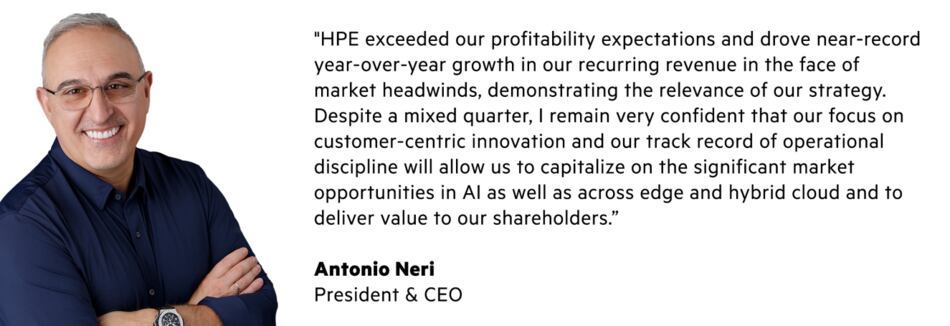
Under the leadership of Antonio Neri, President and CEO of HPE, the company showcased confidence in its customer-centric innovation and operational discipline, believing it will position them to seize significant market opportunities in AI, edge computing, and hybrid cloud.

However, it's important to note that the first quarter results did reveal some challenges for HPE. With revenues of $6.8 billion, the company experienced a downward trend, declining by 14% compared to the previous year. This decline can be attributed to various factors, including the softening of the networking market and timing issues with GPU deals.

Despite the challenges faced by HPE, the company demonstrated resilience and progress in certain key areas. HPE achieved an annualized revenue run-rate (ARR) of $14 billion, which represents a commendable 42% growth from the previous year. The gross margins also showed improvement, with a GAAP of 36.4% and a non-GAAP of 36.2%, showcasing an increase from the prior-year period.

Moreover, HPE achieved positive cash flow from operations of $64 million, indicating a significant increase of $893 million compared to the same quarter last year. Meanwhile, free cash flow (FCF) reached $482 million, marking a substantial increase of $844 million year-over-year.

Looking at the segment results, HPE's server revenue witnessed a decline of 23% at $3.4 billion. On the other hand, the Intelligent Edge segment showed some growth, with revenue reaching $1.2 billion, a 3% increase from the prior-year period. The Hybrid Cloud segment experienced a decline, bringing in $1.2 billion, a decrease of 10% from the previous year. The Financial Services segment remained relatively flat with revenue of $873 million.

It is essential to consider the broader industry landscape, where Dell Technologies, HPE's competitor, also has announced its financial results for the fourth quarter and full-year fiscal 2024.

For the fourth quarter, Dell Technologies' revenue was $22.3 billion, down 11% year over year. Operating income was $1.5 billion and non-GAAP operating income was $2.1 billion, up 25% and down 1% year over year, respectively. Cash flow from operations was $1.5 billion. While the company managed a slight increase in operating income, it failed to meet revenue expectations, which is a matter of concern.

Similarly, for the full year, Dell Technologies' revenue was $88.4 billion, down 14% from fiscal year 2023. Operating income was $5.2 billion and non-GAAP operating income was $7.7 billion, down 10% and 11% respectively. While the full-year diluted earnings per share was $4.36 and non-GAAP diluted earnings per share was $7.13, these numbers are not indicative of a thriving business.

These results painted a nuanced picture of the market conditions faced by technology companies in supercomputing. This perspective helps illustrate the challenges and pressures that HPE is navigating in a rapidly evolving industry. 

As concerns loom over HPE's performance amidst declining revenues and challenging market conditions, the company's leadership remains optimistic about delivering strong returns for shareholders in the remaining fiscal year. HPE's fiscal 2024 outlook includes a flat to 2% growth in revenue, as well as a range of 7% to 11% growth in GAAP operating profit.

In conclusion, while HPE's first-quarter results exhibited some concerning trends, it is worth acknowledging the company's efforts to adapt, innovate, and steer through market challenges. As the technology landscape continues to transform, investors and industry observers will closely monitor HPE's ability to capitalize on emerging opportunities and deliver value in a dynamic and competitive environment.


Image: Geio Tischler

AI finds new roads threatening rainforests, aiding conservation

In a groundbreaking move towards the protection of our planet's precious rainforests, scientists at James Cook University in Australia have harnessed the power of machine learning to uncover previously unknown roads that pose a significant danger to these vital ecosystems. This remarkable breakthrough has the potential to revolutionize conservation efforts worldwide.

The study, led by Distinguished Professor Bill Laurance, utilized convolutional neural networks trained on satellite images to detect unmapped roads in wilderness areas. These hidden pathways, often associated with environmental destruction resulting from activities like logging, mining, and land clearing, have largely evaded detection until now.

The scope of the road-building wave we are currently experiencing is staggering, with an estimated 25 million kilometers of new paved roads projected by mid-century. Developing nations, particularly those in tropical and subtropical regions boasting exceptional biodiversity, bear the brunt of this infrastructure expansion.

Traditionally, road mapping has been a labor-intensive process, requiring the time-consuming task of manually tracing road features using satellite imagery. However, the integration of artificial intelligence and machine learning is transforming this process, enabling incredible progress in large-scale road mapping projects.

Through the development and training of machine-learning models, the researchers successfully identified road features from high-resolution satellite imagery covering remote and forested areas of Papua New Guinea, Indonesia, and Malaysia. This automated approach revealed up to 13 times more road length than previously reported in government or road databases.

Professor Laurance, a co-author of the study, emphasizes the immense potential of machine learning for addressing global road-mapping challenges, stating, "We're not there yet, but we're making good progress." With continued advancements, artificial intelligence holds the promise of providing us with the means to map and monitor roads across the world's most environmentally critical areas.

Undoubtedly, proliferating roads constitute one of the most significant direct threats to tropical forests on a global scale. However, this breakthrough offers renewed hope for combating environmental disruptions associated with unchecked road construction. By strengthening our ability to identify and monitor these hidden roads, we can take proactive measures to mitigate their devastating impact on our fragile ecosystems.

The implications of this study reach far beyond rainforests alone. Through the application of machine learning, we have the potential to enhance global conservation efforts in various ecosystems facing similar threats.

From tackling deforestation to addressing illegal activities, the innovative utilization of artificial intelligence expands our capability to drive positive change.

It is crucial to acknowledge the collaborative nature of this endeavor, involving researchers, technology experts, and policymakers working together to protect our natural heritage. By integrating diverse perspectives, we can ensure the successful implementation of AI-driven solutions while considering the social, economic, and environmental implications that come with it.

As we continue to make strides in advancing machine learning capabilities, we now stand on the threshold of a new era in conservation. With optimism and determination, we are poised to unlock the potential of artificial intelligence, one road at a time, in safeguarding our planet's most valuable ecosystems. Together, we have the power to make a difference and create a more sustainable future.

Decoding the SARS-CoV-2 puzzle: Simulations reveal insights into M protein interactions

Scientists at the University of California, Riverside, have used supercomputer simulations to understand the role of a small protein, known as the Membrane protein or M protein, in shaping the SARS-CoV-2 virus into its distinctive spherical structure. The team's study details their approach to producing large quantities of M protein, characterizing its physical interactions with the viral membrane, and using theoretical modeling and simulations to paint a clearer picture of how these interactions contribute to the virus's spherical shape. From L to R: Roya Zandi, Thomas Kuhlman, and Umar Mohideen.

The researchers have discovered that when the M protein becomes embedded in the membrane, it induces localized reductions in membrane thickness, triggering curvature and ultimately resulting in the virus's distinctive spherical shape. The team turned to Escherichia coli bacteria to produce the M protein, but they encountered a problem as the proteins tended to clump together leading to cellular death. To solve this issue, the researchers induced the E. coli cells to produce an additional protein called Small Ubiquitin-related Modifier (SUMO) alongside the M protein, which prevented unwanted protein aggregation.

This research holds broader implications for coronaviruses as M proteins are integral components of various coronaviruses, making these findings valuable in understanding viral formation and potentially identifying interventions not only for SARS-CoV-2 but also for other pathogenic coronaviruses. The team plans to expand their investigations to explore how M proteins interact with other SARS-CoV-2 proteins, to potentially disrupt these interactions using targeted drugs.

The study's success was due to the collaboration of diverse perspectives within the research team. The team plans to leverage the power of supercomputing simulations to provide critical insights that could aid in the development of effective antiviral strategies. By harnessing the power of diverse perspectives and cutting-edge computational tools, scientists move closer to decoding the intricate mechanisms of SARS-CoV-2 and developing targeted interventions that may help bring an end to the global crisis.