

Left to right: Prof. Shlomi Reuveni, Ph.D. student Ofir Blumer & Dr. Barak Hirshberg

Restarting chemical simulations revolutionizes scientific breakthroughs

In the fast-paced world of chemical research, a groundbreaking study from Tel Aviv University in Israel has unveiled a game-changing technique that could potentially reshape the landscape of scientific exploration and accelerate valuable discoveries. By drawing inspiration from the world of information technology, researchers have successfully demonstrated how the simple act of "restarting" can vastly enhance the sampling in chemical simulations, pushing the boundaries of what is possible in this field. This remarkable achievement not only showcases the power of supercomputing but also highlights the importance of embracing diverse perspectives in advancing scientific knowledge.

Conducted by a team led by Ph.D. student Ofir Blumer in collaboration with Professor Shlomi Reuveni and Dr. Barak Hirshberg from the Sackler School of Chemistry, this study holds promising implications for molecular dynamics simulations. These simulations, often referred to as virtual microscopes, track the intricate motion of atoms in various chemical, physical, and biological systems. They provide valuable insights into processes that range from protein folding to crystal nucleation and hold immense potential in fields like drug design.

However, a significant challenge called the "timescale problem" has long hampered these simulations. They are typically unable to depict processes occurring slower than one millionth of a second, restricting their ability to capture essential phenomena. In a stroke of innovative thinking, the researchers harnessed the concept of "stochastic resetting" commonly employed in information technology, and applied it to chemical simulations.
It may initially seem counterintuitive that restarting simulations can yield faster results. However, the study revealed that reaction times vary significantly across simulations. Some simulations become trapped in intermediate states for extended periods, while others experience rapid reactions. Resetting prevents simulations from getting stuck in these intermediates, ultimately shortening the average simulation time and overcoming the timescale problem.

The researchers further integrated stochastic resetting with Metadynamics, a popular method for expediting the simulations of slow chemical processes. This powerful combination produced more substantial acceleration than each method alone, reducing reliance on prior knowledge and drastically saving time for practitioners. Importantly, the researchers showcased the effectiveness of this combined approach in accurately predicting the rate of slow processes, as validated by successful protein folding simulations.

Diverse perspectives have played a pivotal role in shaping this groundbreaking research. Collaborative efforts between passionate individuals from various backgrounds exemplify the inclusive nature of scientific exploration. By embracing different viewpoints and insights, this project has successfully pushed the boundaries of what can be achieved, sparking excitement and inspiration within the scientific community.

At a time when the world faces complex challenges that demand innovative solutions, the potential impact of this research is immense. Not only does it open new avenues for understanding fundamental chemical processes, but it also presents opportunities for groundbreaking advancements in drug development, materials science, and numerous other fields.

Through the tireless efforts of researchers at Tel Aviv University, the boundaries of what can be achieved with supercomputing and diverse perspectives have been stretched. This achievement reminds us that true scientific progress often arises from the unification of seemingly unrelated disciplines. By thinking beyond traditional boundaries and being open to novel approaches, we can unlock a world of possibilities and accelerate the pace of discovery.

As this exciting research takes its place in history, it serves as a testimony to the potential for groundbreaking scientific breakthroughs when driven by collaboration, innovation, and an unwavering commitment to pushing the boundaries of knowledge. The lessons learned from restarting simulations will undoubtedly pave the way for a new era of research and inspire future generations of scientific explorers to embrace diverse perspectives and never stop pushing the limits of human understanding.

C. “Sesh” Seshadhri
C. “Sesh” Seshadhri

Study casts doubts on the reliability of machine learning methods

In today's digital era, machine learning plays a vital role in our lives by driving social media expansion and shaping various scientific research fields. However, a recent study by UC Santa Cruz has raised concerns about the reliability of widespread machine learning methods behind link prediction.

Link prediction is a popular machine learning task that evaluates the links in a network and predicts future connections. From suggesting friends on social media to predicting the interaction between genes and proteins, link prediction has become a benchmark for testing the performance of machine learning algorithms. But is it trustworthy?

The study by UC Santa Cruz Professor of Computer Science and Engineering C. "Sesh" Seshadhri, in collaboration with Nicolas Menand, reveals the flaws in evaluating the accuracy of link prediction. The commonly used metric for measuring link prediction performance, known as AUC, fails to capture crucial information, thereby giving an exaggerated sense of success.

Seshadhri, a respected figure in theoretical computer science and data mining, discovered mathematical limitations hindering the performance of machine learning algorithms. His investigation into link prediction revealed that the seemingly impressive results may not reflect reality. According to Seshadhri, "It feels like if you measured things differently, maybe you wouldn't see such great results."

Low-dimensional vector embeddings are the key to link prediction, a process that represents individuals within a network as mathematical vectors in space. However, the study finds that AUC, the most commonly used metric, fails to account for fundamental mathematical limitations. This ultimately creates an inaccurate measure of link prediction performance.

The study's findings cast doubt on the widespread use of low-dimensional vector embeddings in machine learning, challenging the notion that these methods are as effective as previously thought. Seshadhri and Menand introduced a new metric, VCMPR, to capture the limitations more comprehensively. Interestingly, when using VCMPR, most leading methods in the field performed poorly. This calls into question the reliability of these algorithms.

Beyond the immediate concern for machine learning accuracy, this research has broader implications for trustworthiness and decision-making in machine learning. Using flawed metrics to assess performance could lead to flawed decision-making in real-world machine-learning applications. Seshadhri asks, "If you have the wrong way of measuring, how can you trust the results?"

While some may argue that these findings are not surprising to those deeply entrenched in the field, the wider community of machine learning researchers needs to take note of this skepticism. The study challenges the dominant philosophy within machine learning, urging researchers to question the validity of metrics and strive for a more comprehensive understanding of their experiments.

In a world where machine learning extends beyond its domain and significantly impacts various fields such as biology, accuracy and trustworthiness are paramount. Biologists utilizing link prediction to identify potential protein interactions in drug discovery, for instance, heavily rely on the expertise of machine learning practitioners to produce reliable tools.

This study, funded by the National Science Foundation and the Army Research Office, serves as a cautionary tale for the machine learning community. It reminds us of the need to approach research with skepticism and constantly question the accuracy of our methodologies. True progress lies in the pursuit of a deeper understanding rather than just chasing higher scores on flawed metrics.

As the field of machine learning continues to evolve, researchers and practitioners must consider diverse perspectives, challenge conventional wisdom, and prioritize the development of more accurate and trustworthy methods. Only then can we fully harness the potential of machine learning while ensuring its reliability and impact on society?

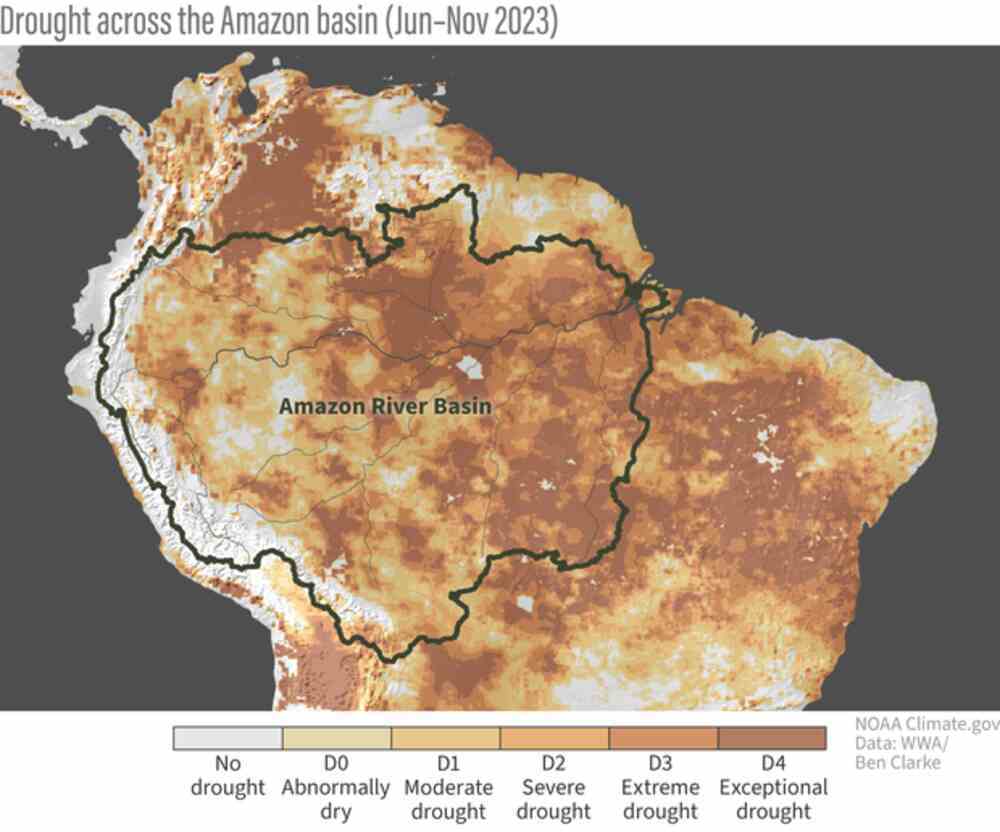
The following information pertains to the drought status of the Amazon River basin from June to November 2023. The classification system used is the U.S. Drought Monitor. According to the analysis conducted by World Weather Attribution and presented by Ben Clarke, a large portion of the eastern half of the basin along with certain areas in the western half are experiencing extreme or exceptional drought conditions. The image used in this report is provided by NOAA Climate.gov.

Climate models inspire hope for our planet's future

According to a recent analysis by the World Weather Attribution project, human-caused global warming played a much larger role than El Niño in intensifying the 2023 Amazon drought. This drought has resulted in many communities being cut off from food supplies, markets for their crops, and health services, causing electricity blackouts and water rationing in some urban areas.

Through observations and supercomputer model simulations, a team of experts found that global warming had doubled the precipitation deficits from El Niño alone. Rising temperatures have amplified water stress, turning the 2023 drought into an "exceptional" one that has become the worst on record. While the research has not yet been peer-reviewed, the team used methods that have previously passed peer-review. Rapid response analyses using these methods have been published in scientific journals, such as their analysis of the 2021 heatwave in the Pacific Northwest and their analysis of record-setting flooding in Louisiana in 2016.

The findings of this analysis underscore the critical importance of addressing the climate crisis to prevent future disasters from happening. This includes curbing deforestation and reforesting cleared and degraded areas in the Amazon to restore the region's moisture-recycling capacity. Reforestation would act as a buffer to global warming until the world can achieve net-zero greenhouse gas emissions.

The supercomputer model simulations have brought to light the impact of global warming and call for immediate action toward mitigating its impact. As the world works to reduce greenhouse gas emissions and stave off further warming, we must take collective action and make the world a better place for future generations. Although the path may seem long, it is possible with the right measures and collective action. The time for action is now!