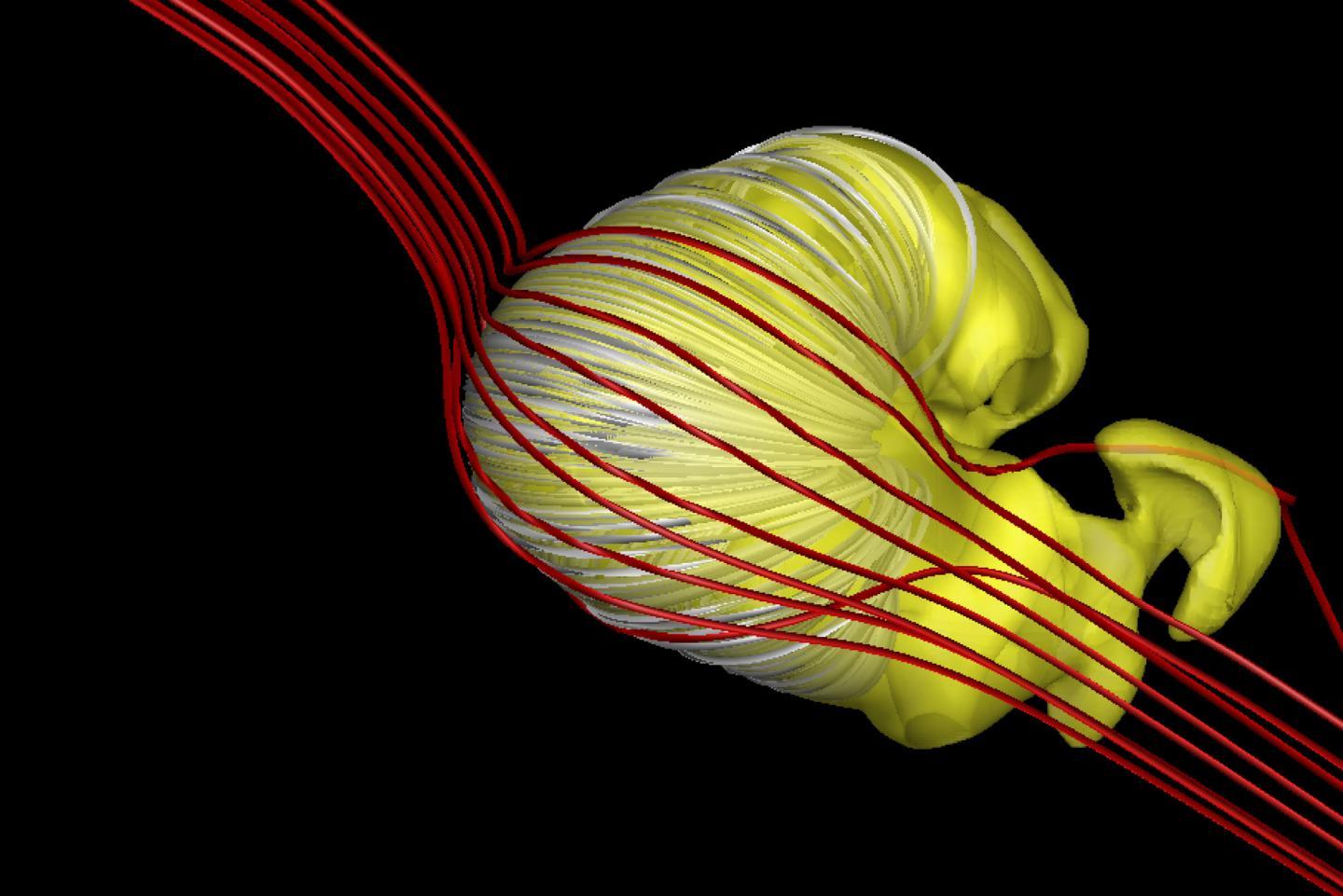
Max Planck researchers unravel dense networks deep inside the brain

Researchers use 3-dimensional electron microscopy to map the local connectome in the cerebral cortex

Unlike any other organ, our brains contain extremely densely packed networks of membranous cables that are used by our about 86 billion nerve cells for communication amongst each other. Since each nerve cell in the main part of mammalian brains, the so-called cerebral cortex, communicates with about 1,000 other nerve cells via synapses placed along these cables over long distances, one expects a total of about 5 million kilometers of wires packed into our skulls - more than 10 times longer than all highways on our planet, in each of our brains. The cables we find in our (and other mammalian) brains are as thin as 50 to 100 nanometers in diameter, about 1000th the diameter of our hairs. The resulting cable convolute is of such density and magnitude, that for more than 100 years, researchers have been able to only map connectivity between a minuscule fraction of neurons in a given piece of brain. CAPTION Dense connectome from the mouse cerebral cortex, the largest connectome to date.  CREDIT Reprinted with permission from A Motta et al., Science DOI:http://science.sciencemag.org/lookup/doi/10.1126/science.aay3134 (2019){module In-article}

Only the development of faster electron microscopic techniques ("3D EM") and of more efficient image analysis routines has made the dense mapping of neuronal networks possible. The novel field of "connectomics" has been pursuing the dense mapping of ever-larger circuits in several species and brain regions.

In the work published today in Science, a team around Max Planck Director Moritz Helmstaedter imaged and analyzed a piece of tissue from the cerebral cortex of a 4-week old mouse, obtained via biopsy from the somatosensory cortex, a part of the cortex occupied with the representation and processing of touch. Here, the researchers applied optimized AI-based image processing and efficient human-machine interaction to analyze all of the about 400,000 synapses and about 2.7 meters of neuronal cable in the volume. With this, they produced a connectome between about 7,000 axons and about 3,700 postsynaptic neurites, yielding a connectome about 26 times larger than the one obtained from the mouse retina more than half a decade ago. Importantly, this reconstruction was at the same time larger and about 33-times more efficient than the one applied to the retina, setting a new benchmark for dense connectomic reconstruction in the mammalian brain.

Fueled by this methodological breakthrough in connectomics, the researchers analyzed the connectome for the patterns of circuitry present. In particular, they asked what fraction of the circuit showed properties that were consistent with the growth of synapses, mechanisms known to contribute to circuit formation and "learning". Alessandro Motta, the first author of the study and an electrical engineer by training, used particular configurations of synapse pairs to study the degree to which they were in agreement with activity-related learning processes ("LTP"). "Because some models of synaptic plasticity make concrete predictions about the increase in synaptic weight when learning, say, to identify a tree or a cat, we were able to extract the imprint of such potential processes even from a static snapshot of the circuit", explains Motta. Since the mouse had had a normal laboratory life until the brain biopsy at 4 weeks of age, the scientists argue that the degree to which circuits are shaped by learning in "normal" sensory states can be mapped using their approach.

"We were surprised how much information and precision is found even in a still relatively small piece of cortex", says Helmstaedter, and adds "Especially the extraction of the likely learned circuit fraction was a major eye-opener for us".

The reported methods may have substantial implications for the transfer of insights about biological intelligence to what today is called "artificial intelligence". "The goal of mapping neuronal networks in the cerebral cortex is a major scientific adventure, also because we hope to be able to extract information about how the brain is such an efficient computer, unlike today's AI", states Helmstaedter. And describes a research field with major players including Google and the research program of the intelligence agencies in the US (IARPA): "The ambition to learn from biological neuronal networks about the future of artificial neuronal networks is shared by major initiatives world-wide. We are very proud of having achieved the first milestone, a dense local cortical connectome, using exclusively public funding from the Max Planck Society".

After almost a decade of work, the researchers are enthusiastic about their achievements. "Being able to take a piece of cortex, process it diligently, and then obtain the entire communication map from that beautiful network is what we have been working for over the last decade", describes Helmstaedter.

The researchers conclude: "We think that our methods, applied over a large range of cortical tissues from different brain areas, cortical layers, developmental time points, and species will tell us how evolution has designed these networks, and what impact experience has on shaping their fine-grained structure".

"Moreover, the connectomic screening will allow the description of circuit phenotypes of psychiatric and related disorders - and tell us to what degree some important brain disorders are in fact connectopathies, circuit diseases."

U.S. Navy connects the dots for quantum networks

Researchers at the U.S. Naval Research Laboratory (NRL) developed a new technique that could enable future advancements in quantum technology.

The technique squeezes quantum dots, tiny particles made of thousands of atoms, to emit single photons (individual particles of light) with precisely the same color and with positions that can be less than a millionth of a meter apart.

"This breakthrough could accelerate the development of quantum information technologies and brain-inspired computing," said Allan Bracker, a chemist at NRL and one of the researchers on the project. CAPTION Schematic of a nanoscale structure called a 'photonic crystal waveguide' that contains quantum dots that can interact with one another when they are tuned to the same wavelength.  CREDIT Chul Soo Kim, US Naval Research Laboratory{module In-article}

In order for quantum dots to "communicate" (interact), they have to emit light at the same wavelength. The size of a quantum dot determines this emission wavelength. However, just as no two snowflakes are alike, no two quantum dots have exactly the same size and shape -- at least when they're initially created.

This natural variability makes it impossible for researchers to create quantum dots that emit light at precisely the same wavelength [color], said NRL physicist Joel Grim, the lead researcher on the project.

"Instead of making quantum dots perfectly identical, to begin with, we change their wavelength afterward by shrink-wrapping them with laser-crystallized hafnium oxide," Grim said. "The shrink wrap squeezes the quantum dots, which shifts their wavelength in a very controllable way."

While other scientists have demonstrated "tuning" of quantum dot wavelengths in the past, this is the first time researchers have achieved it precisely in both wavelength and position.

"This means that we can do it not just for two or three, but for many quantum dots in an integrated circuit, which could be used for optical, rather than electrical computing," Bracker said.

The wide breadth of researcher expertise and science assets at NRL allowed the team to test various approaches to making this quantum dot breakthrough in a relatively short amount of time.

"NRL has in-house facilities for crystal growth, device fabrication, and quantum optical measurements," Grim said. "This means that we could immediately coordinate our efforts to focus on rapidly improving the material properties."

According to Grim and Bracker, this milestone in the manipulation of quantum dots could lay the groundwork for future strides in a number of areas.

"NRL's new method for tuning the wavelength of quantum dots could enable new technologies that use the strange properties of quantum physics for computing, communication, and sensing," Bracker said. "It may also lead to 'neuromorphic' or brain-inspired computing based on a network of tiny lasers."

Applications in which space and power-efficiency are limiting factors may also benefit from this breakthrough approach, researchers said.

Chinese scientists deploy secure metro quantum networks

Successful new field tests of a continuous-variable quantum key distribution (CV-QKD) system over commercial fiber networks could pave the way to its use in metropolitan areas.

That is the key achievement from a joint team of Chinese scientists, published today in Quantum Science and Technology, which demonstrates CV-QKD transmission over commercial deployed fiber link with a distance of 50 kilometres.

Team leader and lead author, Prof. Hong Guo, from a joint team of Peking University and Beijing University of Posts and Telecommunications (PKU-BUPT joint team), Beijing, said: "CV-QKD provides, in principle, unconditional secret keys to protect people's data - such as banking information, emails and passwords. 

{module In-article} "It has attracted much attention in the past few years, because it uses standard telecom components that operate at room temperature, instead of specific quantum devices such as single photon detectors etc, and it has potentially much higher secret key rates. However, most previous long-distance CV-QKD demonstrations were only done in laboratory fiber, without the disturbances caused by the field environment."

Lead authors Dr. Yichen Zhang and Prof. Song Yu, from the PKU-BUPT joint team, Beijing, said: "There are several challenges to bringing a practical CV-QKD system from a laboratory setup to the real world. Deployed commercial dark fibers are inevitably subject to much stronger perturbations from changing environmental conditions and physical stress. This in turn causes severe disturbances of the transmitted quantum states. 

"They also suffer from higher losses due to splices, sharp bends and inter-fiber couplings. The software and hardware of CV-QKD modules must not only be designed to cope with all the conditions affecting the transmission fiber, but must also be robustly engineered to operate in premises designed for standard telecom equipment. Furthermore, as the systems need to run continuously and without frequent attention, they need to be designed to automatically recover from any errors and shield end users from service interruptions."

The PKU-BUPT joint research team carried out two field tests of CV-QKD over commercial fiber networks in two cities of China - Xi'an and Guangzhou - achieving transmission distances of 30.02 km (12.48 dB loss) and 49.85 km (11.62 dB loss), respectively.

Prof. Hong Guo said: "The longest previous field tests of a CV-QKD system were over a 17.52 km deployed fiber (10.25 dB loss) and a 17.7 km deployed fiber (5.6 dB loss), where the secret key rates were 0.2 kbps and 0.3 kbps, respectively. 

"Comparing with these results, our results show a more than twice transmission distance, and a two orders-of-magnitude higher secret key rates, though in more lossy commercial fiber links.

"This is a significant step in bringing CV-QKD closer to everyday use. It has pushed CV-QKD towards a more practical setting, and, naturally, one may expect that a quantum-guaranteed secure metropolitan network could be built within reach of current technologies."