

Basel researchers create identical photons with different quantum dots

Identical light particles (photons) are important for many technologies that are based on quantum physics. A team of researchers from the University of Basel in Switzerland and the University of Bochum in Germany has now produced identical photons with different quantum dots; an important step toward applications such as tap-proof communications and the quantum internet. Although the quantum dots of the Basel researchers are different, they emit exactly identical light particles. (Image: University of Basel, Department of Physics)
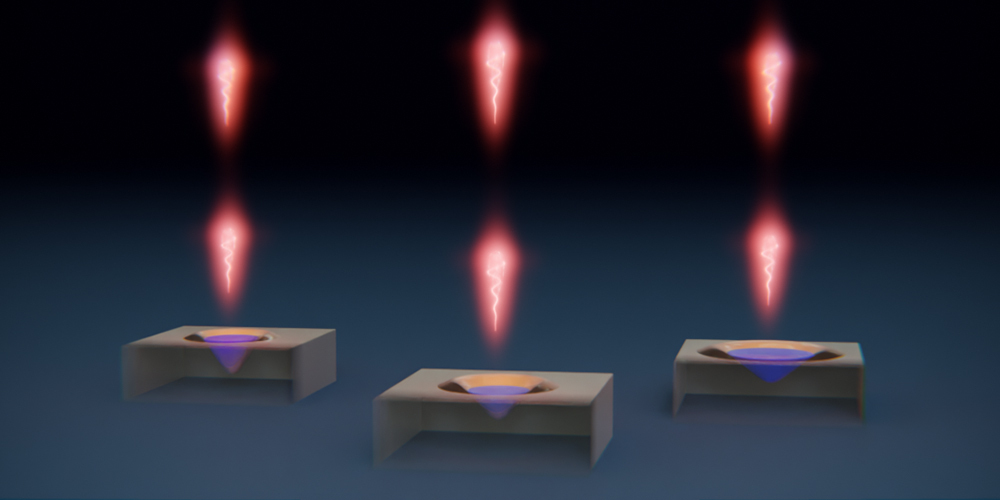
Many technologies that make use of quantum effects are based on exactly equal photons. Producing such photons, however, is extremely difficult. Not only do they need to have precisely the same wavelength (color), but their shape and polarization also have to match.

A team of researchers led by Richard Warburton at the University of Basel, in collaboration with colleagues at the University of Bochum, has now succeeded in creating identical photons originating from different and widely-separated sources.

{media id=283,layout=solo}

Single photons from quantum dots

In their experiments, the physicists used so-called quantum dots, structures in semiconductors only a few nanometres in size. In the quantum dots, electrons are trapped such that they can only take on very specific energy levels. Light is emitted on making a transition from one level to another. With the help of a laser pulse that triggers such a transition, single photons can thus be created at the push of a button.

“In recent years, other researchers have already created identical photons with different quantum dots”, explains Lian Zhai, a postdoctoral researcher and first author of the study. “To do so, however, from a huge number of photons they had to pick and choose those that were most similar using optical filters.” In that way, only very few usable photons remained.

Warburton and his collaborators chose a different, more ambitious approach. First, the specialists in Bochum produced extremely pure gallium arsenide from which the quantum dots were made. The natural variations between different quantum dots could thus be kept to a minimum. The physicists in Basel then used electrodes to expose two quantum dots to precisely tuned electric fields. Those fields modified the energy levels of the quantum dots, and they were adjusted in such a way that the photons emitted by the quantum dots had precisely the same wavelength.

93 percent identical

To demonstrate that the photons were indistinguishable, the researchers sent them onto a half-silvered mirror. They observed that almost every time, the light particles either passed through the mirror as a pair or else were reflected as a pair. From that observation, they could conclude that the photons were 93 percent identical. In other words, the photons formed twins even though they were “born” completely independently of one another.

Moreover, the researchers were able to realize an important building block of quantum computers, a so-called controlled-NOT gate (or CNOT gate). Such gates can be used to implement quantum algorithms that can solve certain problems much faster than classical computers.

“Right now our yield of identical photons is still around one percent”, Ph.D. student Gian Nguyen concedes. Together with his colleague Clemens Spindler he was involved in running the experiment. “We already have a rather good idea, however, how to increase that yield in the future.” That would make the twin-photon method ready for potential applications in different quantum technologies.
Missouri S&T builds smart, connected farms that assist agricultural hazard management

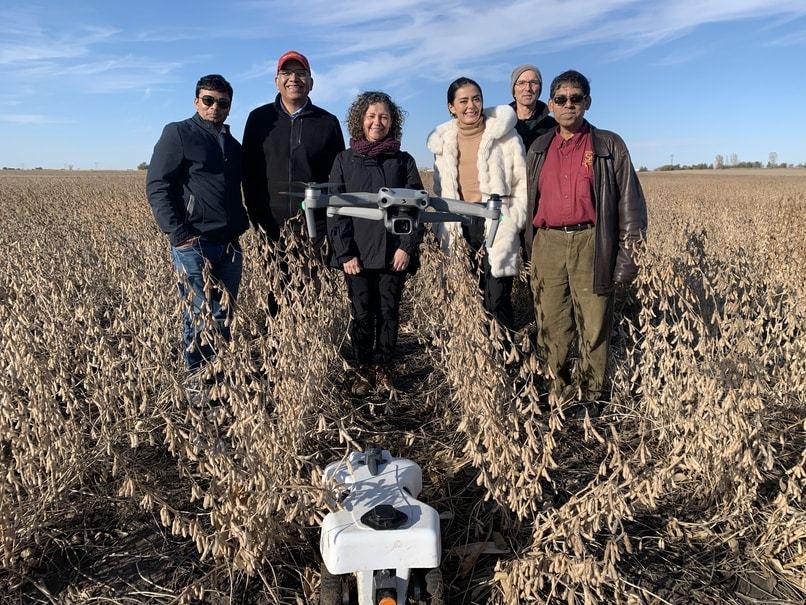
Farming communities face many threats to their livelihood – pest migration, disease spore dispersal, adverse weather, and weed spread to name a few. Researchers at the Missouri University of Science and Technology are developing infrastructure for intelligent and connected farms to improve timely data sharing so that communities can better respond to production threats that expand beyond individual farm boundaries. Missouri S&T is using drones in its collaborative research to help farm communities better communicate agricultural hazards such as pests, weeds and crop diseases. L-R: S&T postdoctoral researcher Ashish Gupta; Asheesh Singh, Iowa State University; Corinne Valdovia and Michelle Segovia, University of Missouri-Columbia; S&T Ph.D. student Kevin Menke and his advisor, Sajal Das. Photo provided by Das.

“Many farms have cameras and sensors on the ground to monitor hazards, but they don’t have the capability to transmit data very far because broadband access is limited,” says Dr. Sajal Das, the Daniel St. Clair Endowed Chair in computer science at Missouri S&T. “We’re developing a communication infrastructure using drones and Wi-Fi-enabled farm machinery to monitor large areas of land and improve real-time data collection.”

In addition, the network can monitor water, pesticide, and fertilizer needs, saving farmers time and money by informing them which sections of land need additional irrigation, suffer from pests, or require fertilizer so that they don’t treat entire fields unnecessarily.

The network uses multi-band dynamic spectrum access, which means there are many wireless radio frequencies to choose from. Das says rural areas have a lot of unlicensed bands that could be tapped at nearly zero cost, but there are challenges.

“Licensed frequency bands, such as those used for radio, TV or cell phones, are reliable and offer better performance than unlicensed frequency bands,” says Das. “Unlicensed frequencies are low cost and easy to deploy, but interference is common.”

Das says the research area covers 50 square miles of agricultural land in Iowa and includes 10 corn and soybean farms. While the geographical area is relatively small, Das says the data-sharing infrastructure being developed is scalable and can be replicated in other agricultural regions. It also incorporates machine learning and data analytics to preserve users’ privacy.

Chinese modelers improve the eddy-resolving ocean models

Ocean general circulation models (OGCMs) become increasingly important for understanding oceanic dynamic processes and ocean environment forecasting. In recent decades, OGCMs have been developed with finer resolution (10km for eddy-resolving OGCMs) given the large computational resources.

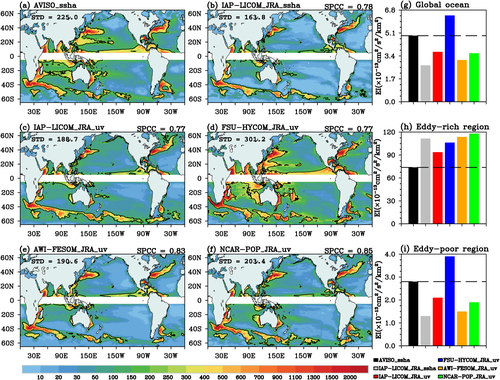
"However, the state-of-the-art eddy-resolving OGCMs tend to simulate a less energetic surface ocean on the global scale. In addition, there is so far no comprehensive and systemic evaluation of the model performance in simulating global mesoscale eddies. Many issues have therefore not been fully discussed," said LIU Hailong, one of the corresponding authors of a study recently published in Geophysical Research LettersMean surface eddy kinetic energy (EKE, cm2/s2) for (a) AVISO_ssha, (b) IAP-LICOM_JRA_ssha, (c) IAP-LICOM_JRA_uv, (d) FSU-HYCOM_JRA_uv, (e) AWI-FESOM_JRA_uv, and (f) NCAR-POP_JRA_uv during 1993–2018. The black contours in (a)–(f) are the global spatial standard deviation (STD; labeled in each panel) for each mean EKE distribution. The spatial pattern correlation coefficients (SPCCs) between each simulation and AVISO_ssha are also labeled in the top right of panels (b)–(f). The energy intensity (EI, cm2/s2/km2) for AVISO_ssha (black bars) and different simulated EKE data sets (colored bars) over (g) the global ocean, (h) eddy-rich regions, and (i) eddy-poor regions are also shown, respectively. The black dashed lines in (g)–(i) are the results for AVISO_ssha.

To address these issues, a research group from the Institute of Atmospheric Physics (IAP), Chinese Academy of Sciences (CAS), investigated the performances of eddy-resolving OGCMs in simulating mesoscale eddies using four eddy-resolving OGCMs forced by different atmospheric reanalysis products, including the self-developed LASG/IAP Climate system Ocean Model version 3 (IAP-LICOM3).

Results show that the eddy-resolving OGCMs tend to simulate more (less) energetic eddy-rich (eddy-poor) regions with a smaller (larger) spatial extent. Quantitatively, there is an approximately 27-60% overestimation of eddy kinetic energy intensity (EI) in the eddy-rich regions, which are mainly located in the Kuroshio-Oyashio Extension, the Gulf Stream, and the Antarctic Circumpolar Currents regions, although the global mean EI is underestimated by 25-45%. Apparently, EI in the eddy-poor region is underestimated.

Further analyses after eddies are identified and tracked show that the overestimation in the eddy-rich regions is mainly contributed by coherent mesoscale eddies' intensity rather than frequency and is more prominent when mesoscale eddies are in their growth stage.

"It's an interesting story, as the eddy-rich regions are simulated more energetic while eddy-poor regions are simulated less energetic," said LIU. "It points out some of the shared problems model developers face before taking further efforts to improve the eddy-resolving ocean models."