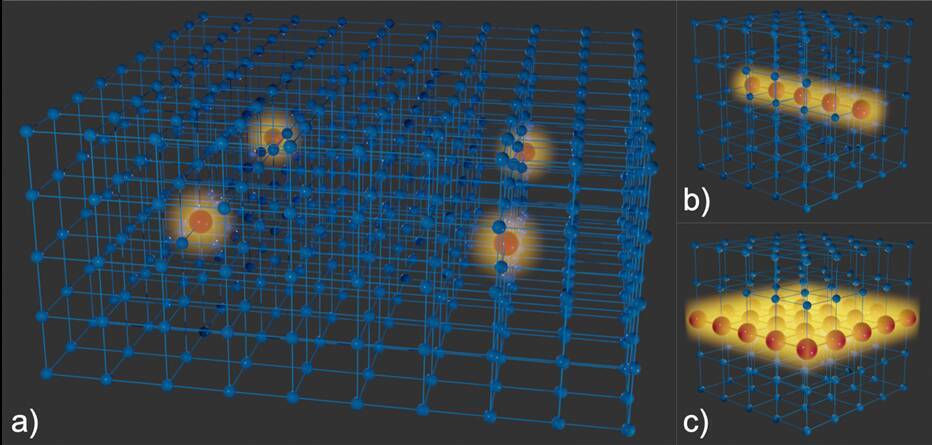
 Manipulating elusive waves like light, sound, or electrons, in periodic structures or crystals, has something mysterious. In the leading physics journal Physical Review Letters, published by the American Physical Society, a team of researchers from the University of Twente now describes how any kind of wave, whether quantum or classical, is confined in any kind of crystal. The results will notably boost efficient new integrated circuits that steer information encoded in tiny light pulses through smart cities.
Waves represent an inseparable part of our everyday life, whether we listen to music, observe our reflection in a mirror, or experience the ocean rocking a sailing ship. A central challenge in manipulating waves for applications requires the ability to confine the waves in small regions in space. Scientists already know that it’s possible by deliberately introducing tailored deviations from perfect periodicity into the crystal. But how exactly are the waves locked up? Are they confined in all dimensions simultaneously, or do they retain the freedom to move along a line or in a plane? Remarkably, the key step from having the crystal’s structure to predicting the confinement of waves had not been taken until now.
DESIGNING CRYSTALS
You might be familiar with crystals formed by minerals in nature. Such crystals can be used to confine quantum-mechanical electronic waves. Man-made crystals of silicon have led to the discovery of electronic transistors, the basis for the ongoing digital revolution. We now know that there are other types of crystals, that can confine and manipulate different types of waves like light, sound, and potentially even earthquakes.
Having a crystal at hand is not enough to confine waves. The internal structure of the crystal must specifically suit the desired application. To make matters more complicated, there are infinite possibilities for this structure, considering all conceivable building blocks and their arrangements in the crystal. Until now, scientists and engineers trying to confine waves had to rely on their intuition, guesswork, and costly trial-and-error experiments. 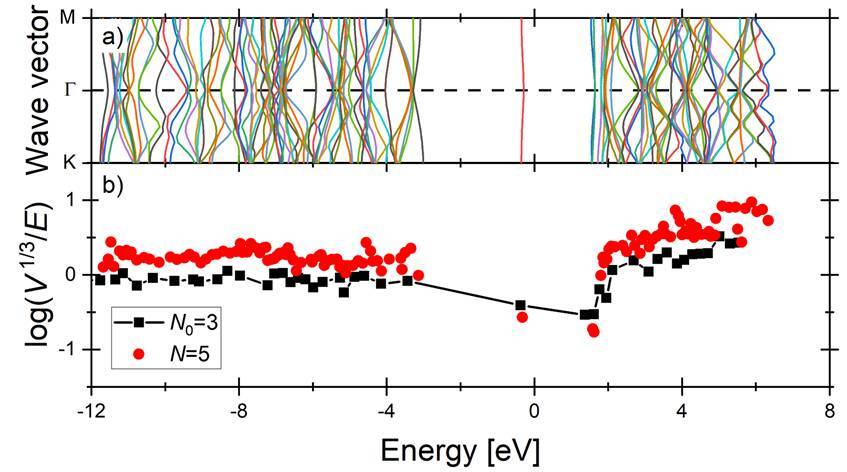
GENERIC APPROACH
In their Physical Review Letters paper, the Twente researchers present a robust analysis tool that predicts how waves are confined within a crystal, using only the crystal’s structure as input. First author and Ph.D. student Marek Kozon MSc explains: “A central parameter in our analysis is a ‘confinement dimensionality’ that we have invented. It describes the confinement for each possible wave.” COPS group leaders prof dr Willem Vos and prof dr Ad Lagendijk add enthusiastically: “We got excited when we realized from discussions with Marek that our method pertains not only to classical waves such as sound and light but also quantum waves such as electrons in tiny nanostructures.” Based on the new know-how, the designers of crystals can now benefit from new ‘rules of thumb’ for specific applications, resulting in highly simplified and thus efficient design processes. MACS group leaders dr Matthias Schlottbom and prof dr Jaap van der Vegt adds: “Our results are relevant for efficient information processing in new photonic and electronic chips that will populate future smart cities.”
This research was done in the groups Complex Photonic Systems (COPS) and Mathematics of Computational Science (MACS), both part of UT’s MESA+ Institute for Nanotechnology. The paper ‘Scaling theory of wave confinement in classical and quantum periodic systems’, by Marek Kozoň, prof dr Ad Lagendijk, dr Matthias Schlottbom, prof dr Jaap van der Vegt and prof dr Willem Vos, has been published in Physical Review Letters in October 2022.
The work is supported by the Shell-NWO/FOM program "Computational Sciences for Energy Research" (CSER), by the NWO-TTW Perspectief program P15-36 ‘Free-form scattering optics’ (FFSO), by the NWO Open Competitie ENW-GROOT “Self-Assembled lcosahedral Photonic Quasicrystals with a Band Gap for Visible Light”, and MESA+ section Applied Nanophotonics (ANP).


 A contact binary is a strongly interacting binary system with two component stars filled with Roche lobes, and there is a common envelope around the component stars.
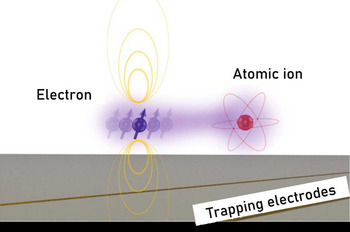 Quantum computers are powerful computational devices that rely on quantum mechanics, or the science of how particles like electrons and atoms interact with the world around them. These devices could potentially be used to solve certain kinds of computational problems in a much shorter amount of time. Scientists have long hoped that quantum supercomputing could be the next great advance in computing; however, existing limitations have prevented the technology from hitting its true potential. For these computers to work, the basic unit of information integral to their operation, known as quantum bits, or qubits, need to be stable and fast.