

Q&A: Why are dark matter halos of ultra-diffuse galaxies so … odd?

A UC Riverside physicist explains 

study co-led by physicists at UC Riverside and UC Irvine has found that dark matter halos of ultra-diffuse galaxies are very odd, raising questions about physicists’ understanding of galaxy formation and the structure of the universe. Hai-Bo Yu is a theoretical physicist at UC Riverside. (Samantha Tieu)

Ultra-diffuse galaxies are so-called because of their extremely low luminosity. The distribution of baryons — gas and stars — is much more spread out in ultra-diffuse galaxies compared to “normal” galaxies with similar masses. 

In the following Q&A, Hai-Bo Yu, an associate professor of physics and astronomy at UCR, shares his thoughts on the findings he and UCI’s Manoj Kaplinghat, a long-term collaborator of Yu’s, have published in The Astrophysical Journal about newly discovered ultra-diffuse galaxies and their dark matter halos.

Yu and Kaplinghat were joined in the research by Demao Kong of Tufts University, and Filippo Fraternali and Pavel E. Mancera Piña of the University of Groningen in the Netherlands. First author Kong will join UCR this fall.

The research was supported by grants from the National Science Foundation, Department of Energy, John Templeton Foundation, National Aeronautics and Space Administration, Netherlands Research School for Astronomy, and ASTRON, the Netherlands Institute for Radio Astronomy.

Q. What is a dark matter halo?

A dark matter halo is the halo of invisible matter that permeates and surrounds a galaxy or a cluster of galaxies. Although dark matter has never been detected in laboratories, physicists are confident dark matter, which makes up 85% of the universe’s matter, exists. 

Q. You’ve found dark matter halos of the ultra-diffuse galaxies are very odd. What is odd about them and what are you comparing them to?

The ultra-diffuse galaxies we studied are much less massive compared to, say, the Milky Way. They contain a lot of gas, however, and they have much higher gas mass than total stellar mass, which is opposite to what we see in the Milky Way. The ultra-diffuse galaxies also have large sizes.

The distribution of dark matter in these galaxies can be inferred from the motion of gas particles. What really surprises us is that the presence of baryonic matter itself, predominantly in the form of gas, is nearly sufficient to explain the measured velocity of gas particles and leaves little room for dark matter in the inner regions, where most of the stars and gas are located. 

This is very surprising because, in the case of normal galaxies, whose masses are similar to those of ultra-diffuse galaxies, it’s the opposite: dark matter dominates over baryonic matter. To accommodate this result, we conclude that these dark matter halos must have much lower “concentrations.” That is, they contain much less mass in their inner regions, compared to those of normal galaxies. In this sense, dark matter halos of the ultra-diffuse galaxies are “odd.”

At first glance, one would expect that such low-concentration halos are so rare that the ultra-diffuse galaxies would not even exist. After looking into the data from state-of-the-art numerical simulations of cosmic structure formation, however, we found the population of low-concentration halos is higher than the expectation.  

Q. What was involved in doing the study?

This is collaborative work. Filippo Fraternali and his student Pavel E. Mancera Piña are experts on the gas dynamics of galaxies. They discovered that ultra-diffuse galaxies rotate more slowly than normal galaxies with similar masses. We worked together to interpret measurement data of the gas motion of these galaxies and infer their dark matter distribution. Furthermore, we analyzed data from simulations of cosmic structure formation and identified dark matter halos that have similar properties as those inferred from the ultra-diffuse galaxies.

Q. Your findings raise questions about our understanding of galaxy formation/structure formation of the universe. How?

We have many questions regarding the formation and evolution of these newly discovered galaxies. For example, ultra-diffuse galaxies contain a lot of gas and we do not know how this gas is retained during galaxy formation. Further, our results indicate that these galaxies may be younger than normal galaxies. The formation of the ultra-diffuse galaxies is not well understood, and more work is needed. 

Q. What makes ultra-diffuse galaxies so interesting?

These are amazing objects to study because of their surprising properties, as discussed in our work. The newly discovered ultra-diffuse galaxies provide a new window for further testing our understanding of galaxy formation, probably even the nature of dark matter.
Hubble Spots Spiraling Stars

Nature likes spirals — from the whirlpool of a hurricane, to pinwheel-shaped protoplanetary disks around newborn stars, to the vast realms of spiral galaxies across our universe.Now astronomers are bemused to find young stars that are spiraling into the center of a massive cluster of stars in the Small Magellanic Cloud, a satellite galaxy of the Milky Way.For more information, visit https://nasa...
...

Read more

Simulations aid the Indian Institute of Science in gauging battery performance

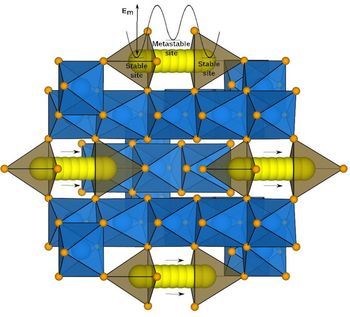
A crucial but poorly-studied parameter that dictates battery performance is the migration barrier. It determines the rate at which ions move through an electrode inside the battery, and ultimately the rate at which it charges or discharges. Because it is hard to measure the migration barrier in the lab, researchers typically use different supercomputer simulations and approximations to quickly predict migration barrier values. However, very few of these simulations have been experimentally verified so far.   Schematic of ionic migration in a sample intercalation host framework. Yellow spheres are the moving ions (e.g., Li, Na, Mg), while the other species constituting the structure are indicated by blue and orange spheres. The inset indicates the nominal variation of the potential energy as the ion migrates within the structure, with Em signifying the migration barrier.  CREDIT Reshma Devi

In a new study, researchers at the Indian Institute of Science (IISc) and their collaborators comprehensively analyzed widely-used computational techniques and verified their predictions of the migration barrier values against actual data observed in lab measurements. Based on their analysis, the team proposes a set of robust guidelines to help researchers choose the most accurate computational framework for testing materials that can be used to develop highly efficient batteries in the future.   

Lithium-ion batteries, which power mobile phones and laptops, consist of three major components: a solid negative electrode (anode), a solid positive electrode (cathode), and either a liquid or solid electrolyte that separates them. While charging or discharging, lithium ions migrate across the electrolyte, creating a potential difference. “The electrodes in lithium-ion batteries are not 100% solid. Think of them like a sponge. They have ‘pores’ through which a lithium-ion has to pass,” explains Sai Gautam Gopalakrishnan, Assistant Professor at the Department of Materials Engineering, IISc, and corresponding author of the paper published in npj Computational Materials   

An important parameter that determines the rate at which the lithium ions penetrate these pores is the migration barrier – the energy threshold that the ions need to overcome to traverse through the electrode. “The lower the migration barrier, the faster you can charge or discharge the battery,” says Reshma Devi, a Ph.D. student at the Department of Materials Engineering and the first author of the study.   

“The same migration barrier value is calculated by one group using one computational technique and another group by using another technique. The values may be equivalent, but we cannot know that for sure,” explains Gopalakrishnan.   

Two specific approximations, called Strongly Constrained and Approximately Normed (SCAN) and Generalised Gradient Approximation (GGA), are the most widely used methods to computationally arrive at the migration barrier, but each one has its disadvantages. “We took nine different materials,” Reshma Devi explains. “We checked which of the approximations come closest to the experimental values for each.”   

The team found that the SCAN functional had better numerical accuracy overall, but the GGA calculations were faster. GGA was found to have a reasonable level of accuracy in calculating the migration barrier in certain materials (such as lithium phosphate), and might be a better option if a quick estimation was needed, the researchers suggest.  

Such insights can be valuable for scientists who seek to test new materials for their performance before they are adapted for battery-related applications, says Gopalakrishnan. “Suppose you have an unknown material and if you quickly want to see whether this material is useful in your application, then you can use computations to do that, provided you know which computational approximation gives you the closest values. This is useful when it comes to materials discovery.”   

The team is also working on developing machine learning tools that can help speed up predictions of migration barriers for a diverse range of materials.