Indian Institute of Science performs simulations to analyze the COVID-19 spread during short conversations

When a person sneezes or coughs, they can potentially transmit droplets carrying viruses like SARS-CoV-2 to others in their vicinity. Does talking to an infected person also carry an increased risk of infection? How do speech droplets or “aerosols” move in the air space between the people interacting? Interactions of speech jets during short conversations between two people separated by a distance of four feet, visualised by an iso-surface of the aerosol concentration. Three different height differences are shown. The blue and red colours represent the simulated speech jets emanating from the mouths of the two people. The simulations were performed on SahasraT at IISc  CREDIT Rohit Singhal
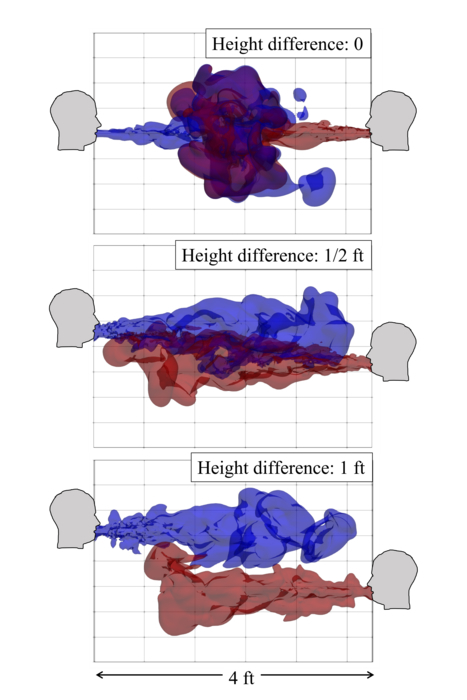
To answer these questions, a research team has carried out supercomputer simulations to analyze the movement of speech aerosols. The team includes researchers from the Department of Aerospace Engineering, Indian Institute of Science (IISc), along with collaborators from the Nordic Institute for Theoretical Physics (NORDITA) in Stockholm and the International Centre for Theoretical Sciences (ICTS) in Bengaluru. Their study was published in the journal Flow.

The team visualized scenarios in which two maskless people are standing two, four, or six feet apart and talking to each other for about a minute, and then estimated the rate and extent of spread of the speech aerosols from one to another. Their simulations showed that the risk of getting infected was higher when one person acted as a passive listener and didn’t engage in a two-way conversation. Factors like the height difference between the people talking and the number of aerosols released from their mouths also appear to play an important role in viral transmission. 

“Speaking is a complex activity … and when people speak, they’re not really conscious of whether this can constitute a means of virus transmission,” says Sourabh Diwan, Assistant Professor in the Department of Aerospace Engineering, and one of the corresponding authors.

In the early days of the COVID-19 pandemic, experts believed that the virus mostly spread symptomatically through coughing or sneezing. Soon, it became clear that asymptomatic transmission also leads to the spread of COVID-19. However, very few studies have looked at aerosol transport by speech as a possible mode of asymptomatic transmission, according to Diwan.

To analyze speech flows, he and his team modified a computer code they had originally developed to study the movement and behavior of cumulus clouds – the puffy cotton-like clouds that are usually seen on a sunny day. The code (called Megha-5) was written by S Ravichandran from NORDITA, the other corresponding author on the paper, and was used recently for studying particle-flow interaction in Rama Govindarajan’s group at ICTS. The analysis carried out by the team on speech flows incorporated the possibility of viral entry through the eyes and mouth in determining the risk of infection – most previous studies had only considered the nose as the point of entry. 

“The computational part was intensive, and it took a lot of time to perform these simulations,” explains Rohit Singhal, first author and Ph.D. student at the Department of Aerospace Engineering. Diwan adds that it is hard to numerically simulate the flow of speech aerosols because of the highly fluctuating (“turbulent”) nature of the flow; factors like the flow rate at the mouth and the duration of speech also play a role in shaping its evolution. 

In the simulations, when the speakers were either of the same height or drastically different heights (one tall and another short), the risk of infection was found to be much lower than when the height difference was moderate – the variation looked like a bell curve. Based on their results, the team suggests that just turning their heads away by about nine degrees from each other while still maintaining eye contact can reduce the risk for the speakers considerably. 

Moving forward, the team plans to focus on simulating differences in the loudness of the speakers’ voices and the presence of ventilation sources in their vicinity to see what effect they can have on viral transmission. They also plan to engage in discussions with public health policymakers and epidemiologists to develop suitable guidelines. “Whatever precautions we can take while we come back to normalcy in our daily interactions with other people, would go a long way in minimizing the spread of infection,” Diwan says. 

Swedish prof builds models to prioritize disease genes, drug targets

An international team of researchers has developed advanced supercomputer models, or digital twins of diseases, to improve diagnosis and treatment. They used one such model to identify the most important disease protein in hay fever. The study underlines the complexity of the disease and the necessity of using the right treatment at the right time. Mikael Benson, professor at Linköping University  CREDIT Thor Balkhed/Linköping University

Why is a drug effective against a certain illness in some individuals, but not in others? With common diseases, medication is ineffective in 40-70 percent of the patients. One reason for this is that diseases are seldom caused by a single “fault” that can be easily treated. Instead, in most diseases, the symptoms are the result of altered interactions between thousands of genes in many different cell types. The timing is also important. Disease processes often evolve over long periods. We are often not aware of disease development until symptoms appear, and diagnosis and treatment are thus often delayed, which may contribute to insufficient medical efficacy.

In a recent study, an international research team aimed to bridge the gap between this complexity and modern health care by constructing computational disease models of the altered gene interactions across many cell types at different time points. The researchers’ long-term goal is to develop such computational models into digital twins of individual patients’ diseases. Such medical digital twins might be used to tailor medication so that each patient could be treated with the right drug at the right time. Ideally, each twin could be matched with and treated with thousands of drugs on the supercomputer, before actual treatment on the patient begins. 

The researchers started by developing methods to construct digital twins of patients with hay fever. They used a technique, single-cell RNA sequencing, to determine all gene activity in each of thousands of individual immune cells – more specifically white blood cells. Since these interactions between genes and cell types may differ between different time points in the same patient, the researchers measured gene activity at different time points before and after stimulating white blood cells with pollen.

To construct supercomputer models of all the data, the researchers used network analyses. Networks can be used to describe and analyze complex systems. For example, a football team could be analyzed as a network based on the passes between the players. The player that passes most to other players during the whole match maybe most important in that network. Similar principles were applied to construct the computer models, or “twins”, as well as to identify the most important disease protein.

In the current study, the researchers found that multiple proteins and signaling cascades were important in seasonal allergies and that these varied greatly across cell types and at different stages of the disease.

­­“We can see that these are extremely complicated changes that occur in different phases of the disease. The variation between different times points means that you have to treat the patient with the right medicine at the right time”, says Dr. Mikael Benson, a professor at Linköping University, who led the study.

Finally, the researchers identified the most important protein in the twin model of hay fever. They show that inhibiting this protein, called PDGF-BB, in experiments with cells was more effective than using a known allergy drug directed against another protein, called IL-4.

 The study also demonstrated that the methods could potentially be applied to give the right treatment at the right time in other immunological diseases, like rheumatism or inflammatory bowel diseases. Clinical implementation will require international collaborations between universities, hospitals, and companies.  

Mizzou prof builds AI for developing new drug therapies

Researchers at the University of Missouri are applying a form of artificial intelligence (AI), previously used to analyze how National Basketball Association (NBA) players move their bodies, to now help scientists develop new drug therapies for medical treatments targeting cancers and other diseases.

The type of AI, called a graph neural network, can help scientists with speeding up the time it takes to sift through large amounts of data generated by studying protein dynamics. This approach can provide new ways to identify target sites on proteins for drugs to work effectively, said Dong Xu, a Curators' Distinguished Professor in the Department of Electrical Engineering and Computer Science at the MU College of Engineering and one of the study’s authors. Dong Xu

“Previously, drug designers may have known about a couple of places on a protein’s structure to target with their therapies,” said Xu, who is also the Paul K. and Dianne Shumaker Professor in bioinformatics. “A novel outcome of this method is that we identified a pathway between different areas of the protein structure, which could potentially allow scientists who are designing drugs to see additional possible target sites for delivering their targeted therapies. This can increase the chances that the therapy may be successful.”

Xu said they can also simulate how proteins can change to different conditions, such as the development of cancer, and then use that information to infer their relationships with other bodily functions.

“With machine learning, we can really study what are the important interactions within different areas of the protein structure,” Xu said. “Our method provides a systematic review of the data involved when studying proteins, as well as a protein’s energy state, which could help when identifying any possible mutation’s effect. This is important because protein mutations can enhance the possibility of cancers and other diseases developing in the body.”