

Mizzou researchers use AI to advance anatomical research from scalpels, scissors to modeling

There was once a time, not so long ago when scientists like Casey Holliday needed scalpels, scissors, and even their own hands to conduct anatomical research. But now, with recent advances in technology, Holliday and his colleagues at the University of Missouri are using artificial intelligence (AI) to see inside an animal or a person — down to a single muscle fiber — without ever cutting. Contrast imaging data and machine learning approaches can now model the 3D architecture of jaw musculature.
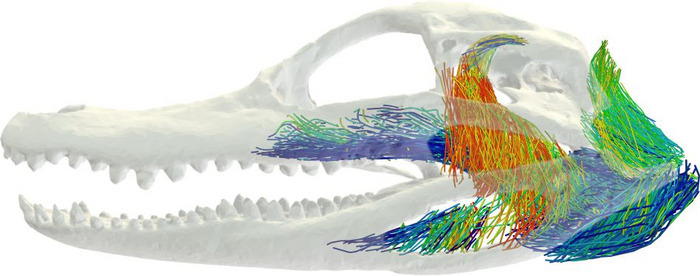
Holliday, an associate professor of pathology and anatomical sciences, said his lab in the MU School of Medicine is one of only a handful of labs in the world currently using this high-tech approach.

AI can teach computer programs to identify a muscle fiber in an image, such as a CAT scan. Then, researchers can use that data to develop detailed 3D computer models of muscles to better understand how they work together in the body for motor control, Holliday said.

Holliday, along with some of his current and former students, did that recently when they began to study the bite force of a crocodile.

“The unique thing about crocodile heads is that they are flat, and most animals that have evolved to bite really hard, like hyenas, lions, T. rexes, and even humans have really tall skulls because all those jaw muscles are oriented vertically,” Holliday said. “They’re designed that way so they put a big vertical bite force into whatever they're eating. But a crocodile’s muscles are oriented more horizontally.”

The 3D models of muscle architecture could help the team determine how muscles are oriented in crocodile heads to help increase their bite force. Helping to lead this effort is one of Holliday’s former students, Kaleb Sellers, who is now a postdoctoral researcher at the University of Chicago.

“Jaw muscles have long been studied in mammals with the assumption that relatively simple descriptors of muscle anatomy can tell you a great deal about skull function,” Sellers said. “This study shows how complex jaw muscle anatomy is in a reptile group.”

Holliday’s lab first began experimenting with 3D imaging several years ago. Some of their early findings were published in 2019 with a study in Integrative Organismal Biology that showed the development of a 3D model of the skeletal muscles in a European starling.

Transitioning into a digital world

Historically, Holliday said anatomical research — and much of what he did growing up — involved dissecting animals with a scalpel or scissors, or what he calls an “analog” approach. He was first introduced to the benefits of using digital imaging to study anatomy when he joined the “Sue the T. rex” project in the late 1990s. To date, it remains one of the largest and most well-preserved Tyrannosaurus rex specimens ever discovered.

Holliday recalls the moment when the T. rex’s giant skull was transported to Boeing’s Santa Susana Field Laboratory in California to be imaged in one of the aerospace company’s massive CAT scanners normally used to scan jet engines on commercial airplanes.

“At the time, it was the only CAT scanner in the world big enough to fit a T. rex skull, and also had the power needed to push X-rays through rocks,” Holliday said. “Coming out of college I had looked at becoming a radiology technician, but with the Sue project I was learning all about how they CAT scanned this thing, and that really caught my fancy.”

Nowadays, Holliday said many of his current and former students at MU are learning to understand anatomy by using the “cutting edge” imaging and modeling methods that he and his colleagues are creating. One of those students is Emily Lessner, a recent MU alumna who developed her passion for “long-dead animals” by working in Holliday’s lab.

“The digitization process is not only useful to our lab and research,” Lessner said. “It makes our work shareable with other researchers to help hasten scientific advancement, and we can also share them with the public as educational and conservation tools. Specifically, my work looking at the soft tissues and bony correlates in these animals has not only created hundreds of future questions to answer but also revealed many unknowns. In that way, not only did I gain imaging skills to help with my future work, but I now have more than a career-worth of avenues to explore.”

Holliday said plans are also in the works to take their 3D anatomical models a step further by studying how human hands have evolved from their evolutionary ancestors. The project, which is still in its early stages, recently received a grant from the Leakey Foundation. Joining Holliday on the project will be two of his colleagues at MU, Carol Ward, a Curators Distinguished Professor of pathology and anatomical sciences, and Kevin Middleton, an associate professor of biological sciences.

While about 90% of the research done in Holliday’s lab involves studying things that exist in the modern world, he said the data they collect can also inform the fossil record, like additional knowledge about how the T. rex moved and functioned.

“With better knowledge of actual muscle anatomy, we can really figure out how the T. rex could really do fine motor controls, and more nuanced behaviors, such as bite force and feeding behavior,” Holliday said.
MIT modeling shows Saturn’s rings, tilt could be the product of an ancient, missing moon

A “grazing encounter” may have smashed the moon to bits to form Saturn’s rings, a new study suggests.

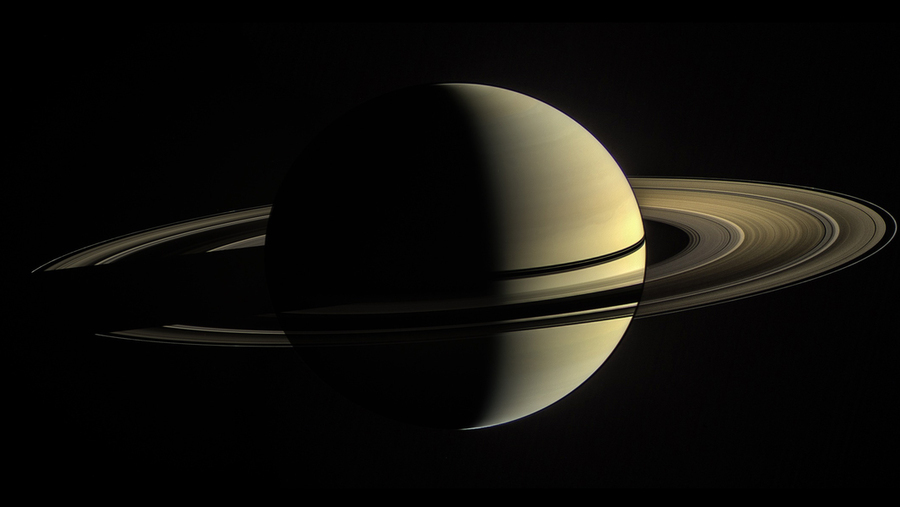
Swirling around the planet’s equator, the rings of Saturn are a dead giveaway that the planet is spinning at a tilt. The belted giant rotates at a 26.7-degree angle relative to the plane in which it orbits the sun. Astronomers have long suspected that this tilt comes from gravitational interactions with its neighbor Neptune, as Saturn’s tilt processes, like a spinning top, at nearly the same rate as the orbit of Neptune. Caption:Scientists propose a lost moon of Saturn, which they call Chrysalis, pulled on the planet until it ripped apart, forming rings and contributing to Saturn’s tilt. Credits:Image: NASA/JPL-Caltech/Space Science Institute

But a new modeling study by astronomers at MIT and elsewhere has found that, while the two planets may have once been in sync, Saturn has since escaped Neptune’s pull. What was responsible for this planetary realignment? The team has one meticulously tested hypothesis: a missing moon.

In a study appearing today in Science, the team proposes that Saturn, which today hosts 83 moons, once harbored at least one more, an extra satellite that they name Chrysalis. Together with its siblings, the researchers suggest, Chrysalis orbited Saturn for several billion years, pulling and tugging on the planet in a way that kept its tilt, or “obliquity,” in resonance with Neptune. 

But around 160 million years ago, the team estimates, Chrysalis became unstable and came too close to its planet in a grazing encounter that pulled the satellite apart. The loss of the moon was enough to remove Saturn from Neptune’s grasp and leave it with the present-day tilt.

What’s more, the researchers surmise, that while most of Chrysalis’ shattered body may have made an impact with Saturn, a fraction of its fragments could have remained suspended in orbit, eventually breaking into small icy chunks to form the planet’s signature rings.

The missing satellite, therefore, could explain two longstanding mysteries: Saturn’s present-day tilt and the age of its rings, which were previously estimated to be about 100 million years old — much younger than the planet itself.

“Just like a butterfly’s chrysalis, this satellite was long dormant and suddenly became active, and the rings emerged,” says Jack Wisdom, professor of planetary sciences at MIT and lead author of the new study.

The study’s co-authors include Rola Dbouk at MIT, Burkhard Militzer of the University of California at Berkeley, William Hubbard at the University of Arizona, Francis Nimmo and Brynna Downey of the University of California at Santa Cruz, and Richard French of Wellesley College.

A moment of progress

In the early 2000s, scientists put forward the idea that Saturn’s tilted axis is a result of the planet being trapped in resonance, or gravitational association, with Neptune. But observations taken by NASA’s Cassini spacecraft, which orbited Saturn from 2004 to 2017, put a new twist on the problem. Scientists found that Titan, Saturn’s largest satellite, was migrating away from Saturn at a faster clip than expected, at a rate of about 11 centimeters per year. Titan’s fast migration, and its gravitational pull, led scientists to conclude that the moon was likely responsible for tilting and keeping Saturn in resonance with Neptune.

But this explanation hinges on one major unknown: Saturn’s moment of inertia, which is how mass is distributed in the planet’s interior. Saturn’s tilt could behave differently, depending on whether the matter is more concentrated at its core or toward the surface.

“To make progress on the problem, we had to determine the moment of inertia of Saturn,” Wisdom says.

The lost element

In their new study, Wisdom and his colleagues looked to pin down Saturn’s moment of inertia using some of the last observations taken by Cassini in its "Grand Finale," a phase of the mission during which the spacecraft made an extremely close approach to precisely map the gravitational field around the entire planet.  The gravitational field can be used to determine the distribution of mass on the planet.

Wisdom and his colleagues modeled the interior of Saturn and identified a distribution of mass that matched the gravitational field that Cassini observed. Surprisingly, they found that this newly identified moment of inertia placed Saturn close to, but just outside the resonance with Neptune. The planets may have once been in sync, but are no longer.

“Then we went hunting for ways of getting Saturn out of Neptune’s resonance,” Wisdom says.

The team first carried out simulations to evolve the orbital dynamics of Saturn and its moons backward in time, to see whether any natural instabilities among the existing satellites could have influenced the planet’s tilt. This search came up empty.

So, the researchers reexamined the mathematical equations that describe a planet’s precession, which is how a planet’s axis of rotation changes over time. One term in this equation has contributions from all the satellites. The team reasoned that if one satellite were removed from this sum, it could affect the planet’s precession.

The question was, how massive would that satellite have to be, and what dynamics would it have to undergo to take Saturn out of Neptune’s resonance?

Wisdom and his colleagues ran simulations to determine the properties of a satellite, such as its mass and orbital radius, and the orbital dynamics that would be required to knock Saturn out of the resonance.

They conclude that Saturn’s present tilt is the result of the resonance with Neptune and that the loss of the satellite, Chrysalis, which was about the size of Iapetus, Saturn’s third-largest moon, allowed it to escape the resonance.

Sometime between 200 and 100 million years ago, Chrysalis entered a chaotic orbital zone, experienced several close encounters with Iapetus and Titan, and eventually came too close to Saturn, in a grazing encounter that ripped the satellite to bits, leaving a small fraction to circle the planet as a debris-strewn ring.

The loss of Chrysalis, they found, explains Saturn’s precession, and its present-day tilt, as well as the late formation of its rings.

“It’s a pretty good story, but like any other result, it will have to be examined by others,” Wisdom says. “But it seems that this lost satellite was just a chrysalis, waiting to have its instability.”

This research was supported, in part, by NASA and the National Science Foundation.

Hiroshima University develops a framework for accurate carbon emissions modeling for China to achieve carbon neutrality

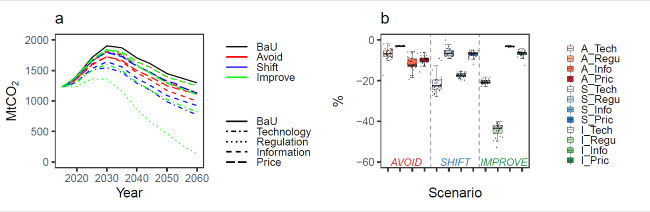
As countries around the world look to reduce carbon emissions, China, currently the largest emitter of carbon dioxide with 30% of global total carbon emissions in 2018, has declared its goal of being carbon neutral by 2060. To achieve this goal, China and other countries with similar climate-change mitigation goals will need to implement the most effective mix of transportation-sector policies, which in turn requires accurate decarbonization models. Carbon dioxide from the ground transport sector in China a) Emission trajectories in China from 2015 to 2060. b) Cumulative emission reduction potentials from 2015 to 2060 in different policy scenarios compared with the business-as-usual scenario. (Runsen Zhang/Hiroshima University)

According to researchers from Hiroshima University, the most commonly used frameworks for modeling carbon emissions in the transportation sector tend to emphasize one set of factors such as behavior, land use planning, or energy consumption, for example, at the expense of other factors. Now, those researchers have developed an integrated framework to take into account the many variables relevant to accurate carbon emissions modeling, allowing policymakers to see a fuller picture to choose the best path forward. They applied this framework to model transportation energy emissions for China’s 31 regions.

Paper coauthor Runsen Zhang, assistant professor at Hiroshima University’s Graduate School of Advanced Science and Engineering at the time of the research, said that the current carbon emissions models have limitations, which is what he and his coauthor, Tatsuya Hanaoka, chief researcher at the National Institute for Environmental Studies in Japan, set out to solve.

“Methodologically, on the one hand, global scenario studies depict an overall picture of energy consumption that appears plausible to energy policymakers and climate change scientists, but land use planning, infrastructure policies, and behavioral factors are hardly modeled,” Zhang said. “On the other hand, transport models with sophisticated behavioral descriptions and a high spatial resolution can provide a significantly more concrete answer to urban transport problems, but they often simplify the representations of the energy system and lack a long-term integrated assessment of cross-sectoral effects.”

In order to address these limitations, the researchers integrated a transport model and an energy system model and relied on the Avoid-Shift-Improve framework to develop a method for projecting future energy consumption and emission in China’s transportation sector. Instead of taking an aggregated overview of China, they looked at each of the 31 regions in order to capture regional characteristics of transportation energy use.

“The transport model passed the mode-specific service demand to the energy system model for estimating the future technology mix transition, energy consumption, and carbon dioxide emissions, while the technology mix and costs were fed back to the transport model to re-calculate the generalized transport cost with an updated technology mix,” Hanaoka said.

The researchers applied four instruments—technology, regulation, information, and price—to each of the three categories in the Avoid-Shift-Improve approach for a total of 12 scenarios, which were also compared against a business-as-usual strategy. The results showed different advantages and disadvantages in each system as well as in each region.

According to Zhang, in addition to showing the importance of a region-specific policy package, the findings illuminate the synergistic coupling and trade-offs among the different variables for developing a policy mix that will best achieve China’s carbon neutrality goal.

“To address long-term emissions reduction needs for China’s transport sector, concrete policy recommendations must be presented to maximize the synergies and minimize the trade-offs among strategies and instruments,” Zhang said. “Importantly, to close the distance between transport and climate change studies, transport planners, energy policymakers and climate experts need to come together to develop innovative solutions toward carbon neutrality.”

According to the researchers, scientists will next need to address air and water transportation, instead of primarily ground transportation, as was the case here due to data availability, and involve other regions of the world.

“Future studies will be geared toward the development of a global transport energy model, including transport by road, rail, water and air,” Hanaoka said.