

SUPERCOMPUTING NEWS SUPERCOMPUTING NEWS
    • MEDIA KIT
    • MOST READ
    • RSS FEED
    • ACADEMIA
    • AEROSPACE
    • APPLICATIONS
    • ASTRONOMY
    • AUTOMOTIVE
    • BIG DATA
    • BIOLOGY
    • CHEMISTRY
    • CLIENTS
    • CLOUD
    • DEFENSE
    • DEVELOPER TOOLS
    • EARTH SCIENCES
    • ECONOMICS
    • ENGINEERING
    • ENTERTAINMENT
    • GAMING
    • GOVERNMENT
    • HEALTH
    • OIL & GAS
    • INDUSTRY
    • INTERCONNECTS
    • MANUFACTURING
    • MIDDLEWARE
    • MOVIES
    • NETWORKS
    • PHYSICS
    • PROCESSORS
    • RETAIL
    • SCIENCE
    • STORAGE
    • SYSTEMS
    • VISUALIZATION
    • AcyMailing subscription form

    • ADD YOUR VIDEOS
    • MANAGE VIDEOS
    • CONVERSATION INBOX
    • SOCIAL ADVERTISER
    • SOCIAL NETWORK VIDEOS
    • SURVEYS
    • GROUPS
    • PAGES
    • MARKETPLACE LISTINGS
    • APPLICATIONS BROWSER
    • PRIVACY CONFIRM REQUEST
    • PRIVACY CREATE REQUEST
    • LEADERBOARD
    • POINTS LISTING
      • BADGES
    • TRADE SHOWS
Sign In
Tyler O'Neal, Staff Editor SCIENCE January 18, 2022, 12:00 pm

German Research Foundation funds project at the University of Göttingen to study causality

How people acquire and use knowledge about causal relationships is the focus of a new project at the Georg Elias Müller Institute of Psychology at the University of Göttingen. The Reinhart Koselleck project on "Mechanisms, Capacities, and Dependencies: A New Theory of Causal Reasoning" has been funded by the German Research Foundation (DFG). The total funding awarded is 1.25 million euros, spread over five years.

Professor Michael Waldmann, head of Cognitive and Decision Sciences at the University of Göttingen and leader of the project, has been studying causal reasoning for many years. "Causal reasoning plays a central role in thinking, for example in predictions, diagnoses, explanations, or planning actions," says the psychologist. "An understanding of biological, medical and physical relationships or the invention of devices such as televisions or mobile phones would be unthinkable without causal knowledge."

Waldmann was one of the first in cognitive psychology to address the question of whether complex statistical models (especially causal Bayes nets) provide adequate theories to explain every day thinking about causality. "However, causal knowledge cannot be expressed solely as a network of statistical relations. Rather, when understanding causal relationships, we also use knowledge about the underlying mechanisms," explains Waldmann. "In philosophy, there has therefore long been a debate about whether understanding causality can be reduced to purely statistical knowledge or knowledge about the underlying mechanisms.”

This project aims to develop a new precise computational theory that integrates the two explanatory approaches within a unified model. Experts from the fields of psychology, philosophy, computer modeling, and anthropology will work together in this interdisciplinary project. The theory will be empirically tested in a series of experiments. In addition to experimental studies with adults, research projects with children and non-human primates are also planned.

Reinhart Koselleck projects aim to provide financial support for outstanding researchers with a proven scientific track record to pursue exceptionally innovative, higher-risk projects.
Agnostiq, Mila partner to bridge quantum supercomputing, ML

Tyler O'Neal, Staff Editor SCIENCE January 18, 2022, 10:00 am

The collaboration will enable both organizations to develop and apply advances at the intersection of their respective technologies to solve some of the world's most critical and challenging business and societal issues.

Agnostiq, Inc. has formed a strategic partnership with Montreal-based Mila to bridge the gap between the quantum supercomputing and machine learning communities.

"Quantum computing will have a tremendous impact on many fields and machine learning is no exception," says Oktay Goktas, CEO of Agnostiq. "A partnership with Mila brings us access to a world-class research community that comes with decades of experience in machine learning, which will, in turn, help us design better tools for emergent quantum machine learning use cases."

The new partnership gives Mila access to Agnostiq's quantum researchers, who are working on classes of machine learning problems that are specific to quantum computing, and Agnostiq access to Mila's AI/ML researchers and partner network. Partnering with Mila will help Agnostiq remain at the forefront and be among the first to discover compelling new use cases for quantum machine learning.

"Agnostiq offers an exciting opportunity to explore ML challenges specific to quantum computing, as our strategic alliance with this promising startup will allow us to combine our expertise," says Stéphane Létourneau, Executive Vice President of Mila. "Mila's research community works daily toward improving the democratization of machine learning, developing new algorithms, and advancing deep learning capabilities. We are thrilled to work closely with Agnostiq to continue these important missions."

The partnership will also support Agnostiq's talent attraction and retention efforts, encouraging potential candidates to apply, as they will have the opportunity to collaborate with Mila's world-renowned researchers. Finally, the collaboration further validates Canada's position as a global leader in quantum supercomputing and machine learning research. 

Japanese astrophysicists show how gas giants form from dust to planet

Tyler O'Neal, Staff Editor SCIENCE January 17, 2022, 6:57 pm

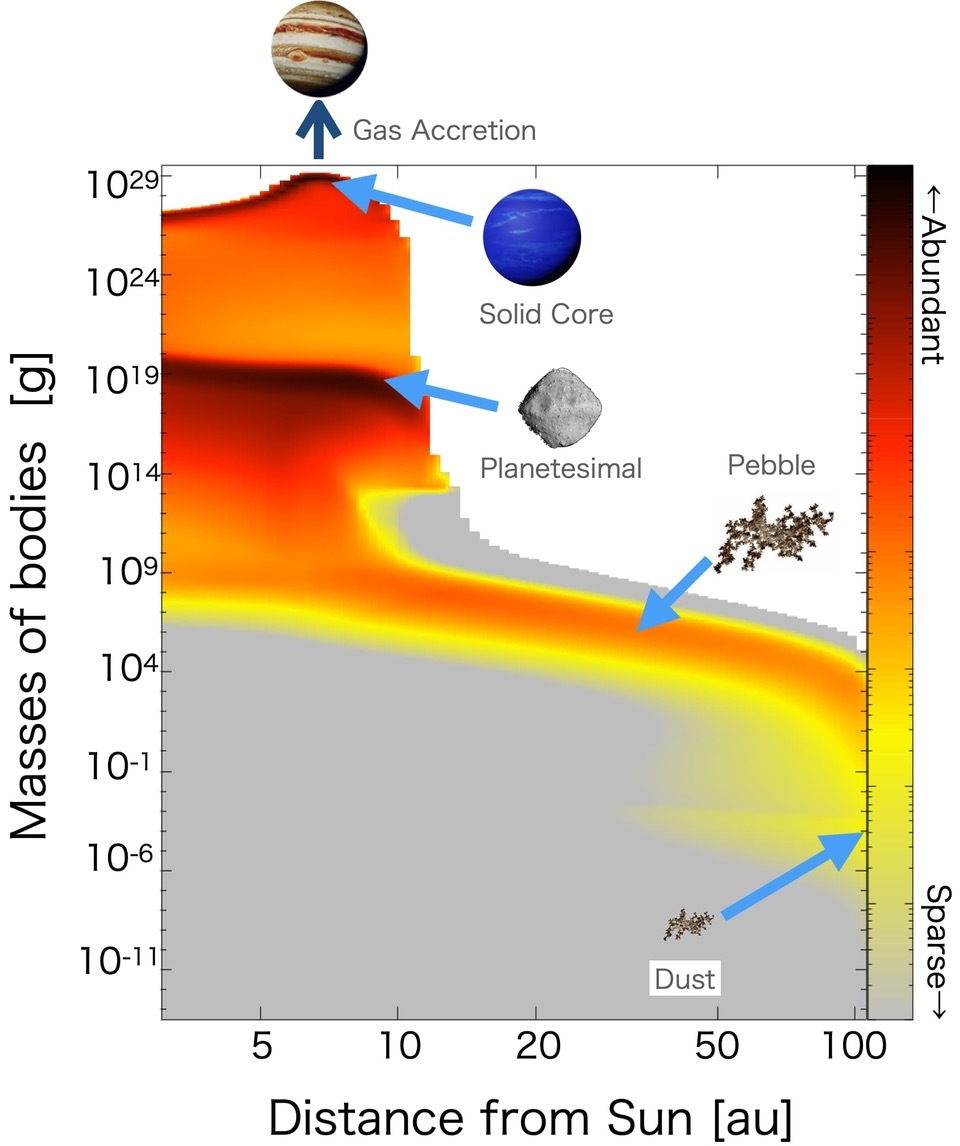
Gas giant planets, such as Jupiter, can form rapidly by incorporating nearby icy bodies made from drifting pebbles born in the outer parts of young planetary systems – all in about 200,000 years. This finding has implications for understanding how habitable planets are created; not just in our solar system, but in others too.  Result of dust-to-planet simulation: Mass distribution of bodies from dust to planets at about 200,000 years. (Credit: Hiroshi Kobayashi)

Gas giants are made of a massive solid core surrounded by an even larger mass of helium and hydrogen. But even though these planets are quite common in the Universe, scientists still don’t fully understand how they form. Now, astrophysicists Hiroshi Kobayashi of Nagoya University and Hidekazu Tanaka of Tohoku University have developed supercomputer simulations that simultaneously use multiple types of celestial matter to gain a more comprehensive understanding of how these colossal planets grow from specks of dust. Their findings were published in The Astrophysical Journal.

“We already know quite a bit about how planets are made,” says Kobayashi. “Dust lying within the far-reaching ‘protoplanetary disks’ surrounding newly formed stars collides and coagulates to make celestial bodies called planetesimals. These then amass together to form planets. Despite everything we know, the formation of gas giants, like Jupiter and Saturn, has long baffled scientists.”

This is a problem because gas giants play huge roles in the formation of potentially habitable planets within planetary systems.

For gas giants to form, they must first develop solid cores that have enough mass, about ten times that of Earth, to pull in the huge amounts of gas for which they are named. Scientists have long struggled to understand how these cores grow. The problem is two-fold. First, core growth from the simple amassing of nearby planetesimals would take longer than the several million years during which the dust-containing protoplanetary disks survive. Second, forming planetary cores interact with the protoplanetary disk, causing them to migrate inward towards the central star. This makes conditions impossible for gas accumulation.

To tackle this problem, Kobayashi and Tanaka used state-of-the-art computer technologies to develop simulations that can model how dust lying within the protoplanetary disk can collide and grow to form the solid core necessary for gas accumulation. A major issue with current programs was that they could only simulate planetesimal or pebble collisions separately. “The new program can handle celestial bodies of all sizes and simulate their evolution via collisions,” explains Kobayashi.

The simulations showed that pebbles from the outer parts of the protoplanetary disk drift inwards to grow into icy planetesimals at about 10 astronomical units (au) from the central star. A single astronomical unit represents the mean distance between the Earth and the Sun. Jupiter and Saturn are about 5.2au and 9.5au away from the Sun, respectively. Pebble growth into icy planetesimals increases their numbers in the region of the developing planetary system that is about 6-9 au from the central star. This encourages high core growth rates, resulting in the formation of solid cores massive enough to accumulate gas and develop into gas giants in about 200,000 years.

“We expect our research will help lead to the full elucidation of the origin of habitable planets, not only in the solar system but also in other planetary systems around stars,” says Kobayashi.

  1. University of Waterloo researchers use AI to analyze tweets debating vaccination, climate change
  2. QuTech takes important step in quantum supercomputing with error correction

Page 55 of 61

  • 50
  • 51
  • 52
  • 53
  • 54
  • 55
  • 56
  • 57
  • 58
  • 59
POPULAR RIGHT NOW
  • Supercomputers replace ‘bathtub’ flood maps with physics-based digital twins of Britain’s coastline
    Supercomputers replace ‘bathtub’ flood maps with physics-based digital twins of Britain’s coastline
  • Supercomputers push neural quantum simulation beyond previous limits
    Supercomputers push neural quantum simulation beyond previous limits
  • Intel’s AI supercomputing revival: Q2 financial surge signals new era for CPU-powered HPC infrastructure
    Intel’s AI supercomputing revival: Q2 financial surge signals new era for CPU-powered HPC infrastructure
  • AWS supercomputing investment reaches historic scale as Amazon’s AI strategy powers record financial results
    AWS supercomputing investment reaches historic scale as Amazon’s AI strategy powers record financial results
  • AI infrastructure financing fears shake semiconductor sector
    AI infrastructure financing fears shake semiconductor sector
  • Catching the wave of the future: Supercomputers unlock the hidden dynamics of Venus
    Catching the wave of the future: Supercomputers unlock the hidden dynamics of Venus
  • NCAR supercomputers run planet scale climate experiments impossible in the real world
    NCAR supercomputers run planet scale climate experiments impossible in the real world
  • AI hunts the cosmos: Machine learning helps astronomers discover the first ‘Wandering’ supermassive black hole caught destroying a star
    AI hunts the cosmos: Machine learning helps astronomers discover the first ‘Wandering’ supermassive black hole caught destroying a star
  • Supercomputing for the masses: Meta's vision of a personal superintelligence for everyone
    Supercomputing for the masses: Meta's vision of a personal superintelligence for everyone
  • NVIDIA helps turn AI compute into a new asset class as Wall Street mobilizes $500 billion
    NVIDIA helps turn AI compute into a new asset class as Wall Street mobilizes $500 billion
THIS YEAR'S MOST READ
  • Wall Street wants to trade supercomputing power like oil
    Wall Street wants to trade supercomputing power like oil
  • Beamforming the future: BeammWave's 6G push signals the rise of orbital-terrestrial wireless networks
    Joakim Axmon
    Joakim Axmon
  • Cosmic ambition at scale: UK’s supercomputer unlocks a 2.5 petabytes universe
    Cosmic ambition at scale: UK’s supercomputer unlocks a 2.5 petabytes universe
  • Hidden order, revealed at scale: Supercomputing, electron ptychography uncover the inner workings of relaxor ferroelectrics
    Hidden order, revealed at scale: Supercomputing, electron ptychography uncover the inner workings of relaxor ferroelectrics
  • Intel's Q1 results signal supercomputing surge driving Xeon momentum
    Intel's Q1 results signal supercomputing surge driving Xeon momentum
  • When stars fall apart: Supercomputing reveals the hidden physics of black holes
    When stars fall apart: Supercomputing reveals the hidden physics of black holes
  • MIT develops computational framework to probe dark matter via gravitational waves
    MIT develops computational framework to probe dark matter via gravitational waves
  • Explainable AI moves into the watershed: FAMU-FSU engineers build predictive framework for real-time E. coli forecasting
    FAMU-FSU College of Engineering Assistant Professor Nasrin Alamdari. (Scott Holstein/FAMU-FSU College of Engineering)
    FAMU-FSU College of Engineering Assistant Professor Nasrin Alamdari. (Scott Holstein/FAMU-FSU College of Engineering)
  • Multi-layer simulations reveal the hidden supply chain of solar prominences
    Multi-layer simulations reveal the hidden supply chain of solar prominences
  • Japanese scientists decode dolphin speed with supercomputing: Turbulence, vortices, and the hidden physics of propulsion
    Japanese scientists decode dolphin speed with supercomputing: Turbulence, vortices, and the hidden physics of propulsion
  • FRONTPAGE
  • LATEST
  • POPULAR
  • REGISTER
  • SOCIAL
  • VIDEO
  • SUBSCRIPTION
  • RSS
  • GUIDELINES
  • PRIVACY
  • TOS
  • ABOUT
  • +1 (816) 799-4488
  • editorial@supercomputingonline.com
© 2001 - 2026 SuperComputingOnline.com, LLC. All rights reserved. This material may not be published, broadcast, rewritten or redistributed without permission.
Sign In
  • FRONT PAGE
  • LATEST
    • MEDIA KIT
    • MOST READ
    • RSS FEED
    • ACADEMIA
    • AEROSPACE
    • APPLICATIONS
    • ASTRONOMY
    • AUTOMOTIVE
    • BIG DATA
    • BIOLOGY
    • CHEMISTRY
    • CLIENTS
    • CLOUD
    • DEFENSE
    • DEVELOPER TOOLS
    • EARTH SCIENCES
    • ECONOMICS
    • ENGINEERING
    • ENTERTAINMENT
    • HEALTH
    • INDUSTRY
    • INTERCONNECTS
    • GAMING
    • GOVERNMENT
    • MANUFACTURING
    • MIDDLEWARE
    • MOVIES
    • NETWORKS
    • OIL & GAS
    • PHYSICS
    • PROCESSORS
    • RETAIL
    • SCIENCE
    • STORAGE
    • SYSTEMS
    • VISUALIZATION
  • VIDEOS
    • ADD YOUR VIDEOS
    • MANAGE VIDEOS
  • COMMUNITY
    • TRADE SHOWS
    • SOCIAL NETWORK VIDEOS
    • SURVEYS
    • APPLICATIONS BROWSER
    • CONVERSATION INBOX
    • SOCIAL ADVERTISER
    • GROUPS
    • MARKETPLACE LISTINGS
    • PAGES
    • LEADERBOARD
    • POINTS LISTING
      • BADGES
    • PRIVACY CONFIRM REQUEST
    • PRIVACY CREATE REQUEST

Hey there! We noticed you’re using an ad blocker.