

SUPERCOMPUTING NEWS SUPERCOMPUTING NEWS
    • MEDIA KIT
    • MOST READ
    • RSS FEED
    • ACADEMIA
    • AEROSPACE
    • APPLICATIONS
    • ASTRONOMY
    • AUTOMOTIVE
    • BIG DATA
    • BIOLOGY
    • CHEMISTRY
    • CLIENTS
    • CLOUD
    • DEFENSE
    • DEVELOPER TOOLS
    • EARTH SCIENCES
    • ECONOMICS
    • ENGINEERING
    • ENTERTAINMENT
    • GAMING
    • GOVERNMENT
    • HEALTH
    • OIL & GAS
    • INDUSTRY
    • INTERCONNECTS
    • MANUFACTURING
    • MIDDLEWARE
    • MOVIES
    • NETWORKS
    • PHYSICS
    • PROCESSORS
    • RETAIL
    • SCIENCE
    • STORAGE
    • SYSTEMS
    • VISUALIZATION
    • AcyMailing subscription form

    • ADD YOUR VIDEOS
    • MANAGE VIDEOS
    • CONVERSATION INBOX
    • SOCIAL ADVERTISER
    • SOCIAL NETWORK VIDEOS
    • SURVEYS
    • GROUPS
    • PAGES
    • MARKETPLACE LISTINGS
    • APPLICATIONS BROWSER
    • PRIVACY CONFIRM REQUEST
    • PRIVACY CREATE REQUEST
    • LEADERBOARD
    • POINTS LISTING
      • BADGES
    • TRADE SHOWS
Sign In
Tyler O'Neal, Staff Editor SCIENCE January 24, 2022, 7:09 am

Canadian prof builds models to simulate effects of pregnancy on kidneys

In Ontario, Canada, University of Waterloo researchers are using supercomputer simulations to better understand the impacts pregnancy can have on kidneys.

The new research will help medical practitioners better understand the physiology of the kidneys during pregnancy and develop appropriate patient care and treatments to improve health outcomes.

The researchers are interested in how the kidneys change during a typical pregnancy and how increased strain on the kidneys can lead to gestational diseases. The kidneys can also be affected by preeclampsia - unusually high blood pressure during pregnancy that may lead to organ damage.

“One thing that happens during pregnancy is that plasma volume expands to supply a developing fetus and placenta,” said Melissa Stadt, a master’s researcher in applied mathematics at the University of Waterloo. “There’s also retention of extra sodium and potassium, which are essential electrolytes during pregnancy. Everything about pregnancy means a lot more work for the kidneys.”

The research team used super computational models representing kidney function during mid-and late pregnancy. These in-silico experiments, so-called because they are essentially conducted in the silicon of computer chips, provide a way to simulate different kinds of strain on the kidneys that would otherwise not be possible to test in live pregnancies without substantial risk.

Because of the risks associated with human pregnancies, medical researchers often use other mammals like rats for research. Although computational models do not require any live test subjects, the research team still modeled rat pregnancies so they could incorporate more of the existing scientific data into their study.

“What’s powerful about computational modeling is that we can do trials that we could never do in live experiments,” said Anita Layton, professor of applied mathematics and Canada 150 Research Chair in mathematical biology and medicine at the University of Waterloo. “We can easily change one parameter and see the implications. Once we have the working model, we can see how these changes affect pregnancy.”

While computational models of organs like the kidneys are only ever approximations of what may happen in a specific individual case, they are a safe, cost-effective, and timely way to conduct trials, not just of the various impacts pregnancy may have on the kidneys, but also of potential treatments and medications. 

“If things go wrong in pregnancy, it can affect the mother for the rest of their life, and the growing fetus is very sensitive to any complications that affect the mother’s organs,” said Layton. “That’s where our models come in. Unfortunately, there’s a big gap in medical research related to all the changes in the kidneys of pregnant women. So our research is trying to make some progress and help improve health outcomes during pregnancy.”
Rice shows how iron catalyzes corrosion in 'inert' carbon dioxide

Tyler O'Neal, Staff Editor SCIENCE January 21, 2022, 10:00 am

The iron that rusts in water theoretically shouldn’t corrode in contact with an “inert” supercritical fluid of carbon dioxide. But it does. 

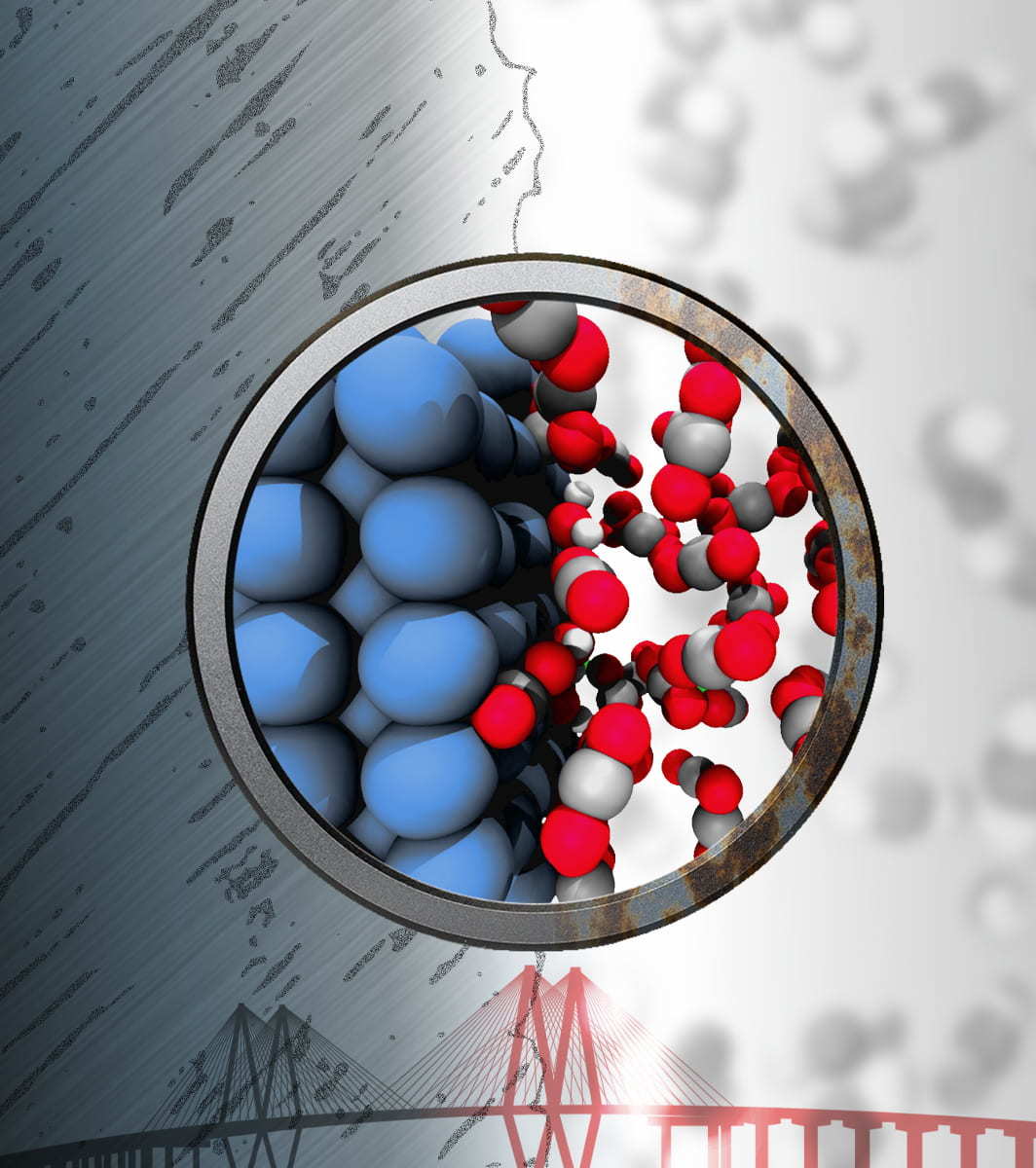
The reason has eluded materials scientists to now, but a team at Rice University has a theory that could contribute to new strategies to protect the iron from the environment. Iron (blue) can react with trace amounts of water to produce corrosive chemicals despite being bathed in “inert” supercritical fluids of carbon dioxide. Atomistic simulations carried out at Rice University show how this reaction happens. (Credit: Evgeni Penev/Rice University)

Materials theorist Boris Yakobson and his colleagues at Rice’s George R. Brown School of Engineering found through atom-level simulations that iron itself plays a role in its corrosion when exposed to supercritical CO2 (sCO2) and trace amounts of water by promoting the formation of reactive species in the fluid that come back to attack it. 

In their research, published in the Cell Press journal Matter, they conclude that thin hydrophobic layers of 2D materials like graphene or hexagonal boron nitride could be employed as a barrier between iron atoms and the reactive elements of sCO2. 

Rice graduate student Qin-Kun Li and research scientist Alex Kutana are co-led authors of the paper. Rice assistant research professor Evgeni Penev is a co-author.

Supercritical fluids are materials at a temperature and pressure that keeps them roughly between phases -- say, not all liquid, but not yet all gas. The properties of sCO2 make it an ideal working fluid because, according to the researchers, it is “essentially inert,” noncorrosive, and low-cost. 

“Eliminating corrosion is a constant challenge, and it’s on a lot of people’s minds right now as the government prepares to invest heavily in infrastructure,” said Yakobson, the Karl F. Hasselmann Professor of Materials Science and NanoEngineering and a professor of chemistry. “Iron is a pillar of infrastructure from ancient times, but only now are we able to get an atomistic understanding of how it corrodes.”

The Rice lab’s simulations reveal the devil’s in the details. Previous studies have attributed corrosion to the presence of bulk water and other contaminants in the superfluid, but that isn’t necessarily the case, Yakobson said.

“Water, as the primary impurity in sCO2, provides a hydrogen bond network to trigger interfacial reactions with CO2 and other impurities like nitrous oxide and to form corrosive acid detrimental to iron,” Li said.

The simulations also showed that the iron itself acts as a catalyst, lowering the reaction energy barriers at the interface between iron and sCO2, ultimately leading to the formation of a host of corrosive species: oxygen, hydroxide, carboxylic acid, and nitrous acid. 

To the researchers, the study illustrates the power of theoretical modeling to solve complicated chemistry problems, in this case predicting thermodynamic reactions and estimates of corrosion rates at the interface between iron and sCO2. They also showed all bets are off if there’s more than a trace of water in the superfluid, accelerating corrosion.

Chinese researchers use CFD to simulate SARS-COV-2 transmission and infection on airline flights

Tyler O'Neal, Staff Editor SCIENCE January 20, 2022, 6:39 pm

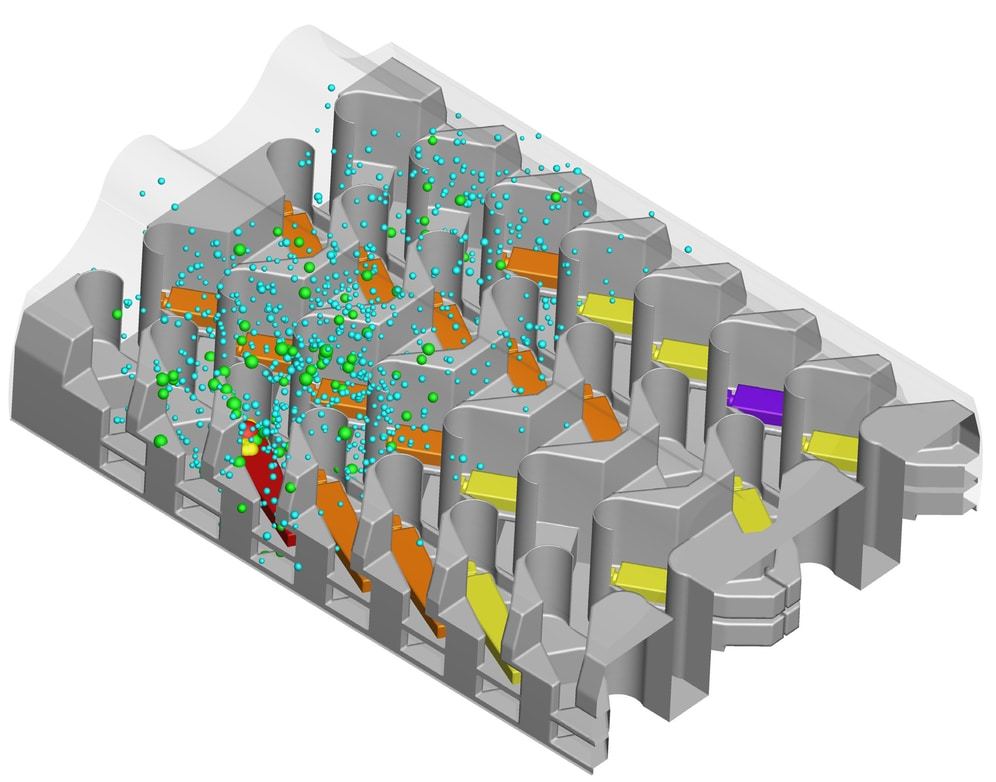
A study published in Indoor Air simulated the transmission of SARS-CoV-2, the virus that causes COVID-19, on a flight from London to Hanoi and another flight from Singapore to Hangzhou. Image credit: Dr. Lai

When simulating the dispersion of droplets of different sizes generated by coughing, talking, and breathing activities in an airline cabin by an infected person, researchers found that the SARS-CoV-2 virus contained in such droplets traveled by the cabin air distribution and was inhaled by other passengers.

The scientists counted the number of viral copies inhaled by each passenger to determine infection. Their method correctly predicted 84% of the infected/uninfected cases on the first flight. The team also found that wearing masks and reducing conversation frequency between passengers could help to reduce the risk of exposure on the second flight.

“We are very pleased to see that our model validated by experimental data can achieve such a high accuracy in predicting COVID-19 transmission in airliner cabins,” said corresponding author Dayi Lai, Ph.D., Associate Professor and Associate Head of the Department of Architecture, School of Design of Shanghai Jiao Tong University, in China. “Also, it’s important to know that wearing masks makes a significant impact on reducing the transmission.”

  1. RIT scientists confirm a highly eccentric black hole merger for the first time
  2. Canada's new simulations can improve avalanche forecasting

Page 52 of 61

  • 47
  • 48
  • 49
  • 50
  • 51
  • 52
  • 53
  • 54
  • 55
  • 56
POPULAR RIGHT NOW
  • Supercomputers replace ‘bathtub’ flood maps with physics-based digital twins of Britain’s coastline
    Supercomputers replace ‘bathtub’ flood maps with physics-based digital twins of Britain’s coastline
  • Supercomputers push neural quantum simulation beyond previous limits
    Supercomputers push neural quantum simulation beyond previous limits
  • Intel’s AI supercomputing revival: Q2 financial surge signals new era for CPU-powered HPC infrastructure
    Intel’s AI supercomputing revival: Q2 financial surge signals new era for CPU-powered HPC infrastructure
  • AWS supercomputing investment reaches historic scale as Amazon’s AI strategy powers record financial results
    AWS supercomputing investment reaches historic scale as Amazon’s AI strategy powers record financial results
  • AI infrastructure financing fears shake semiconductor sector
    AI infrastructure financing fears shake semiconductor sector
  • Catching the wave of the future: Supercomputers unlock the hidden dynamics of Venus
    Catching the wave of the future: Supercomputers unlock the hidden dynamics of Venus
  • NCAR supercomputers run planet scale climate experiments impossible in the real world
    NCAR supercomputers run planet scale climate experiments impossible in the real world
  • AI hunts the cosmos: Machine learning helps astronomers discover the first ‘Wandering’ supermassive black hole caught destroying a star
    AI hunts the cosmos: Machine learning helps astronomers discover the first ‘Wandering’ supermassive black hole caught destroying a star
  • Supercomputing for the masses: Meta's vision of a personal superintelligence for everyone
    Supercomputing for the masses: Meta's vision of a personal superintelligence for everyone
  • NVIDIA helps turn AI compute into a new asset class as Wall Street mobilizes $500 billion
    NVIDIA helps turn AI compute into a new asset class as Wall Street mobilizes $500 billion
THIS YEAR'S MOST READ
  • Wall Street wants to trade supercomputing power like oil
    Wall Street wants to trade supercomputing power like oil
  • Beamforming the future: BeammWave's 6G push signals the rise of orbital-terrestrial wireless networks
    Joakim Axmon
    Joakim Axmon
  • Cosmic ambition at scale: UK’s supercomputer unlocks a 2.5 petabytes universe
    Cosmic ambition at scale: UK’s supercomputer unlocks a 2.5 petabytes universe
  • Hidden order, revealed at scale: Supercomputing, electron ptychography uncover the inner workings of relaxor ferroelectrics
    Hidden order, revealed at scale: Supercomputing, electron ptychography uncover the inner workings of relaxor ferroelectrics
  • Intel's Q1 results signal supercomputing surge driving Xeon momentum
    Intel's Q1 results signal supercomputing surge driving Xeon momentum
  • When stars fall apart: Supercomputing reveals the hidden physics of black holes
    When stars fall apart: Supercomputing reveals the hidden physics of black holes
  • MIT develops computational framework to probe dark matter via gravitational waves
    MIT develops computational framework to probe dark matter via gravitational waves
  • Explainable AI moves into the watershed: FAMU-FSU engineers build predictive framework for real-time E. coli forecasting
    FAMU-FSU College of Engineering Assistant Professor Nasrin Alamdari. (Scott Holstein/FAMU-FSU College of Engineering)
    FAMU-FSU College of Engineering Assistant Professor Nasrin Alamdari. (Scott Holstein/FAMU-FSU College of Engineering)
  • Multi-layer simulations reveal the hidden supply chain of solar prominences
    Multi-layer simulations reveal the hidden supply chain of solar prominences
  • Japanese scientists decode dolphin speed with supercomputing: Turbulence, vortices, and the hidden physics of propulsion
    Japanese scientists decode dolphin speed with supercomputing: Turbulence, vortices, and the hidden physics of propulsion
  • FRONTPAGE
  • LATEST
  • POPULAR
  • REGISTER
  • SOCIAL
  • VIDEO
  • SUBSCRIPTION
  • RSS
  • GUIDELINES
  • PRIVACY
  • TOS
  • ABOUT
  • +1 (816) 799-4488
  • editorial@supercomputingonline.com
© 2001 - 2026 SuperComputingOnline.com, LLC. All rights reserved. This material may not be published, broadcast, rewritten or redistributed without permission.
Sign In
  • FRONT PAGE
  • LATEST
    • MEDIA KIT
    • MOST READ
    • RSS FEED
    • ACADEMIA
    • AEROSPACE
    • APPLICATIONS
    • ASTRONOMY
    • AUTOMOTIVE
    • BIG DATA
    • BIOLOGY
    • CHEMISTRY
    • CLIENTS
    • CLOUD
    • DEFENSE
    • DEVELOPER TOOLS
    • EARTH SCIENCES
    • ECONOMICS
    • ENGINEERING
    • ENTERTAINMENT
    • HEALTH
    • INDUSTRY
    • INTERCONNECTS
    • GAMING
    • GOVERNMENT
    • MANUFACTURING
    • MIDDLEWARE
    • MOVIES
    • NETWORKS
    • OIL & GAS
    • PHYSICS
    • PROCESSORS
    • RETAIL
    • SCIENCE
    • STORAGE
    • SYSTEMS
    • VISUALIZATION
  • VIDEOS
    • ADD YOUR VIDEOS
    • MANAGE VIDEOS
  • COMMUNITY
    • TRADE SHOWS
    • SOCIAL NETWORK VIDEOS
    • SURVEYS
    • APPLICATIONS BROWSER
    • CONVERSATION INBOX
    • SOCIAL ADVERTISER
    • GROUPS
    • MARKETPLACE LISTINGS
    • PAGES
    • LEADERBOARD
    • POINTS LISTING
      • BADGES
    • PRIVACY CONFIRM REQUEST
    • PRIVACY CREATE REQUEST

Hey there! We noticed you’re using an ad blocker.