 How to resolve AdBlock issue?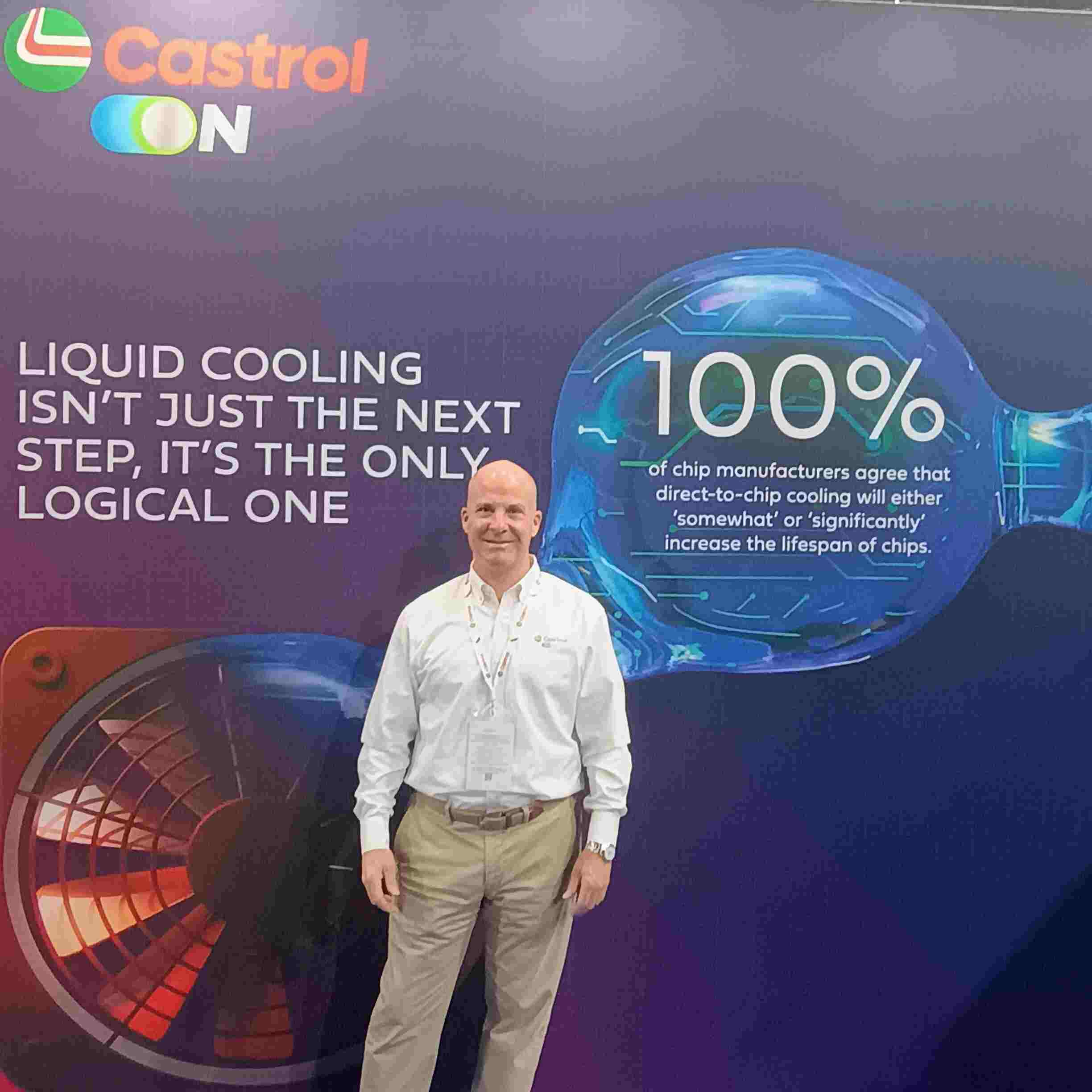
In STL, the rising heat of next-generation AI met its match at SC25 as Castrol announced a strategic investment in Electronic Cooling Solutions (ECS), a Santa Clara–based thermal engineering firm known for its deep bench of CFD modeling, reliability testing, and design-for-deployment expertise. The move signals Castrol’s shift from “fluid supplier” to full-stack thermal partner for data centers navigating the swelling power demands of artificial intelligence and high-performance computing.
Between keynotes, we sat down with Darren Burgess, Castrol’s Data Center Cooling specialist from Austin, Texas. In a conversation that bounced from Bitcoin mines to hyperscale design rooms, Burgess laid out why Castrol is betting big on immersion cooling, and why ECS is the linchpin.
Immersion Cooling’s Momentum and Why Single-Phase Leads Today
Burgess described immersion cooling as “the simplest path to big power savings,” emphasizing single-phase immersion as the star of today’s deployments. Bitcoin miners have already paved the way: predictable thermals, easy heat capture, fewer moving parts, and measurable reductions in energy overhead.
“The industry is learning what miners figured out early,” Burgess told us. “When the density goes up, air just taps out.”
Two-phase immersion may be the future, but Castrol is positioning it carefully. “It’s coming,” Burgess said. “But the industry needs predictable supply chains and stability first. That’s where Castrol’s global network becomes an advantage.”
The Glycol Problem No One Talks About
Castrol’s data center expansion isn’t just about immersion. Burgess highlighted a quieter but critical battleground: the chemistry inside traditional hydronic loops. Specifically, propylene glycol (PG 25), a staple in cooling systems, whose stability is often taken for granted.
“PG is like a living system,” Burgess said. “If you don’t monitor it, corrosion becomes an invisible tax. Fluid health isn’t optional anymore, it’s uptime insurance.”
Castrol is developing next-gen formulations, including detoxified ethylene glycol options with higher-temperature tolerance.
ECS + Castrol: A Full-Stack Thermal Alliance
The newly announced investment gives Castrol something it has never possessed at a global scale: deep thermal engineering capabilities that touch every layer of system design.
ECS brings:
- Room-to-rack thermal modeling
- System-level CFD
- Failure-mode and reliability analysis
- Immersion and liquid cooling design validation
- Acclimation, condensation, and corrosion forensic services
Their portfolio includes AI module liquid-cooling designs up to 17 kW, corrosion root-cause tracing, and environmental acclimation studies for hyperscale data centers.
With Castrol’s investment, Bharat Vats, an industry veteran and former CEO of Atom Power, has been named President and CEO of ECS. His mandate: scale up ECS’s impact across hyperscalers, OEMs, cloud providers, and energy-intensive AI labs.
“Working with Castrol opens the door for ECS to reach the entire data center ecosystem,” Vats said. “Together, we can accelerate the shift to more efficient cooling architectures.”
Why This Investment Matters Now
A recent Castrol-commissioned survey found that 74% of data-center experts now believe liquid cooling is the only path forward for today’s AI power densities. Yet many operators hesitate due to integration complexity and a lack of trusted partners.
Castrol believes combining its supply-chain muscle with ECS’s engineering precision will remove those barriers.
Peter Huang, Castrol’s Global VP of Data Centre Thermal Management, put it plainly: “The industry needs partners that can guide them from whiteboard to deployment. Castrol wants to be that end-to-end partner.”
A Turning Point for AI-Era Data Centers
SC25 has made one thing obvious: thermal is no longer a back-of-house concern. It is the governing constraint of AI. The players who master heat will be the ones who shape the computing landscape of the next decade.
With Castrol expanding from automotive lubricants into immersion, hydronics, and now full-stack thermal design, and ECS bringing decades of analysis and validation expertise, the partnership lands at a pivotal moment.
Together, they’re sending a clear message to hyperscalers and AI labs everywhere: The future isn’t just faster. The future runs colder.