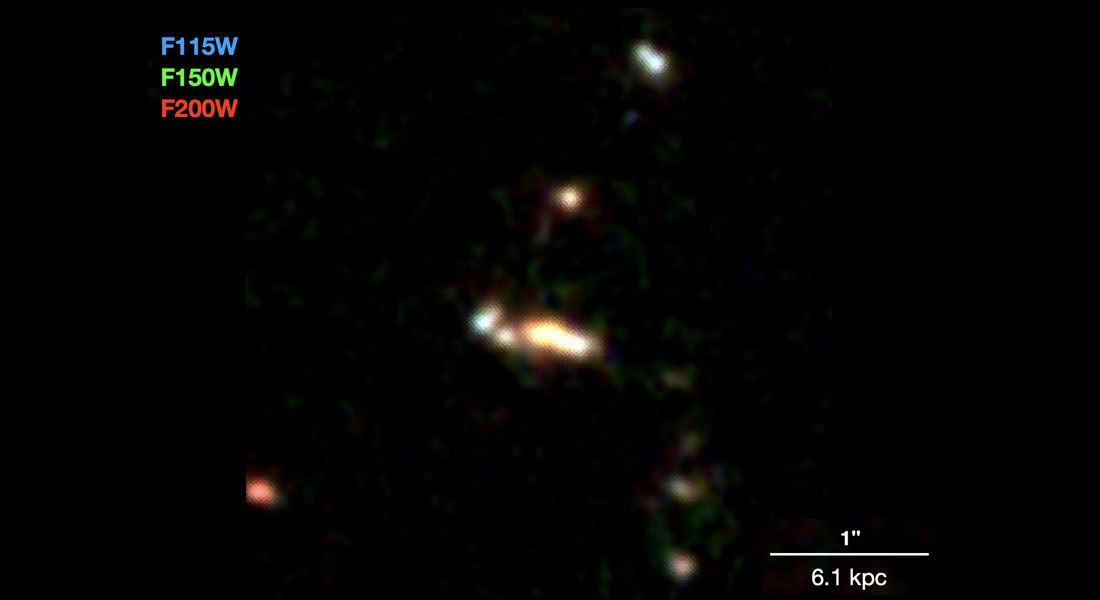
A group of small galaxies, seen almost 13 billion years back in time, likely in the process of forming a massive galaxy. The colors are composed from three different infrared colors. The white, horisontal bar shows the scale of approximately 20,000 lightyears. Credit: Shuowen Jin et al. (2023).

Giant galaxy formation caught in action with Danish supercomputing, JWST

Astronomers from the Cosmic Dawn Center have unveiled the nature of the densest region of galaxies seen with the James Webb Space Telescope (JWST) in the early Universe. They find it to be likely the progenitor of a massive, Milky Way-like galaxy, seen at a time when it is still assembling from smaller galaxies. The discovery corroborates our understanding of how galaxies form. 

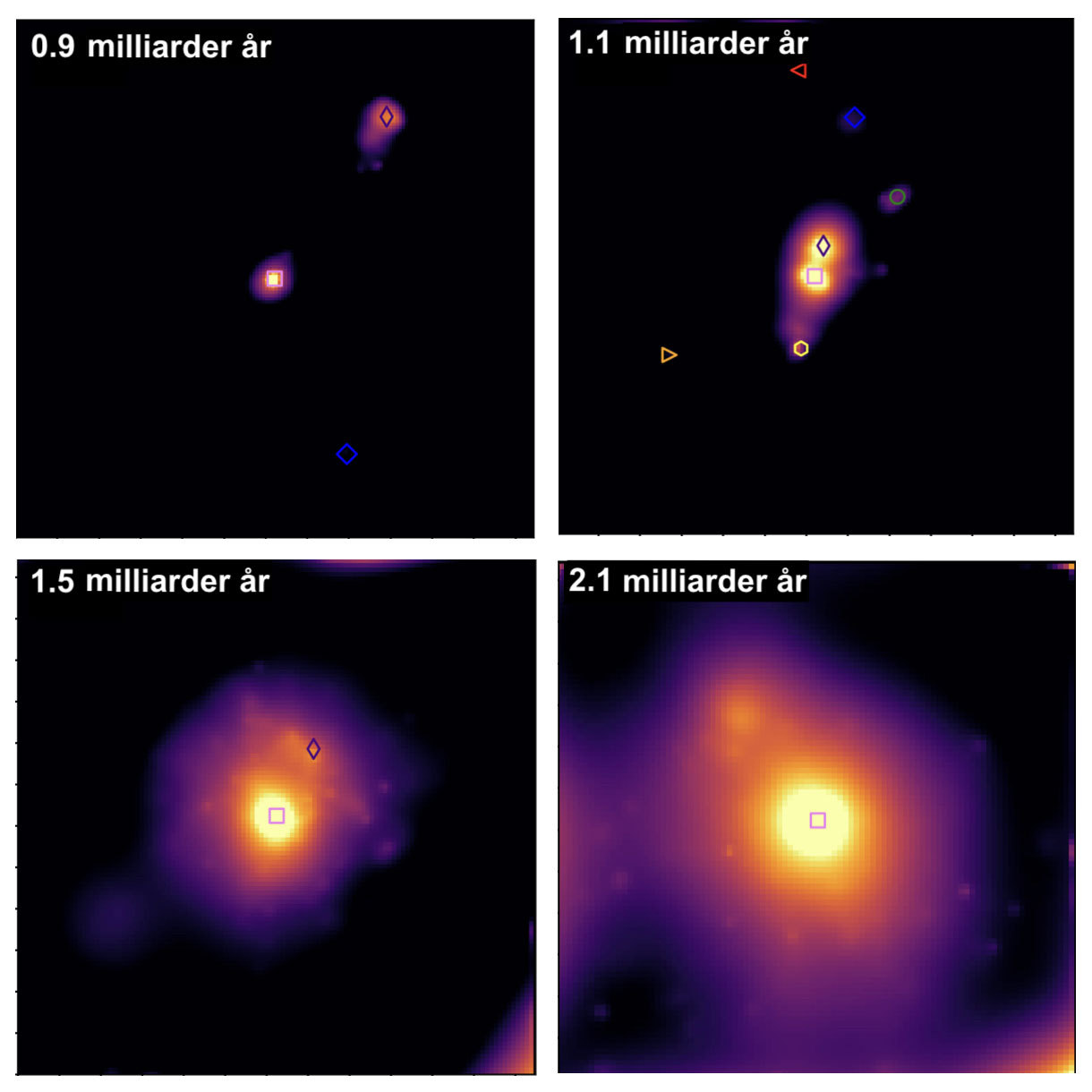
Four snapshots of the evolution of a simulated proto-galaxy from the "EAGLE" simulation, chosen to resemble the observed group CGG-z5. The brightness show the density of stars in the galaxies, and the symbols follow individual clumps of matter. In the 1.2 billion years that pass between the upper left and the lower right, the galaxies grows from a total stellar mass of 5 billion Suns to 65 billion Suns. Credit: A. Vijiayan and S. Jin.

According to our current understanding of structure formation in the Universe, galaxies form hierarchically, with small structures forming first in the very early Universe, later merging to build up larger structures. This is the prediction of theories and supercomputer simulations and is verified by observations of galaxies at various epochs in the history of the Universe.

To observe the very first structures assembling, we have to look as far back in time, and hence as far away, as possible. But these sources are both very small and very faint, and their detection requires advanced technologies.

In a new study, the early progenitor of what today will likely have evolved into a massive, Milky Way-sized galaxy, has been detected. This group of smaller galaxies, dubbed CGG-z5, was found through the observational program called "CEERS" with the James Webb Space Telescope and is seen when the Universe was only 1.1 billion years old, 8% of its current age.

CGG-z5 was discovered using the code GalCluster, which was created by Nikolaj Sillassen, an MSc student at the Cosmic Dawn Center (DAWN). 

"I developed the software during my studies to detect this kind of structure, and now we applied it to data from the CEERS program," says Nikolaj Sillassen, who already found a similar but more nearby group while testing the software.

"It's great to see how useful my code is becoming."

Impossible without James Webb

The brightest members of the galaxy group were discovered previously with the Hubble Space Telescope. But the CEERS program revealed new and smaller members.

"The other members of the group are both small and faint. Without the sensitivity and the spatial resolution of James Webb, we simply wouldn't be able to detect them," explains Shuowen Jin, Marie Curie Fellow at the Cosmic Dawn Center (DAWN) and lead author of the current study.

Exactly what the "future" of the galaxy group CGG-z5 will be, is of course unknown. Rather than forming a single galaxy, it could be that the group evolves into a large cluster of galaxies at later times. Yet another possibility is that the members are in reality not so closely packed as it seems, but instead a part of a filamentary structure that we just happen to view from one end to the other.

Help from supercomputer simulations

To distinguish between these scenarios, more precise observations involving the more time-consuming spectroscopy are needed. But in the meantime, help is available from supercomputer simulations:

"To better understand the nature and evolution of CGG-z5, we searched for similar structures in large-scale, hydrodynamical simulations," says Aswin Vijiayan, Postdoctoral Fellow at the Cosmic Dawn Center who conducted the simulation analysis in the study. "We found 14 structures that match closely the physical properties of our observed group CGG-z5, and then traced the evolution of these structures through time in the simulations, from the early Universe to the present epoch.

Although the exact unfolding of the evolution of these 14 structures is different, they all shared the same fate: Roughly 0.5 to 1 billion years later, they merge to form a single galaxy which, by the time the Universe is half its current age, have masses comparable to our own Milky Way.

"Given the predictions of the simulations, it is therefore tempting to speculate that the CGG-z5 system will also follow a similar evolutionary path and that we captured the process of small galaxies assembling into a single massive galaxy," Shuowen Jin concludes.

"Interestingly, the number of these early groups like CGG-z5 in a given volume of space is similar to the number of massive galaxies at later cosmic times", says Georgios Magdis, associate professor at DAWN and partaker in the study. "This makes merging groups appealing as the main progenitors of massive galaxies at later epochs".

Large samples and further work are needed to verify this picture.

(Image: Cern)
(Image: Cern)

Finnish researchers create a Higgs boson data-inspired AI algorithm for the field of visual analytics

A new AI algorithm developed by researchers at the Finnish Center for Artificial Intelligence is aimed at visualizing datasets as clearly as possible. The project demonstrated that the solution chosen independently by the algorithm was often very close to that most commonly favored by humans. 

The human brain has an astounding ability to observe various traits even from extremely large quantities of visual information. This ability is utilized, for example, in the study of large data masses whose content must be compacted into a form understandable to human intelligence. This problem of dimensional reduction is central to visual analytics.

At the Finnish Center for Artificial Intelligence (FCAI), researchers affiliated with Aalto University and the University of Helsinki tested the functionality of the most well-known methods of visual analytics, finding that none worked when the amount of data grew significantly. For example, the t-SNE, LargeViz, and UMAP methods were no longer able to distinguish extremely strong signals of observational groupings in the data when the number of observations was in the hundreds of thousands. 

Higgs boson data inspired the creation of the new algorithm

The dataset for experiments related to the discovery of the Higgs boson contains more than 11 million feature vectors, for instance.

“The visualizations drawn from them resembled a tangle of yarn, revealing none of the notable characteristics of particle behavior included in the data”, says Professor of Statistics and Probability Jukka Corander from the University of Helsinki.

“This finding provided the impetus to develop a new method that utilizes graphical acceleration similarly to modern AI methods for neural network computing. “

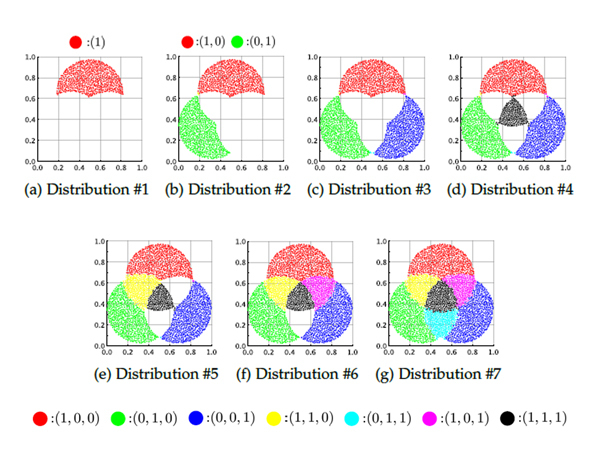
The AI algorithm designed by the researchers is aimed at visualization, so that data clusters and other macroscopic features, easily observed by and understandable to humans, are as distinct as possible. 

In the project, several volunteers tested the technique. It turned out that the solution independently chosen by the algorithm was often very close to the solution most typically favored by humans; in this situation, human intelligence clearly distinguishes, according to personal notions, between clusters of data composed of similar observations. When applying the technique to the Higgs boson data, their most important physical characteristics were clearly highlighted. 

“This is a veritable quantum leap in the field of visual analytics. Besides being several orders of magnitude faster than previous methods, our technique also is much more reliable in connection with challenging applications,” says Professor of Computer Science Jukka Corander from the University of Helsinki.

Under the direction of Corander’s group, a separate interface was also designed for utilizing the technique as efficiently as possible in genomics applications. This way, users can even analyze their datasets interactively by uploading files directly into the web browser. Employing global bacterial and SARS-CoV-2 datasets, this further study illustrated how the new tool can be used to quickly examine as many as millions of genomes and identify relevant characteristics.

The study was a collaboration between the Director of FCAI, Professor Sami Kaski, and Jukka Corander’s groups. Professor Zhirong Yang from the Norwegian University of Science and Technology served as the project lead. Professor Yang has a doctoral degree from Aalto University and has subsequently worked as a researcher at both Aalto University and the University of Helsinki in Professor Corander’s group. 

MIT physicists have found a new way to switch superconductivity on and off in magic-angle graphene. This figure shows a device with two graphene layers in the middle (in dark gray and in inset). The graphene layers are sandwiched in between boron nitride layers (in blue and purple). The angle and alignment of each layer enables the researchers to turn superconductivity on and off in graphene with a short electric pulse.

MIT physicists demo exotic properties in magic-angle graphene to switch superconductivity abruptly for realizing neuromorphic supercomputing

A quick electric pulse completely flips the material’s electronic properties, opening a route to ultrafast, brain-inspired, superconducting electronics.

With some careful twisting and stacking, MIT physicists have revealed a new and exotic property in “magic-angle” graphene: superconductivity that can be turned on and off with an electric pulse, much like a light switch.

The discovery could lead to ultrafast, energy-efficient superconducting transistors for neuromorphic devices — electronics designed to operate in a way similar to the rapid on/off firing of neurons in the human brain.

Magic-angle graphene refers to a very particular stacking of graphene — an atom-thin material made from carbon atoms that are linked in a hexagonal pattern resembling chicken wire. When one sheet of graphene is stacked atop a second sheet at a precise “magic” angle, the twisted structure creates a slightly offset “moiré” pattern or superlattice, that can support a host of surprising electronic behaviors.

In 2018, Pablo Jarillo-Herrero and his group at MIT were the first to demonstrate magic-angle twisted bilayer graphene. They showed that the new bilayer structure could behave as an insulator, much like wood, when they applied a certain continuous electric field. When they upped the field, the insulator suddenly morphed into a superconductor, allowing electrons to flow, friction-free.

That discovery was a watershed in the field of “twistronics,” which explores how certain electronic properties emerge from the twisting and layering of two-dimensional materials. Researchers including Jarillo-Herrero have continued to reveal surprising properties in magic-angle graphene, including various ways to switch the material between different electronic states. So far, such “switches” have acted more like dimmers, in that researchers must continuously apply an electric or magnetic field to turn on superconductivity and keep it on.

Now Jarillo-Herrero and his team have shown that superconductivity in magic-angle graphene can be switched on, and kept on, with just a short pulse rather than a continuous electric field. The key, they found, was a combination of twisting and stacking.

The team reports that by stacking magic-angle graphene between two offset layers of boron nitride — a two-dimensional insulating material — the unique alignment of the sandwich structure enabled the researchers to turn graphene’s superconductivity on and off with a short electric pulse.

“For the vast majority of materials, if you remove the electric field, zzzzip, the electric state is gone,” says Jarillo-Herrero, who is the Cecil and Ida Green Professor of Physics at MIT. “This is the first time that a superconducting material has been made that can be electrically switched on and off, abruptly. This could pave the way for a new generation of twisted, graphene-based superconducting electronics.”

His MIT co-writers are lead researcher Dahlia Klein Ph.D. ’21, graduate student Li-Qiao Xia, and former postdoc David MacNeill, along with Kenji Watanabe and Takashi Taniguchi of the National Institute for Materials Science in Japan.

Flipping the switch

In 2019, a team at Stanford University discovered that magic-angle graphene could be coerced into a ferromagnetic state. Ferromagnets are materials that retain their magnetic properties, even in the absence of an externally applied magnetic field.

The researchers found that magic-angle graphene could exhibit ferromagnetic properties in a way that could be turned on and off. This happened when the graphene sheets were layered between two sheets of boron nitride such that the crystal structure of the graphene was aligned to one of the boron nitride layers. The arrangement resembled a cheese sandwich in which the top slice of bread and the cheese orientations are aligned, but the bottom slice of bread is rotated at a random angle with respect to the top slice. The result intrigued the MIT group.

“We were trying to get a stronger magnet by aligning both slices,” Jarillo-Herrero says. “Instead, we found something completely different.”

In their current study, the team fabricated a sandwich of carefully angled and stacked materials. The “cheese” of the sandwich consisted of magic-angle graphene — two graphene sheets, the top rotated slightly at the “magic” angle of 1.1 degrees with respect to the bottom sheet. Above this structure, they placed a layer of boron nitride, exactly aligned with the top graphene sheet. Finally, they placed a second layer of boron nitride below the entire structure and offset it by 30 degrees with respect to the top layer of boron nitride.

The team then measured the electrical resistance of the graphene layers as they applied a gate voltage. They found as others have, that the twisted bilayer graphene switched electronic states, changing between insulating, conducting, and superconducting states at certain known voltages.

What the group did not expect was that each electronic state persisted rather than immediately disappearing once the voltage was removed — a property known as bistability. They found that, at a particular voltage, the graphene layers turned into a superconductor, and remained superconducting, even as the researchers removed this voltage.  

This bistable effect suggests that superconductivity can be turned on and off with short electric pulses rather than a continuous electric field, similar to flicking a light switch. It isn’t clear what enables this switchable superconductivity, though the researchers suspect it has something to do with the special alignment of the twisted graphene to both boron nitride layers, which enables a ferroelectric-like response of the system. (Ferroelectric materials display bistability in their electric properties.)

“By paying attention to the stacking, you could add another tuning knob to the growing complexity of magic-angle, superconducting devices,” Klein says. 

For now, the team sees the new superconducting switch as another tool researchers can consider as they develop materials for faster, smaller, more energy-efficient electronics.

“People are trying to build electronic devices that do calculations in a way that’s inspired by the brain,” Jarillo-Herrero says. “In the brain, we have neurons that, beyond a certain threshold, they fire. Similarly, we now have found a way for magic-angle graphene to switch superconductivity abruptly, beyond a certain threshold. This is a key property in realizing neuromorphic computing.”  

This research was supported in part by the U.S. Air Force Office of Scientific Research, the U.S. Army Research Office, and the Gordon and Betty Moore Foundation.