

SUPERCOMPUTING NEWS SUPERCOMPUTING NEWS
    • MEDIA KIT
    • MOST READ
    • RSS FEED
    • ACADEMIA
    • AEROSPACE
    • APPLICATIONS
    • ASTRONOMY
    • AUTOMOTIVE
    • BIG DATA
    • BIOLOGY
    • CHEMISTRY
    • CLIENTS
    • CLOUD
    • DEFENSE
    • DEVELOPER TOOLS
    • EARTH SCIENCES
    • ECONOMICS
    • ENGINEERING
    • ENTERTAINMENT
    • GAMING
    • GOVERNMENT
    • HEALTH
    • OIL & GAS
    • INDUSTRY
    • INTERCONNECTS
    • MANUFACTURING
    • MIDDLEWARE
    • MOVIES
    • NETWORKS
    • PHYSICS
    • PROCESSORS
    • RETAIL
    • SCIENCE
    • STORAGE
    • SYSTEMS
    • VISUALIZATION
    • AcyMailing subscription form

    • ADD YOUR VIDEOS
    • MANAGE VIDEOS
    • CONVERSATION INBOX
    • SOCIAL ADVERTISER
    • SOCIAL NETWORK VIDEOS
    • SURVEYS
    • GROUPS
    • PAGES
    • MARKETPLACE LISTINGS
    • APPLICATIONS BROWSER
    • PRIVACY CONFIRM REQUEST
    • PRIVACY CREATE REQUEST
    • LEADERBOARD
    • POINTS LISTING
      • BADGES
    • TRADE SHOWS
Sign In
Tyler O'Neal, Staff Editor ACADEMIA June 20, 2022, 10:58 am

MIT built model helps identify mutations that drive cancer

The system rapidly scans the genome of cancer cells and could help researchers find targets for new drugs.

Cancer cells can have thousands of mutations in their DNA. However, only a handful of those actually drives the progression of cancer; the rest are just along for the ride.

Distinguishing these harmful driver mutations from the neutral passengers could help researchers identify better drug targets. To boost those efforts, an MIT-led team has built a new supercomputer model that can rapidly scan the entire genome of cancer cells and identify mutations that occur more frequently than expected, suggesting that they are driving tumor growth. This type of prediction has been challenging because some genomic regions have an extremely high frequency of passenger mutations, drowning out the signal of actual drivers

“We created a probabilistic, deep-learning method that allowed us to get a really accurate model of the number of passenger mutations that should exist anywhere in the genome,” says Maxwell Sherman, an MIT graduate student. “Then we can look all across the genome for regions where you have an unexpected accumulation of mutations, which suggests that those are driver mutations.”

In their new study, the researchers found additional mutations across the genome that appear to contribute to tumor growth in 5 to 10 percent of cancer patients. The findings could help doctors to identify drugs that would have a greater chance of successfully treating those patients, the researchers say. Currently, at least 30 percent of cancer patients have no detectable driver mutation that can be used to guide treatment.

Sherman, MIT graduate student Adam Yaari, and former MIT research assistant Oliver Priebe are the lead writers of the study. Bonnie Berger, the Simons Professor of Mathematics at MIT and head of the Computation and Biology group at the Computer Science and Artificial Intelligence Laboratory (CSAIL), is a senior author of the study, along with Po-Ru Loh, an assistant professor at Harvard Medical School and an associate member of the Broad Institute of MIT and Harvard. Felix Dietlein, an associate professor at Harvard Medical School and Boston Children’s Hospital, is also an author of the paper.

A new tool

Since the human genome was sequenced two decades ago, researchers have been scouring the genome to try to find mutations that contribute to cancer by causing cells to grow uncontrollably or evade the immune system. This has successfully yielded targets such as epidermal growth factor receptor (EGFR), which is commonly mutated in lung tumors, and BRAF, a common driver of melanoma. Both of these mutations can now be targeted by specific drugs.

While those targets have proven useful, protein-coding genes make up only about 2 percent of the genome. The other 98 percent also contains mutations that can occur in cancer cells, but it has been much more difficult to figure out if any of those mutations contribute to cancer development. 

“There has really been a lack of computational tools that allow us to search for these driver mutations outside of protein-coding regions,” Berger says. “That's what we were trying to do here: design a computational method to let us look at not only the 2 percent of the genome that codes for proteins but 100 percent of it.”

To do that, the researchers trained a type of computational model known as a deep neural network to search cancer genomes for mutations that occur more frequently than expected. As a first step, they trained the model on genomic data from 37 different cancer types, allowing the model to determine the background mutation rates for each type. 

“The really nice thing about our model is that you train it once for a given cancer type, and it learns the mutation rate everywhere across the genome simultaneously for that particular type of cancer,” Sherman says. “Then you can query the mutations that you see in a patient cohort against the number of mutations you should expect to see.”

The data used to train the models came from the Roadmap Epigenomics Project and an international collection of data called the Pan-Cancer Analysis of Whole Genomes (PCAWG). The model’s analysis of this data gave the researchers a map of the expected passenger mutation rate across the genome, such that the expected rate in any set of regions (down to the single base pair) can be compared to the observed mutation count anywhere across the genome.

Changing the landscape

Using this model, the MIT team was able to add to the known landscape of mutations that can drive cancer. Currently, when cancer patients’ tumors are screened for cancer-causing mutations, a known driver will turn up about two-thirds of the time. The new results of the MIT study offer possible driver mutations for an additional 5 to 10 percent of the pool of patients.

One type of noncoding mutation the researchers focused on is called “cryptic splice mutations.” Most genes consist of sequences of exons, which encode protein-building instructions, and introns, which are spacer elements that usually get trimmed out of messenger RNA before it is translated into protein. Cryptic splice mutations are found in introns, where they can confuse the cellular machinery that splices them out. This results in introns being included when they shouldn’t be.

Using their model, the researchers found that many cryptic splice mutations appear to disrupt tumor suppressor genes. When these mutations are present, the tumor suppressors are spliced incorrectly and stop working, and the cell loses one of its defenses against cancer. The number of cryptic splice sites that the researchers found in this study accounts for about 5 percent of the driver mutations found in tumor suppressor genes. 

Targeting these mutations could offer a new way to potentially treat those patients, the researchers say. One possible approach that is still in development uses short strands of RNA called antisense oligonucleotides (ASOs) to patch over a mutated piece of DNA with the correct sequence.

“If you could make the mutation disappear in a way, then you solve the problem. Those tumor suppressor genes could keep operating and perhaps combat the cancer,” Yaari says. “The ASO technology is actively being developed, and this could be a very good application for it.”

Another region where the researchers found a high concentration of noncoding driver mutations is in the untranslated regions of some tumor suppressor genes. The tumor suppressor gene TP53, which is defective in many types of cancer, was already known to accumulate many deletions in these sequences, known as 5’ untranslated regions. The MIT team found the same pattern in a tumor suppressor called ELF3. 

The researchers also used their model to investigate whether common mutations that were already known might also be driving different types of cancers. As one example, the researchers found that BRAF, previously linked to melanoma, also contributes to cancer progression in smaller percentages of other types of cancers, including pancreatic, liver, and gastroesophageal. 

“That says that there’s actually a lot of overlap between the landscape of common drivers and the landscape of rare drivers. That provides the opportunity for therapeutic repurposing,” Sherman says. “These results could help guide the clinical trials that we should be setting up to expand these drugs from just being approved in one cancer, to being approved in many cancers and being able to help more patients.”

Portland State math prof wins $2.1M grant to expand data-driven research, training

Tyler O'Neal, Staff Editor ACADEMIA June 17, 2022, 12:00 pm

The Research Training Group grant is a testament to PSU's ability to develop a leading program in computational math, statistics

Bruno Jedynak, one of the mathematics and statistics professors who is part of the NSF-funded Research Training Group, stands in front of the Coeus high-performance computing cluster on campus.  CREDIT NashCo Photo

As employers clamor for more data scientists and industrial and government labs take on more data-driven research, a new federal grant will help a group of Portland State faculty continue impactful research projects while also training the next generation of researchers to meet the demand. 

The five-year, $2.1 million Research Training Group in Computation- and Data-Enabled Science grant from the National Science Foundation will allow eight Mathematics + Statistics faculty to integrate research and training for as many as five postdoctoral researchers and 30 undergraduate and graduate students at PSU. 

"Everyone wants people who have data acumen, people who can do deep research but who can also work with real data," said lead principal investigator Jay Gopalakrishnan, professor of mathematics. "We have strengths among our faculty in various areas of computational science. We are uniquely positioned to produce these new workforce additions with deep knowledge in the area where they do Ph.D. research, plus a broad understanding of current issues in data-driven science."

Gopalakrishnan said the highly selective grant from the National Science Foundation is a testament to PSU's ability to develop a leading program in computational mathematics and statistics. 

Those efforts began in 2010 with a $3.9 million investment from alum Fariborz Maseeh supporting the recruitment of mid-career faculty from reputed universities. They continued in 2016 with the launch of the Portland Institute for Computational Science and the acquisition and deployment of the first open supercomputing cluster in the state of Oregon — a valuable research and training resource for over 200 members. This coming fall, four new faculty members will join the department as part of a cluster hire in "Computational Science for a Sustainable Future."

"We clearly showed that we have a trajectory of growth and all that began with Dr. Maseeh," Gopalakrishnan said.

The NSF grant will support research on foundational theory in mathematics and statistics as well as in topics as diverse as a simulation of optical fibers that drive today's internet; forecasting of weather, air quality, and drought; understanding the progression of diseases such as cancer and dementia, and optimizing warehouse locations and wireless services. 

Gopalakrishnan said the vertical integration of faculty, postdocs, and students in the group allows for shared learning and mentoring. Postdoctoral researchers can act as faculty multipliers, assisting faculty and, in turn, assisting graduate and undergraduate students in carrying out the group's research and training activities. Graduate students will work closely with faculty mentors while themselves being mentors for undergraduate students.

A major focus of the group will be providing students with opportunities to work with real-world data. Doctoral students will work in a consulting lab on projects from regional clients and have at least two external internships. Postdocs and selected undergraduates will also have the opportunity to participate in client projects and lab activities.

Other elements of the research group include a new seminar series that favors dialogue over monologue, the inclusion of a top external faculty member on each doctoral student's Ph.D. committee, summer boot camps to overcome the anticipated lack of trainee prerequisites, and city-based and community-serving research experiences for undergraduates.

"These are all pretty radical ideas that this grant is enabling us to embark on," Gopalakrishnan said. "I don’t know of any math department in the country with all the innovative training structures we proposed, like the consulting lab, the experimental seminars, the community service aspects, the boot camps, etc."

Gaia discovers strange stars in the most detailed Milky Way survey to date

Tyler O'Neal, Staff Editor ACADEMIA June 13, 2022, 12:00 pm

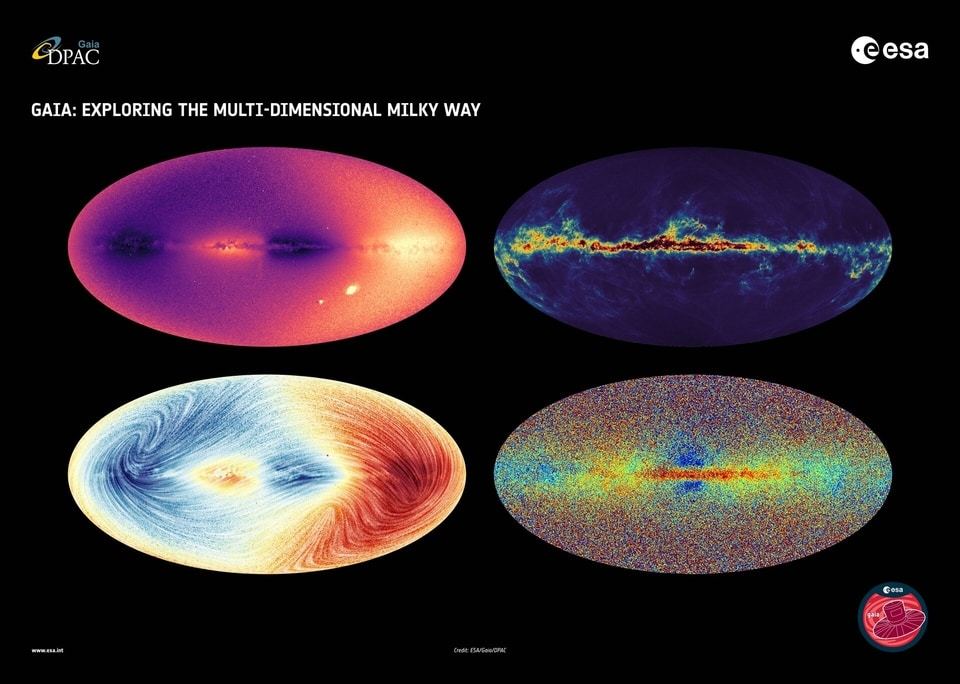
Today, ESA’s Gaia mission released its new treasure trove of data about our home galaxy. Astronomers describe strange ‘starquakes’, stellar DNA, asymmetric motions, and other fascinating insights in this most detailed Milky Way survey to date.

Gaia is ESA’s mission to create the most accurate and complete multi-dimensional map of the Milky Way. This allows astronomers to reconstruct our home galaxy’s structure and past evolution over billions of years, and to better understand the lifecycle of stars and our place in the Universe.  This image shows four sky maps made with the new ESA Gaia data released on 13 June 2022.

What’s new in data release 3?

Gaia’s data release 3 contains new and improved details for almost two billion stars in our galaxy. The catalog includes new information including chemical compositions, stellar temperatures, colors, masses, ages, and the speed at which stars move towards or away from us (radial velocity). Much of this information was revealed by the newly released spectroscopy data, a technique in which the starlight is split into its constituent colors (like a rainbow). The data also includes special subsets of stars, like those that change brightness over time.

Also new in this data set is the largest catalog yet of binary stars, thousands of Solar System objects such as asteroids and moons of planets, and millions of galaxies and quasars outside the Milky Way. 

There are 6 Gaia data processing centers: at the Institute of Astronomy in Cambridge (United Kingdom), at the University of Geneva in Switzerland, at the Barcelona Supercomputing Centre in Spain, at the University of Torino in Italy, at the Centre National d'Etudes Spatiales in Toulouse (France) and the European Space Astronomy Centre in Madrid, Spain. Each data processing center is responsible for a specific part of the processing and collaborates with the rest of the Gaia consortium to ensure the best scientific data products are obtained.

Starquakes

One of the most surprising discoveries coming out of the new data is that Gaia can detect starquakes – tiny motions on the surface of a star – that change the shapes of stars, something the observatory was not originally built for.

Previously, Gaia already found radial oscillations that cause stars to swell and shrink periodically, while keeping their spherical shape. But Gaia has now also spotted other vibrations that are more like large-scale tsunamis. These nonradial oscillations change the global shape of a star and are therefore harder to detect.

Gaia found strong nonradial starquakes in thousands of stars. Gaia also revealed such vibrations in stars that have seldomly been seen before. These stars should not have any quakes according to the current theory, while Gaia did detect them at their surface.

“Starquakes teach us a lot about stars, notably their internal workings. Gaia is opening a goldmine for ‘asteroseismology' of massive stars,” says Conny Aerts of KU Leuven in Belgium, who is a member of the Gaia collaboration.

The DNA of stars

What stars are made of can tell us about their birthplace and their journey afterward, and therefore about the history of the Milky Way. With today’s data release, Gaia is revealing the largest chemical map of the galaxy coupled to 3D motions, from our solar neighborhood to smaller galaxies surrounding ours.

Some stars contain more ‘heavy metals’ than others. During the Big Bang, only light elements were formed (hydrogen and helium). All other heavier elements – called metals by astronomers – are built inside stars. When stars die, they release these metals into the gas and dust between the stars called the interstellar medium, out of which new stars form. Active star formation and death will lead to an environment that is richer in metals. Therefore, a star’s chemical composition is a bit like its DNA, giving us crucial information about its origin. 

With Gaia, we see that some stars in our galaxy are made of primordial material, while others like our Sun are made of matter enriched by previous generations of stars. Stars that are closer to the center and plane of our galaxy are richer in metals than stars at larger distances. Gaia also identified stars that originally came from different galaxies than our own, based on their chemical composition. 

“Our galaxy is a beautiful melting pot of stars,” says Alejandra Recio-Blanco of the Observatoire de la Côte d’Azur in France, who is a member of the Gaia collaboration. 

“This diversity is extremely important because it tells us the story of our galaxy’s formation. It reveals the processes of migration within our galaxy and accretion from external galaxies. It also clearly shows that our Sun, and we, all belong to an ever-changing system, formed thanks to the assembly of stars and gas of different origins.”

Binary stars, asteroids, quasars, and more

Other papers that are published today reflect the breadth and depth of Gaia's discovery potential. A new binary star catalog presents the mass and evolution of more than 800 thousand binary systems, while a new asteroid survey comprising 156 thousand rocky bodies is digging deeper into the origin of our Solar System. Gaia is also revealing information about 10 million variable stars, mysterious macro-molecules between stars, as well as quasars and galaxies beyond our cosmic neighborhood.

“Unlike other missions that target specific objects, Gaia is a survey mission. This means that while surveying the entire sky with billions of stars multiple times, Gaia is bound to make discoveries that other more dedicated missions would miss. This is one of its strengths, and we can’t wait for the astronomy community to dive into our new data to find out even more about our galaxy and its surroundings than we could’ve imagined,” says Timo Prusti, Project Scientist for Gaia at ESA.

Gaia is ESA’s mission to create the most accurate and complete multi-dimensional map of the Milky Way. This allows astronomers to reconstruct our home galaxy’s structure and past evolution over billions of years, and to better understand the lifecycle of stars and our place in the Universe. 

  1. UAB's proteomic analysis of 2,002 tumors identifies 11 pan-cancer molecular subtypes across 14 types of cancer
  2. Chinese scientists observe large-scale, ordered, tunable Majorana-zero-mode lattice

Page 60 of 123

  • 55
  • 56
  • 57
  • 58
  • 59
  • 60
  • 61
  • 62
  • 63
  • 64
POPULAR RIGHT NOW
  • Supercomputers uncover a new class of cosmic explosions hidden in plain sight
    Supercomputers uncover a new class of cosmic explosions hidden in plain sight
  • AI supercharges the hunt for stronger magnets: Iowa State researchers launch a new era of intelligent materials discovery
    AI supercharges the hunt for stronger magnets: Iowa State researchers launch a new era of intelligent materials discovery
  • IBM's Historic stock collapse raises questions for the future of enterprise supercomputing
    IBM's Historic stock collapse raises questions for the future of enterprise supercomputing
  • Could a novel dark matter theory simultaneously resolve multiple cosmic enigmas? Supercomputer simulations provide a compelling, albeit currently unverified, potential solution
    Could a novel dark matter theory simultaneously resolve multiple cosmic enigmas? Supercomputer simulations provide a compelling, albeit currently unverified, potential solution
  • Melting icebergs may be reshaping Earth’s greatest ocean current
    Melting icebergs may be reshaping Earth’s greatest ocean current
  • Supercomputers replace ‘bathtub’ flood maps with physics-based digital twins of Britain’s coastline
    Supercomputers replace ‘bathtub’ flood maps with physics-based digital twins of Britain’s coastline
  • Supercomputers push neural quantum simulation beyond previous limits
    Supercomputers push neural quantum simulation beyond previous limits
  • Intel’s AI supercomputing revival: Q2 financial surge signals new era for CPU-powered HPC infrastructure
    Intel’s AI supercomputing revival: Q2 financial surge signals new era for CPU-powered HPC infrastructure
  • AI infrastructure financing fears shake semiconductor sector
    AI infrastructure financing fears shake semiconductor sector
  • AWS supercomputing investment reaches historic scale as Amazon’s AI strategy powers record financial results
    AWS supercomputing investment reaches historic scale as Amazon’s AI strategy powers record financial results
THIS YEAR'S MOST READ
  • Wall Street wants to trade supercomputing power like oil
    Wall Street wants to trade supercomputing power like oil
  • Cosmic ambition at scale: UK’s supercomputer unlocks a 2.5 petabytes universe
    Cosmic ambition at scale: UK’s supercomputer unlocks a 2.5 petabytes universe
  • Hidden order, revealed at scale: Supercomputing, electron ptychography uncover the inner workings of relaxor ferroelectrics
    Hidden order, revealed at scale: Supercomputing, electron ptychography uncover the inner workings of relaxor ferroelectrics
  • Beamforming the future: BeammWave's 6G push signals the rise of orbital-terrestrial wireless networks
    Joakim Axmon
    Joakim Axmon
  • Intel's Q1 results signal supercomputing surge driving Xeon momentum
    Intel's Q1 results signal supercomputing surge driving Xeon momentum
  • When stars fall apart: Supercomputing reveals the hidden physics of black holes
    When stars fall apart: Supercomputing reveals the hidden physics of black holes
  • Multi-layer simulations reveal the hidden supply chain of solar prominences
    Multi-layer simulations reveal the hidden supply chain of solar prominences
  • Japanese scientists decode dolphin speed with supercomputing: Turbulence, vortices, and the hidden physics of propulsion
    Japanese scientists decode dolphin speed with supercomputing: Turbulence, vortices, and the hidden physics of propulsion
  • Cosmic feedback at scale: Supercomputing reveals how quasars regulate the early Universe
    Cosmic feedback at scale: Supercomputing reveals how quasars regulate the early Universe
  • Modeling life at the microscopic scale: A computational breakthrough in oxygen transport
    Modeling life at the microscopic scale: A computational breakthrough in oxygen transport
MOST READ OF ALL-TIME
  • Largest Computational Biology Simulation Mimics The Ribosome
    Details
    112109
    The amino acid (green) slithers into the chemical reaction center, moving through an evolutionarily ancient corridor of the ribosome (purple). The amino acid is delivered to the reaction core by the transfer RNA molecule (yellow).
    The amino acid (green) slithers into the chemical reaction center, moving through an evolutionarily ancient corridor of the ribosome (purple). The amino acid is delivered to the reaction core by the transfer RNA molecule (yellow).
  • Silicon 'neurons' may add a new dimension to chips
    Details
    80997
    Silicon 'neurons' may add a new dimension to chips
  • Linux Networx Accelerators Expected to Drive up to 4x Price/Performance
    Details
    75540
  • Complex Concepts That Really Add Up
    Details
    73641
    Complex Concepts That Really Add Up
  • Blue Sky Studios Donates Animation SuperComputer to Wesleyan
    Details
    68143
    Each rack holds 52 Angstrom Microsystem-brand “blades,” with a memory footprint of 12 or 24 gigabytes each. (Photos by Olivia Bartlett Drake)
    Each rack holds 52 Angstrom Microsystem-brand “blades,” with a memory footprint of 12 or 24 gigabytes each. (Photos by Olivia Bartlett Drake)
  • Humanities, HPC connect at NERSC
    Details
    57950
  • TeraGrid ’09 'Call for Participation'
    Details
    54954
  • Turbulence responsible for black holes' balancing act
    Details
    52316
  • Cray Wins $52 Million SuperComputer Contract
    Details
    50143
  • SDSC Researchers Accurately Predict Protein Docking
    Details
    46084
  • FRONTPAGE
  • LATEST
  • POPULAR
  • REGISTER
  • SOCIAL
  • VIDEO
  • SUBSCRIPTION
  • RSS
  • GUIDELINES
  • PRIVACY
  • TOS
  • ABOUT
  • +1 (816) 799-4488
  • editorial@supercomputingonline.com
© 2001 - 2026 SuperComputingOnline.com, LLC. All rights reserved. This material may not be published, broadcast, rewritten or redistributed without permission.
Sign In
  • FRONT PAGE
  • LATEST
    • MEDIA KIT
    • MOST READ
    • RSS FEED
    • ACADEMIA
    • AEROSPACE
    • APPLICATIONS
    • ASTRONOMY
    • AUTOMOTIVE
    • BIG DATA
    • BIOLOGY
    • CHEMISTRY
    • CLIENTS
    • CLOUD
    • DEFENSE
    • DEVELOPER TOOLS
    • EARTH SCIENCES
    • ECONOMICS
    • ENGINEERING
    • ENTERTAINMENT
    • HEALTH
    • INDUSTRY
    • INTERCONNECTS
    • GAMING
    • GOVERNMENT
    • MANUFACTURING
    • MIDDLEWARE
    • MOVIES
    • NETWORKS
    • OIL & GAS
    • PHYSICS
    • PROCESSORS
    • RETAIL
    • SCIENCE
    • STORAGE
    • SYSTEMS
    • VISUALIZATION
  • VIDEOS
    • ADD YOUR VIDEOS
    • MANAGE VIDEOS
  • COMMUNITY
    • TRADE SHOWS
    • SOCIAL NETWORK VIDEOS
    • SURVEYS
    • APPLICATIONS BROWSER
    • CONVERSATION INBOX
    • SOCIAL ADVERTISER
    • GROUPS
    • MARKETPLACE LISTINGS
    • PAGES
    • LEADERBOARD
    • POINTS LISTING
      • BADGES
    • PRIVACY CONFIRM REQUEST
    • PRIVACY CREATE REQUEST

Hey there! We noticed you’re using an ad blocker.