Japan unveils the mysteries of the genome structure in the human cell nucleus using simulation

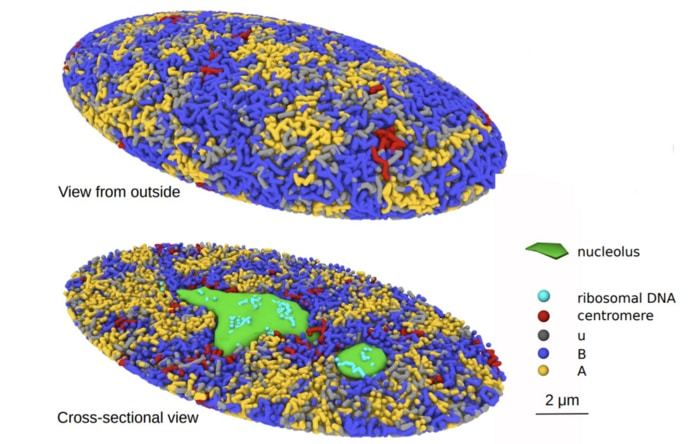
A team of researchers at Nagoya University in Japan has created a 3-Dimensional computational simulation of the process of genome structure formation in the human cell nucleus. They expect the model to contribute to the understanding of cellular regulatory mechanisms and diseases, such as cancer, that damage the genome.  New modeling technique provides a platform to investigate the relationship between the structure, dynamics, and functions of the human genome  CREDIT Shin Fujishiro, Masaki Sasai

The three-dimensional structure of the genome plays a vital role in regulating the DNA functions of animal and plant cells because it affects its reading and replication. Shin Fujishiro and Masaki Sasai, Professor Emeritus of Nagoya University’s Department of Complex Systems Science, Graduate School of Informatics, constructed a 3D model by analyzing the whole genome of human cells. They used this model as a platform to investigate the relationship between the structure, dynamics, and functions of the human genome. 

“The spatial organization of DNA and its dynamic movement in cells are crucial for understanding cell functions,” Professor Sasai explains. “Researchers have devoted considerable effort to explaining DNA organization in cells by developing various experimental methods, including biochemical and microscope technologies, but now a unified picture is required. Our research introduces the first computational model that can quantitatively analyze various data from the full genome of human cells in a consolidated way.” 

To help understand the process, the researchers investigated chromatin. Chromatin is a mixture of DNA with proteins that exist in cells as a way to keep the DNA compact. According to their model, chromatin is unevenly distributed and during the unfolding process that occurs during cell division, repulsive forces among the chromatin chains induce them to separate. This same force also separates chromatin into active and inactive compartments in the nuclei. The researchers found that their proposed mechanism clarified biochemical and microscopic findings of previous studies.  

Professor Sasai adds: “Our model provides an indispensable tool and an original perspective in cell biology. From the computational model developed in this research, we can determine how perturbations in cells affect genome dynamics and organization. We can also investigate how disease cells, including various cancer cells, affect the genome. It allows us to more deeply analyze the relationship between genome structure and transcription regulation. The model developed in this research provides a fundamental tool and a new viewpoint in cell biology.” 

University of Exeter makes a pivotal breakthrough in the quest to control light to evolve the next generation of quantum sensing, supercomputing

The team of researchers, including Dr. Oleksandr Kyriienko from the University of Exeter, has shown that controlling light can be achieved by inducing and measuring a nonlinear phase shift down to a single polariton level. This is a pivotal breakthrough in the quest to control light to evolve the next generation of quantum sensing and supercomputing.

Polaritons are hybrid particles that combine properties of light and matter. They arise in optical structures at strong light-matter coupling, where photons hybridize with underlying particles in the materials – quantum well excitons (bound electron-hole pairs).

The new research, led by the experimental group of Prof D Krizhanovskii from the University of Sheffield, has observed that interaction between polaritons in micropillars leads to a cross-phase-modulation between modes of different polarization.

The change of phase is significant even in the presence of (on average) a single polariton and can be further increased in structures with stronger confinement of light. This brings an opportunity for quantum polaritonic effects that can be used for quantum sensing and supercomputing.

Theoretical analysis, led by Dr. Oleksandr Kyriienko, shows the observed single polariton phase shift can be further increased, and cascading micropillars offer a path toward polaritonic quantum gates.

Quantum effects with weak light beams can in turn help detect chemicals, and gas leakage, and perform computation at largely increased speed.

Dr. Kyriienko said: “The experimental results reveal that quantum effects at a single polariton level can be measured in a single micropillar. From the theory point of view, it is important to increase phase shifts and develop the system into an optically controlled phase gate. We will see more efforts to build quantum polaritonic lattices as a quantum technology platform.”

Polaritons have proven to be an excellent platform for nonlinear optics, where particles enjoy increased coherence due to cavity field and strong nonlinear from exciton-exciton scattering.

Previously, polaritonic experiments led to the observation of polaritonic Bose-Einstein condensation and various macroscopic nonlinear effects, including the formation of solitons and vortices. However, the observation of quantum polaritonic effects in the low occupation limit remains an uncharted field.

The study shows that polaritons can sustain nonlinearity and coherence in extremely small occupations. This triggers a search for polaritonic systems that can further enhance quantum effects and operate as quantum devices.

Dr.. Paul Walker, the corresponding author of the study, explains: “We have used high-quality micropillars from gallium arsenide provided by collaborators from the University of Paris Saclay, France. These pillars confine modes of different polarization that are close in energy. By pumping light into one of the modes (fundamental), we probe a signal sent into another (higher energy) mode, and observe that the presence of a weak (single photon) pulse leads to polarization rotation. This can be seen as a controlled phase rotation.”

The senior author of the study Prof Krizhanovskii concludes: “In the presented experiment we have made a first step to see single-polariton effects. There is certainly a room for improvement. In fact, using cavities of smaller size and optimizing the structure we expect to increase phase shift orders of magnitude. This will establish the state-of-the-art for future polaritonic chips.”

MIT built model helps identify mutations that drive cancer

The system rapidly scans the genome of cancer cells and could help researchers find targets for new drugs.

Cancer cells can have thousands of mutations in their DNA. However, only a handful of those actually drives the progression of cancer; the rest are just along for the ride.

Distinguishing these harmful driver mutations from the neutral passengers could help researchers identify better drug targets. To boost those efforts, an MIT-led team has built a new supercomputer model that can rapidly scan the entire genome of cancer cells and identify mutations that occur more frequently than expected, suggesting that they are driving tumor growth. This type of prediction has been challenging because some genomic regions have an extremely high frequency of passenger mutations, drowning out the signal of actual drivers

“We created a probabilistic, deep-learning method that allowed us to get a really accurate model of the number of passenger mutations that should exist anywhere in the genome,” says Maxwell Sherman, an MIT graduate student. “Then we can look all across the genome for regions where you have an unexpected accumulation of mutations, which suggests that those are driver mutations.”

In their new study, the researchers found additional mutations across the genome that appear to contribute to tumor growth in 5 to 10 percent of cancer patients. The findings could help doctors to identify drugs that would have a greater chance of successfully treating those patients, the researchers say. Currently, at least 30 percent of cancer patients have no detectable driver mutation that can be used to guide treatment.

Sherman, MIT graduate student Adam Yaari, and former MIT research assistant Oliver Priebe are the lead writers of the study. Bonnie Berger, the Simons Professor of Mathematics at MIT and head of the Computation and Biology group at the Computer Science and Artificial Intelligence Laboratory (CSAIL), is a senior author of the study, along with Po-Ru Loh, an assistant professor at Harvard Medical School and an associate member of the Broad Institute of MIT and Harvard. Felix Dietlein, an associate professor at Harvard Medical School and Boston Children’s Hospital, is also an author of the paper.

A new tool

Since the human genome was sequenced two decades ago, researchers have been scouring the genome to try to find mutations that contribute to cancer by causing cells to grow uncontrollably or evade the immune system. This has successfully yielded targets such as epidermal growth factor receptor (EGFR), which is commonly mutated in lung tumors, and BRAF, a common driver of melanoma. Both of these mutations can now be targeted by specific drugs.

While those targets have proven useful, protein-coding genes make up only about 2 percent of the genome. The other 98 percent also contains mutations that can occur in cancer cells, but it has been much more difficult to figure out if any of those mutations contribute to cancer development. 

“There has really been a lack of computational tools that allow us to search for these driver mutations outside of protein-coding regions,” Berger says. “That's what we were trying to do here: design a computational method to let us look at not only the 2 percent of the genome that codes for proteins but 100 percent of it.”

To do that, the researchers trained a type of computational model known as a deep neural network to search cancer genomes for mutations that occur more frequently than expected. As a first step, they trained the model on genomic data from 37 different cancer types, allowing the model to determine the background mutation rates for each type. 

“The really nice thing about our model is that you train it once for a given cancer type, and it learns the mutation rate everywhere across the genome simultaneously for that particular type of cancer,” Sherman says. “Then you can query the mutations that you see in a patient cohort against the number of mutations you should expect to see.”

The data used to train the models came from the Roadmap Epigenomics Project and an international collection of data called the Pan-Cancer Analysis of Whole Genomes (PCAWG). The model’s analysis of this data gave the researchers a map of the expected passenger mutation rate across the genome, such that the expected rate in any set of regions (down to the single base pair) can be compared to the observed mutation count anywhere across the genome.

Changing the landscape

Using this model, the MIT team was able to add to the known landscape of mutations that can drive cancer. Currently, when cancer patients’ tumors are screened for cancer-causing mutations, a known driver will turn up about two-thirds of the time. The new results of the MIT study offer possible driver mutations for an additional 5 to 10 percent of the pool of patients.

One type of noncoding mutation the researchers focused on is called “cryptic splice mutations.” Most genes consist of sequences of exons, which encode protein-building instructions, and introns, which are spacer elements that usually get trimmed out of messenger RNA before it is translated into protein. Cryptic splice mutations are found in introns, where they can confuse the cellular machinery that splices them out. This results in introns being included when they shouldn’t be.

Using their model, the researchers found that many cryptic splice mutations appear to disrupt tumor suppressor genes. When these mutations are present, the tumor suppressors are spliced incorrectly and stop working, and the cell loses one of its defenses against cancer. The number of cryptic splice sites that the researchers found in this study accounts for about 5 percent of the driver mutations found in tumor suppressor genes. 

Targeting these mutations could offer a new way to potentially treat those patients, the researchers say. One possible approach that is still in development uses short strands of RNA called antisense oligonucleotides (ASOs) to patch over a mutated piece of DNA with the correct sequence.

“If you could make the mutation disappear in a way, then you solve the problem. Those tumor suppressor genes could keep operating and perhaps combat the cancer,” Yaari says. “The ASO technology is actively being developed, and this could be a very good application for it.”

Another region where the researchers found a high concentration of noncoding driver mutations is in the untranslated regions of some tumor suppressor genes. The tumor suppressor gene TP53, which is defective in many types of cancer, was already known to accumulate many deletions in these sequences, known as 5’ untranslated regions. The MIT team found the same pattern in a tumor suppressor called ELF3. 

The researchers also used their model to investigate whether common mutations that were already known might also be driving different types of cancers. As one example, the researchers found that BRAF, previously linked to melanoma, also contributes to cancer progression in smaller percentages of other types of cancers, including pancreatic, liver, and gastroesophageal. 

“That says that there’s actually a lot of overlap between the landscape of common drivers and the landscape of rare drivers. That provides the opportunity for therapeutic repurposing,” Sherman says. “These results could help guide the clinical trials that we should be setting up to expand these drugs from just being approved in one cancer, to being approved in many cancers and being able to help more patients.”