Penn-developed open-source algorithm personalizes which cancer mutations are best targets for immunotherapy

Supercomputer model could lead to more effective therapeutic vaccines

As tumor cells multiply, they often spawn tens of thousands of genetic mutations. Figuring out which ones are the most promising to target with immunotherapy is like finding a few needles in a haystack. Now a new model developed by researchers in the Abramson Cancer Center at the University of Pennsylvania hand-picks those needles so they can be leveraged in more effective, customized cancer vaccines. Cell Systems published the data on the model's development today, and the algorithm is already available online as an open-source technology to serve as a resource. web d5726{module In-article}

"There are mutations in tumors that can lead to powerful immune responses, but for every one mutation that generates a robust response, about 50 mutations don't work at all, which means the signal-to-noise ratio is not great," said the study's lead author Lee P. Richman, an MD/Ph.D. candidate in Cancer Biology in the Perelman School of Medicine at the University of Pennsylvania. "Our model works like a filter that highlights the signal and shows us which targets to focus on."

Currently, sequencing a tumor and identifying possible immunotherapies is based on a measurement called tumor mutations burden (TMB), essentially a measure of the rate of mutations present in a given tumor. Tumors with a high rate of mutation are more likely to respond to immunotherapy targeting inhibitors like PD-1. The problem is that as cancer cells divide, they mutate at random, and since they divide exponentially, the potential mutations are almost infinite. This means that while given immunotherapy can target some percentage of cancer cells, it may not be enough to be an effective treatment for any given patient.

The Penn team's model looks instead at protein sequences from samples of individual patients and evaluates how much of it looks similar to healthy cells and how much looks different enough that the immune system might react to it. The more it is dissimilar, the better immunotherapy target it makes because it's more likely to attract and activate therapies with less collateral damage to healthy cells. The model's prediction is also personalized to each patient's sample. The team analyzed samples of 318 patients from five different clinical trial data sets and not only confirmed the association between dissimilarity and promise as an immunotherapy target but also found that dissimilarity correlated to increased overall survival after PD-1 therapy in patients with non-small cell lung cancer.

"With so many different possibilities of mutations, we essentially boiled the question of which targets to use down to a math problem, then developed an algorithm to solve it," said Andrew J. Rech, MD, PhD, a resident in Pathology and Laboratory Medicine and the study's co-senior author along with Robert H. Vonderheide, MD, DPhil, director of the Abramson Cancer Center. "We also knew it was important to make this model available for other researchers to help inform vaccine development and clinical trials."

The researchers say in addition to its use in trials, future work will also include applying the tool to more data sets to refine the algorithm.

German physicists couple key components of quantum technologies

Researchers develop an easy-to-produce interface between quantum emitters and nanophotonic networks

Quantum effects are genuinely found in the world of nanostructures and allow a wide variety of new technological applications. For example, a quantum supercomputer could in the future solve problems, which conventional supercomputers need a lot of time to handle. All over the world, researchers are engaged in intensive work on the individual components of quantum technologies - these include circuits that process information using single photons instead of electricity, as well as light sources producing such individual quanta of light. Coupling these two components to produce integrated quantum optical circuits on chips presents a particular challenge. CAPTION Various designs form photonic crystals which concentrate light in a cavity.  CREDIT J. Olthaus, P. Schrinner et al./Adv. Quantum Technol.{module In-article}

Researchers at the University of Münster (Germany) have now developed an interface that couples light sources for single photons with nanophotonic networks. This interface consists of so-called photonic crystals, i.e. nanostructured dielectric materials that can enhance a certain wavelength range when light passes through. Such photonic crystals are used in many areas of research, but they had not previously been optimized for this type of interface. The researchers took particular care to achieve this feat in a way that allows for replicating the photonic crystals straightforwardly by using established nanofabrication processes.

"Our work shows that it is not only in highly specialized laboratories and unique experiments that complex quantum technologies can be produced," says physicist Dr. Carsten Schuck, an assistant professor at Münster University who headed the study together with Dr. Doris Reiter, likewise an assistant professor, who works in the field of solid-state theory. The results could help to make quantum technologies scalable. The study has been published in the journal Advanced Quantum Technologies.

Background and method:

As single photons obey the laws of quantum physics, researchers talk of quantum emitters with respect to the light sources involved. For their study, the researchers considered quantum emitters that are embedded in nanodiamonds and emit photons when they are stimulated by means of electromagnetic fields. In order to produce the interfaces desired, the researchers' aim was to develop optical structures tailored to the wavelength of the quantum emitters.

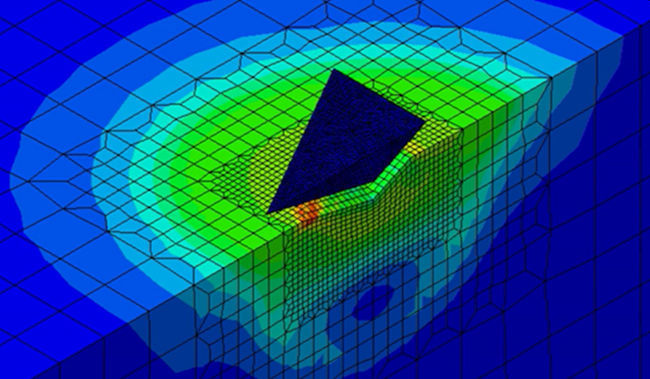
Cavities or holes in photonic crystals are well suited for trapping light in minute volumes and getting it to interact with matter such as, in this case, nanodiamonds. Jan Olthaus, a PhD student in physics in Doris Reiter's junior research group, developed theoretical concepts and special supercomputer-assisted simulation techniques in order to compute the designs for these photonic crystals.

The theoretically developed designs were produced by physicists in the junior research group headed by Carsten Schuck at the Center for Nanotechnology and the Center for Soft Nanoscience at Münster University. PhD student Philipp Schrinner manufactured the crystals from a thin film of silicon nitride. For this purpose, he used modern electron beam lithography and special etching methods on the equipment at the Münster Nanofabrication Facility and succeeded in producing high-quality crystals directly on the base material of silicon dioxide.

In structuring the crystals, the researchers varied not only the size and the arrangement of the cavities but also the width of the waveguide on which the cavities were placed. The results measured showed that photonic crystals which demonstrated a special variation in hole sizes were best suited for the interfaces.

"Our collaboration - between theoretical and experimental physicists - is an ideal one for physics research," says Doris Reiter. "This type of collaboration isn't always easy, as our respective methods of working are often very different indeed - which is why we are all the more delighted that it turned out so well in the case of our two junior research groups." "What's special about our work," adds Carsten Schuck, "is that our designs don't require any additional processing steps because they are compatible with established thin-film technology for integrated photonic circuits." This cannot be taken for granted in the development of complex quantum technologies, because although researchers often succeed in producing an important, high-quality component as a one-off, they are not able to produce multiple copies of the same component again.

The next steps for the researchers involve trying to position the quantum emitters, embedded in the nanodiamonds, at certain spots on the photonic crystals - with the aim of putting the results of the study into practice. To this end, the team headed by Carsten Schuck is already developing a special nanofabrication technique which is able, for example, to place a diamond just 100-nanometres in size with an accuracy of fewer than 50 nanometres. The team of theoretical physicists led by Doris Reiter wants to extend the studies to other materials systems and more complex geometries of photonic crystals and, for example, use elliptical holes instead of round ones.

Germany's Halle files patent for novel, high-performance transistors from spintronics

Today's computer processors are increasingly pushed to their limits due to their physical properties. Novel materials could be the solution. Physicists from Martin Luther University Halle-Wittenberg (MLU) have investigated if and how these materials might be developed. They have created, tested and filed a patent for a concept that utilizes the latest findings from the field of spintronics. The team reported on their research in the journal "ACS Applied Electronic Materials".

With their new concept, the researchers at MLU want to improve the properties of diodes and transistors. Common processors use thousands of diodes and transistors to process data. "The energy efficiency of these individual components determines how much energy is consumed by the processor overall," says Professor Ingrid Mertig, a theoretical physicist at MLU. Energy loss, which occurs when electrical energy is converted into heat, remains the biggest challenge, she explains. When developing these components, scientists also have to decide whether to create very powerful and energy-efficient components that can only be used for a specific purpose, or to create parts that can be used in a variety of ways, but which have lower performance and require more energy. {module In-article}

For its latest innovation, the team of researchers investigated whether spintronics can be used to solve these problems. It is based on a special property of electrons: the spin. This is a kind of intrinsic angular momentum of electrons that generates a magnetic moment which is the origin of magnetism. The researchers have investigated if and how a diode or transistor can be developed that uses this spin in addition to the charge of the electron. The concept is based on newly discovered magnetic materials that contain spin information in a particular way. These could replace traditional semiconductor materials in the novel components.

"Our proposals for the new transistors combine data processing and storage. There is no loss of energy and they can easily be reconfigured," explains Dr. Ersoy Sasioglu, a physicist at MLU and first author of the paper. A patent has already been filed for the design of these spintronic components. The research group from Halle focusses on using theoretical simulations in designing novel materials. In cooperation with experimental physicists from the University of Bielefeld, the scientists now want to test which materials are best suited for the new components.