There has been a lot of progress and development in the superconductivity (zero electrical resistance) front owing to its wide range of applications in MRI machines, particle accelerators, and low-loss power cables. However, its widespread use has been limited due to the extremely low temperatures required to maintain the superconducting state. Therefore, over the last decade, a lot of researchers have focused on achieving what is known as “high-temperature superconductivity” or superconductivity above liquid nitrogen temperature.
Recently, metal hydrides have emerged as an ideal candidate for high-temperature, or high-TC superconductivity (Tc being the transition temperature) since they maintain metallicity and superconductivity at relatively lower pressures. Amongst these, ternary hydrides, which are made of two elements and hydrogen, have shown superconductivity at room temperatures under high pressure, implying lower cooling costs. In particular, ternary hydrides of lanthanum (La) and yttrium (Y) have exhibited superconductivity at around 253 K.
Now, a group of researchers from Japan has further investigated the superconductivity and stability of La, Y, and cerium (Ce) hydrides. This study, led by Prof. Ryo Maezono from the Japan Advanced Institute of Science and Technology (JAIST), was made available online on October 5, 2022, and subsequently published in Volume 28 of the journal Materials Today Physics on November 1, 2022. The research group also included Associate Professor Kenta Hongo and Assistant Professor Kousuke Nakano from JAIST.
“By exploiting supercomputer simulations, it is possible to predict whether an unknown crystal structure exhibits thermodynamic and lattice-dynamic stability. Our group has been working with metal hydrides for a while now and this is the fourth result with Y/Ce and La/Ce compounds following the preceding findings with La/Y (2021.12.07), Y/Mg (2022.01.18), and Mg/Sc (2022.02.08). Such new findings are being launched one after another,” says Prof. Maezono, explaining the team’s motivation behind the study.
In principle, increasing the number of elemental combinations in simulations from two to three opens up new possibilities for high-TC superconductors. But, the number of combinations becomes too large for such simulations to be feasible. To tackle this, the team used an evolutionary algorithm-based crystal structure prediction (CSP) method to predict the crystal structure as well as the quantum ESPRESSO code to perform phonon dispersion and electron-phonon coupling (EPC) of the ternary hydrides. Further, the Eliashberg function and the Allen-Dynes modified McMillan formula was used to predict the superconducting critical temperature (TC).
Calculations revealed the existence of thermodynamically stable phases in the Y–Ce–H and La–Ce–H systems in the 100-400 gigapascals (GPa) pressure range. Amongst these, P4/mmm-YCeH8, P6m2-YCeH18, R3m-YCeH20, P4/mmm-LaCeH8, and R3m-LaCeH20 showed lattice-dynamic stabilities and resistance to decomposition at high temperatures. The EPC calculations and the Allen-Dynes-modified McMillan formula predicted high-temperature superconductivity for three of these phases. The TC for R3m-YCeH20, R3m-LaCeH20, and P6m2-YCeH18 was calculated to be 122 K at 300 GPa, 116 K at 250 GPa, and 173 K at 150 GPa, respectively. Additionally, the team found that the pressure for stabilizing P6m2-YCeH18 could be lowered to 150 GPa, an accessible condition for its synthesis.
“By combining ab initio simulations with data science in this manner, we can accelerate the development of materials that can achieve power and energy efficiency via superconductivity. This would lead to the realization of a more energy-efficient and sustainable society,” concludes Prof. Maezono.
Indeed, we could be seeing Y–Ce–H and La–Ce–H systems used as high-temperature superconductors pretty soon!
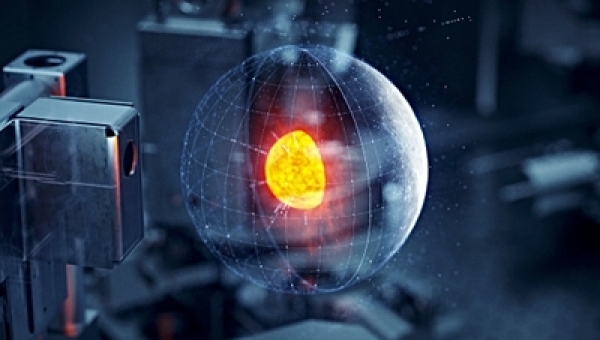
Using a simulation method based on random numbers scientists were able to describe the properties of warm dense hydrogen as accurately as never before
Finding out the properties of quantum systems that are made of many interacting particles is still a huge challenge. While the underlying mathematical equations are long known, they are too complex to be solved in practice. Breaking that barrier most probably would lead to a plethora of new findings and applications in physics, chemistry, and the material sciences. Researchers at the Center for Advanced Systems Understanding (CASUS) at Helmholtz-Zentrum Dresden-Rossendorf (HZDR) have now taken a major step forward by describing so-called warm dense hydrogen – hydrogen under extreme conditions like high pressures – as accurately as never before. The scientists’ approach, based on a method that puts random numbers to use, can for the first time solve the fundamental quantum dynamics of the electrons when many hydrogen atoms interact under conditions usually found in planet interiors or fusion reactors (Physical Review Letters, DOI: 10.1103/PhysRevLett.129.066402).
Hydrogen is the most abundant element in the universe. It is the fuel that powers the stars including our sun and it constitutes the interior of planets like our solar system’s gas giant Jupiter. The most common form of hydrogen in the universe is not the color- and odorless gas nor the hydrogen-containing molecules like water that are well-known on earth. It is the warm dense hydrogen of stars and planets – extremely compressed hydrogen that is in certain cases even conducting electricity as metals do. Warm dense matter research studies matter under conditions such as very high temperatures or pressures commonly found everywhere in the universe except for the surface of the earth where they do not occur naturally.
Simulation methods and their limits
In trying to elucidate the characteristics of hydrogen and other matter under extreme conditions, scientists heavily rely on simulations. A widely used one is called density functional theory (DFT). Despite its success, it has fallen short to describe warm dense hydrogen. The main reason is that correct simulations require precise knowledge of the interaction of electrons in warm dense hydrogen. But this knowledge is missing and scientists still have to rely on approximations of this interaction, leading to incorrect simulation results. Due to this knowledge gap, it is not possible, for example, to simulate the heat-up phase of inertial confinement fusion (ICF) reactions correctly. Removing this roadblock could significantly advance ICF, one of two major branches of fusion energy research, to become a much-needed zero-carbon power generation technology.
In the new publication, lead author Maximilian Böhme, Dr. Zhandos Moldabekov, Young Investigator Group Leader Dr. Tobias Dornheim (all CASUS-HZDR), and Dr. Jan Vorberger (Institute of Radiation Physics-HZDR) showed for the first time that properties of warm dense hydrogen can be described very precisely with so-called Quantum Monte Carlo (QMC) simulations. “What we did was to extend a QMC method called path-integral Monte-Carlo (PIMC) to simulate the static electronic density response of warm dense hydrogen,” says Böhme who is pursuing a doctorate with his work at CASUS. “Our method does not rely on the approximations previous approaches suffered from. It instead directly computes the fundamental quantum dynamics and therefore is very precise. When it comes to scale, however, our approach has its limits as it is computationally intense. Even though relying on the largest supercomputers, we so far can only handle particle numbers in the double-digit range.”
Higher scales – and still precise
The implications of the new method could be far-ranging: Combining PIMC and DFT cleverly could result in benefiting both from the accuracy of the PIMC method and the speed and versatility of the DFT method – the latter one being by far less computationally intense. “So far scientists were poking around in the fog to find reliable approximations for electron correlations in their DFT simulations,” says Dornheim. “Using the PIMC results for very few particles as a reference they now can tune the settings of their DFT simulations until the DFT results match the PIMC results. With the improved DFT simulations, we should be able to yield exact results in systems of hundreds to even thousands of particles.”
Adapting this approach, scientists could significantly enhance DFT which will result in improved simulations of the behavior of any kind of matter or material. In fundamental research, it will allow predictive simulations that experimental physicists need to compare to their experimental findings from large-scale infrastructures like the European X-Ray Free-Electron Laser Facility (European XFEL) near Hamburg (Germany), the Linac Coherent Light Source (LCLS) at the National Accelerator Laboratory in Menlo Park or the National Ignition Facility (NIF) at Lawrence Livermore National Laboratory in Livermore (both USA).
Speaking more specifically about hydrogen, the work of Böhme and his colleagues could potentially contribute to nailing down the details of how warm dense hydrogen becomes metallic hydrogen, a new phase of hydrogen studied intensively both by experiments and simulations. Generating metallic hydrogen experimentally in the lab could enable very interesting applications in the future.