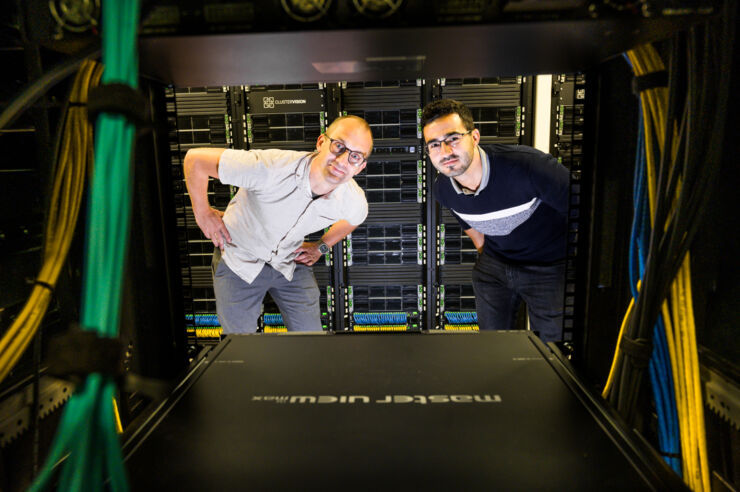
Mika Gustafsson and David Martínez hope that AI-based models could eventually be used in precision medicine to develop treatments and preventive strategies tailored to the individual.  Thor Balkhed
Mika Gustafsson and David Martínez hope that AI-based models could eventually be used in precision medicine to develop treatments and preventive strategies tailored to the individual. Thor Balkhed

Artificial intelligence is paving the way for precision medicine

Artificial Intelligence (AI) models can accurately estimate a person's age and determine whether they have a smoking history or not. Researchers at Linköping University have developed an AI-based method that can be used to address various medical and biological issues. This method can identify epigenetic markers that were previously known and those that are new and associated with conditions. The goal of AI models is to simplify complex biological data and extract the most relevant characteristics and patterns. The ultimate objective is to create an interpretable AI model that can help understand why someone is ill or not.

Epigenetics refers to the regulation of gene activity, which can be compared to a power switch that turns genes on or off without altering them. This process can be influenced by several factors, such as smoking, dietary habits, and environmental pollution. To develop personalized treatments and preventive strategies, researchers at Linköping University (LiU) have trained numerous AI neural network models using epigenetic data from over 75,000 human samples. These models are of the autoencoder type, which helps to self-organize the data and identify interrelation patterns in the vast amount of information.

Research conducted by LiU scientists has revealed that smoking leaves permanent traces on the DNA even after a person quits smoking. The researchers developed a model that compared the effects of smoking on the body with existing models. These models are based on specific epigenetic changes that occur in the lungs as a result of smoking. The new model can detect if someone is a current, former, or non-smoker. Additionally, other models that utilize epigenetic markers can estimate an individual's chronological age or group of individuals based on their health status.

The researchers at Linköping University trained an autoencoder and used its results to classify individuals on age, and smoker status and diagnose the disease systemic lupus erythematosus, SLE. While existing models depend on selected epigenetic markers, the autoencoders developed by the researchers performed equally well or better. The researchers discovered that their models could identify new markers associated with the condition they were examining, such as markers for respiratory diseases and DNA damage. The autoencoder models were designed to compress complex biological data into a representation of the most relevant characteristics and patterns in the data. The researchers allowed the data to speak for itself, and the autoencoder self-organized the data in a way similar to how it works in the body. Using the most important characteristics found by the autoencoder, the researchers can create models to classify a large amount of environment-related, individual-specific factors where there is not enough training data for complex AI models.

It is sometimes difficult to understand how certain types of AI work. They are like black boxes that provide answers but it is unclear how they arrived at those answers. However, Mika Gustafsson and his team are working on creating interpretable AI models. These models let researchers look inside the black box and better understand how the AI works. This is important because it helps us understand why certain conditions and diseases occur, not just whether someone is affected or not. The research was funded by several organizations including the Swedish Research Council, the Wallenberg AI, Autonomous Systems and Software Program (WASP), and the SciLifeLab & Wallenberg National Program for Data-Driven Life Science (DDLS).
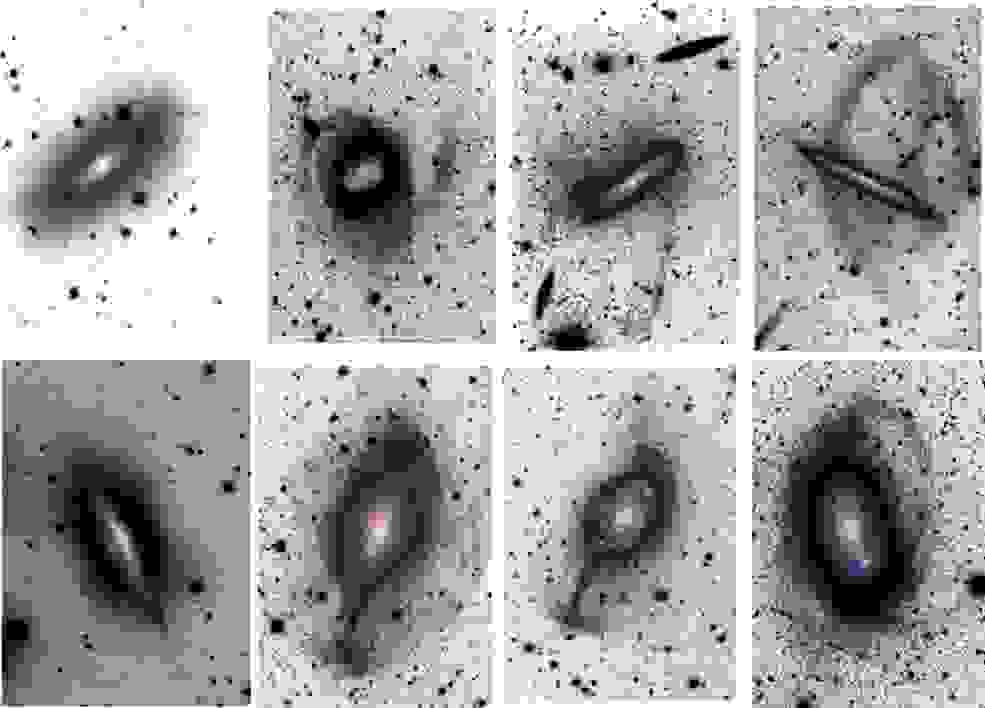
Astronomers use a special technique to find stellar streams. They reverse the light and dark tones of images, similar to negative images, but stretch them to highlight the faint streams. Color images of nearby galaxies are scaled and superposed to emphasize the visible disk. These galaxies are surrounded by massive halos of hot gas containing sporadic stars, which are seen as the shadowy areas around each galaxy. NASA's upcoming Nancy Grace Roman Space Telescope is expected to improve these observations by resolving individual stars, allowing for a better understanding of each stream's stellar populations and the ability to spot stellar streams of various sizes in more galaxies. Credit: Carlin et al. (2016), based on images from Martínez-Delgado et al. (2008, 2010)

NASA's Roman mission prepares to handle a massive amount of data in the future

The Nancy Grace Roman Space Telescope (Roman) team is preparing for the deluge of data the mission will return by creating simulations, scouting the skies with other telescopes, calibrating Roman’s components, and more. Simulations will be used to test algorithms, estimate Roman’s scientific return, and fine-tune observing strategies so that the most can be learned about the universe. Roman will also identify interesting targets that observatories such as NASA’s James Webb Space Telescope can zoom in on for more detailed studies. ezgif.com resize 1 91c3e

As part of a mission to uncover the mysteries of dark energy, scientists from around the world will work together to maximize the potential of the Roman telescope. The mission is expected to launch by May 2027. To ensure that scientists are equipped with the necessary tools, various teams, and individuals will contribute their efforts to the cause. Julie McEnery, the senior project scientist at NASA’s Goddard Space Flight Center in Greenbelt, Maryland, said that they are laying a foundation by harnessing the science community at large. The goal is to perform powerful scientific research right from the start. The simulation plays a vital role in the preparation phase. Scientists can use it to test algorithms, estimate Roman’s scientific returns, and fine-tune observation strategies.

The teams will sprinkle different cosmic phenomena through a simulated dataset and then run machine learning algorithms to see how well they can automatically find the phenomena. Given Roman’s enormous data collection rate, identifying underlying patterns quickly and efficiently will be crucial. During its five-year primary mission, the Roman telescope is expected to amass 20,000 terabytes (20 petabytes) of observations containing trillions of individual measurements of stars and galaxies.

Preparing for the launch of the Roman Space Telescope is a complex process, as every observation made by the telescope will be used by multiple teams for different scientific purposes. Scientists will carry out preliminary observations using other telescopes such as the Hubble Space Telescope, the Keck Observatory, and PRIME. These observations will help to optimize Roman’s observations and better understand the data the mission will deliver.

Astronomers will explore ways to combine data from different observatories and use multiple telescopes in tandem. For instance, combining observations from PRIME and Roman would help astronomers learn more about objects found via warped space-time. Roman scientists will also use archived Hubble data to learn about the history of cosmic objects and identify interesting targets that telescopes such as the James Webb Space Telescope can study in detail.

Planning for each Roman science case will take many teams working in parallel. Scientists will need to consider all the things needed to study a particular object, such as algorithms for dim objects, ways to measure star positions precisely, understanding detector effects, and developing effective strategies to image stellar streams.

One team is developing processing and analysis software for Roman’s Coronagraph Instrument, which will unveil several cutting-edge technologies that could help astronomers directly image planets beyond our solar system. They will simulate different objects and planetary systems the Coronagraph could unveil, from dusty disks surrounding stars to old, cold worlds similar to Jupiter.

The mission’s science centers are getting ready to manage Roman’s data pipeline and establish systems for planning and executing observations. They will convene a survey definition team to determine Roman’s optimal observation plans in detail based on all the preparatory information generated by scientists and the interests of the broader astronomical community.

The team is excited to set the stage for Roman and ensure that each of its future observations will contribute to a wealth of scientific discoveries.

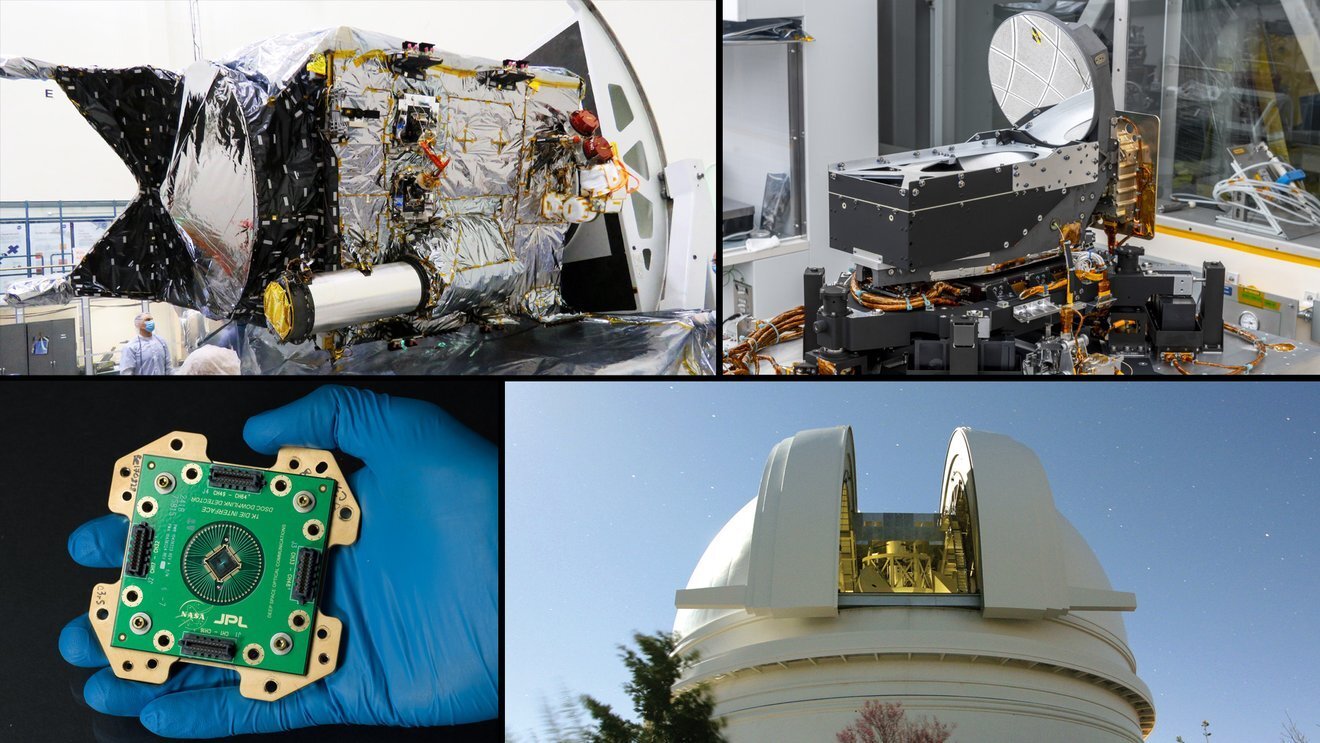
NASA’s DSOC is composed of a flight laser transceiver attached to Psyche and a ground system that will send and receive laser signals. Clockwise from top left: the Psyche spacecraft with DSOC attached, flight laser transceiver, downlink ground station at Palomar, and downlink detector.

NASA demos deep space optical communications

NASA's Deep Space Optical Communications (DSOC) experiment will showcase the use of laser or optical-based communications as far as Mars. The technology involves the use of equipment in space and on Earth, which includes a flight laser transceiver, two ground telescopes, and a high-power near-infrared laser transmitter. Despite the challenges of dealing with faint laser photon signals and a lag of over 20 minutes at the farthest distance, the experiment will offer a groundbreaking experience for transmitting higher data rates from deep space. DSOC will be launched on Oct. 12 as part of NASA's Psyche mission. It will pave the way for future missions to Mars by testing key technologies that would allow the transmission of denser science data and even stream video from the Red Planet. 


It is important to know about the amazing technology demonstration that's happening. NASA is testing a new technology called DSOC which uses lasers to increase data transmission from deep space. Until now, NASA has been using only radio waves to communicate with missions that travel beyond the Moon. With optical communications, much like fiber optics replacing old telephone lines on Earth, we can expect much higher data rates throughout the solar system, with 10 to 100 times the capacity of state-of-the-art systems currently used by spacecraft. This will help us better enable future human and robotic exploration missions, as well as support higher-resolution science instruments.

The 200-inch (5.1-meter) Hale Telescope at Caltech's Palomar Observatory in San Diego County, California, has also been equipped with a special superconducting high-efficiency detector array to collect data sent from the flight transceiver. The tech demo involves equipment both in space and on Earth. While NASA's Psyche spacecraft relies on traditional radio communications for mission operations, the DSOC flight laser transceiver, which is an experiment attached to the spacecraft, features both a near-infrared laser transmitter and a sensitive photon-counting camera. The laser transceiver is designed to send high-rate data to Earth and receive a laser beam sent from Earth. However, it is just one part of the technology demonstration.

Since there is no dedicated infrastructure on Earth for deep space optical communications, two ground telescopes have been updated to communicate with the flight laser transceiver. The Optical Communications Telescope Laboratory located at NASA's Jet Propulsion Laboratory in Southern California has integrated a high-power near-infrared laser transmitter with the technology demonstration. The transmitter will deliver a modulated laser signal to DSOC's flight transceiver and serve as a beacon, or pointing reference, to enable accurate aiming of the returned laser beam back to Earth.

DSOC faces unique challenges as it aims to transmit data at a high rate over a distance of up to 240 million miles (390 million kilometers) during the first two years of Psyche's six-year journey to the asteroid belt. As Psyche travels further away from Earth, the laser photon signal weakens, making it increasingly difficult to decode the data. Furthermore, the photons take longer to reach their destination, resulting in a lag of over 20 minutes at the farthest distance of the tech demo. As the positions of Earth and the spacecraft are constantly changing as the photons travel, the DSOC ground and flight systems will need to adjust and point to where the ground receiver (at Palomar) and flight transceiver (on Psyche) will be when the photons arrive.

Advanced technologies will collaborate to ensure that the lasers are accurately targeted and that high-bandwidth data is transmitted from deep space. Precise pointing of the flight laser transceiver and ground-based laser transmitter is crucial. It is comparable to hitting a dime from a mile away while it is moving. Therefore, the transceiver must be isolated from vibrations that could nudge the laser beam off the target. Initially, Psyche will direct the flight transceiver toward Earth, while autonomous systems on the flight transceiver assisted by the Table Mountain uplink beacon laser will control the pointing of the downlink laser signal to Palomar Observatory.

JPL has developed a cryogenically cooled superconducting nanowire photon-counting array receiver, which is integrated into the Hale Telescope. The instrument is equipped with high-speed electronics that record the time of arrival of single photons, allowing the signal to be decoded. The DSOC team has even developed new signal-processing techniques to extract information from the weak laser signals that will have been transmitted over tens to hundreds of millions of miles.

NASA is working on an optical communications project that aims to revolutionize communication in space. In 2013, NASA conducted the Lunar Laser Communications Demonstration which resulted in record-breaking uplink and downlink data rates between Earth and the Moon. In 2021, a new project called Laser Communications Relay Demonstration was launched to test high-bandwidth optical communications relay capabilities from geostationary orbit, enabling spacecraft to communicate with Earth even without a direct line of sight. Additionally, NASA's TeraByte InfraRed Delivery system achieved the highest-ever data rate from a satellite in low-Earth orbit to a ground-based receiver in the last year.

The latest project, called DSOC, is taking optical communications beyond the Moon, paving the way for high-bandwidth communications in deep space. This has the potential to lead to high-data-rate communications that can support streaming and high-definition imagery. This technology could be crucial in enabling humanity's next giant leap when NASA sends astronauts to Mars.