


Irish astrophysicists use AI to search for signs of extraterrestrial life

A team of astrophysicists from Trinity College Dublin and Onsala Space Observatory in Sweden are searching for extraterrestrial radio signals in the hopes of finding signs of intelligent alien life. The team is using both the Irish LOFAR telescope and its counterpart in Onsala, Sweden to monitor millions of star systems. Professor Evan Keane, Associate Professor of Radio Astronomy in Trinity’s School of Physics and Head of the Irish LOFAR Telescope, plans to monitor millions of star systems. The research is being supported by Science Foundation Ireland and will rely on machine learning techniques to sift through the immense volume of data.

For over 60 years, scientists have been searching for extraterrestrial radio signals, many of which have been conducted using single observatories. Unfortunately, this method has limited the ability to identify signals from the haze of terrestrial interference on Earth. Most of the effort has focused on frequencies above 1 GHz, as the single-dish telescopes employed operate at these frequencies.

Now, a new collaboration led by Trinity College Dublin, with the Breakthrough Listen team and Onsala Space Observatory in Sweden, is perfecting a multi-site, multi-telescope technique that allows them to search at much lower frequencies of 110 – 190 MHz.

The Breakthrough Listen program is a comprehensive search for technologically advanced extraterrestrial life. The program is developed with dedicated instruments at the Irish and Swedish LOFAR stations. One of the significant benefits of using multiple sites is that it reduces the likelihood of a "false positive" signal. Such signals can arise due to interference from various human sources on Earth.

The team has recently published details of their method and their ongoing search in the Astronomical Journal. They have already scanned 1.6 million star systems flagged as interesting targets by the Gaia and TESS space missions, run by ESA and NASA, respectively. So far, these searches have not yielded any results, but the search has only just begun.

Prof. Keane commented that evidence has steadily mounted over the last 50 years that the constituents and conditions necessary for life are relatively common in the Universe. This begs one of life's greatest unanswered questions: are we alone? The search for extra-terrestrial intelligence, or SETI, may seem like something from a movie to some people, but it has been a scientific pursuit for decades and a host of very good reasons.

With this project, the team is basing their search on the common assumption that civilizations elsewhere in the Universe may employ similar technologies to those developed on Earth. As a result, radio frequencies are a logical domain for conducting SETI surveys due to the widespread use of telecommunications and radar. The team's access to next-generation radio telescopes offers a great chance for a deep dive into the Universe.

Owen Johnson, PhD Candidate in Trinity's School of Physics, is the first author of the journal article, and the first Irish person to ever undertake a PhD on the topic of SETI. He added that what makes surveys like this one truly captivating is the fact that they are pushing these telescopes to their absolute limits, directing them toward substantial portions of the sky. As a result, they have the exciting possibility of discovering all sorts of wild and wondrous phenomena during this process and if they are very fortunate, even encountering cosmic neighbors.

LOFAR is soon to undergo a staged series of upgrades across all stations in the array across Europe, which will allow an even broader SETI at ranges of 15 - 240 MHz. The team has billions of star systems to explore and will be relying on some machine-learning techniques to sift through the immense volume of data.

"That in itself is interesting – it would be fairly ironic if humankind discovered alien life by using artificial intelligence," Owen Johnson concluded.
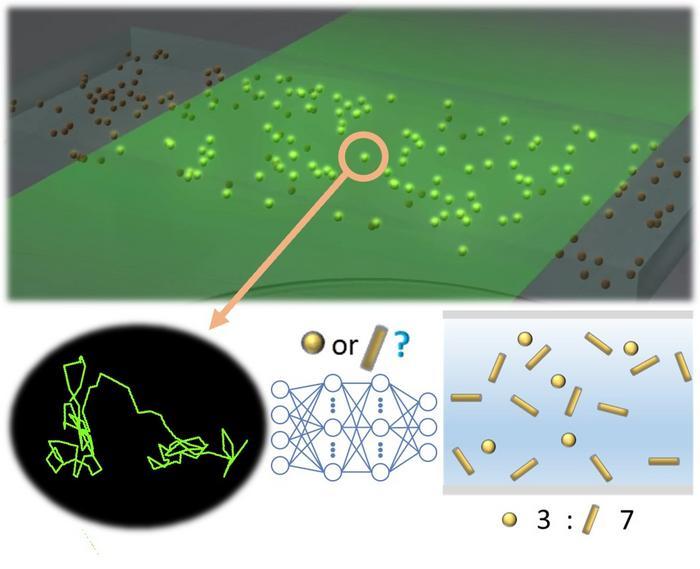

 Scheme of shape prediction of nanoparticles using NTA + deep learning analysis
Scheme of shape prediction of nanoparticles using NTA + deep learning analysis

Deep learning now solves nanoparticle shape identification challenges

The Innovation Center of NanoMedicine (iCONM) and The University of Tokyo have proposed a new method to evaluate the shape anisotropy of nanoparticles. This new method solves a long-standing issue in nanoparticle evaluation that dates back to the time of Einstein. The method uses deep learning to detect differences in shape and has achieved an 80% classification accuracy on a single-particle basis for two types of gold nanoparticles that are approximately the same size but have different shapes. This innovative approach has the potential to advance fundamental research on Brownian motion of non-spherical particles in liquid. Furthermore, it can be useful in practical applications such as the detection of foreign substances in homogeneous systems.

The paper titled "Analysis of Brownian motion trajectories of non-spherical nanoparticles using deep learning" was published online in the APL Machine Learning journal on October 25, 2023. The group led by Prof. Takanori Ichiki, Research Director of iCONM (Professor, Department of Materials Engineering, Graduate School of Engineering, The University of Tokyo in Japan) proposed this new method.

Nanoparticles are useful materials in the medical, pharmaceutical, and industrial fields. Therefore, it is necessary to evaluate the properties and agglomeration state of each nanoparticle and perform quality control. Nanoparticle Tracking Analysis (NTA) is one way to evaluate nanoparticles in liquid by analyzing the trajectory of Brownian motion. It is a simple method to measure single particles from micro to nano size. However, it has a long-standing problem that it cannot evaluate the shape of nanoparticles.

Detecting the trajectory of Brownian motion is important as it reflects the influence of particle shape. However, measuring extremely fast motion is difficult, and conventional analysis methods are not accurate because they assume that the particle is spherical. Their research group has developed a deep learning model that identifies shapes from measured Brownian motion trajectory data without altering the experimental method.

Their model includes a 1-dimensional CNN model that extracts local features through convolution and a bidirectional LSTM model that accumulates temporal dynamics. By integrating these models, they have achieved approximately 80% classification accuracy on a single-particle basis for two types of gold nanoparticles that are approximately the same size but have different shapes. This is a significant improvement compared to conventional NTA alone.

Furthermore, they were able to create a calibration curve to determine the mixing ratio of a mixed solution of two types of nanoparticles (spherical and rod-shaped). This method is sufficiently accurate in detecting the shape of various types of nanoparticles in liquid using deep learning analysis, making it a practical tool for the first time.

In traditional NTA methods, it is not possible to directly observe the shape of particles, and the information obtained is limited. Although the trajectory of Brownian motion measured by the NTA device contains information on the shape of nanoparticles, detecting the shape anisotropy of nanoparticles has been a challenge due to the extremely short relaxation time. Also, conventional analysis methods assume particles to be spherical, which leads to inaccurate results when the particle is non-spherical. To overcome these challenges, they aimed to develop a new method that is simple and accessible. They introduced deep learning, which is good at finding hidden correlations in large-scale data, into data analysis without changing simple experimental methods. This approach enabled them to solve a long-standing problem in Brownian motion analysis and accurately detect the shape anisotropy of nanoparticles.

In this paper, they aimed to determine the shapes of two types of particles. However, they believe that the method used can have practical applications such as detecting foreign substances in homogeneous systems, considering the shapes of commercially available nanoparticles. The expansion of NTA can lead to applications not only in research but also in the industrial field. It can be useful in evaluating the properties, agglomeration state, and uniformity of non-spherical nanoparticles, and in quality control. This technology can be particularly helpful in evaluating the properties of diverse biological nanoparticles, such as extracellular vesicles, in an environment similar to that of living organisms. Furthermore, it has the potential to be an innovative approach in fundamental research on Brownian motion of non-spherical particles in liquid.

The West Antarctic Ice Sheet will continue to increase its rate of melting over the rest of the century, no matter how much we reduce fossil fuel use.

Scientists use a supercomputer to simulate the melting of the West Antarctic Ice Sheet, determine controllable melting by reducing greenhouse gas emissions

The melting rate of the West Antarctic Ice Sheet will increase in the coming century, regardless of how much we reduce our fossil fuel use. Even if we manage to limit global temperature rise to 1.5°C, melting will still occur three times faster than it did during the 20th century. Scientists simulated the ocean-driven melting of the West Antarctic Ice Sheet using the UK’s national supercomputer to determine how much melting is inevitable and how much can still be controlled by reducing greenhouse gas emissions. They found that even under the most ambitious targets of the 2015 Paris Agreement, the impact of mid-range emissions scenarios on melting is not significantly different when considering climate variability like El Niño.

The West Antarctic Ice Sheet is losing ice and is the largest contributor to sea-level rise in Antarctica. Previous models suggest that this loss is due to the warming of the Southern Ocean, particularly the Amundsen Sea region. The West Antarctic Ice Sheet contains enough ice to raise the global mean sea level by up to five meters, which will greatly impact the millions of people living near the coast worldwide. A better understanding of future changes will allow policymakers to plan and adapt more readily.

Lead author Dr Kaitlin Naughten, a researcher at the British Antarctic Survey, states that it appears that we have lost control of the melting of the West Antarctic Ice Sheet. This means that if we wanted to preserve it in its original state, we would have needed to take measures to combat climate change decades ago. However, recognizing the situation in advance provides the world with more time to adapt to the rising sea levels. In case there is a need to abandon or substantially re-engineer a coastal region, a 50-year lead time will make all the difference.

The team carried out simulations of four future scenarios of the 21st century and one historical scenario of the 20th century. The future scenarios either stabilized the global temperature rise at the targets set out by the Paris Agreement, 1.5°C and 2°C or followed standard scenarios for medium and high carbon emissions.

All scenarios resulted in significant and widespread warming of the Amundsen Sea and increased melting of its ice shelves. The three lower-range scenarios followed nearly identical pathways over the 21st century. Even under the best-case scenario, the warming of the Amundsen Sea accelerated by a factor of three, and the melting of the floating ice shelves that stabilized the inland glaciers followed, although it began to flatten by the end of the century.

The worst-case scenario had more ice shelf melting than the others, but only after 2045. The authors warn that this high fossil fuel scenario, where emissions increase rapidly, is unlikely to occur.

Naughten cautions that reducing our dependence on fossil fuels is crucial. What we do now will help to slow the rate of sea level rise in the long term. The slower the sea level changes, the easier it will be for governments and society to adapt, even if it can’t be stopped altogether stopped.