University of Barcelona's Mark Gieles discovers a supersized black hole population in the star cluster Palomar 5

Palomar 5 is a unique star cluster. First of all, it is one of the “fluffiest” clusters in the halo of our Galaxy, with the average distance between the stars being a few light-years, comparable to the distance from the Sun to the nearest star. Secondly, it has a specular stellar stream associated with it that spans more than 20 degrees across the sky. In a study, an international team of astronomers and astrophysicists led by the University of Barcelona show that both distinguishing features of Palomar 5 are likely the result of massive black hole populations of more than 100 black holes in the center of the cluster. ICCUB researcher Mark Gieles. Image: ICCUB

“The number of black holes is roughly three times larger than expected from the number of stars in the cluster, and it means that more than 20% of the total cluster mass is made of black holes. They each have a mass of about 20 times the mass of the Sun, and they formed in supernova explosions at the end of the lives of massive stars when the cluster was still very young” says Prof Mark Gieles, from the Institute of Cosmos Sciences of the University of Barcelona (ICCUB) and lead author of the study.

Tidal streams are streams of stars that were ejected from disrupting star clusters or dwarf galaxies. In the last few years, nearly thirty thin streams have been discovered in the Milky Way halo. "We do not know how these streams form, but one idea is that they are disrupted star clusters. However, none of the recently discovered streams have a star cluster associated with them, hence we can not be sure. So, to understand how these streams formed, we need to study one with a stellar system associated with it. Palomar 5 is the only case, making it a Rosetta Stone for understanding stream formation and that is why we studied it in detail" explains Gieles.

The researchers use supercomputers to simulate the orbits and the evolution of each star from the formation of the cluster until the final dissolution. They varied the initial properties of the cluster until a good match with observations of the stream and the cluster was found. The team finds that Palomar 5 formed with a lower black hole fraction, but stars escaped more efficiently than black holes, such that the black hole fraction gradually increased. The black holes dynamically puffed up the cluster in gravitational slingshot interactions with stars, which led to even more escaping stars and the formation of the stream. Just before it completely dissolves - roughly a billion years from now - the cluster will consist entirely of black holes. Above is a all sky view in galactic coordinates. The number of stars is higher in brighter regions. Most of the image, where the Milky Way plane is visible (b = 0 degrees), is produced using Gaia eDR3 data. The small patch in the top-centre shows a region where deeper DESI Legacy Imaging Survey (DECaLS) data is available, which allows for Palomar 5 and its tidal tails to be seen. Image: M. Gieles et al./Gaia eDR3/DESI DECaLS

Gieles points out that "we have shown that the presence of a large black hole population may have been common in all the clusters that formed the streams." This is important for our understanding of globular cluster formation, the initial masses of stars, and the evolution of massive stars.

This work also has important implications for gravitational waves.

Palomar 5 is a globular cluster discovered in 1950 by Walter Baade. It is in the Serpens constellation at a distance of about 65,000 light-years, and it is one of the roughly 150 globular clusters that orbit around the Milky Way. It is older than 10 billion years, like most other globular clusters, it formed in the earliest phases of galaxy formation. It is about 10 times less massive and 5 times more extended than a typical globular cluster and in the final stages of dissolution.

NASA, NOAA, FEMA help communities weather another year of tropical storms, hurricanes

The center of Hurricane Elsa has formed to the east of the Windward and the southern Leeward Islands and is expected to bring heavy rainfall to those areas over the weekend, according to an update today from the National Hurricane Center.

The storm is moving toward the west-northwest at almost 30 miles an hour, and its forecast track could bring it to the Florida Keys early next week.

June 1 marked the official start of the Atlantic hurricane season, which officially ends Nov. 30. After 2020 brought a record number of named storms in the Atlantic basin, NASA is prepared to help understand and monitor these storms from the unique vantage of space with experts available to provide insights on hurricanes and other extreme weather events. NASA’s new Earth System Observatory will guide efforts related to climate change, disaster mitigation, fighting forest fires, and improving real-time agricultural processes – including helping to better understand Category 4 to 5 hurricanes such as Hurricane Maria, shown here in a 2017 thermal image captured by NASA’s Terra satellite. Credits: NASA

Using data from its 20-plus Earth-observing satellites, NASA plays a foundational role in the science of hurricanes. For operational forecasting, it has partnered with the National Oceanic and Atmospheric Administration (NOAA). NOAA is predicting another active season, with an above-average number of named storms. NASA is developing new technology and missions to study storm formation and impacts, including more ways to understand Earth as a system.

In 2020, a record-tying nine storms rapidly intensified. These quick changes in storm strength can leave communities in their path without time to properly prepare.

NASA builds and launches NOAA's satellites that provide the data feed into supercomputers that produce weather prediction models. Scientists from NASA and NOAA also collaborate to improve these models continuously. Researchers at NASA JPL have developed a machine learning model that could more accurately detect rapidly intensifying storms.

Climate change is increasing the heat in the ocean basins and making it more likely that storms will intensify faster and become stronger, a phenomenon NASA scientists continue to study.

"As climate change intensifies and makes natural hazards like hurricanes more damaging, NASA is more committed than ever to innovative Earth science research," said NASA Administrator Bill Nelson. "Our next-generation Earth System Observatory will build on NASA's existing capabilities to provide an unprecedented understanding of the Earth from bedrock to the atmosphere, so we are better prepared to protect our communities from hurricanes and other extreme weather events."

NASA's goal for disaster preparedness, response, mitigation, and recovery is bridging the gap between data and the people who need it. Before, during, and after a hurricane or tropical storm makes landfall, NASA satellites are in a prime position to identify impacts.

NASA works with local officials and first responders, federal agencies such as FEMA and the U.S. Army Corps of Engineers, and infrastructure experts to determine what information they need and to supply it in usable formats in real-time. Examples include information on infrastructure failures and disruptions, contaminated water supplies, and other hotspots for urgent response needs.

NC State prof shows how common perovskite superfluoresces at high temperatures can be used as the basic building blocks for quantum applications

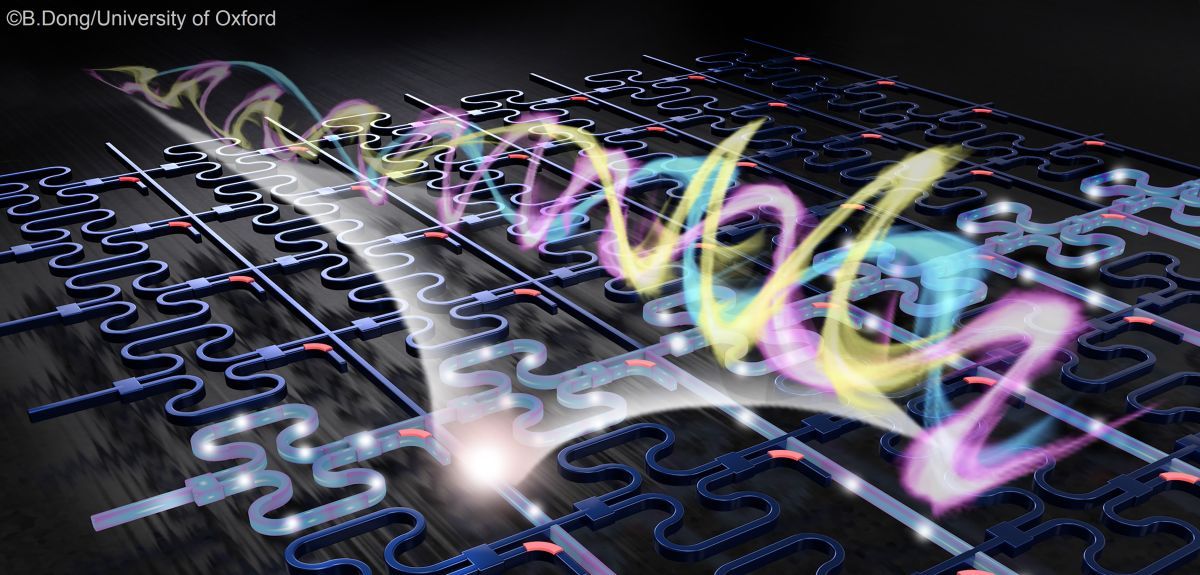
A commonly studied perovskite can superfluoresce at temperatures that are practical to achieve and at timescales long enough to make it potentially useful in quantum supercomputing applications. The finding from North Carolina State University researchers also indicates that superfluorescence may be a common characteristic for this entire class of materials.

Superfluorescence is an example of quantum phase transition – when individual atoms within a material all move through the same phases in tandem, becoming a synchronized unit. 

For example, when atoms in an optical material such as a perovskite are excited they can individually radiate light, create energy, and fluoresce. Each atom will start moving through these phases randomly, but given the right conditions, they can synchronize in a macroscopic quantum phase transition. That synchronized unit can then interact with external electric fields more strongly than any single atom could, creating a superfluorescent burst.

“Instances of spontaneous synchronization are universal, occurring in everything from planetary orbits to fireflies synchronizing their signals,” says Kenan Gundogdu, professor of physics at NC State and corresponding author of the research. “But in the case of solid materials, these phase transitions were thought to only happen at extremely low temperatures. This is because the atoms move out of phase too quickly for synchronization to occur unless the timing is slowed by cooling.”

Gundogdu and his team observed superfluorescence in the perovskite methylammonium lead iodide, or MAPbI3 while exploring its lasing properties. Perovskites are materials with a crystal structure and light-emitting properties useful in creating lasers, among other applications. They are inexpensive, relatively simple to fabricate, and are used in photovoltaics, light sources, and scanners.

“When trying to figure out the dynamics behind MAPbI3’s lasing properties, we noticed that the dynamics we observed couldn’t be described simply by lasing behavior,” Gundogdu says. “Normally in lasing, one excited particle will emit light, stimulate another one, and so on in a geometric amplification. But with this material we saw synchronization and a quantum phase transition, resulting in superfluorescence.”

But the most striking aspects of the superfluorescence were that it occurred at 78 Kelvin and had a phase lifetime of 10 to 30 picoseconds.

“Generally superfluorescence happens at extremely cold temperatures that are difficult and expensive to achieve, and it only lasts for femtoseconds,” Gundogdu says. “But 78 K is about the temperature of dry ice or liquid nitrogen, and the phase lifetime is two to three orders of magnitude longer. This means that we have macroscopic units that last long enough to be manipulated.”

The researchers think that this property may be more widespread in perovskites generally, which could prove useful in quantum applications such as computer processing or storage.

“Observation of superfluorescence in solid-state materials is always a big deal because we’ve only seen it in five or six materials thus far,” Gundogdu says. “Being able to observe it at higher temperatures and longer timescales opens the door to many exciting possibilities.”