

Japanese researchers predict the most stable boron nitride structure with quantum simulations

Researchers settle the debate on the relative stabilities of boron nitride’s structures using a state-of-the-art quantum simulation method

Boron nitride (BN) is a versatile material with applications in a variety of engineering and scientific fields. This is largely due to an interesting property of BN called “polymorphism,” characterized by the ability to crystallize into more than one type of structure. This generally occurs as a response to changes in temperature, pressure, or both. Furthermore, the different structures, called “polymorphs,” differ remarkably in their physical properties despite having the same chemical formula. As a result, polymorphs play an important role in material design, and a knowledge of how to selectively favor the formation of the desired polymorph is crucial in this regard. The structures and space groups of (a) zinc-blende boron nitride (cBN), (b) hexagonal boron nitride (hBN), (c) wurtzite boron nitride (wBN), and (d) rhombohedral boron nitride (rBN). Boron and nitrogen atoms are depicted in brown and blue, respectively.  CREDIT Kousuke Nakano from JAIST.
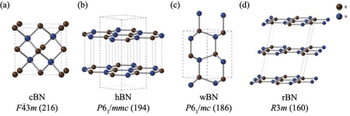
However, BN polymorphs pose a particular problem. Despite conducting several experiments to assess the relative stabilities of BN polymorphs, a consensus has not emerged on this topic. While computational methods are often the go-to approach for these problems, BN polymorphs have posed serious challenges to standard computation techniques due to the weak “van der Waals (vdW) interactions” between their layers, which are not accounted for in these computations. Moreover, the four stable BN polymorphs, namely rhombohedral (rBN), hexagonal (hBN), wurtzite (wBN), and zinc-blende (cBN) manifest within a narrow energy range, making the capture of small energy differences together with vdW interactions even more challenging.

Fortunately, an international research team led by Assistant Professor Kousuke Nakano from the Japan Advanced Institute of Science and Technology (JAIST) has now provided evidence to settle the debate. In their study, they addressed the issue with a state-of-the-art first-principles calculations framework, namely fixed-node diffusion Monte Carlo (FNDMC) simulations. FNDMC represents a step in the popular quantum Monte Carlo simulations method, in which a parametrized many-body quantum “wavefunction” is first optimized to attain the ground state and then supplied to the FNDMC.

Additionally, the team also computed the Gibbs energy (the useful work obtainable from a system at constant pressure and temperature) of BN polymorphs for different temperatures and pressures using density functional theory (DFT) and phonon calculations. This paper was made available online on March 24, 2022, published in The Journal of Physical Chemistry C.

According to the FNDMC results, hBN was the most stable structure, followed by rBN, cBN, and wBN. These results were consistent at both 0 K and 300 K (room temperature). However, the DFT estimations yielded conflicting results for two different approximations. Dr. Nakano explains these contradictory findings: “Our results reveal that the estimation of relative stabilities is greatly influenced by the exchange correlational functional or the approximation used in the DFT calculation. As a result, a quantitative conclusion cannot be reached using DFT findings, and a more accurate approach, such as FNDMC, is required.”

Notably, the FNDMC results were in agreement with that generated by other refined computation methods, such as “coupled cluster,” suggesting that FNDMC is an effective tool for dealing with polymorphs, especially those governed by vdW forces. The team also showed that it can provide other important information, such as reliable reference energies, when experimental data is unavailable.

Dr. Nakano is excited about the prospects of the method in the area of materials science. “Our study demonstrates the ability of FNDMC to detect tiny energy changes involving vdW forces, which will stimulate the use of this method for other van der Waals materials,” he says. “Moreover, molecular simulations based on this accurate and reliable method could empower material designs, enabling the development of medicines and catalysts.”

Solving the relative stability conundrum is undoubtedly a huge step forward. But there is still work to be done and the pace is sure to go up!


Early human habitats linked to past climate shifts

A study by an international team of scientists provides clear evidence for a link between astronomically-driven climate change and human evolution.

By combining the most extensive database of well-dated fossil remains and archeological artifacts with an unprecedented new supercomputer model simulating earth’s climate history over the past 2 million years, the team of experts in climate modeling, anthropology, and ecology was able to determine under which environmental conditions archaic humans likely lived (Fig. 1). Preferred habitats of Homo sapiens (purple shading, left), Homo heidelbergensis (red shading, middle), Homo neanderthalensis (blue shading, right) calculated from a new paleoclimate model simulation conducted at the IBS Center for Climate Physics and a compilation of fossil and archeological data. Lighter values indicate higher habitat suitability. The dates (1 ka = 1000 years before present) refer to the estimated ages of the youngest and oldest fossils used in the study.

The impact of climate change on human evolution has long been suspected but has been difficult to demonstrate due to the paucity of climate records near human fossil-bearing sites. To bypass this problem, the team instead investigated what the climate in their computer simulation was like at the times and places humans lived, according to the archeological record. This revealed the preferred environmental conditions of different groups of hominins. From there, the team looked for all the places and times those conditions occurred in the model, creating time-evolving maps of potential hominin habitats.

“Even though different groups of archaic humans preferred different climatic environments, their habitats all responded to climate shifts caused by astronomical changes in earth’s axis wobble, tilt, and orbital eccentricity with timescales ranging from 21 to 400 thousand years,” said Axel Timmermann, lead author of the study and Director of the IBS Center for Climate Physics (ICCP) at Pusan National University in South Korea.

To test the robustness of the link between climate and human habitats, the scientists repeated their analysis, but with ages, the fossils shuffled like a deck of cards. If the past evolution of climatic variables did not impact where and when humans lived, then both methods would result in the same habitats. However, the researchers found significant differences in the habitat patterns for the three most recent hominin groups (Homo sapiensHomo neanderthalensis, and Homo heidelbergensis) when using the shuffled and the realistic fossil ages. “This result implies that at least during the past 500 thousand years the real sequence of past climate change, including glacial cycles, played a central role in determining where different hominin groups lived and where their remains have been found”, said Prof. Timmermann.

“The next question we set out to address was whether the habitats of the different human species overlapped in space and time. Past contact zones provide crucial information on potential species successions and admixture,” said Prof. Pasquale Raia from the Università di Napoli Federico II, Naples, Italy, who together with his research team compiled the dataset of human fossils and archeological artifacts used in this study. From the contact zone analysis, the researchers then derived a hominin family tree, according to which Neanderthals and likely Denisovans derived from the Eurasian clade of Homo heidelbergensis around 500-400 thousand years ago, whereas Homo sapiens’ roots can be traced back to Southern African populations of late Homo heidelbergensis around 300 thousand years ago.

Our climate-based reconstruction of hominin lineages is quite similar to recent estimates obtained from either genetic data or the analysis of morphological differences in human fossils, which increases our confidence in the results,” remarks Dr. Jiaoyang Ruan, co-author of the study and postdoctoral research fellow at the IBS Center for Climate Physics.

The new study was made possible by using one of South Korea’s fastest supercomputers named Aleph. Located at the headquarters of the Institute for Basic Science in Daejeon, Aleph ran non-stop for over 6 months to complete the longest comprehensive climate model simulation to date. “The model generated 500 Terabytes of data, enough to fill up several hundred hard disks,” said Dr. Kyung-Sook Yun, a researcher at the IBS Center for Climate Physics who conducted the experiments. “It is the first continuous simulation with a state-of-the-art climate model that covers earth’s environmental history of the last 2 million years, representing climate responses to the waxing and waning of ice-sheets, changes in past greenhouse gas concentrations, as well as the marked transition in the frequency of glacial cycles around 1 million years ago,” adds Dr. Yun.

“So far, the paleoanthropological community has not utilized the full potential of such continuous paleoclimate model simulations. Our study clearly illustrates the value of well-validated climate models to address fundamental questions on our human origins,” says Prof. Christoph Zollikofer from the University of Zurich, Switzerland, and co-author of the study.

Going beyond the question of early human habitats, and times and places of human species’ origins, the research team further addressed how humans may have adapted to varying food resources over the past 2 million years. “When we looked at the data for the five major hominin groups, we discovered an interesting pattern. Early African hominins around 2-1 million years ago preferred stable climatic conditions. This constrained them to relatively narrow habitable corridors. Following a major climatic transition about 800 thousand years ago, a group known under the umbrella term Homo heidelbergensis adapted to a much wider range of available food resources, which enabled them to become global wanderers, reaching remote regions in Europe and eastern Asia,” said Elke Zeller, a Ph.D. student at Pusan National University and co-author of the study.

“Our study documents that climate played a fundamental role in the evolution of our genus Homo. We are who we are because we have managed to adapt over millennia to slow shifts in the past climate,” says Prof. Axel Timmermann.

Japanese researchers use Monte Carlo, MD simulations to predict self-organization of charged Janus particles

Researchers from The Research Center for Advanced Science and Technology and The Institute of Industrial Science at The University of Tokyo used a new supercomputer simulation to model the electrostatic self-organization of zwitterionic nanoparticles, which are useful for drug delivery. They found that including transient charge fluctuations greatly increased the accuracy, which may help lead to the development of new self-assembling smart nanomaterials. Researchers at The University of Tokyo used a hybrid of Monte Carlo and molecular dynamics simulations to predict the self-assembly of charged Janus particles, which may lead to biomimetic nanostructures that can assemble like proteins  CREDIT Institute of Industrial Science, The University of Tokyo

In ancient Roman mythology, Janus was the god of both beginnings and endings. His dual nature was often reflected in his depiction with two faces. He also lends his name to so-called Janus particles, which are nanoparticles that contain two or more distinct physical or chemical properties on their surface. One promising “two-faced” solution uses zwitterionic particles, which are spheres with a positively charged side and a negatively charged side. Researchers hope to create self-organizing structures, which can be activated by changes in a solution’s salt concentration or pH. However, this kind of “bottom-up” engineering requires more accurate supercomputer simulations to implement.

Now, a team of researchers from The Research Center for Advanced Science and Technology and The Institute of Industrial Science at The University of Tokyo has created a new supercomputer model that incorporates transient fluctuations in the change distributions on the surface of the particles that can give rise to a wider variety of structures, compared with current software. “Simulating the dynamic dissociation or association of ionization groups is inherently more challenging and must be iterated repeatedly until self-consistent results are obtained,” first author Jiaxing Yuan says.

The researchers showed that the previous method of assuming each of the particles carries a constant charge can give inaccurate results. To simulate the possible transition to compact clusters, instead of exclusively producing elongated strands, the computer needed to include short-lived fluctuations in surface charge. These differences are particularly noticeable at low salt concentration and high electrostatic coupling strength.

In living organisms, proteins fold into very specific shapes based in large part on the attraction between the positively and negatively charged regions. In the future, artificially designed particles may be able to self-assemble when triggered by a change in conditions. “With zwitterionic particles, we hope to create functional materials with tunable properties, similar to the self-organization of charged proteins,” senior author Hajime Tanaka says.