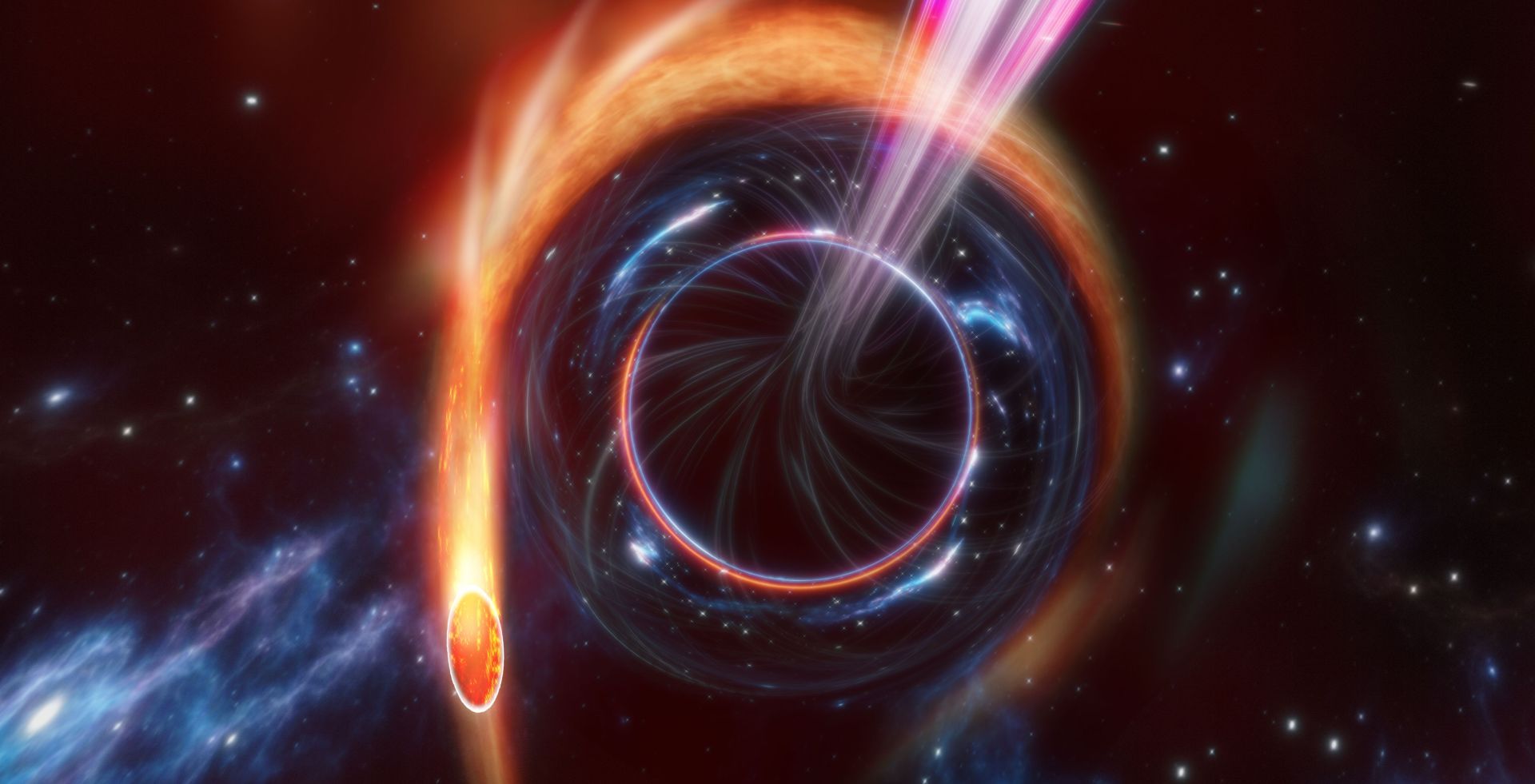
A star is being consumed by a nearby supermassive black hole. Astronomers call this a tidal disruption event (TDE). What makes this TDE a very rare TDE is that as the black hole rips apart the star, two jets of material moving with almost the speed of light are launched in opposite directions producing light in all wavelengths. Such jetted-TDEs are extremely rare and AT2022cmc, depicted here is the first one discovered with an optical telescope. Image credit: Carl Knox (OzGrav, ARC Centre of Excellence for Gravitational Wave Discovery, Swinburne University of Technology)

Caltech astronomers use big data mining to identify rare cosmic events in ZTF survey data 

Astronomers from the Zwicky Transient Facility collaboration have observed a truly rare cosmic “lunch” - a supermassive black hole devouring a nearby star and releasing powerful jets in the process. Dubbed AT2022cmc, this discovery was made while sieving through ZTF survey data using a novel method designed to alert astronomers for such rare events in near real-time.

The universe can be a violent place. Stars die or collide with each other and black holes devour everything that gets too close. These and other events produce flashes of light in the night sky that astronomers call transients. The Zwicky Transient Facility is currently one of the largest transient surveys astronomers use to study the ever-changing universe. The survey is also a treasure trove of rare, strange, and unusual events that often astronomers discover by chance.

“Our new search technique helps us to quickly identify rare cosmic events in the ZTF survey data. And since ZTF and upcoming larger surveys such as Vera Rubin’s LSST scan the sky so frequently, we can now expect to uncover a wealth of rare, or previously undiscovered cosmic events and study them in detail,” says Igor Andreoni, a postdoctoral associate in the Department of Astronomy at UMD and NASA Goddard Space Flight Center.

AT2022cmc is a peculiar case of what is known as a tidal-disruption event or TDE. TDEs happen with a star approaching a black hole is violently ripped apart by the black hole’s gravitational tidal forces—similar to how the Moon pulls tides on Earth but with greater strength. Then, pieces of the star are captured into a swiftly spinning disk orbiting the black hole. Finally, the black hole consumes what remains of the doomed star in the disk.

In some extremely rare cases such as AT2022cmc, the supermassive black hole launches “relativistic jets”—beams of matter traveling close to the speed of light—after destroying a star. Discovered in Feb 2022, astronomers led by Andreoni followed up AT2022cmc and observed it with multiple facilities at multiple wavelengths. 

“The last time scientists discovered one of these jets was well over a decade ago,” said Michael Coughlin, an assistant professor of astronomy at the University of Minnesota Twin Cities and co-lead on the paper. “From the data we have, we can estimate that relativistic jets are launched in only 1% of these destructive events, making AT2022cmc an extremely rare occurrence. In fact, the luminous flash from the event is among the brightest ever observed.”

The novel data-crunching method - equivalent to searching through a million pages of information every night - allowed Andreoni and colleagues to conduct a rapid analysis of the ZTF data and identify the AT2022cmc TDE with relativistic jets. They quickly started follow-up observations that revealed an exceptionally bright event across the electromagnetic spectrum, from the X-rays to the millimeter and radio.

ESO’s Very Large Telescope revealed that AT2022cmc was at a cosmological distance of 8.5 billion light years away. The Hubble Space Telescope optical/infrared images and radio observations from the Very Large Array pinpointed the location of AT2022cmc with extreme precision.

The researchers believe that AT2022cmc was at the center of a galaxy that is not yet visible because the light from AT2022cmc outshone it, but future space observations with Hubble or James Webb Space Telescopes may unveil the galaxy when the transient eventually disappears.

It is still a mystery why some TDEs launch jets while others may not. From their observations, Andreoni and his team concluded that the black holes in AT2022cmc and other similarly jetted TDEs are likely spinning rapidly so as to power the extremely luminous jets. This suggests that a rapid black hole spin may be one necessary ingredient for jet launching—an idea that brings researchers closer to understanding the physics of supermassive black holes at the center of galaxies billions of light years away.

Before AT2022cmc, only a couple of possible jetted TDEs were known, primarily discovered by gamma-ray space missions, which detect the highest-energy forms of radiation produced by these jets. With their new method, astronomers can now search for such rare events in ground-based optical surveys.

“Astronomy is changing rapidly,” Andreoni said. “More optical and infrared all-sky surveys are now active or will soon come online. Scientists can use AT2022cmc as a model for what to look for and find more disruptive events from distant black holes. This means that more than ever, big data mining is an important tool to advance our knowledge of the universe.”


Mathematicians crack a hard problem for fluid equations

The motion of fluids in nature, including the flow of water in our oceans, the formation of tornadoes in our atmosphere, and the flux of air surrounding airplanes, have long been described and simulated by what is known as the Navier–Stokes equations.

Yet, mathematicians do not have a complete understanding of these equations. While they are a useful tool for predicting the flow of fluids, we still do not know if they accurately describe fluids in all possible scenarios. This led the Clay Mathematics Institute of New Hampshire to label the Navier–Stokes equations as one of its seven Millennium Problems: the seven most pressing unsolved problems in all of mathematics.

The Navier–Stokes Equation Millennium Problem asks mathematicians to prove whether "smooth" solutions always exist for the Navier–Stokes equations. Put simply, smoothness refers to whether equations of this type behave in a predictable way that makes sense. Imagine a simulation in which a foot presses the gas pedal of a car, and the car accelerates to 10 miles per hour (mph), then to 20 mph, then to 30 mph, and then to 40 mph. However, if the foot presses the gas pedal and the car accelerates to 50 mph, then to 60 mph, then instantly to an infinite number of miles per hour, you would say there is something wrong with the simulation.

This is what mathematicians hope to determine for the Navier–Stokes equations. Do they always simulate fluids in a way that makes sense, or are there some situations in which they break down?

For an in-depth explanation of this topic, see the blog post "Why global regularity for Navier-Stokes is hard" by Australian mathematician Terence Tao.

In a paper published on the preprint site arXiv on October 19, Caltech's Thomas Hou, the Charles Lee Powell Professor of Applied and Computational Mathematics, and Jiajie Chen (Ph.D. 22) of New York University's Courant Institute provide proof that resolves a longstanding open problem for the so-called 3D Euler singularity. The 3D Euler equation is a simplification of the Navier–Stokes equations, and a singularity is a point where an equation starts to break down or "blow up," meaning it can suddenly become chaotic without warning (like the simulated car accelerating to an infinite number of miles per hour). The proof is based on a scenario first proposed by Hou and his former postdoc, Guo Luo, in 2014. Thomas Hou Credit: Vicki Chiu/Caltech

Hou's computation with Luo in 2014 discovered a new scenario that showed the first convincing numerical evidence for a 3D Euler blowup, whereas previous attempts to discover a 3D Euler blowup were either inconclusive or not reproducible.

In the latest paper, Hou and Chen show definitive and irrefutable proof of Hou and Luo's work involving 3D Euler equation blowup. "It starts from something that behaves nicely, but then somehow evolves in a way where it becomes catastrophic," Hou says.

"For the first ten years of my work, I believed there was no Euler blow-up," says Hou. After more than a decade of research since Hou has not only proved his former self wrong, he's settled a centuries-old mathematics mystery.

"This breakthrough is a testament to Dr. Hou's tenacity in addressing the Euler problem and the intellectual environment that Caltech nurtures," says Harry A. Atwater, Otis Booth Leadership Chair of the Division of Engineering and Applied Science, Howard Hughes Professor of Applied Physics and Materials Science, and director of the Liquid Sunlight Alliance. "Caltech empowers researchers to apply sustained creative effort on complex problems – even over decades – to achieve extraordinary results."

Jiajie Chen Credit: Briana Ticehurst/CaltechHou and colleagues' combined effort in proving the existence of blowup with the 3D Euler equation is a major breakthrough in its own right but also represents a huge leap forward in tackling the Navier-Stokes Millennium Problem. If the Navier–Stokes equations could also blow up, it would mean something is awry with one of the most fundamental equations used to describe nature.
"The whole framework that we set up for this analysis would be tremendously helpful for Navier–Stokes," Hou says. "I have recently identified a promising blowup candidate for Navier-Stokes. We just need to find the right formulation to prove the blowup of the Navier-Stokes ."

The paper detailing the proof is titled "Stable Nearly Self-Similar Blowup of the 2D Boussinesq and 3D Euler Equations with Smooth Data."

Funding for the research was provided by the National Science Foundation and by the Choi Family Postdoctoral Fund, Choi Family Gift Fund, and the Choi Family Graduate Fellowship Fund.

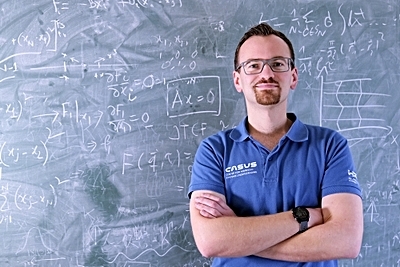
German-born Tobias Dornheim received his doctorate from Kiel University (Germany) in 2018. After a brief postdoctoral stay in Kiel, he joined CASUS in 2019. In early 2022 he was promoted to a Young Investigator Group Leader at CASUS. Dornheim is 32 years old.  Source: HZDR / Michal Bajda
German-born Tobias Dornheim received his doctorate from Kiel University (Germany) in 2018. After a brief postdoctoral stay in Kiel, he joined CASUS in 2019. In early 2022 he was promoted to a Young Investigator Group Leader at CASUS. Dornheim is 32 years old. Source: HZDR / Michal Bajda

German scientist receives prestigious ERC Starting Grant to shatter a computational bottleneck

Employing modern machine learning methods, Young Investigator Dr. Tobias Dornheim aims to tackle one of the fundamental computational bottlenecks in physics, chemistry, and related disciplines: the fermion sign problem

The decision of the European Research Council (ERC) to fund the Starting Grant proposal “Predicting the Extreme” (PREXTREME) is a major success for the Görlitz-based Center for Advanced Systems Understanding CASUS, an institute of the Helmholtz-Zentrum Dresden-Rossendorf (HZDR). Handed in by Dr. Tobias Dornheim, leader of a Young Investigator Group at CASUS, PREXTREME suggests developing a reliable theoretical description of warm dense matter with the help of machine learning (ML) methods. Ideally, Dornheim’s approach will lead to computationally solving the fermion sign problem amounting to a revolution in quantum theory. In any case, the work will result in answers to many fundamental questions about warm dense hydrogen and heavier elements and it will also have a direct impact on applications in material science, astrophysical models, and nuclear fusion. The ERC is granting Dornheim nearly 1.5 million euros to be spent over the next 5 years on scientific staff, technical equipment, and travel.

Electrons, protons, and neutrons are Fermi particles, named after the Italian physicist Enrico Fermi. They make up the matter we see in the world around us. The quantum mechanical behavior of Fermi particles decisively determines the physical and chemical properties of most materials. Computing these properties from the first principles requires adding the contributions of all Fermi particles in the material. Each particle can add both positive and negative terms to this computation that may cancel each other. With each particle, exponentially more combinations of these “signed” terms are necessary for an accurate calculation.

The state-of-the-art Monte-Carlo calculations Tobias Dornheim has brought forth an approach to the accurate result by randomly taking into account most but not all of the terms, a method called Monte-Carlo sampling. Until now, these calculations still can only be executed on the largest supercomputers in the world and only for a few Fermi particles due to the exponential increase in computation time with each particle added. To solve this fermion sign problem, a turn away from the exponential increase of supercomputing power is urgently needed.

In the past, Tobias Dornheim has shown several times that he is capable of finding clever ways around quantum problems. For example, he was part of a team that received the American Physical Society’s John Dawson Award for Excellence in Plasma Physics Research 2021. The award was granted for elegantly combining different, complementary simulation methods resulting in predictions for the collective behavior of many electrons that were more accurate than ever before.

Introducing modern machine learning methods

After many incremental improvements, Dornheim now sets out to make a big splash with PREXTREME. The proposal is based on simulation methods of the path integral Monte Carlo (PIMC) class, and its central idea is a decisive improvement of PIMC simulations of fermions. “Within the granted ERC project, I will combine particularly well-suited PIMC methods with modern ML algorithms,” explains Dornheim. “This will result in PIMC simulations without the exponential compute bottleneck as well as without any uncontrolled approximations. In the end, I hope to enable scientists of many different specializations – not just from warm dense matter research – to find answers to their questions that to date remain unanswered due to the fermion sign problem.”

Warm dense matter (WDM) researchers study matter under conditions such as very high temperatures or pressures commonly found almost everywhere in the universe except for the surface of the earth where they do not occur naturally. Typically, astrophysical objects in our solar system such as the giant planets Jupiter and Saturn as well as outside of our solar systems like exoplanets and brown dwarfs take center stage in WDM research. Besides gaining fundamental insights into astrophysics, such research is also of high importance for technological applications such as nuclear fusion and for developing much-needed new materials such as nanodiamonds.

Scientific excellence in Görlitz

Dornheim joined CASUS as a postdoc in 2019. In early 2022, he there established his own junior research group “Frontiers of Computational Quantum Many-Body Theory”. According to Michael Bussmann, Scientific Head of CASUS, the success is highly deserved: “I congratulate Tobias and am very happy for him. The accolade from the European Research Council recognizes his achievements to date and his scientific vision for the coming years. It also shows that CASUS has been able to attract excellent researchers to Görlitz in a short time, who are at the forefront of international research. To me, this success confirms that our chosen path of excellence, interdisciplinarity, and openness is the right one.”

“Earlier this year, CASUS has become an institute of the HZDR,” recalls Prof. Sebastian M. Schmidt, Scientific Director of the HZDR. “This grant is a clear indication that digital methods and tools will become essential in all classic realms of research from physics to medicine. I am therefore very pleased that with CASUS we have a first-class institute at HZDR working at the frontier of the digitalization of science.”

Since its inception in 2007, the ERC has established itself as a major European funding organization. The ERC Starting Grant scheme is a highly competitive program with a proposal acceptance rate of about 14 percent in 2022. For an early-career researcher, an ERC Starting Grant is arguably the biggest success that can be achieved. This year, the ERC has decided to fund 408 proposals resulting in 636 million euros spent on ambitious young scientists from research areas as diverse as medicine, economics, or engineering. Including Dornheim’s grant, HZDR scientists have so far received six ERC recognitions – three of them are ERC Starting Grants. After the official announcement of the winning proposals by the ERC in late November, the grant agreement preparation is currently ongoing to pave the way for the project to start on March 1st, 2023.