

Species have few good options when it comes to surviving climate change, they can genetically adapt to new conditions, shift their ranges, or both.
But new research in PNAS indicates that conflicts between species as they adapt and shift ranges could lead experts to underestimate extinctions, and underscores the importance of landscape connectivity.
Researchers at the University of British Columbia and the University of Montpellier trying to understand how species might respond to climate change conducted large-scale supercomputer simulations which show that although movement and genetic adaptation to climate change each help maintain biodiversity, these two factors can come into conflict.  {module In-article}
Dispersal refers to species movement across landscapes, while adaptation is the evolutionary response of organisms to environmental change. When species both disperse and adapt, faster evolving species prevent slower adapting species from shifting their ranges, driving them to extinction.
UBC ecologist Patrick Thompson, the lead author of the study, said the research highlights the value of wildlife corridors, which can help preserve the largest biological diversity possible. As well, it underscores the dangers of fragmenting a landscape, for example by erecting barriers or dividing the terrain with roads.
“The good news is this conflict between moving and adapting is reduced when movement rates are high, which emphasizes the importance of maintaining well-connected landscapes,” said Thompson.
Previous studies have looked at issues of dispersal and adaptation, but tend to focus on a single species. By modeling an environment with several species interacting, the researchers hope to provide a better understanding of the risks that climate change poses for biodiversity.
“If we don’t account for both dispersal and adaptation, we can overestimate how many species might survive in a changing environment,” Thompson concluded.
To increase the efficiency of microchips, 3D structures are now being investigated. However, spintronic components, which rely on electron spin rather than charge, are always flat. To investigate how to connect these to 3D electronics, University of Groningen physicist Dr. Kumar Sourav Das created curved spin transport channels. Together with his colleagues, he discovered that this new geometry makes it possible to independently tune charge and spin currents. The results were published online by the journal Nano Letters on 13 September 2019.
Das started with two main questions: how to tune spin current using geometry, and how to create spin transport in a 3D nanostructure. Electron spin is a quantum mechanical property, a magnetic moment that can be used to transfer or store information. Spin is already used in memory storage, and could also be used in logic circuits. 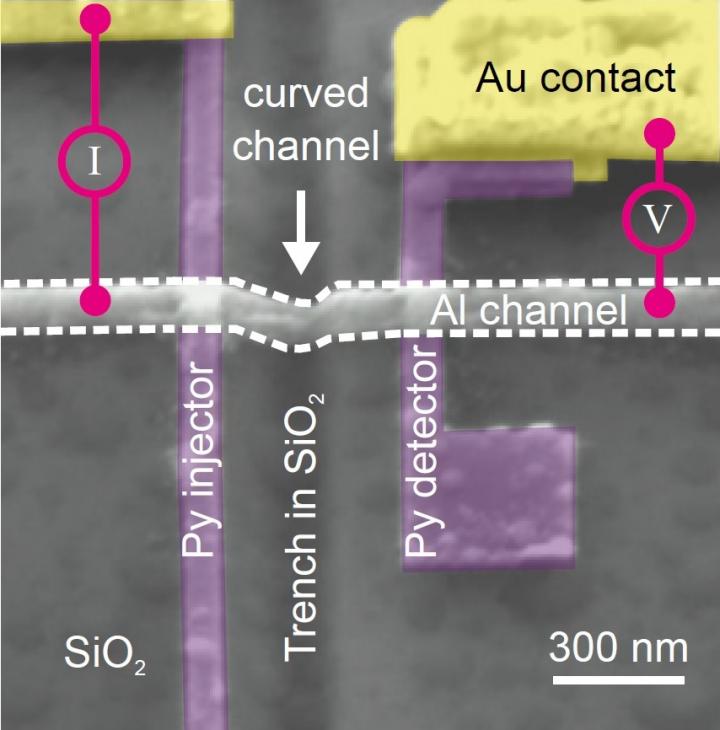 {module In-article}
Curved architecture
'So far, most spintronic devices have been based on a flat structure. We wanted to find out how the spin currents behave in a curved channel', says Das. Using silicon oxide substrates with trenches created by an ion beam, designed at the HZDR in Dresden by Dr. Denys Makarov, Das grew aluminum nanochannels that crossed the trenches. In this curved architecture, the thickness of the aluminum varies at nanoscale dimensions, shorter than the spin relaxation length.
Das used different sized trenches and measured both spin resistance and charge currents. 'What we discovered is that variations in the trench size affect spin and charge transport in the channel differently', Das explains. 'We were, therefore, able to independently tune both spin and charge currents based on the channel geometry.'
Novel functionalities
His colleague Dr. Carmine Ortix from Utrecht University created a theoretical model describing this phenomenon. 'Our theory clearly demonstrates that it is possible to independently tune the spin and charge characteristics using the shape of the materials alone. This possibility overcomes the existing technological hurdles for the applicability of spintronics in modern electronics', says Dr. Ortix. 'Extending low-dimensional structures into the three-dimensional space can provide the means to modify conventional functionalities or even launch completely novel functionalities by suitably tailoring the shape of real materials.'
'This discovery is important because it allows us to tune spintronic components to match both the spin current and the charge current of electronic circuits', says Das. 'It enables the efficient integration of spin injectors and detectors or spin transistors into modern 3D circuitry.' This could help to create more energy-efficient electronics, as spintronics is an attractive way of creating low-power devices. 'And we can now use our model to purpose-design channels.'
 {module In-article}