German prof uses FE for insights into how plesiosaurs swam underwater

Plesiosaurs are characterized by four uniform flippers. It was possible to reconstruct whether they used these in a rowing or flying motion underwater thanks to a combination of paleontological and engineering methods.

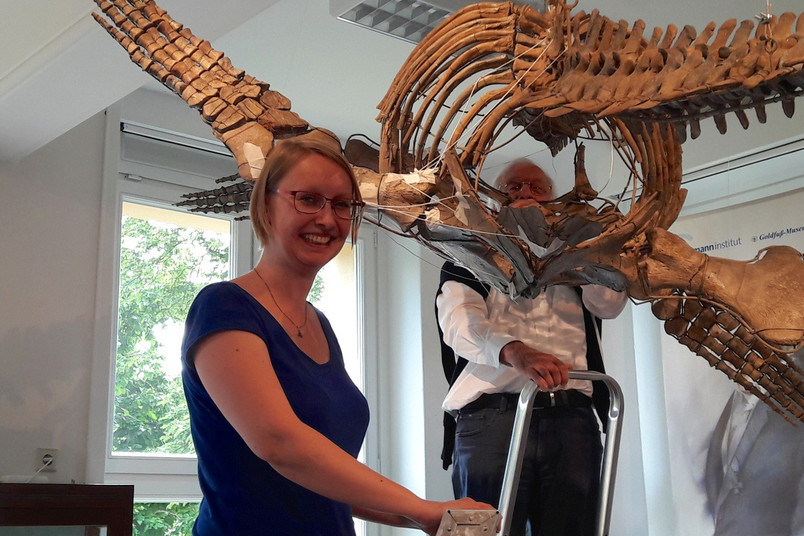
Plesiosaurs, which lived about 210 million years ago, adapted to life underwater uniquely: their front and hind legs evolved in the course of evolution to form four uniform, wing-like flippers. In her thesis supervised at Ruhr-Universität Bochum and the University of Bonn, Dr. Anna Krahl investigated how they used these to move through the water. Partly by using the finite element method, which is widely used in engineering, she was able to show that it was necessary to twist the flippers to travel forward. She was able to reconstruct the movement sequence using bones, models, and reconstructions of the muscles. To reconstruct the muscles, Anna Krahl (front) and Ulrich Witzel used a model made from bone replicas and material from the hardware store. This analog model consists of molds of the fore- and hind flippers, wooden slats, chandelier clamps, eyelets and ropes. © Privat
Plesiosaurs belong to a group of saurians called Sauropterygia, or paddle lizards, that re-adapted to living in the oceans. They evolved in the late Triassic 210 million years ago, lived at the same time as the dinosaurs, and became extinct at the end of the Cretaceous period. Plesiosaurs are characterized by an often extremely elongated neck with a small head – the elasmosaurs even have the longest neck of all vertebrates. But there were also large predatory forms with rather short necks and huge skulls. In all plesiosaurs, the neck is attached to a teardrop-shaped, hydrodynamically well-adapted body with a markedly shortened tail.

Researchers have puzzled for 120 years how plesiosaurs swam

The second feature that makes plesiosaurs so unusual is their four uniform wing-like flippers. “Having the front legs transformed into wing-like flippers is relatively common in evolution, for instance in sea turtles. Never again, however, did the hind legs evolve into an almost identical-looking airfoil-like wing,” explains Anna Krahl, whose doctoral thesis was supervised by Professor P. Martin Sander (Bonn) and Professor Ulrich Witzel (Bochum). Sea turtles and penguins, for example, have webbed feet. For more than 120 years, researchers in vertebrate paleontology have puzzled over how plesiosaurs might have swum with these four wings. Did they row like freshwater turtles or ducks? Did they fly underwater like sea turtles and penguins? Or did they combine underwater flight and rowing like modern-day sea lions or the pig-nosed turtle? It is also unclear whether the front and rear flippers were flapped in unison, in opposition, or out of phase.

Anna Krahl has been studying the body structure of plesiosaurs for several years. She examined the bones of the shoulder and pelvic girdle, the front, and hind flippers, and the shoulder joint surfaces of the plesiosaur Cryptoclidus eurymerus from the Middle Jurassic period (about 160 million years ago) on a complete skeleton displayed in the Goldfuß Museum of the University of Bonn. Plesiosaurs have stiffened elbow, knee, hand, and ankle joints, but functioning shoulder, hip, and finger joints. “Analysis comparing them to modern-day sea turtles, and based on what is known about their swimming process, indicated that plesiosaurs were probably not able to rotate their flippers as much as would be necessary for rowing,” concludes Krahl, summarizing one of her preliminary papers. Rowing is primarily a back-and-forth motion that uses water resistance to move forward. The preferred direction of flipper movement in plesiosaurs, on the other hand, was up-and-down, as used by underwater fliers to generate propulsion.

The question remained how plesiosaurs could ultimately twist their flippers to place them in a hydrodynamically favorable position and produce lift without rotating the upper arm and thigh around the longitudinal axis. “This could work by means of twisting the flippers around their long axis,” says Anna Krahl. “Other vertebrates, such as the leatherback turtle, have also been shown to use this movement to generate propulsion through the lift.” Twisting, for example, involves bending the first finger far downward and the last finger far upward. The remaining fingers bridge these extreme positions so that the flipper tip is almost vertical without requiring any real rotation in the shoulder or wrist.

A reconstruction of the muscles of the fore- and hind flippers for Cryptoclidus using reptiles alive today showed that plesiosaurs could actively enable such flipper twisting. In addition to classical models, the researchers also made computer tomographies of the humerus and femur of Cryptoclidus and used them to create virtual 3D models. “These digital models were the basis for calculating the forces using a method we borrowed from engineering: the finite element method, or FE,” explains Anna Krahl. All the muscles and their angles of attachment on the humerus and femur were virtually reproduced in an FE computer program that can simulate physiological functional loads, for example on construction components but also on prostheses. Based on muscle force assumptions from a similar study on sea turtles, the team was able to calculate and visualize the loading on each bone.

Twisting of the flippers can be proven indirectly

During a movement cycle, the limb bones are loaded by compression, tension, bending, and torsion. “The FE analyses showed that the humerus and femur in the flippers are functionally loaded mainly by compression and to a much lesser extent by tensile stress,” Anna Krahl explains. “This means that the plesiosaur built its bones by using as little material as necessary.” This natural state can only be maintained if the muscles that twist the flippers and the muscles that wrap around the bone are included. "We can therefore indirectly prove that plesiosaurs twisted their flippers to swim efficiently," Anna Krahl sums up.

The team was also able to calculate forces for the individual muscles that generated the upstroke and downstroke. For instance, it transpired that the downstroke of both pairs of flippers was more powerful than the upstroke. This is comparable to our sea turtles today and different from today's penguins, which move forward the same distance with the upstroke as with the downstroke. "Plesiosaurs adapted to life in water in a very different way than whales, for example," notes Anna Krahl, who now works at the Eberhard Karls University in Tübingen, Germany. "This unique path of evolution exemplifies the importance of paleontological research because it’s the only way we can appreciate the full range of what evolution can bring about."


Kobe University researchers show the link between temperature, dehydration, tectonic tremors in Alaska

A Kobe University research group has shed light on how low-frequency tectonic tremors occur; these findings will contribute to better predictions of future megathrust earthquakes. The thick blue solid line outlines the Yakutat terrane. The white circle indicates the epicentre of the low-frequency tectonic tremors, and the light blue dashed line shows the area where the tectonic tremors occurred, which is used in Figures 2 to 4. The area inside the pink dashed box is the model region used in this study, and the pink dashed line down the center of the box divides the model region into northeast and southwest areas, and represents the boundary between the subducted Yakutat terrane and the subducted Pacific plate in the model. The black lines indicate the isodepth contours of the upper surface of the subducted oceanic plate (with a contour interval of 20 km), red arrows show the plate motion velocity in the Aleutian Trench, and the red triangles indicate volcanoes.  CREDIT Iwamoto, K., Suenaga, N. & Yoshioka, S. Relationship between tectonic tremors and 3-D distributions of thermal structure and dehydration in the Alaska subduction zone. Sci Rep 12, 6234 (2022). https://doi.org/10.1038/s41598-022-10113-2
In addition to the subducting Pacific plate, the Alaska subduction zone is also characterized by a subducting oceanic plateau called the Yakutat terrane. Low-frequency tectonic tremors, which are a type of slow earthquake, have only been detected in the subducted Yakutat terrane area. However, the mechanism by which these events occur is not well understood.

Researchers at Kobe University performed a 3D numerical thermomechanical simulation of thermal convection in the Alaska subduction zone to reveal the mechanism behind these low-frequency tremors. Based on the 3D thermal structure obtained from the simulation, and the indications of hydrous minerals contained in the slab, the researchers calculated the water content distribution and compared the results of these calculations in the area where the tremors occur.

The results revealed high levels of dehydration in the marine sediment layers and ocean crust in the earthquake region. The researchers believe that the reason the tremors only occur in the Yakutat terrane is that the marine sediment layers and ocean crust are thicker there, which means that the level of dehydration is higher than in the western adjacent Pacific plate (where tectonic tremors don’t have to occur).

The Kobe University research group consisted of 2nd year Master’s student IWAMOTO Kaya (Department of Planetology, Graduate School of Science), Academic Researcher SUENAGA Nobuaki, and Professor YOSHIDA Shoichi (both of the Research Center's for Urban Safety and Security).

Main Points

  • Elucidating the mechanism by which low-frequency tremors occur is important for understanding the plate subduction process. It is believed that this will also help illuminate how shallower megathrust earthquakes occur.
  • In this study, the research group constructed a 3D thermomechanical model of the Alaska subduction zone and calculated the subducting plate’s maximum water content and level of dehydration.
  • The dehydration levels from the subducting plate’s marine sediment layers and ocean crust were highest in the region where low-frequency tremors occur. Therefore, it is thought that the water expelled from the subducted plate contributes to the occurrence of these tectonic tremors.

Research Background
An oceanic plateau called the Yakutat terrane is subducting in the Alaska subduction zone. Low-frequency tectonic tremors occur at this subducting plateau. The region where slow earthquakes (such as low-frequency tectonic tremors) occur is deeper and adjacent to the area where megathrust earthquakes occur, which suggests a connection between the two. Revealing the mechanism behind how low-frequency tectonic tremors occur is therefore important for understanding the occurrence of various earthquake events in subduction zones. This research group constructed a 3D thermomechanical model of the Alaska subduction zone so that they could investigate the temperature and level of dehydration in the areas near where low-frequency tremors occur.

Research Methodology
The researchers performed a 3D numerical thermomechanical simulation by the subduction of the Yakutat terrane and Pacific plate in the Alaska subduction zone. It is thought that as the Pacific plate subducts, it brings the hydrous minerals in the slab into the deep high temperature and high-pressure regions, and these conditions cause a dehydration reaction where water is expelled from the hydrous minerals. Based on the 3D thermal structure obtained from the numerical simulation, the researchers determined the dehydration levels of the hydrous minerals in the slab. From these results, it was understood that in the region where low-frequency tremors occur, a large amount of water is expelled due to the high temperature and high-pressure conditions that cause the dehydration degradation reactions. It is thought that low-frequency earthquakes don’t occur in the Pacific plate because it has thin layers and therefore experiences little dehydration. On the other hand, the Yakutat terrane’s ocean crust and marine sediment layers are comparatively thicker, meaning that it experiences high levels of dehydration. The researchers concluded that this is why low-frequency tectonic tremors only occur in the Yakutat terrane.

Further Research
In 1964, a megathrust earthquake occurred in Alaska. This is the biggest earthquake that has occurred in the Alaska subduction zone and the second most powerful earthquake recorded in world history. The low-frequency tectonic tremors that were the subject of this research occurred close to the epicenter of the 1964 earthquake, at the downdip of the plate interface.
Next, the research group will continue to make thermomechanical models of various subduction zones search for universal and regional characteristics of the causal mechanisms behind undersea megathrust earthquakes and slow earthquakes. This research will contribute to improving our understanding of how earthquakes occur and our ability to predict future megathrust earthquakes.

JU prof builds a neurobiological model to better understand creative processes

Creativity is understood as the creation of novel, useful and surprising solutions. The researchers argue that the associated cognitive processes, such as the ability to abstract, improvise, or think divergently, involve different brain areas that are interconnected. These areas include the cerebellum, hippocampus, prefrontal cortex, and basal ganglia (see figure). Different areas are activated depending on the type of creativity. The similarities and differences between these types of creativity and their neuronal circuits are described by the model with the help of algorithms. Dopamine plays an essential role as a critical modulator for controlling and optimizing creative neural pathways. Radwa Khalil, Neurobiologist at Jacobs University Bremen.

With this proposed neural network model, the scientists, for the first time, provide a unified framework for seemingly three different forms of creativity. "With this starting point, we hope to thoroughly contribute to a better understanding of the underlying neuronal mechanisms," said Khalil. "The more we know about these mechanisms, the more specifically we can promote creativity and possibly contribute as promising interventions for people with relevant disturbed brain areas." 

With their model, the scientists also want to initiate a discussion about neurobiology and creativity, adds Radwa Khalil. An associate professor, Ahmed A. Moustafa, from the University of Johannesburg and the School of Psychology at Bond University in Australia, is also involved in the research. As a visiting Professor of the German Academic Exchange Service (DAAD), Moustafa will continue his creativity research this summer at Jacobs University, hosted and led by Professor Dr. Ben Godde Professor of Neuroscience at Jacobs University Bremen in Germany.